17 Jun 2013 | Americas
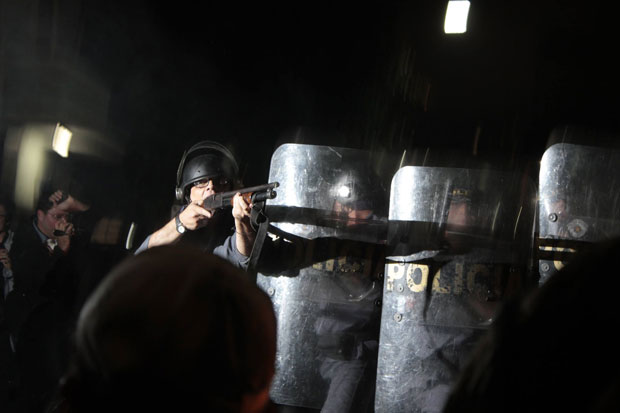
Sparked by a series of transport fare hikes and official corruption, the ongoing mass protests in Brazil’s cities have been greeted by crackdowns by police. Rafael Spuldar reports on the journalists caught in the crossfire
While large protests are not common events in Brazil, some of the protesters say “the giant has awoken”, meaning that Brazil’s population of 190 million is mobilising to fight corruption and political misconduct.
As many as 15 journalists were injured by police and two were taken into custody during last Thursday’s demonstrations in São Paulo, according to Brazil’s Association of Investigative Journalism (Associação Brasileira de Jornalismo Investigativo, Abraji). The journalists were allegedly beaten, maced or hit by non-lethal rubber bullets covering the protests.
Photographer Sérgio Andrade da Silva from Futura Press agency was hit in the eye by a rubber bullet. Doctors say his chances of full recovery are less than 5 in a hundred.
Reporter Giuliana Valloni from Folha de S.Paulo, Brazil’s biggest daily newspaper, was also hit in the eye by a rubber bullet. She says a policeman shot at her from a 20-meters.
“I wasn’t attacking anyone, I wasn’t cursing at anyone. I was doing my job”, Giuliana told Folha from her hospital bed.
“I saw him aiming at me, but I never thought he would fire, because I had (policemen) aiming at me before that night. You’ll never think that an armed guy in uniform will ever shoot you in the face”, she said.
Folha says that seven of its staff members – including Giuliana – were attacked by policemen at Thursday’s protests.
The harshest clashes between policemen and protesters occurred on Consolação Avenue, in downtown São Paulo. The crowd attempted to march up Consolação to reach Paulista Avenue – the financial center — but riot police blocked their way. More than 200 people were taken into custody.
Videos posted on social media and on YouTube allegedly show police abuse against demonstrators. Some people were targeted with tear gas in their own homes while recording videos of the protests. Other videos show protesters being shot even while they chanted sem violência, sem violência (“no violence, no violence”).
Organizations like Abraji and Brazil’s Press Association (Associação Brasileira de Imprensa, ABI) issued statements denouncing police excesses against media professionals and protesters, and urging the government to take action against them.
“The Union’s Public Ministry cannot be neither passive nor irresponsive before the soulless violence committed in São Paulo’s capital by the State’s security forces, which repeats without originality the repressive practices of the dictatorial regime”, said ABI in its statement, linking the recent events to the repression seen during Brazil’s military rule (1964-1985).
Abraji’s executive director Guilherme Alpendre says acts of violence against journalists during demonstrations are not a common thing, and he believes negative feedback will probably ease down police action and prevent new cases like the ones seen in São Paulo last Thursday.
However, Alpendre points out the fact that attacks by state agents against journalists have increased in the past three years. He cites reporters Mauri König and Rodrigo Neto as examples of that trend: the former wrote about police misconduct in the state of Paraná and had to move to Peru after receiving death threats, while the latter was shot down after denouncing involvement of police members with crime gangs in the state of Minas Gerais.
“I’m not saying all these cases are connected, or that the same method was employed in them, but what we see now is more violence perpetrated by the state against journalists. Those were media professionals identified as such, and they were attacked anyway”, Alpendre told Index on Censorship.
The demonstrations are taking place in many cities — São Paulo, Rio, Brasília, Belo Horizonte, Curitiba, Goiânia and Natal. It started as a national movement against the increase in bus fares, but now its members – mostly young people from leftist parties and students’ organizations – claim their demands are broader.
Protests could be seen during the weekend in federal capital Brasília, Belo Horizonte and Rio de Janeiro, coinciding with the start of the Confederations Cup, a warm-up event to next year’s World Cup, to be hosted in Brazil. Protesters demanded less money be spent on building stadiums and more be applied to education and other social works.
While protests in Belo Horizonte were peaceful, riot police used tear gas and stun grenades against the crowds in Rio and Brasília, where 29 people were arrested.
More demonstrations are scheduled for today. Protests are also being organised in 27 cities around the world in solidarity.
Some scholars have linked demonstrations in Brazil to those seen in Turkey, where mostly young, web-connected people have taken the streets – first to protest against the building of a shopping mall on a park, but later to fight the government.
Spanish sociologist Manuel Castells – one of the world’s most prominent cyberculture theorists – said last week that the demonstrations all over the world found a new way to gather and claim “the city back to the citizens”.
“Before, if people were discontented, the only thing they could do was to go to a mass demonstration organized by parties and unions, which would soon start to negotiate in the name of people. But now the capacity to self-organize is spontaneous. This is new, and this is social networking”, said Castells.
11 Feb 2013 | Egypt
 Over the weekend, an Egyptian court approved a month-long ban on YouTube, for refusal to remove controversial anti-Islam film the Innocence of Muslims. In addition to a ban on YouTube, the same court ordered a ban on any other website hosting the film.
It’s unclear when the ban is meant to go into effect — and a Google (the owner of YouTube) spokesperson on Saturday said that they have not “received nothing from the judge or government related to this matter.”
The film’s trailer sparked angry protests and calls for its removal in September last year, for its crude depiction of Islam’s prophet Muhammad. Cairo was one of the sites of violent protests outside of its American Embassy. Shortly after the start of 11 September protests against the film, Pakistan reportedly blocked YouTube for refusing to remove the video, with Prime Minister Raja Pervaiz Ashraf declaring that “blasphemous content will not be accepted at any cost.” In addition to Pakistan, Egypt would be joining Bangladesh, Sudan, and Afghanistan in blocking YouTube for hosting clips from the film.
However, Egyptian human rights activist and technology expert Ramy Raoof dismissed the ban as “impractical”, and explained to Egypt Independent yesterday that it would be very difficult — and expensive — for the Egyptian government to actually implement it. Another anonymous expert told the newspaper that even if the ban is implemented, it would be a “very weak solution” as Egyptians “will still find a way around it”.
Egypt’s Ministry of Communications and Information Technology has yet to respond to the rulings, but activists have pointed out that the government body has shown reluctance to enforce such bans in the past. In 2009 Egypt made a decision to ban pornography that went unenforced. Egyptian prosecutor Abdel Maguid Mahmoud ordered the ban to be enforced in early November last year — but Telecommunications Minister Hany Mahmoud said that it would be “technically difficult” to actually block the sites.
Still, even with doubt cast over the feasibility of its implementation, human rights groups have slammed the ruling as a step backwards for internet freedom after the fall of Mubarak two years ago. Bahey Al Din Hassan, the head of the Cairo Institute for Human Rights told the Wall Street Journal that the ruling reflects the ever-increasing influence of Egypt’s religious conservatives — as well as a sign of even more restrictions on freedom of expression in the country.
Sara Yasin is an editorial assistant at Index. She tweets from @missyasin.
1 Feb 2013 | Uncategorized
A US military judge has ruled the government must dismantle a monitoring system which allowed censors to suspend the broadcast of hearings for Guantanamo prisoners suspected of planning the 9/11 attacks. Army Colonel James Pohl said on 31 January it was “the last time” a third party could decide whether the hearings would be broadcast. The closed-circuit broadcast feed was stopped for a few minutes during a 28 January pre-trial hearing of Khalid Sheikh Mohammed — alleged organiser of the 9/11 attacks — and four other defendants. It revealed for the first time that an unknown external force was listening in on the trial and censoring proceedings at will. The feed was cut when Mohammed’s lawyer David Nevin requested the preserve secret CIA prisons where the defendants had been held before being taken to Guantanamo. Pohl, who was unsure why the information was censored as it was public information, said he and the court security officer were the only ones allowed to halt the broadcast.
An investigation into protests in Burma in November 2012 has discovered that police forces used white phosphorus to disperse crowds, causing demonstrators severe burns. Police involvement left more than 100 Buddhist monks and other participants badly burned, injuries authorities said were caused by tear gas and smoke grenades. An analysis in a Bangkok laboratory concluded that the canisters, which were collected by lawyers after the protests, contained traces of white phosphorus.
Protestors had staged an occupation at Letpaduang copper mine for 11 days before police broke up the crowd. The report will be sent to a government appointed panel fronted by opposition leader Aung San Suu Kyi for review. White Phosphorus is typically used in war to create a smoke screen and its use against people has been disputed.
An Indian state has banned a film for 15 days following complaints that it was offensive to Muslims. Tamil Nadu state in southern India banned the action film Vishwaroopam — which was due to be released on 25 January — after concerns that protests outside cinemas could turn violent. Muslim groups said the film portrayed their faith in a negative light and were offended that the terrorist in the film was Muslim. Tamil Nadu’s Chief Minister Jayalalithaa Jayaram said the state didn’t have enough police to impose law and order outside the 500 cinemas it was set to play in. Film director and co-producer Kamal Haasan has appealed for the ban to be lifted in Tamil Nadu and is expected to hear a judgement by 6 February.

Naomi Campbell has won damages after the Telegraph falsely claimed she organised elephant polo matches
On 31 January, a 15-year-old girl in Iceland won the right to keep her birth name, despite authorities saying it wasn’t feminine enough. Reykjavik District Court allowed Blaer Bjarkardottir to hold on to her first name Blaer, meaning light breeze — a name her mother Bjork Eidsdottir gave her from birth, apparently unaware the name was on the government banned list. Icelandic authorities had originally rejected the name for being too masculine, referring to her only as “girl” in communication with officials. Iceland has official rules for what name a baby can be given. Names are supposed to fit with Icelandic grammatical rules and the alphabet. The ruling means the name can now be taken by girls across Iceland.
Naomi Campbell has accepted damages from The Daily Telegraph after she was falsely accused of organising an elephant polo match in India for her partner’s birthday. The newspaper had printed a story on 3 November 2012, alleging that Campbell arranged the tournament in Jodhpur for Vladimir Doronin’s 50th birthday celebrations. The model accepted an apology from the Telegraph, as well as “substantial” damages — although the figure has not been disclosed. Campbell’s lawyer Gideon Benaim said at London’s High Court that the “unfounded” claims had caused a “storm” of publicity in India after media outlets across the country republished the story.