12 Oct 2018 | News, Turkey, Turkey Uncensored
[vc_row][vc_column][vc_column_text]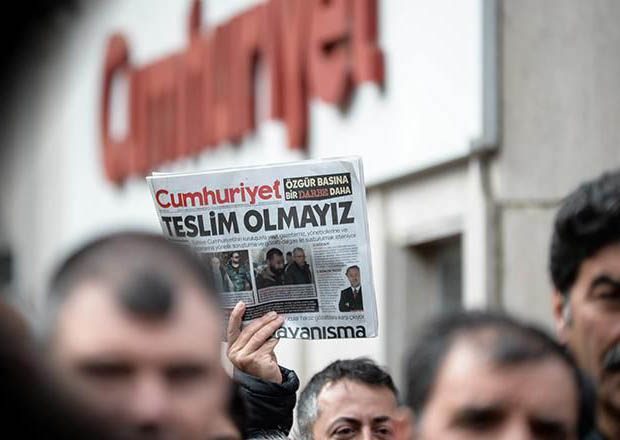
After 495 days in pre-trial detention on a trumped-up charge of terrorism, Murat Sabuncu was allowed to return to his desk as editor-in-chief of Cumhuriyet in March 2018. In a country where around 90 percent of the media is slavishly pro-government, Cumhuriyet — Turkey’s oldest and arguably its most prestigious newspaper — had established a reputation for independence and as a standard-bearer for journalistic reporting.
His reinstatement lasted a mere six months. A ruling by the Supreme Court of Appeals on 7 September resulted in the dismissal of several members of staff, including Sabuncu. A new board was appointed and with it came a shift in editorial policy. Those who took control of the paper were none other than the people who testified against Cumhuriyet staff in the first place. Around 30 journalists and writers — some of whom had also been in jail — resigned in protest.
Cumhuriyet had been split between competing factions for years: a group of left-wing nationalists, who saw themselves as defenders of the Atatürkist doctrine, and another group consisting of journalists and writers ranging from social democrats to socialists who are much more critical of the country’s official ideology, particularly on the Kurdish issue. That feud has only escalated in recent years as Turkey has become increasingly polarised, not just between religious and secular, but also between nationalists, including within the Islamic community, and those who demand a confrontation with the dark pages of the country’s history.
A key question is whether the latest change in management is a natural consequence of the divide or part of the government’s continued efforts to silence a powerful oppositional voice – especially at a time when the judiciary’s independence is routinely up for debate.
Ahmet Şık, a prominent and outspoken journalist, recently turned MP for the pro-Kurdish Peoples’ Democratic Party (HDP), has no doubts about the answer. “Those who are claiming to have liberated Cumhuriyet are the same ones who collaborated with people who arrested us, threw us in prison by serving as false witnesses,” Şık tweeted. “They are no better than those who have looted this country.”
Şık spent time in pre-trial detention and was released in March 2018 along with Sabuncu. Both men were eventually sentenced on 25 April to seven-and-a-half years in prison on terror-related charges but were freed pending appeal.
Godsend for the government
Cumhuriyet is a unique example in Turkey. While most media organisations in the country are run by a corporation, it is administrated by a non-profit organisation called the Cumhuriyet Foundation. The chairman of the new board is Alev Coşkun, a former politician who has been a board member since the early 1990s. A lot of Şık’s anger is directed towards Coşkun, who was chairman prior to the board election held in 2013. When Coşkun lost, he sued his own newspaper. After a four-year-long legal spat, the board was invalidated by the Supreme Courts of Appeals. In his capacity of the acting chairman, Coşkun convened a new board election, which he eventually won over Akın Atalay, with the support of other discontented ex-board members. Atalay, a lawyer by profession, was the latest defendant released from pre-trial detention in the Cumhuriyet case. He was also given the longest sentence of eight years, one month and 15 days for “aiding a terrorist organisation without being a member”.
Coşkun’s role in the case against Cumhuriyet has been controversial. “He is the person responsible for the investigation,” says Ergin Cinmen, one of the lawyers who represented Cumhuriyet’s staff during the trial. “The trial was launched after Coşkun testified to the prosecutor. Coşkun was also heard during the trial as the prosecutor’s witness and repeated his accusations.”
The nature of Coşkun’s allegations proved to be a godsend for the government, according to Banu Güven, a journalist who closely followed the trial. “The arguments used against the former board in their dispute contain precisely the accusations the government desired,” she says.
The background of the case goes back to 2008 when a police operation named Ergenekon was launched against military officers accused of plotting a coup and their alleged media connections. Cumhuriyet’s Ankara office was searched and veteran Ankara bureau chief Mustafa Balbay arrested along with the revered editorialist İlhan Selçuk. The latter, who was 73 years old at the time, was released two days later, but Balbay remained in pre-trial prison for almost five years. The investigations were allegedly led by prosecutors and police officers linked to the movement around the cleric Fethullah Gülen, then an ally of the government.
In 2013 this narrative was turned upside down. After one of the prosecutors who had overseen Ergenekon instigated probes against ministers and pro-government businessmen, the split between the ruling party and the Gülen movement reached a point of no return. Gülen was now seen as the arch nemesis of the government and would be accused of orchestrating the failed coup attempt of 15 July 2016. Ergenekon convicts, including Balbay and former chief-of-staff İlker Başbuğ, were set free. Verdicts against them were quashed by the Supreme Court of Appeals. To top it all, the entire Ergenekon plot to overthrow the government came to be regarded as a fiction invented by Gülen organisation members. Liberals, guilty in the eyes of staunch secularists for turning a blind eye to the Islamic roots of the ruling Justice and Development Party (AKP), were now blamed by the government for being tools of the Gülen movement.
In the middle of all this, Coşkun lost his election to the board. The paper changed under his successor Atalay, particularly following the appointment of Can Dündar as the new editor-in-chief in 2015. Cumhuriyet’s editorial policy became a less “old school”. It was more outspoken on the Kurdish issue at a time when the government was whipping up tensions around the conflict with renewed and vicious military operations in the southeast. The newspaper began unequivocally distancing itself from the political establishment. In May 2015 Cumhuriyet ran pictures that allegedly showed weapons sent to Jihadi groups in Syria on trucks belonging to the Turkish intelligence agency. This, as far as the government was concerned, was the last straw. Accused of “treason” by president Recep Tayyip Erdogan during a live broadcast, Dündar was arrested and charged with espionage. His editorial policy was declared the root of all evil.
“What makes the trial against Cumhuriyet unique is that the case is entirely based on criminal charges laid out against an editorial policy,” says Cinmen. “This is something unprecedented in the world.”
“Journalism was on trial,” says Güven. “The objective was to eradicate a pluralist editorial policy backing freedoms and peace.” She stresses that while the new board members accused their predecessors of being “liberals who had supported Erdogan against the military tutelage,” they were the ones who collaborated with the government in laying the groundwork for the trial.
A “lost struggle” for editorial independence
When Coşkun testified to the prosecutor days after the raid on Cumhuriyet’s offices on 31 October 2016, he was seen carrying an edition of Cumhuriyet which featured a report on Gülen on its front page. It also emerged that Coşkun had written an anonymous letter to the president’s office. In the letter, Coşkun accused his successor of having “organic ties” with both the Gülen organisation and the pro-Kurdish HDP. His allegations echoed Balbay’s statement after he had stopped writing for Cumhuriyet a few months before. “Everything from being [pro-Gülen] to pro-Kurdish is allowed at Cumhuriyet,” Balbay tweeted.
Both Coşkun and Balbay were witnesses for the prosecution, causing a huge uproar in the court. During Coşkun’s court statements when he deplored the presence of Turhan Günay, Cumhuriyet’s literary editor who had spent nine months in prison despite his later acquittal. “Why is Günay even here in this trial?” Coşkun asked. Günay’s voice interrupted his statement: “Thanks to you, sir.”
If Coşkun’s role has rubbed salt in the defendants’ wounds during the case, Cinmen argues that the government was determined to silence Cumhuriyet no matter what. “The decision had been made,” he says. “Coşkun and his letter were merely instrumentalised.”
Academic Ceren Sözeri, one of Turkey’s most prominent media experts, also emphasises that the newspaper won’t adopt a pro-government policy just because Coşkun was re-elected as chairman. Yet the new board may also have to pay its dues to the government, Sözeri warns. “If the operation against Cumhuriyet is usually thought as two separate trials (the management case and the criminal case), it was essentially a struggle for editorial independence. I believe that this struggle was lost.”
Güven believes that the change in management was the result of direct government intervention. If there is one subject the old board and the government agreed on, Güven argues, it was the Kurdish issue. A shift of the newspaper’s tone on the Kurdish issue was to become decisive. “Though there are still opposition writers in Cumhuriyet, the newspaper is now more acceptable in the government’s eyes.”
After taking over the newspaper, the new board solemnly announced in a front-page editorial that Atatürk and his principles “had returned to the newspaper”. “Harsh accusations against the previous editorial policy and statements in the form of martial law declarations show that [the board’s] concerns go beyond merely reporting,” says Sözeri. She stresses that the way the newspaper changed hands played a “decisive role” for those journalists and writers who resigned. “It is very hard, even impossible doing real journalism on government’s terms,” she says.
In a country where shifts in the editorial policies of newspapers are only considered natural after changes in management, Sözeri warns that the handover in Cumhuriyet could be a tragic turning point. “Protecting editorial independence is key to preventing such shifts,” she says. “This is only possible through association and solidarity.”
Without that solidarity, an important press freedom case degenerated into one in which both journalists’ freedom and the very future of their newspaper were at stake.[/vc_column_text][/vc_column][/vc_row][vc_row][vc_column][vc_basic_grid post_type=”post” max_items=”4″ element_width=”6″ grid_id=”vc_gid:1539616867253-70d074aa-d114-8″ taxonomies=”55″][/vc_column][/vc_row]
20 Sep 2018 | News, Volume 47.03 Autumn Extras
[vc_row][vc_column][vc_row_inner][vc_column_inner][vc_column_text]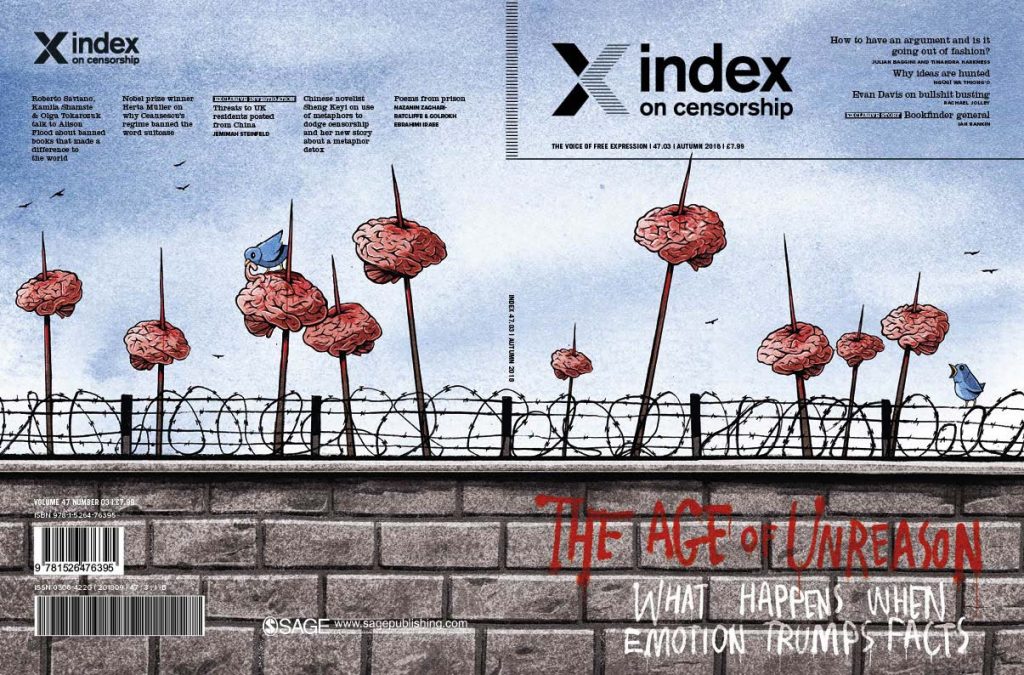
[/vc_column_text][/vc_column_inner][/vc_row_inner][/vc_column][/vc_row][vc_row][vc_column][vc_column_text]
The special report in our Autumn 2018 issue of Index on Censorship magazine, The Age of Unreason, focuses on bullshit busting and what happens when emotion trumps facts. See how prone to bullshit you are by taking our quiz, based on articles featured in the magazine.
[streamquiz id=”2″][/vc_column_text][vc_separator][/vc_column][/vc_row][vc_row content_placement=”top”][vc_column width=”1/3″][vc_custom_heading text=”The Age of Unreason” font_container=”tag:p|font_size:24|text_align:left” link=”url:https%3A%2F%2Fwww.indexoncensorship.org%2F2018%2F09%2Fage-of-unreason%2F|||”][vc_column_text]The autumn 2018 issue of Index on Censorship magazine explores the age of unreason. Are facts under attack? Can you still have a debate? We explore these questions in the issue, with science to back it up.
With: Timandra Harkness, Ian Rankin, Sheng Keyi[/vc_column_text][/vc_column][vc_column width=”1/3″][vc_single_image image=”102479″ img_size=”medium” alignment=”center” onclick=”custom_link” link=”https://www.indexoncensorship.org/2018/09/age-of-unreason/”][/vc_column][vc_column width=”1/3″ css=”.vc_custom_1481888488328{padding-bottom: 50px !important;}”][vc_custom_heading text=”Subscribe” font_container=”tag:p|font_size:24|text_align:left” link=”url:https%3A%2F%2Fwww.indexoncensorship.org%2Fsubscribe%2F|||”][vc_column_text]In print, online. In your mailbox, on your iPad.
Subscription options from £18 or just £1.49 in the App Store for a digital issue.
Every subscriber helps support Index on Censorship’s projects around the world.
 SUBSCRIBE NOW[/vc_column_text][/vc_column][/vc_row]
11 Sep 2018 | Artistic Freedom, News, Turkey, Turkey Uncensored
[vc_row][vc_column][vc_column_text]
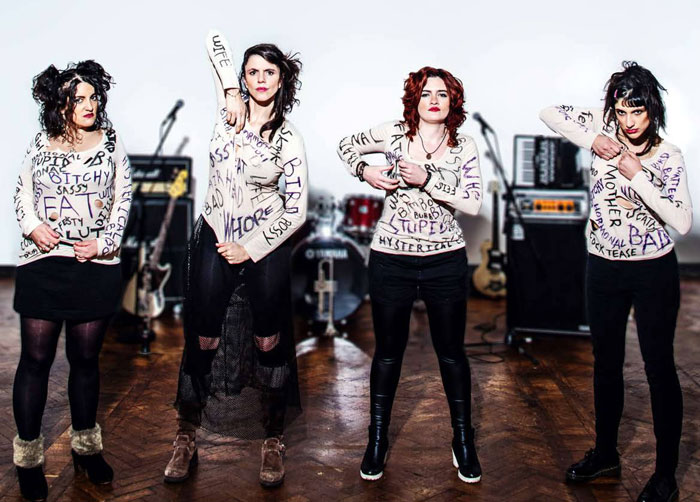
Enough is Enough is a play formed as a gig, tells the stories of real people about sexual violence, through song and dark humour. It is written by Meltem Arikan, directed by Memet Ali Alabora, with music by Maddie Jones, and includes four female cast members who act as members of a band.
For Turkish director and actor Memet Ali Alabora, theatre is about creating an environment in which the audience is encouraged to think, react and reflect. His goal is to leave the audience thinking about and questioning issues, whether it be democracy, free speech, women’s rights or the concept of belonging.
Alabora has always been fascinated by the notion of play and games, even as a child. “I was in a group of friends that imitated each other, told jokes, made fun of things and situations,” he says. The son of actors Mustafa Alabora and Betül Arım, he was exposed early on to the theatre. In high school, Alabora took on roles in plays by Shakespeare and Orhan Veli. He was one of the founders of Garajistanbul, a contemporary performing arts institution in Istanbul.
For Alabora, ludology — the studying of gaming — is not merely about creating different theatrical personalities and presenting them to the audience each time. Rather, it is about creating an alternative to ordinary life — an environment in which actors and members of the audience could meet, intermingle and interact. For those two hours or so, participants are encouraged to think deeply about and reflect upon their own personal stories and the consequences of their actions.
“I think I’m obsessed with the audience. I always think about what is going to happen to the audience at the end of the play: What will they say? What situation do I want to put them in?” the Turkish actor says “It’s not about what messages I want to convey. I want them to put themselves in the middle of everything shown and spoken about, and think about their own responsibility, their own journey and history.”
“It’s not easy to do that for every audience you touch. If I can do that with some of the people in the audience, I think I will be happy,” Alabora adds.
It is this desire to create an environment in which the audience is encouraged to take part, to reflect, to think that Alabora brought to Mi Minör, a Turkish play that premiered in 2012. Written by Turkish playwright Meltem Arıkan, it is set in the fictional country of “Pinima”, where “despite being a democracy, everything is decided by the president”. In opposition to the president is the pianist, who cannot play high notes, such as the Mi note, on her piano because they have been banned. The play encouraged the audience to use their smartphones to interact with each other and influence the outcome.
Alabora explained the production team’s motivation behind the play: “At the time when we were creating Mi Minör, our main motive was to make each and every audience if possible to question themselves. This is very important. The question we asked ourselves was: if we could create a situation in which people could face in one and a half hour, about autocracy, oppression, how would people react?”
The goal wasn’t to “preach the choir” or convey a certain message about the world. It was to encourage the audience not be complacent. “Would the audience stand with the pianist, who advocates free speech and freedom of expression, or would they side with the autocratic president?” Alabora asks.
Alabora considered was how people would react when faced with the same situation in real life. “They were reacting, but was it a sort of reaction where they react, get complacent with it and go back to their ordinary lives, or would they react if they see the same situation in real life?”
On 27 May 2013, a wave of unrest and demonstrations broke out in Gezi Park, Istanbul to protest the urban development plans being carried out there. Over the next few days, violence quickly escalated, with the police using tear gas to suppress peaceful demonstrations. By July 2013, over 8,000 people were injured and five dead.
In the aftermath, Turkish authorities accused Mi Minör of being a rehearsal for the protests. Faced with threats against their lives, Arikan, Alabora and Pinar Ogun, the lead actress, had little choice but to leave the country.
But how could a play that was on for merely five months be a rehearsal for a series of protests that involved more than 7.5 million people in Istanbul alone? “You can’t teach people how to revolt,” Alabora says. “Yes, theatre can change things, be a motive for change, but we’re not living in the beginning of the 20th century or ancient Greece where you can influence day-to-day politics with theatre.”
The three artists relocated to Cardiff, but their experience did not prevent them from continuing with the work they love. They founded Be Aware Productions in January 2015 and their first production, Enough is Enough, written by Arikan, told the stories of women who were victims of domestic violence, rape, incest and sexual abuse. The team organised a month-long tour of more than 20 different locations in Wales.
“In west Wales, we performed in a bar where there was a rugby game right before – there was already an audience watching the game on TV and drinking beer,” Alabora says. “The bar owner gave the tickets to the audience in front and kept the customers who had just seen the rugby game behind.”
“After the play, we had a discussion session and it was as if you were listening to the stories of these four women in a very intimate environment,” he adds. “When you go through something like that, it becomes an experience, which is more than seeing a show.”
After each performance, the team organised a “shout it all out” session, in which members of the audience could discuss the play and share their personal stories with each other. One person said: “Can I say something? Don’t stop what you are doing. You have just reached out one person tonight. That’s a good thing because it strengthened my resolve. Please keep doing that. Because you have given somebody somewhere some hope. You have given me that. You really have.”
Be Aware Productions is now in the process of developing a new project that documents how the production team ended up in Wales and why they chose it as their destination.
“What we did differently with this project was that we did touring rehearsals. We had three weeks of rehearsal in six different parts of Wales. The rehearsals were open to the public, and we had incredible insight from people about the show, about their own stories and about the theme of belonging,” Alabora shares.
Just like Mi Minor and Enough is Enough, the motivation behind this new project is to encourage the audience to think, to reflect on their own personal stories and experiences: “With this new project, I want them to really think personally about what they think or believe and where this sense of belonging is coming from, have they thought about it, and just share their experiences.” [/vc_column_text][vc_row_inner content_placement=”top”][vc_column_inner width=”1/4″][vc_column_text]
[/vc_column_text][/vc_column_inner][vc_column_inner width=”3/4″][vc_column_text]
Index encourages an environment in which artists and arts organisations can challenge the status quo, speak out on sensitive issues and tackle taboos.
Index currently runs workshops in the UK, publishes case studies about artistic censorship, and has produced guidance for artists on laws related to artistic freedom in England and Wales.
Learn more about our work defending artistic freedom.[/vc_column_text][/vc_column_inner][/vc_row_inner][/vc_column][/vc_row][vc_row][vc_column][vc_basic_grid post_type=”post” max_items=”12″ style=”load-more” items_per_page=”4″ element_width=”6″ grid_id=”vc_gid:1536657340830-d3ce1ff1-7600-4″ taxonomies=”15469″][/vc_column][/vc_row]
4 Sep 2018 | Academic Freedom, News, Turkey, Turkey Uncensored
Hanifi Barış, an outspoken Kurdish academic and lawyer, has been imprisoned by Turkish authorities since 4 July 2018. His detention for sharing press articles on social media is another demonstration of the repeated attacks against freedom of expression and critical opinions in Turkey.
Hanifi Barış obtained his Ph.D from the Centre for Citizenship, Civil Society and Rule of Law at the University of Aberdeen in 2017. Interested in political theory and human rights, he has published several articles and book chapters on Kurdish politics. After completing his dissertation, Barış moved back to Turkey and settled in Istanbul, where he started working as a lawyer. In his roles as an academic and a lawyer, Barış stood out as an ardent defender of human rights. In 2012, he drew public attention for representing a famous conscientious objector and defending his client’s rights to answer to the court in Kurdish. In January 2016, he was one of the Academics for Peace who signed the petition “We will not be a party to this crime”, which denounced the state-sanctioned violence in the Kurdish regions and called on the Turkish government to re-establish peace negotiations.
On 3 July, Barış received a call from Istanbul Bakırköy Police station, asking him to give a statement about his social media posts. The next day, after giving his statement to the police, he was referred to the court, where the prosecutor requested his arrest. He was accused of producing “terrorist propaganda” on the ground of article 7/2 of the Anti-Terror Law no 3713. Barış had shared news articles and commentaries from international and local media on his Facebook and Twitter accounts. It is worth emphasising that he did not add any of his own commentary on the posts. At the court’s request Barış was sent to prison on the same day. Since then, the appeals of his lawyer, Mehmet Doğan, for his release pending trial have been repeatedly denied. Even worse, when Barış asked to be moved to another dormitory in Silivri Prison, he was sent to an individual cell and remained in solitary confinement for 12 days.
On 23 July 2018, İstanbul’s 29th High Criminal Court accepted the indictment against Barış and re-affirmed his pre-trial detention. The Court based its decision on an ongoing assessment of digital materials that had been supposedly confiscated during an alleged search of his residence and belongings. However, no such search ever took place. This blatant disregard for the rule of law and due process casts serious doubts on Barış’s prospect for a fair trial, highlighting Turkey’s systematic use of pre-trial detention as a means of intimidation.
The news and commentaries shared by Barış on social media were critical of the Turkish government and its policies in Syria. They included articles from websites such as The Guardian and Foreign Policy. It is absurd to construe those articles as “terrorist propaganda” under article 7/2 of the Anti-Terror Law, which criminalises statements “justifying or praising or inciting the terrorist organizations’ methods which contain violence, force or threat”. Rather, Barış’s indictment reflects the Turkish government’s criminalisation of free speech and attempt to silence all critical opinions. Just as the repression of critical newspapers and media has been on the rise in recent years, arrests on the ground of social media posts have witnessed a dramatic increase. While the crackdown has particularly targeted Kurdish politicians and activists, journalists, students, lawyers and academics, arbitrary arrests of social media users serve as a warning to all who voice their dissent against the current Turkish regime.
Since early July, Academics for Peace, Barış’s colleagues from the University of Aberdeen and human rights organisations have strongly protested against his detention. An ongoing petition asking for his immediate release has received almost 5,000 signatures. Many of those who signed are internationally-renowned academics. At the University of Aberdeen, which has actively sought to mobilise support since Barış’s arrest, one of his colleagues describes him as “a clear-headed scholar, who draws on his experience as a practising lawyer to make original contributions to thinking on political community and direct or semi-direct democracy”. Barış, he says, is “the kind of scholar who could find common ground with academics from almost any perspective: always good-natured, cheerful and unfailingly kind to everyone he interacted with.”
Barış’s first hearing is scheduled for Sep 18th. International observers are invited to monitor his hearing at Çağlayan Courthouse, with the hope that Barış will be immediately released and cleared of unfounded accusations.
