14 Mar 2014 | Africa, News, Uganda
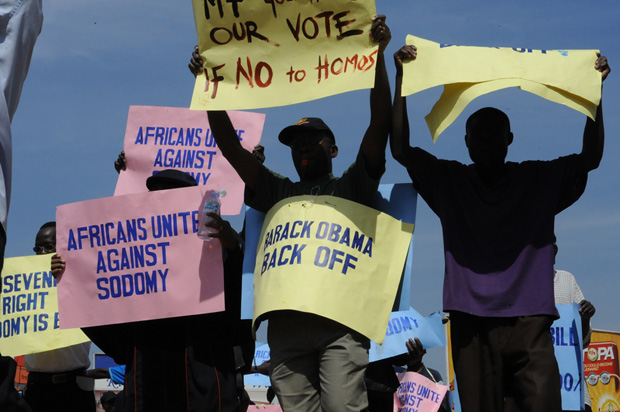
Hundreds of Ugandans took to the streets in support of the government’s proposed anti-homosexuality bill in 2009 (Image: Edward Echwalu/Demotix)
A petition has been filed to the Constitutional Court of Uganda seeking to repeal the Anti Homosexuality Act 2014, on the grounds that it is “draconian” and “unconstitutional”.
The petitioners — MP Fox Odoi, Joe Oloka Onyango, Andrew Mwenda, Ogenga Latigo, Paul Semugooma, Jacqueline Kasha, Julian Onziema, Frank Mugisha and two civil society organisations — are challenging sections 1, 2 and 4 of the recently passed anti-gay law, which criminalise homosexual activity, between consenting adults in private. They argue these sections are in contravention of the right to privacy and equality before the law without discrimination, guaranteed under the Ugandan constitution. They also claim the that bill was passed without quorum in parliament, despite Prime Minister Amama Mbabazi informing the speaker of this — also an unconstitutional act.
Addressing the media after filing the petition, Odoi vowed to fight for the rights of gay people even if it meant him losing support from his constituency. “I would rather lose my seat in parliament than leave the rights of the minorities to be trampled upon. I don’t fear losing an election, but I fear living in a society that has no room for minorities,” he said. “A country that cannot tolerate minority groups like gays should never claim to be democratic, lawful and pro-people,” he added.
The petitioners have highlighted several parts of the new law that they believe to be unconstitutional. They argue that life sentence for homosexuality is in contravention of the freedom from cruel, inhuman and degrading punishment, while the section subjecting persons charged with “aggravated homosexuality” to compulsory HIV test is inconsistent with a number of articles in the constitution.
The petition also argues that through banning aiding, abetting, counselling, procuring and promotion of homosexuality, the law is creating overly broad offences. Additionally, the group state that it’s wrong for the act to penalise legitimate debate on homosexuality, as well as professional counsel, HIV-related service provision and access to general health services for gay people.
Petitioner Ogenga Latigo, former leader of the opposition in parliament, questioned the competence of the speaker of parliament who passed the law without quorum. Speaker Rebecca Kadaga has in the past been vocal about her disdain for homosexuals, and wanted this law passed before the end of 2012 as a “Christmas gift” to Ugandans. “The speaker’s position should always remain neutral while tabling issues in parliament, but our speaker went on and enforced her views on all MPs; the speaker never followed the procedures that govern the passing of laws in parliament because of her homophobic beliefs,” he said.
The group argues that since the law was enacted, there has been an increase in the number of violent attacks on gay people. In other instances, they say, those suspected or known to be gay have been evicted from their apartments by homophobic landlords.
Odoi, who authored a minority report against the bill before it was passed by parliament, is optimistic that the petition will succeed, if the case is handled by unbiased judges. “We want court to declare the law unconstitutional, null and void and cease to be a binding law, thus give a chance to homosexuals to enjoy their rights and freedoms,” he asserted.
This article was posted on March 14 2014 at indexoncensorship.org
13 Mar 2014 | Awards, News
Lucien Bourjeily openly confronted the Lebanese censorship bureau by writing a play Would It Pass Or Not? about censorship in Lebanon. The play was banned, exposing the farcical sensitivity of the censors and forcing them to justify their actions in public.
The play was produced by March – an anti-censorship NGO of which Bourjeily is an advisory board member.
In conversation with Index, Bourjeily told of his bizarre encounters with the censor board’s general when summoned to the bureau in Beirut on 28 August.
“The play could not go ahead” he was told “because it was not realistic. It was exaggerated”. “True”, said Bourjeily, “it’s fiction. Of course it’s unrealistic and exaggerated. Otherwise it would be a documentary”.
Bourjeily recounts the general turning to his subaltern and describing scenes from the play, asking “would such a thing happen here?”, unintentionally and ironically echoing a scene in the play itself. When censors are censoring a play about censorship, things are bound to turn to farce sooner or later.
Normally, Lebanon’s censors will suggest changes to works that will allow them to pass – a joke removed here, a political remark erased there. But with Bourjeily’s play, this was apparently not going to happen.
The censors’ next move was interesting: they would show, they said, that Boujeily’s play had no artistic merit. On 3 September, General Mounir Akiki appeared on television bearing testimony from four “critics”, each of whom said the same thing; that there was no artistic value in “Would it pass or not?”
Curiously, none of these critics were named, despite their views being taken very seriously indeed. One said that Bourjeily’s play contained “a defamatory hallucination indicating the absence of his artistic level”, another that the play “was not related to the theatre, but rather with prosaic words. It does not meet the conditions regarding structure.”
Nominees: Advocacy | Arts | Digital Activism | Journalism
Join us 20 March 2014 at the Barbican Centre for the Freedom of Expression Awards
This article was posted on 13 March 2014 at indexoncensorship.org
13 Mar 2014 | News, United Arab Emirates
(Photo illustration: Shutterstock)
On 3 March 2011 a group of Emirati intellectuals sent a petition to the country’s rulers that politely requested democratic reform and political participation. Authorities have responded by spending the past three years jailing and torturing those who supported the petition. Now citizens are using social media platforms to criticise security services for growing levels of repression with authorities responding in kind by arresting and torturing them.
Since punitive legislation governing use of the internet was passed in November 2012 at least six people have been sent to prison for comments made on Twitter. The latest to be convicted are Khalifa Rabeiah and Othman al-Shehhi who were both sentenced to five years in prison and ordered to pay fines of £81,875 on 10 March for criticising security services on Twitter.
The story for these two men has become a predictable one for those who dare to criticise authorities in the United Arab Emirates (UAE). They were arrested on 24 July and spent at least six months detained at an unknown location where they say officers tortured them and denied them access to a lawyer. Their families desperately sought information about the reason for their detention but were told by the attorney general’s office that no warrant had been issued for their arrest, so they could not help.
The only available information about their arrest came from the government-linked television channel 24.ae, which broadcast a report analysing Rabeiah’s Twitter account. They accused him of sedition based on his use of hashtags that demonstrated support for jailed political prisoners. There is no information detailing the offending comments made by al-Shehhi, although he used the same hashtags as Rabeiah on his account.
Both men are members of al-Islah, an organisation linked with calls for political reform, and used Twitter to show solidarity with jailed members of their colleagues. The hashtag they used most, “Free Emirates”, has been active for the past three years since the authorities began to arrest political activists with a particular focus on members of al-Islah.
As authorities continue to arrest people for comments made on social media this crackdown increasingly resembles a rather frightening incarnation of Whac-A-Mole. Immediately after news was released of these latest convictions hashtags sprang up in support of both men, with Twitter users criticising security services and calling for political prisoners to be released.
It is clear that repression is fuelling dissent and with repression on the rise criticism will only increase in its intensity. These men may be deprived of their means to criticise but their jailing has sparked a wave of renewed anger at security services. Each arrest, every allegation of torture and the conclusion of more political show trials simply serves to make the problem more complicated and unsolvable for authorities.
Even the international community has started to take notice of what is happening in the UAE. Following a country visit in January a United Nations (UN) expert published a report calling for an investigation into torture and described the country’s judiciary as being under the control of the executive. The security services might not be able to arrest the UN representative but it is unlikely she will be allowed to visit again, as is the case for several Human Rights Watch employees who were banned from the country earlier in the year.
Khalifa Rabeiah and Othman al-Shehhi spoke out on Twitter because political activists were being tortured and subjected to unfair trials. In so doing they suffered the same fate, becoming two more names on a lengthening list of political prisoners. It is unclear how this crackdown will conclude but it is increasingly apparent that the threat of imprisonment has failed to prevent people from criticising repression and with each new arrest authorities create many more political opponents.
This article was posted on March 13 2014 at indexoncensorship.org
13 Mar 2014 | India, News, Pakistan
Improbable as it may seem, but 67 Kashmiri university students were briefly charged with sedition for cheering for Pakistan, and celebrating its win over India, during an Asia Cup cricket match in early March.
Sections of the Indian Penal Code that they were charged under were the following:
Section 124a – “Whoever by words, either spoken or written, or by signs, or by visible representation, or otherwise, brings or attempts to bring into hatred or contempt, or excites or attempts to excite disaffection towards the Government established by law..”
Section 153 – “Whoever malignantly, or wantonly by doing anything which is illegal, gives provocation to any person intending or knowing it to be likely that such provocation will cause the offence of rioting to be committed shall..”
Section 427 – “Whoever commits mischief and thereby causes loss or damage to the amount of fifty rupees or upwards..”
The students were watching the match in Meerut, at the Swami Vivekanand Subharti University when the ruckus started. According to conflicting reports, the hooting of the Kashmiri students at Pakistan’s win caused those supporting India to chase them and throw stones at their rooms. The Kashmiri students protested the next day, but the university officials suspended them for three days as “resentment was growing in other hostels because of their behavior.” The police charged them under the Indian Penal Code. After a public outcry, the Uttar Pradesh police dropped the charges, however, there is a battle of words between the police and university officials as to who initiated the charges against the students.
The incident, once again, has exposed the fragile faultlines between Kashmir and India – and the perceived disloyalty of the Kashmiri Muslims to India. The controversy has brought about some harsh reactions, including a tweet by famous lyricist Javed Akhtar that said – “Why the suspension of those 67 Kashmiri students who cheered Pakistan is revoked. They should be rusticated and sent back to Kashmir.” Others, like Shivam Vij, took a more nuanced position, stating that, “not taking action against them would have escalated the violence at the university and in the city. The Indian students at the university were responding with the same sentiment that makes Kashmiri Muslims suspect their Hindu minority: the sentiment of nationalism. How acceptable would it be to a Pakistani if some in Pakistan openly and publicly cheered for the Indian cricket team in a match against Pakistan?”
Tidbits from Kashmir also help cement this view of the Muslims from the Kashmir Valley to the rest of India. Reports that firecrackers celebrated Pakistan’s win all night, and that a skirmish between Indian army personnel and local Kashmir youth celebrating the results of the match ended in a stabbing. There have also been defiant editorials from Pakistan countering the action against the students, declaring that, “it is not the win of Pakistan but the loss of India against any cricket playing nation that revives interest for cricket in Kashmir. India’s loss is a temporary relief from all the melancholy and grief that the people of Kashmir go through on a daily basis, inflicted by the Indian state and its military architecture.”
While this incident in question might have, on the surface, been about cricket and extremely ungentlemanly behavior, very quickly it seemed to have translated into politics as usual. A outcry about serious charges against university students – Kashmiris who had travelled far from home to obtain an Indian degree – was raised by many Indians in the media, by the Chief Minister of Jammu and Kashmir, and international groups. Many of these students were in Meerut given under the PMSSS, or the Prime Minister’s Special Scholarship Scheme, meant to enhance job opportunities for Kashmiri youth, meant mainly for low-income families. This is part of a larger drive to assimilate Kashmiri youth into the mainstream economic and educational life of India.
Indian Express’s Shekhar Gupta lamented the controversy given cricket’s globalized nature where it is increasingly normal to cheer for favourite player from another country. Instead he feels that “India’s majority has a minority complex” and this is coming to the fore “when the BJP is surging ahead, and not because of any mandir, tension with Pakistan, or rash of terror attacks. And when, in fairness, you have to acknowledge that there isn’t even a vaguely communal appeal in its leader Narendra Modi’s campaign message. India has had a 13-year period of total peace, unprecedented in its independent history. There has been a steep decline in terror incidents. Even the Maoists seem to be shrinking slowly. And yet, our level of jingoism is as if we were approaching an imminent war, as if India were under siege, its borders getting violated with impunity, the enemy at the gates.” Many echo Gupta’s view, fearing that those who believe the BJP under Narendra Modi will form government after the elections in April 2014, might be quick to adopt the jingoistic Hindu nationalism the party was based on.
Adding a layer to this incident is an interesting point of view offered by journalist Prayaag Akbar who writes about India’s many Muslims who feel affinity towards Pakistani cricket team, but are rarely called out for it, unlike the Kashmiri Muslims. He writes – “that some Indian Muslims, not just Kashmiris, support Pakistan during cricket matches must be acknowledged. But categorisation is self-fulfilling, some will say, and sport excites tribalism. It does not immediately follow—and this seems to be the consideration at the crux of the issue—that they will support Pakistan in a war against India. Yet it does not immediately follow that they will not, either. No one on either side of the debate can assert their position with complete confidence. What we can say with certainty is there has been a failure of assimilation, that has in part been caused by a rarely acknowledged, yet generally accepted, narrowed definition of what it means to be Indian.”
Cricket, criticisms and cartoons cannot be simply deemed seditious by the Uttar Pradesh police because they are problematic. And, ironically, this is in the shadow of the largest democratic exercise in the world, the Indian elections, a month away.
This article was published on March 13, 2014 at indexoncensorship.org
