4 Mar 2015 | Afghanistan, Awards, mobile
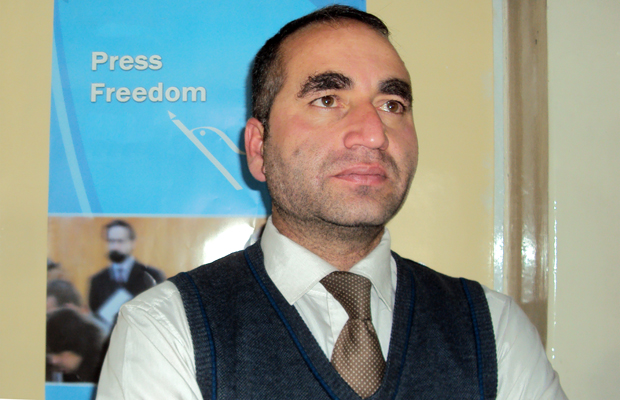
Campaigning nominee Abdul Mujeeb Khalvatgar
Abdul Mujeeb Khalvatgar is an Afghan journalist and the executive director of the media advocacy group Nai Supporting Open Media in Afghanistan, which works to develop a free media as the country develops a peacetime society. A radio journalist for more than 10 years, he began his career with the Internews Network in 2002 and then as general manager for a national radio channel, Salam Watander.
Khalvatgar has been a tireless campaigner for a free and fair Afghan media. Nai is the only organisation in the country to monitor violence against Afghan journalists. It has offered basic training to around 10,000 Afghan journalists, teaching investigative reporting, TV hosting and technical skills. Nai also runs a network of all-female radio stations, which Khalvatgar helped set up.
The Afghan media sector has grown from having only 15 media outlets in 2000 to almost 1,000 in 2014. With this growth, new challenges have arisen. Since 2001 more than 40 journalists have been killed in Afghanistan and hundreds of attacks on members of the press have been recorded. Many of these are believed to have been perpetrated by the government. Operating in a well-documented atmosphere of violence and hostility, Khalvatgar aims to strengthen Afghan democracy by being one of the founding fathers of a free media in the country.
“The problem here is that on the one hand, the government of Afghanistan are trying to push and pressurise as much as possible the environment for free expression and free media. On the other hand the terrorists, the Taliban, are trying to silence the people who are working as journalists, who are working as media activists and those who are trying to support them,” Khalvatgar told Index on Censorship.
Her says insecurity is one of the main problems facing Afghan journalists. “Just 20 kilometres outside of Kabul it is sometimes not possible to report on what is going on,” he says, adding that outside the big cities, journalist have to self-censor for fear of the local government, local powers, and in south and east of the country, the Taliban. Even in big cities, he explains, it is sometimes difficult to investigate stories related to corruption in depth “because you don’t feel safe to do it”. He also highlights impunity for crimes against members of the press, the undefined relationship between media owners and journalists and the lack of access to information as challenges to media freedom.
Khalvatgar joined Nai as executive director in 2010, a position he still holds. He is part of Afghanistan’s Foundation Open Society Institute, working as media coordinator and acting country manager, as well as an active member of Access to Information Law Working Group, a collective of more than 15 media professionals and activists working for better access to information law in Afghanistan. He spent the better part of 2012 successfully campaigning to get a government draft law withdrawn that would have dampened media freedom and given more power over the press to conservative bodies. He also helped launch Afghanistan’s first media awards, as well as its Legacy Fund, which raises money for families of Afghan reporters who have been killed. And he is doing this work at great personal risk.
“I have had threats from Taliban that they want to kill me; threats from the government of Afghanistan that I do not criticise the government; threats from the local powers to not touch the kind of hegemonies that they have,” he lists. “But I do believe in what I’m doing. And I do love what I’m doing. So any kind of threats will not stop me.”
Khalvatgar says he is delighted about the Index award nomination, but true to form, his focus on is on his country’s media community. “If I win this award, it is an award for the people; for 49 journalists who have been killed in Afghanistan, for their families, for the almost 12,000 people that are working in the media sector in Afghanistan.”
This article was posted on March 4 2015 at indexoncensorship.org
3 Mar 2015 | About Index, Campaigns, Press Releases, Statements
On the second anniversary of the start of the mass “UAE 94” trial that imprisoned dozens of government critics and reform activists in the United Arab Emirates (UAE), including prominent human rights defenders, judges, academics, and student leaders, a coalition of 13 organizations calls on the UAE government to release immediately and unconditionally all those imprisoned solely for peacefully exercising their rights to freedom of expression and association following this grossly unfair trial, as well as those who remain detained or imprisoned for publicizing concerns about it. The organizations also call on the authorities to ensure that the allegations of torture and other ill-treatment that the individuals were subjected to prior to and following their trial are promptly, independently, impartially and thoroughly investigated, that those responsible are held to account, and that the victims have access to effective remedies and to reparation.
The organizations share the serious concerns raised since 2011 by several UN human rights bodies and human rights organizations regarding the UAE government’s continuing pattern of harassment, secret, arbitrary and prolonged incommunicado detention, torture and other ill-treatment, enforced disappearances, and unfair trials targeting activists and those critical of the authorities, as well as its increasing use of national security as a pretext to clamp down on peaceful activism and to stifle calls for reform.
The space for dissent in the UAE is increasingly shrinking. The repression has been entrenched with the enactment in 2012 of the cybercrimes law, which the government has used to silence social media activists and others who support and defend freedom of expression online, and the enactment of the 2014 counter-terror law. The vague and overly broad definition of terrorism in the 2014 law, which treats a wide range of activities, including those protected by human rights standards, as amounting to terrorism, may be used to sentence human rights defenders or critics of the government to lengthy prison terms or even death.[1]
The organizations call on the UAE government, which currently is a member of the UN Human Rights Council, to adhere to its obligations to uphold human rights at home, including respecting the rights to freedom of opinion and expression, and to freedom of association and peaceful assembly.
The anniversary of the mass trial, widely known as the “UAE 94” trial, coincides with the anniversary of the March 2011 petition from a group of 133 high-profile women and men addressed to the UAE President, which called for democratic reform. The petition elicited an uncompromisingly repressive response from the UAE authorities and many of its signatories, and their families, have been harassed, arbitrarily arrested, or imprisoned in the four years since they put their names to their call for reform.
The UAE 94 trial, which began on 4 March 2013 before the State Security Chamber of the Federal Supreme Court in Abu Dhabi, saw a total of 94 defendants, including eight who were charged and tried in absentia, stand trial en masse on the charge of establishing an organization that aimed to overthrow the government, a charge which they all denied. The trial failed to meet international fair trial standards and was widely condemned by human rights organizations and UN bodies, including the UN Working Group on Arbitrary Detention. The court accepted prosecution evidence that consisted largely of “confessions” made by defendants while they were in pre-trial detention. The court failed to require, before the admission of such evidence, that the prosecution prove beyond reasonable doubt that the “confessions” were obtained by lawful means and voluntarily from the accused. The court also failed to take steps to investigate, or order a prompt, independent, impartial and thorough investigation of the defendants’ claims that State Security interrogators had forced them, under torture or other ill-treatment, to make false “confessions” incriminating themselves and others during months when they were held incommunicado in secret locations and without access to lawyers or the outside world. The defendants were also denied a right of appeal to a higher tribunal; under UAE law, Federal Supreme Court judgments are final and not subject to appeal.[2]
On 2 July 2013, the court convicted 69 of the 94 defendants, including the eight tried in absentia, and acquitted 25. The defendants included many people who had achieved prominence in the UAE in their respective fields in the law, education and academia, business, and as government advisers. The court sentenced to prison terms of between seven and 15 years many well-known figures including: prominent human rights lawyer and law professor Dr Mohammed Al-Roken, who has written a number of books and journal articles on human rights, freedom of expression, and counterterror laws; high profile lawyers Dr Mohammed Al-Mansoori and Salem Al-Shehhi; judge Mohammed Saeed Al-Abdouli; law professor and former judge Dr Ahmed Al-Zaabi; lawyer and university professor Dr Hadef Al-Owais; senior member of the Ras Al-Khaimah ruling family Sheikh Dr Sultan Kayed Mohammed Al-Qassimi; businessman Khalid Al-Shaiba Al-Nuaimi; Science teacher Hussain Ali Al-Najjar Al-Hammadi; blogger and former teacher Saleh Mohammed Al-Dhufairi; student leader Abdulla Al-Hajri; and student and blogger Khalifa Al-Nuaimi who, before his arrest, had kept an active blog which he used to express criticism of the human rights situation in the UAE and the heavy-handed approach of the State Security apparatus.[3]
Others convicted at the trial include seven activists, known as the “UAE 7”, who had their citizenship arbitrarily withdrawn in 2011 and were told to leave the country. They are economist Ahmed Ghaith Al-Suwaidi; teacher Hussein Al-Jabri; former long-term employee of the Ministry of Presidential Affairs Hassan Al-Jabri; teacher Ibrahim Hassan Al-Marzouqi; former teacher Sheikh Mohammed Al-Sadeeq; Dr Shahin Abdullah Al-Hosni; and Dr Ali Hussain Al-Hammadi.
During the trial, the authorities took steps to prevent independent reporting of the proceedings. International media and independent trial observers were not permitted access to the court. Security authorities refused to allow an independent trial observer delegated by Amnesty International entry to the UAE immediately prior to the opening of the trial. Two independent observers sent by the International Commission of Jurists were turned away by plain-clothed security officials before they reached the Federal Supreme Court building.[4] Another international observer mandated by the International Federation for Human Rights, the Gulf Center for Human Rights, the Cairo Institute for Human Rights Studies, and the Arabic Network for Human Rights Information, was also denied access to the final trial hearing on 2 July 2013, despite an earlier indication by the UAE authorities that she would be allowed to attend.[5]
In November 2013, the UN Working Group on Arbitrary Detention issued an Opinion on the UAE 94 case, concluding that the UAE government had deprived the defendants of their right to a fair trial, enshrined in Article 10 of the Universal Declaration of Human Rights (UDHR). The Working Group on Arbitrary Detention found that the arrest and detention of the individuals had resulted from the exercise of their rights to freedom of opinion and expression and to freedom of peaceful assembly and association, guaranteed under articles 19 and 20 of the UDHR, stating that the restrictions on those rights could not be considered to be proportionate and justified. It declared the arrest and detention of the 61 defendants who were imprisoned following the mass trial to be arbitrary and called on the UAE authorities to release them and afford them appropriate reparation.[6]
Authorities also barred some of the defendants’ relatives from the courtroom; and others, who were permitted to attend, were harassed, detained or imprisoned after they criticized the proceedings and publicized torture allegations made by the defendants on the Twitter social media website.
In April 2013, a court sentenced Abdullah Al-Hadidi, the son of one of the UAE 94 who was convicted, Abdulrahman Al-Hadidi, to 10 months’ imprisonment on the charge of publishing details of the trial proceedings “without probity and in bad faith,” after he criticized the proceedings on Twitter. He was released in November 2013.
Blogger and netizen, Obaid Yousef Al-Zaabi, brother of Dr Ahmed Al-Zaabi, was arrested in July 2013 and again in December 2013, and was prosecuted on several charges based on his Twitter posts about the trial, including spreading “slander concerning the rulers of the UAE using phrases that lower their status, and accusing them of oppression” and “disseminating ideas and news meant to mock and damage the reputation of a governmental institution.” In June 2014, Obaid Yousef Al-Zaabi was acquitted of all charges but, despite this, the authorities continue to arbitrarily detain him, even though there is no legal basis for depriving him of his liberty. He remains in the prisoners’ ward of Sheikh Khalifa Medical City Hospital in Abu Dhabi, as he continues to suffer from advanced arthritis and rheumatism and has difficulty walking.[7]
Osama Al-Najjar, netizen and son of Hussain Ali Al-Najjar Al-Hammadi, was arrested in March 2014 and prosecuted for charges based on messages he posted on Twitter defending his father, who is one of the UAE 94. In November 2014, he was sentenced to three years’ imprisonment and a heavy fine for charges including “designing and running a website on social networks with the aim of publishing inaccurate, satirical and defaming ideas and information that are harmful to the structure of State institutions”; “offending the State”; “instigating hatred against the State”; and “contacting foreign organizations and presenting inaccurate information” about the UAE 94 trial and living conditions inside Al-Razeen Prison. He had no right to appeal the verdict and is imprisoned in Al-Wathba Prison, Abu Dhabi.[8]
The UAE 94 trial proved to be the centerpiece of the authorities’ broader crackdown targeting expression of dissent and advocacy of greater public participation in the governance of the UAE and other reform. At one stroke, the authorities removed from the public arena their most prominent critics and the country’s leading advocates of reform, while signaling to other potential dissenters that they will not tolerate open political debate in the UAE or any form of criticism of the government.[9]
The coalition is very concerned about the lack of space for rights organizations to do their legitimate work and about the repeated attempts by the UAE authorities or their supporters to eliminate freedom of expression for its residents, not only in the traditional media, but also on social media networks. On 28 October 2014, for example, high profile human rights defender and blogger Ahmed Mansoor’s Twitter account, in which he publishes his personal thoughts and views, was hacked. On 15 February 2015, three sisters, Asma Khalifa Al-Suwaidi, Maryam Khalifa Al-Suwaidi and Alyaziyah Khalifa Al-Suwaidi, were subject to enforced disappearance and there are serious concerns for their safety. The three sisters have campaigned peacefully online for the release of their brother, one of the UAE 94 prisoners, Dr Issa Al-Suwaidi, highlighting his unfair trial and the human rights violations to which he was subjected at the hands of UAE authorities. Dr Issa Al-Suwaidi is a respected academic and was the General Secretary of the Red Crescent in the UAE between 1996 and 1998.
On 16 February 2015, government-owned newspaper The National reported that the UAE government had adopted 36 recommendations made by the Human Rights Department of the UAE’s Ministry of Foreign Affairs after it carried out a study of international reports on the country’s human rights performance. The online newspaper said one of the recommendations was that an independent committee be established to review all allegations of torture, which the coalition endorses. However, the report disappeared from The National’s website the day after it was published, which is discouraging.[10]
The coalition urgently calls on the UAE authorities to implement recommendations by UN bodies and international human rights organizations to:
- release immediately and unconditionally all those individuals detained or imprisoned solely for peacefully exercising their rights to freedom of expression and association;
- prohibit the practice of secret detention;
- institute safeguards against torture and other ill-treatment, and ensure that all complaints or allegations of torture and other ill-treatment are promptly, independently and thoroughly investigated;
- ensure that victims of torture and other ill-treatment, arbitrary detention, and other human rights violations have access to effective remedies;
- ensure that all persons deprived of their liberty receive a fair and public hearing by an independent and impartial court in accordance with international human rights standards, including by having the right to appeal the judgment before a higher court or tribunal;
- publish the 36 recommendations made by the Human Rights Department of the UAE’s Ministry of Foreign Affairs, and implement the recommendation that an independent committee be established to review all allegations of torture;
- amend any legislation which impermissibly restricts the rights to freedom of expression, association and assembly, with a view to bringing all of these laws into full conformity with the UAE’s obligations under international human rights law, including the Universal Declaration of Human Rights; and
- ratify the International Covenant on Civil and Political Rights and its Optional Protocols, and the International Convention for the Protection of all Persons from Enforced Disappearance.
***********************************
Amnesty International
For more information please call Amnesty International’s Middle East and North Africa press officer Sara Hashah on +44 20 7413 5566 / +44 7778 472 126, or email: [email protected]
Arabic Network for Human Rights Information (ANHRI)
For more information, please email Rawda Ahmed, Deputy Executive Director and Head of Legal Aid Unit, on [email protected]
ARTICLE 19
For more information, please contact David Diaz-Jogeix, Director of Programmes, on [email protected]
Gulf Centre for Human Rights
For more information, please call Khalid Ibrahim on +961 70159552, or email: [email protected] www.gc4hr.org
Freedom House
For media inquiries, please email Robert Herman, Vice President for Regional Programs, on [email protected]
Front Line Defenders
For more information, please call Jim Loughran, Head of Media and Communications on +353 (0)1 212 3750, or email [email protected]
Index on Censorship
For more information, please contact Melody Patry, senior advocacy officer, on +44 207 260 2660 or [email protected]
International Commission of Jurists
For more information, please contact Said Benarbia, Middle East and North Africa Programme, on + 41 22 979 38 17 or [email protected]
International Federation for Human Rights (FIDH)
For more information, please contact Arthur Manet, Director of media relations, on +33 1 43 55 90 19 or [email protected]
Lawyers for Lawyers
For more information, please call Ms Adrie van de Streek, Executive Director on +31 (0)6 26 274 390 or email [email protected]
Lawyers’ Rights Watch Canada
For more information, please call Gail Davidson, Executive Director, on +1 (604) 736 1175, or email [email protected]
PEN International
For more information, please contact PEN’s Communications and Campaigns Manager Sahar Halaimzai on +44 (0) 20 7405 0338 or email [email protected]
Reporters Without Borders
For more information, please call Lucie Morillon, Programme Director on +33 1 44 83 84 71, or email [email protected]
[1] Gulf Centre for Human Rights, Front Line Defenders, Cairo Institute for Human Rights Studies, Arabic Network for Human Rights Information, UAE: Fear that Anti-Terrorism Law will be used to curtail human rights and target human rights defenders, 13 December 2014, http://www.gc4hr.org/news/view/850
[2] International Commission of Jurists, Mass Convictions Following an Unfair Trial: The UAE 94 Case, 4 October 2013, http://icj.wpengine.netdna-cdn.com/wp-content/uploads/2013/10/UAE-report-4-Oct-2013smallpdf.com_.pdf
[3] A few days before his own arrest in July 2012, Khalifa al-Nuaimi wrote on his blog about the wave of mass arrests by the UAE’s State Security apparatus, saying “You do not have the right to take a son from his father…a father from his son…a teacher from his students…a preacher from his audience…and imprison them unlawfully.”
[4] International Commission of Jurists, United Arab Emirates: ICJ condemns blatant disregard of the right to a fair and public trial, 12 March 2013, http://www.icj.org/united-arab-emirates-icj-condemns-blatant-disregard-of-the-right-to-a-fair-and-public-trial/?_sm_au_=iVV7R4317ftBnjDP
[5] Doughty Street Chambers, UAE denies International Legal Observer access to verdict in show trial of UAE 94, 1 July 2013, http://www.doughtystreet.co.uk/news/article/uae-denies-international-legal-observer-access-to-verdict-in-show-trial-of-; The coalition released two judicial observation reports based on interviews conducted by British human rights lawyer Melanie Gingell with family members who attended the hearings, local human rights defenders and activists, as well as international and local media: International Federation for Human Rights, Gulf Center for Human Rights, Cairo Institute for Human Rights Studies, the Arabic Network for Human Rights Information, United Arab Emirates: Criminalising Political Dissent, 27 August 2013, https://www.fidh.org/International-Federation-for-Human-Rights/north-africa-middle-east/united-arab-emirates/united-arab-emirates-criminalising-political-dissent-13879; Alkarama, Amnesty International, Arabic Network for Human Rights Information, Gulf Centre for Human Rights, Human Rights Watch, International Federation for Human Rights, UAE: Unfair Trial, Unjust Sentences, 3 July 2013, https://www.fidh.org/International-Federation-for-Human-Rights/north-africa-middle-east/united-arab-emirates/uae-unfair-trial-unjust-sentences-13590
[6] United Nations General Assembly, Human Rights Council, Working Group on Arbitrary Detention, Opinions adopted by the Working Group on Arbitrary detention at its 68th Session (13-22 November 2013), UN Doc A/HRC/WGAD/2013/60.
[7] Amnesty International understands that during the first few weeks after his arrest, a senior State Security Prosecution official told Obaid Yousef Al-Zaabi that he would not be released even if he went to trial and a court found him innocent.
[8] Reporters Without Borders, Online activist gets three years for criticizing torture of detainees, 2 December 2014, http://en.rsf.org/emirats-arabes-unis-online-activist-gets-three-years-02-12-2014,47327.html;
[9] Amnesty International, There is no freedom here – Silencing dissent in the United Arab Emirates (MDE 25/018/2014), 18 November 2014 https://www.amnesty.org/en/documents/MDE25/0018/2014/en/
[10] The National, “Government approval for 36 human rights ‘recommendations’, FNC hears”, 16 February 2015, http://www.thenational.ae/uae/government-approval-for-36-human-rights-recommendations-fnc-hears
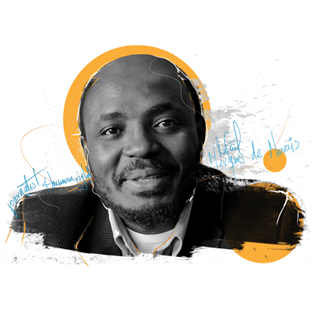 2015 Freedom of Expression Journalism Award-winner Rafael Marques de Morais has exposed government and industry corruption in Angola – speaking out for those whose human rights have been violated in his country.