20 Mar 2018 | Statements
[vc_row][vc_column][vc_column_text]
Index on Censorship believes a recent call to remove Holocaust-denial books from major British retailers by campaign group Hope Not Hate is a threat to freedom of expression.
“Encouraging bookshops not to stock certain content because it’s considered hateful is problematic,” Index CEO Jodie Ginsberg said, “When you’re suggesting removing titles from some of the largest bookshops in the country, which are the ones most people can access, then you are limiting people’s access to information. Anything that limits people’s ability to find out information is a threat to freedom of expression
[/vc_column_text][/vc_column][/vc_row][vc_row][vc_column][vc_custom_heading text=”Don’t lose your voice. Stay informed.” use_theme_fonts=”yes”][vc_separator color=”black”][vc_row_inner][vc_column_inner width=”1/2″][vc_column_text]Index on Censorship is a nonprofit that campaigns for and defends free expression worldwide. We publish work by censored writers and artists, promote debate, and monitor threats to free speech. We believe that everyone should be free to express themselves without fear of harm or persecution – no matter what their views.
Join our mailing list (or follow us on Twitter or Facebook) and we’ll send you our weekly newsletter about our activities defending free speech. We won’t share your personal information with anyone outside Index.[/vc_column_text][/vc_column_inner][vc_column_inner width=”1/2″][gravityform id=”20″ title=”false” description=”false” ajax=”false”][/vc_column_inner][/vc_row_inner][vc_separator color=”black”][/vc_column][/vc_row][vc_row][vc_column][vc_basic_grid post_type=”post” max_items=”12″ style=”load-more” items_per_page=”4″ element_width=”6″ grid_id=”vc_gid:1521711003986-1a22655f-cb95-0″ taxonomies=”6534″][/vc_column][/vc_row]
20 Mar 2018 | Press Releases
Međunarodni institut za medije (IPI) i Europski centar za medijske slobode (ECPMF) objavili su danas novi program potpore prekograničnim projektima istraživačkog novinarstva u zemljama Europske unije vrijedan do 450 tisuća eura.
http://www.ij4eu.net/
Fond “Istraživačko novinarstvo za Europu – #IJ4EU” (Investigative Journalism for Europe) namijenjen je poticanju i jačanju suradnje među novinarima i redakcijama u Europskoj uniji na projektima u javnom interesu i od prekograničnog značaja. Fond ima za cilj podržati istrage koje odražavaju kontrolnu ulogu medija i one projekte koji omogućavaju javnosti da one na vlasti drži odgovornim za svoje postupke i dužnosti na funkcijama koje drže. Na taj način nastoji se pridonijeti održivosti demokracije i vladavine prava u EU.
Fondom će upravljati Međunarodni institut za medije (IPI), globalna mreža urednika, medijskih rukovoditelja i vodećih novinara koja se bavi zaštitom slobode medija još od 1950. godine.
Za potpore u maksimalnom iznosu od 50 tisuća eura se mogu prijaviti prekogranični timovi istraživačkih novinara iz najmanje dvije zemlje članice Europske unije, a koji će sprovesti istraživanje u javnom interesu i od prekograničnog značaja.
Predloženi projekti moraju imati za cilj otkivanje novih informacija. Jednako su poželjni već postojeći istraživački timovi, kao i oni novo oformljeni za potrebe #IJ4EU konkursa. U tijeku, ali nedovršene istrage, također ispunjavanju uvjete konkursa i mogu dobiti podršku iz ovog fonda kako bi istraga bila završena i objavljena u medijima. Posebno se potiču na prijavu timovi novinara ili redakcija koji rade izvan glavnih ili najvećih gradova u zemlji, ili u onim zemljama u kojima je istraživačko novinarstvo posebno izloženo riziku.
Program je namijenjen financiranju svih platformi, uključujući tisak, radio, TV, online medije, produkciju dokumentarnog filma i izvještavanje na kombiniranim platformama (multi-platform story-telling).
Financirani mogu biti samo projekti planirani za objavu (i dostupni u formatu koji se može objaviti) u uglednim medijima ili na platformama u najmanje dvije zemlje EU najkasnije do 31. prosinca 2018. godine.
Rok za prijave je 3. svibanj 2018. što je ujedno i Međunarodni dan slobode medija. Prijave moraju biti dostavljene na engleskom jeziku uz detaljan opis projekta, pojedinosti o istraživačkom timu, plan istraživanja i objavljivanja, budžet i procjenu rizika.
Neovisni žiri će odabrati projekte koji će biti financirani, a sklapanje ugovora o korištenju sredstava sa uspješnim kandidatima planirano je do 15. lipnja 2018.
Za prijave i više informacija o uvjetima natječaja i prijavljivanja te o postupku odabira kandidata, posjetite web stranicu fonda.
“Istraživačko novinarstvo, koje ima ključnu ulogu u bilo kojoj funkcionalnoj demokraciji, pod pritiskom je u cijeloj Europskoj uniji”, izjavila je izvršna direktorica Međunarodnog instituta za medije (IPI), Barbara Trionfi. “Pružanje financijske podrške istraživačkim projektima je način jamčenja da informacije o problemima poput korupcije, financijskog kriminala, zloupotreba ljudskih prava i uništavanja okoliša dospiju do javnosti”.
Ona je također dodala: “Budući da se takva istraživanja danas rijetko ograničavaju na jednu državu, od suštinskog je značaja da novinarske ekipe koje pokrivaju ove teme – rade preko granica. Ponosni smo što će #IJ4EU fond pružiti mogućnost za to”.
For any questions, please contact:
Javier Luque
Head of Digital Media
IPI
Email: [email protected]
Tel.: +43 1 5129011
20 Mar 2018 | Awards, Fellowship 2018, News
[vc_row][vc_column][vc_video link=”https://youtu.be/YgtBa8yoc80″][vc_column_text]Zimbabwean performance artist and activist Silvanos Mudzvova uses theatre to protest against the repressive regime of former president Robert Mugabe and to agitate for greater democracy and LGBT rights. 
“Artists in Zimbabwe have a lot of fear and only artists who support the regime can openly critique freely,” Mudzvova says. “However, I have started a revolution, where so many artists are producing resistance art works. I have managed to employ fellow artists to openly condemn the Mugabe regime leading to the term ‘arts activism’ becoming popular in Zimbabwe.”
Many of Mudzvova’s recent works in Zimbabwe have involved “guerrilla” theatre. He has specialised in performing “hit-and-run” actions in public places to grab the attention of politicians and defy censorship laws which forbid public performances without police clearance.
Mudzvova has been abducted, beaten and arrested for his work. In April 2016, he put on a one-man play outside the country’s parliament. The play, Missing Diamonds, I Need My Share, was inspired by the controversy surrounding Mugabe’s admission that the country lost $15 billion to diamond companies without any legal consequences. Mudzvova was arrested as a result. In September 2016, Mudzvova was abducted from his home, beaten and left for dead for participating in the Tajamuka (We Are Rising Up) protest group.
Mudzova has been vocal about the recent political change in Zimbabwe, stating that the new government should “engage the international community and rebuild relations and above all end corruption and improve the human rights situation. He should work with opposition to create an environment conducive for free and fair elections.”
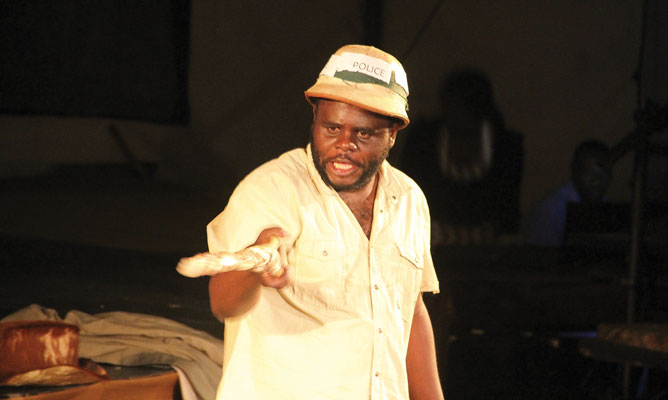
His play In Chains has been replicated in several anti-government demonstrations in Zimbabwe and across the world by Zimbabweans as a creative protest against the regime. And Mudzova himself has continued to use his position as a prominent theatre activist to post videos on his Facebook site BhanditTV.
“The nomination motives me to work extra hard for the removal of censorship laws and it has given exposure to my profile as a human rights defender,” he told Index on Censorship. “This also improves my personal security from the junta government as they now know the world is watching.”
See the full shortlist for Index on Censorship’s Freedom of Expression Awards 2018 here.[/vc_column_text][/vc_column][/vc_row][vc_row full_width=”stretch_row_content” equal_height=”yes” el_class=”text_white” css=”.vc_custom_1490258749071{background-color: #cb3000 !important;}”][vc_column width=”1/2″][vc_custom_heading text=”Support the Index Fellowship.” font_container=”tag:p|font_size:28|text_align:center” use_theme_fonts=”yes” link=”url:https%3A%2F%2Fwww.indexoncensorship.org%2Fsupport-the-freedom-of-expression-awards%2F|||”][vc_column_text]
By donating to the Freedom of Expression Awards you help us support
individuals and groups at the forefront of tackling censorship.
Find out more
[/vc_column_text][/vc_column][vc_column width=”1/2″ css=”.vc_custom_1521479845471{background-image: url(https://www.indexoncensorship.org/wp-content/uploads/2017/05/2017-awards-fellows-1460×490-2_revised.jpg?id=90090) !important;background-position: center !important;background-repeat: no-repeat !important;background-size: cover !important;}”][/vc_column][/vc_row][vc_row][vc_column][vc_basic_grid post_type=”post” max_items=”4″ element_width=”6″ grid_id=”vc_gid:1521542120650-a4167fa1-ebad-5″ taxonomies=”10735″][/vc_column][/vc_row]
20 Mar 2018 | News, Russia
[vc_row][vc_column][vc_single_image image=”98826″ img_size=”full” add_caption=”yes” alignment=”center”][vc_column_text]
This article by Sergey Smirnov, editor-in-chief of MediaZona, was originally published at openDemocracy Russia.
The poisoning of Sergey Skripal has led to a sharp deterioration in UK-Russia relations. For now, London’s official moves, such as deporting 23 Russian diplomats and searching planes inbound from Russia, look moderate. But Boris Johnson’s statement on 16 March was likely unexpected for Moscow. The British foreign minister came to the conclusion that Vladimir Putin sanctioned the attack on Skripal too quickly, though the Kremlin has, for now, merely commented that Johnson’s tone was “unacceptable”.
Immediately after the attack, the British parliament began discussing possible responses to Moscow. One of the first proposals was to stop the Russia Today TV channel, which is financed by the Russian government and is openly involved in propaganda, from broadcasting in the UK. And here it’s important to understand that British MPs have raised an important topic — one that’s painful not just for the Kremlin, but the whole of Russian society, including the opposition.
Banning the Russian propaganda channel in the UK will provoke a predictable reaction in Moscow. And London needs to understand beforehand what will happen (though the Kremlin hasn’t particularly hidden its intentions). First, Maria Zakharova, spokesperson for Russia’s Foreign Ministry, then Margarita Simonyan, head of RT, made it clear: all British media will be banned in response. This will concern first and foremost the BBC. It’s unclear what will happen to the work of other British media in Russia.
The Kremlin brought independent media in Russia under control long ago. If they managed to deal with television by the mid-2000s, then the internet didn’t really attract the attention of the Russian authorities for some time after. But in recent years the pressure has increased: independent media are often brought under control via oligarchs loyal to the Kremlin. For big internet publications, every year it gets harder to work. High-class independent journalists are fired if they choose not to betray their principles. Meanwhile, the authorities aren’t in a rush to pressure foreign media working in Russia.
Here, it’s important to explain the actions of the Russian authorities, which have been and will be demonised quite enough. The issue is that Vladimir Putin and his team don’t have — and have never had — a clearly worked-out programme to destroy democracy, including freedom of speech. As a rule, all their decisions are situative. Russian television was taken under control after Putin was sharply criticised by the oligarchs Boris Berezovsky and Vladimir Gusinsky. The Russian president likes to act in response to any threats.
Take the events of the past six years. In 2011, hundreds of thousands of people, dissatisfied with the prospect of Putin returning to power, came onto the streets of Russian cities. The protest was suppressed, but the Russian authorities were seriously worried. They set themselves the task of makingeverything dependent on them, in order to ensure these scenes would never be repeated. The authorities undertook various actions: from formally liberalising the political sphere to passing repressive laws at the very moment when people stopped protesting.
Once again, it’s important to understand that the Kremlin’s reaction was a response to street protest. Although these laws may have been prepared beforehand, it seems they were thought up on the spot. Take the “Foreign Agents” law as an example — this law banned NGOs which take foreign funds from being involved in “political activity”. As is often the case in Russia, this law didn’t only touch on the work of human rights organisations, but many others, from environmental NGOs to, most recently, a diabetes society.
Why did they pass this law? Because the authorities believed that the 2011-2012 protests were organised from abroad. The mass protest started after election observers found large-scale falsifications at the parliamentary elections. The Golos election monitoring association prepared the observers. Golos received foreign funding. This is how the Kremlin put it together.
A similar situation happened with the Kremlin’s response to Ukraine. Putin was sure that he was simply responding to attempts by the west to take Ukraine further from Moscow’s influence — and, at the same time, breaking Putin’s agreements with Viktor Yanukovych. The 2012 ban on adopting Russian children (the “Dima Yakovlev” law) was also perceived as a response to hostile actions from the west.
Here, I’m trying to explain the Kremlin’s logic, which becomes even clearer in the case of Russia Today in the US. After RT was registered under the Foreign Agent Registration Act in November last year, Moscow started feverishly searching for return measures. The initial suggestions were more reminiscent of North Korea, e.g. banning all independent media, including social networks and even the internet. But then the Kremlin softened its position. All US media, which receive state financing, were declared foreign agents. Other US media have yet to fall under this law’s purview.
For me, there’s two reasons for this. The first, as I wrote above, is that the Kremlin is convinced that it’s defending itself from attacks. It has to respond. The second is that Moscow still leaves itself room for manoeuvre and bargaining. If you ban everything at once, there’s nothing to discuss further — and the Kremlin doesn’t want to end up isolated like North Korea. But the risk of isolation has risen after the Skripal poisoning, and the Russian authorities see this. They won’t make any sudden moves on their own.
This is what western states need to understand about the Kremlin’s behaviour. Currently, there’s no signs that Putin will change his traditional tactics after re-election. The Russian authorities will still monitor the domestic opposition and the actions of the west (and will respond to them). The west needs to understand that the Kremlin’s reaction vis-a-vis freedom of speech and human rights depends on their reaction. Not least of all because the Russian authorities love appealing to the west’s double standards. All actions in connection with RT are seen as the west’s hypocrisy in the field of freedom of speech.
By banning Russian propaganda, the western world helps Putin in his fight against freedom of speech.
[/vc_column_text][/vc_column][/vc_row][vc_row][vc_column][vc_basic_grid post_type=”post” max_items=”4″ element_width=”6″ grid_id=”vc_gid:1521550689819-572c0ade-65d6-1″ taxonomies=”15″][/vc_column][/vc_row]
