This article first appeared in the Spring 2026 issue of Index on Censorship, The monster unleashed: How Hungary’s illliberal vision is seducing the Western world published on 2 April 2026.
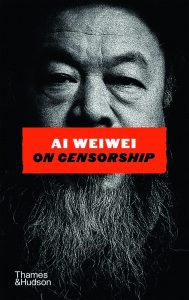
Ai Weiwei’s new book is, in a sense, anything but new. “Censorship, through intimidation and sanction is evident in the history of the Chinese Communist Party,” he writes in Ai Weiwei on Censorship, recently published in the United Kingdom by Thames and Hudson. This frame of reference does more than anthologise, however. History puts the present in context. “For over 70 years, censorship policies have been a core function of the regime and a widely accepted aspect of society. The first to be sanctioned were always those with independent thought or differing political ideologies.”
Index spoke with Ai via email. He was in a Cambridge cafe during his UK book tour in February 2026. The university town is not unfamiliar for Ai; his teenage son goes to school in the city. But over the last decade, Ai has lived a peripatetic existence. He keeps a studio in Berlin but no longer lives there. Cambridge was home for a while. In 2020, at the beginning of the pandemic, Ai moved to Portugal. But he does not call that country, or any other, home. “I do not have a country, nor a homeland, but I don’t need one,” Ai told Index. “I just need to wake up every day and recognise that I am still alive.”
Last August, Ai briefly travelled to Kharkiv, a frontline of the four-year war started by Russia’s invasion of Ukraine. “It was a surreal experience to witness Ukrainians defending their own territory and their national dignity,” he said. “Their commitment is immense.”
In mid-December, Ai visited China for the first time since leaving in 2015. “Meeting up with my ninety-three-year-old mother was a special experience,” he said. “I feel [that] in certain respects China has not changed at all. But it also felt unfamiliar – a sensation I had never experienced before.”
Ai posted a limited number of pictures and videos of the trip – without commentary – on Instagram in real time, though they could not be viewed in China itself. Ai is critical of social media platforms in general. They “engage in active and passive censorship under governmental influence,” he said. Nevertheless, he does use Instagram, “as a diary, to deposit traces of my everyday life,” he explains.
All that said, Ai is concerned about the ubiquitous presence of social media in everyday life. It is gradually turning us passive and docile, he thinks. “Today, trying to maintain independent thought is far more difficult than it was in the past,” he told Index. “Controlled by major powers, large capital, huge corporations, and dominant technology, the internet is serving to extract even greater resources, exploit humanity’s information, guide consumption, and even mislead public opinion to manipulate the populace.”
Artificial intelligence has, over the last few years, become the dominant presence in the global conversation about the reach – and overreach – of technology and commerce into the private lives of citizens. Ai equally distrusts AI. In his opinion, it is already boxing us into a more homogenised global society. He referenced an incident (without specifying the precise details) where someone testing China’s Deepseek AI platform asked it to talk about Ai Weiwei. Deepseek’s response? “Let’s talk about something else.”
“[AI] is commonly described as a liberating productive force, but … systems impose new constraints on traditional ways of human existence, producing a reality that is more unpredictable, chaotic, and disruptive,” Ai said. “Eventually, we are going to lose the poetic aspect of human nature, which includes each individual’s possibility [sic] of making mistakes according to their own habits.”
The symbiotic relationship between big data and censorship is a key theme in Ai’s book. In the country where he grew up, he notes, this relationship has created an inescapable panopticon. “[In] China, censorship operates around the clock, infiltrating every channel of communication. It impacts all forms of personal expression related to the public, whether communicated through publications, art exhibitions or social networks.”
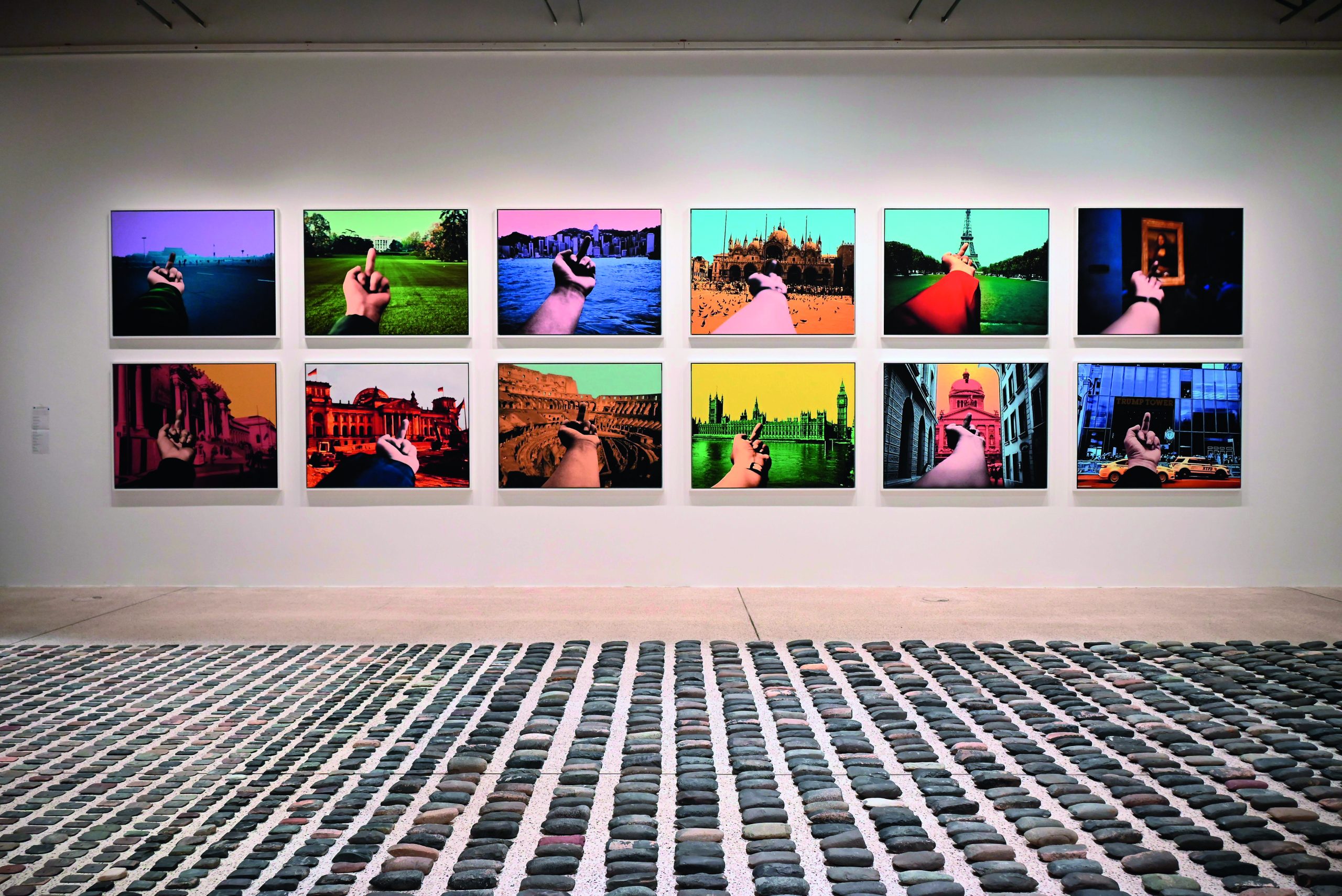
Ai Weiwei’s Study of Perspective is a universal gesture of defiance to the world. Photo: Ercilla/Alam
Running in the family
Ai Weiwei comes from a family of dissenters. His father, Ai Qing, was one of modern China’s most influential poets. A key text of his is Understanding Writers and Respecting Writers, published in 1942.
“Writers ask for no privileges other than the freedom to write,” Ai Qing wrote in the essay. “Only when artistic creation is granted … can art play a role in advancing social reform.”
In the early days of the communist revolution, Mao Zedong sought Ai Qing’s advice about the potential role that culture could play in a communist society. But their views were not compatible. Despite being a voracious reader and lover of poetry, Mao did not believe that writers should be treated with respect or understanding.
Ai Weiwei was born in Beijing in 1957 – the same year that Mao launched the so-called Anti-Rightist Campaign. 300,000 individuals, including many artists and intellectuals, were exiled to China’s remote border regions, to undergo reform and political education. Ai Qing was banished to Heilongjiang Province, in the far northeast.
A decade later, at the onset of the Cultural Revolution, Ai Qing was moved to the desert region of Little Siberia. Daily duties included cleaning toilets. Ai joined his father in political exile. “That experience with my father helped me recognise the worst aspect of human nature: blindness and ignorance,” Ai told Index.
From his father, Ai learned that the artist’s life – despite the difficulties that this would, of necessity, entail – could help in forging a path towards political resistance. In 1981, Ai left China to study in the USA, at the Parsons School of Design in New York. His artistic mentors from that period included the Irish-American artist Sean Scully and Allen Ginsberg, the acclaimed poet. In 1988, Ai put on his first solo art show, Old Shoes, Safe Sex, at New York’s Ethan Cohen Gallery. Five years later, Ai returned to China to be with his father, who had fallen ill. Ai Qing died in 1996, aged 86.
The biographies of father and son have many commonalities. Both received their artistic education in the West (Ai Qing, between 1929 and 1932, in Paris); both were publicly persecuted and silenced for refusing to conform with the China Communist Party’s codes of political censorship. Ai’s difficult relationship with the Chinese authorities began in 2005 when he started a blog in China. “To express yourself needs a reason, but expressing yourself is the reason,” his first post read.
“This is my question: where are those lives?” another blog post, from the summer of 2008, asked. Ai was referring to the estimated 80,000 individuals killed in an earthquake in the southwestern Chinese province of Sichuan. In the wake of the natural disaster, the Chinese government censored and controlled information, so Ai decided to undertake a “citizens’ investigation”. Accompanied by followers from his blog, he travelled to the ruins of the earthquake and began to document the names of those who perished.
“I met many families who lost their children,” said Ai. “I was trying to raise a collective voice in pursuit of fairness and justice, but it felt almost impossible.”
The following summer, as the 20th anniversary of the Tiananmen protests approached, Sina – China’s biggest news portal – shut down Ai’s blog because he refused to self-censor his posts. Ai, remarkably, seems almost blasé when recalling this period of censorship: “In one moment we believe that a certain space for freedom exists, but in another moment that space disappears. This is part of the normal order.”
Under surveillance
In early April 2011, the Chinese authorities detained Ai at Beijing International Airport, as he was about to board a flight for Hong Kong. His interrogators put absurd allegations to him about his conduct, claiming that he was engaged in “economic crimes”, but keeping the details vague.
The politically motivated accusations, Ai told Index, were meant to break my “commitment to truth justice” and “to tarnish my reputation”. He said: “I was secretly detained for 81 days, but I was not subjected to verbal, physical harm or humiliation. The harm I endured was more of a psychological nature.”
The episode gave Ai a valuable insight into how power works within a complex state bureaucracy. “It was not about right or wrong; but [about] the singularity and certainty of power’s inviolability”, he said. “Which makes all the efforts you have made appear pale and powerless in its presence.”
Despite his release without charge, Ai’s passport was confiscated by the state. Then in the autumn of 2015, he discovered a hidden listening device inside his Beijing art studio. The authorities had “assumed I was engaged in secret and disreputable activities,” he said. “I believed they would come to recognise their misjudgement since my actions were entirely open and public.”
Farcically, the authorities asked Ai to return the surveillance device – which he described as resembling an outdated relic “from the Cold War era”. By then, his passport had been returned. He was free to travel. Ai left Beijing for Berlin. The following February, as the refugee crisis sparked by unrest in the Middle East gripped Europe, Ai and a team of artists created a public art installation in Berlin, placing 14,000 unused life vests around the pillars of the Konzerthaus, a landmark concert hall in the German capital.
Not just China
 But censorship exists in the West too. In 2023, Ai’s exhibition at London’s Lisson Gallery was cancelled after Ai posted and then deleted social media posts about the Hamas Israel conflict. Ai was keen to point out that recently, he was asked by Britain’s Royal Academy Magazine to write an opinion piece about artists’ ability (or lack thereof) to speak truth to power. “I submitted the article, and then I was informed that due to a reduction in the magazine’s pages, they could not publish my piece,” Ai explained. “Similar things have happened many times in the UK, where they use gentlemanly British politeness to make the most ruthless decisions.” [see box below]. The Royal Academy Magazine was asked for comment,
Ai mentioned other examples of western censorship. “The global film market is now dominated by China,” he said. “There is a desire not to offend major financial backers, so most of my films are rejected by many major international film festivals.”
Ai’s documentary films include Coronation (2020), which secretly filmed hospitals, homes, and quarantine sites in Wuhan, China – the first city to be hit by the global COVID-19 pandemic – and Human Flow (2017), which provided a detailed and emotional exploration of the global refugee crisis. “Everything is Art. Everything is Politics,” reads a caption in the latter film’s opening sequence. Thirty minutes later, another caption appears on the screen. “When the Berlin Wall fell in 1989, there were 11 countries around the world with border fences and walls,” it reads. “By 2016, 70 countries had built border fences and walls.”
But can artists transcend borders and governments? Ai believes yes. Presently, his art is being showcased in exhibitions in New Delhi, Cambridge and Cologne. Later in the year, Ai will be staging exhibitions in Seattle, Guimarães in Portugal, and Gyeongju in South Korea, aside from a Manchester show in July 2026 called Button up! which reflects on two centuries of Chinese British relations, globalisation and interconnected power structures which cause wars and global crises. At 68, the outspoken and resilient Chinese artist shows no signs of slowing down.
Undoubtedly, being a man without a country must take its toll. But there are some advantages too. “I can imagine going anywhere,” Ai said. “The earth is round, and at any latitude or longitude there is the possibility of survival.” Is this the definition of true freedom, the freedom that Ai Qing wrote about back in the 1940s? Not exactly.
“Humanity’s longing for freedom, and the price it pays in pursuit of freedom, is an enduring endeavour,” Ai concluded. “But freedom is an unattainable goal.”
Ai Weiwei’s book On Censorship was published by Thames and Hudson in January 2026
Truth is at the heart of all art
by Ai Weiwei
For an artist, speaking the truth is not optional; it is the essential quality of art itself. The very existence of art arises from an individual’s particular experience, something that cannot be replaced. Using that experience to express oneself, whether through words or images, is one of the most fundamental ways in which art exists. It is a responsibility, and it is also an obligation. For if art loses its perseverance in truth, its effort to speak true words, then it becomes like a river without water, or a field or mountain without trees – art would lose its very possibility of existing in the world.
Yet in most circumstances, this is not what we see. We encounter many kinds of expression, many forms and languages, but how distant are these forms and languages from art’s essential appeal? We can say that what we usually see is the reiteration of already accepted values, without any expression that offers new possibilities, new sensibilities, or wholly individual feelings. Every artist, like every individual, knows that speaking the truth and insisting on one’s own perspective is dangerous, and may exact a heavy price. Books may go unpublished, exhibitions may be closed, concerts cancelled. We see this every day. Those who refuse to betray their conscience and insist on telling the truth are always the first to be punished. My father, as a poet, endured such punishment throughout his life. He was not an activist nor someone engaged in politics, but rather a poet in the purest sense – someone who would not, in any circumstances, betray his conscience, a man who would speak his mind without calculating gain or loss. He paid dearly for this. He was exiled for 20 years. The year I was born was the year he was exiled. I, too, became collateral, enduring the catastrophic consequences of his truth-telling.
When I was growing up, I did not feel the need to speak the truth because I did not yet know what truth was. But when I reached a certain age, I began to recognise what was false. I detest falsehood to the extreme, because it alters the quality of our lives. It makes us look at our surroundings without confidence. Meanwhile, once we recognise untruth, we no longer dare to look at ourselves. Even so, speaking the truth remains difficult. First of all, language as a form of expression – or art as a form of expression – requires being seen or heard, which is a difficult process in itself. My voice was not heard or seen until I was nearly 50 years old; only then did I find my language and my manner of expression. But this language and manner of expression are not permanent. They are like a plant, and do not have an eternal lifespan. Therefore, as artists, we must continuously challenge and doubt ourselves in our understanding of truth, seeking ways to break through censorship – including self-censorship. In this process of pursuing truth, the path is strewn with thorns and full of obstacles; there is a real risk of falling into the abyss at any moment. Even so, I have paid every price required, and I am proud of that, because I am not doing it for myself but for the world we see with our own eyes, so that it may become clearer, and so that we may express ourselves with greater accuracy. An artist’s being truly exists when there is both self-awareness of the real and self-expression of the real. This “self” does not inherently exist on its own; rather, it emerges when confronted with a certain reality.
Ai Weiwei is a Chinese artist whose exhibitions are held all over the world. This article was originally written for the Royal Academy magazine, but did not appear