2 Aug 2013 | Americas, Brazil, News, Religion and Culture
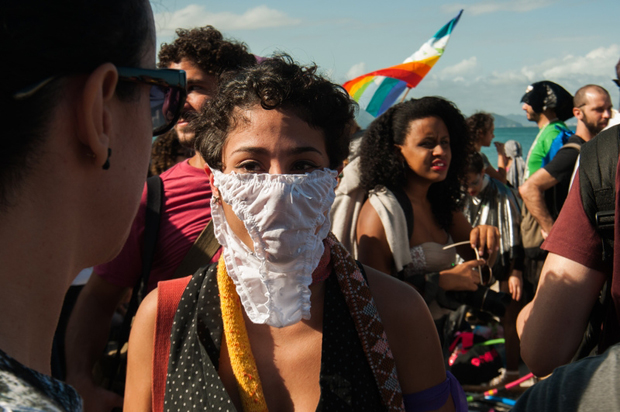
A demonstrator disguises her face during a the “March of the Sluts” in Rio de Janeiro. (Photo: Vito Di Stefano / Demotix)
“If someone is gay, and seeks God’s good will, who am I to judge?”, he told reporters on his flight back to Italy on 28 July.
“The problem is not having this orientation. We should be brothers. The problem is lobbying towards this orientation, or lobbying for jealous people, politicians, masons. This is the worst problem,” Francis said.
Frei Betto, one of Brazil’s most prominent members of Liberation Theology – a leftist religious trend created in South America in the 70’s – hopes that the Pope’s remarks about the gay community can start a new phase of dialogue.
“With Francis, the themes of sexuality could be discussed in the church with greater freedom and integrity,” he said in an interview.
However, Francis could not escape criticism from leaders of Brazil’s gay movements.
“During the debate on equal marriage law in Argentina, (Jorge Mario) Bergoglio acted as an extremist leader. He said the bill was a plot of the devil to destroy God’s plan and called for holy war”, says deputy Jean Wyllys, recalling the attitude of the pontiff back in 2010, when he was archbishop of Buenos Aires.
“Pope Francis is even worse that pastor Feliciano, because he is much more powerful, richer and smarter”, says Bahia’s Gay Group president Luiz Mott, in a reference to federal deputy and pastor Marco Feliciano, president of the Chamber of Deputies’ Human Rights Committee and famous for his homophobic remarks.
“(Francis) began his pontificate with two deeply antigay attitudes: he canonized Pope John Paul II, the biggest homophobe in the 20th century, and signed along with Pope Benedict XVI his first encyclical, which condemns gay families.”
Frei Betto concedes that most Catholics still feel cautious about more controversial issues like gay marriage, but he believes that the pope “opened an important door” to gay people.
“He took the theme out of the closet. He also supported the demonstrations, emphasizing that young people should protest, and criticized the idolatry of power and money.”
The pope spoke about the demonstrations that have broken out in Brazil’s major cities since early June. Addressing cultural and business leaders at Rio de Janeiro’s Municipal Theater, Francis said that constructive dialogue is “essential to face the present,” in a clear mention to the protests.
“Between selfish indifference and violent protest, there is an option whenever possible: dialogue. Dialogue between generations, the dialogue with the people, the ability to give and receive, remaining open to the truth,” Francis said.
Later, speaking to 3 million people on Copacabana beach, he expressly urged people to go on protests, saying that those who want to be “protagonists of change” should “overcome apathy”, though in an orderly way. “Go out the streets!”, Francis exclaimed to the crowd.
However, while the Pontiff spoke, a few hundred protesters gathered in the “March of the Sluts”, walking the boardwalk of Copacabana Beach carrying placards in favor of abortion and women’s and gays’ rights. Some women walked down the street topless, while a group smashed figures of the Virgin Mary.
“The pope supported the demonstrations, but I don’t think he learned about the March of the Sluts, which I consider disrespectful to the Christian faith, by stepping on crucifixes and such”, says Frei Betto.
Theologian Leonardo Boff, another prominent Liberation Theology figure in Brazil, says the Pope’s humbler approach led to a more understanding view of the protesters, by defending young people’s “utopia” and “the right of them to be heard”.
“The biggest legacy is the figure of Pope Francis: a humble servant of faith, deprived of all pomp, touching and letting others touch him, speaking the language of young people and (telling) the truth with sincerity”, he posted on his blog.
Francis had arrived in Brazil on 22 July where he led World Youth Journey, an international Catholic event hosted in Rio de Janeiro. Hundreds of thousands of Catholics from all over the world flocked to Rio in order to have a closer look at the Pope, who assumed a more straight-forward, simpler approach towards followers than his predecessor, Benedict XVI.
14 May 2013 | In the News
ARGENTINA
From the Magazine: The press and the maiden
In Argentina, media organizations take sides: for or against the government. Graciela Mochkofsky tells the story behind the turf war between President Fernández de Kirchner and Grupo Clarín. (Index on Censorship)
CHINA
Hollywood Films Face China’s Strict Censorship
Quentin Tarantino’s “Django Unchained” was re-released in China after censors made changes to the film to meet the country’s strict standards.(Edge on the Net)
GHANA
Former Adentan MP Partly Blames Censorship Board For Recent Crimes
In the wake of the security challenges confronting Ghana, the former Member of Parliament for Adentan constituency, Kojo Adu Asare has questioned the competence of the various censorship boards in the country in the execution of their duties.
(Peace FM)
INDIA
Will social media be a game changer for Indian politics?
Election fever has completely gripped the Indian media. Though general elections are scheduled for 2014, the news cycle regularly carries rumours of early elections every time another corruption scandal breaks. Pundits, analysts and party spokespersons, appearing on television every night, attempt to connect with India’s growing middle classes. And a big topic of conversation: the potential for social media to become a game changer in the next election, Mahima Kaul reports from New Delhi. (Index on Censorship)
TUNISIA
Rights group frets over Tunisian ‘loopholes’
Certain aspects of a draft constitution under review in Tunisia contain “loopholes” that could undermine basic civil liberties, Human Rights Watch said. (UPI.com)
TURKEY
Turkish Court Imposes Media Clampdown on Reyhanli Bombing
A court in the small town decided on a “reporting ban,” applicable nationwide, about this act of terror. (Al Monitor)
UNITED KINGDOM
Nesbitt pushes ahead with free speech law for Ulster
The first draft of a law to strengthen the defence of free speech in Northern Ireland has been written — two months after the News Letter revealed that Stormont had vetoed the Defamation Bill. (Belfast Newsletter)
UNITED STATES
IRS abuses power in targeting tea party
The extraordinary revelation this week that the Internal Revenue Service targeted tea party groups for more aggressive enforcement highlights exactly why caution is needed in any response to the much-vilified Supreme Court decision in Citizens United v. FEC. It also shows how all Americans, from the most liberal to the most conservative, should closely guard their First Amendment rights, and why giving the government too much power to limit political speech will inevitably result in selective enforcement against unpopular groups. (CNN)
Some NFL Players Have Less Margin For Their Free Speech
If Mrs. Burke’s civics class taught us nothing, it’s that the First Amendment to the Constitution gives us unfettered rights to free speech. We can say whatever we want, whenever we want, without fear of consequence or repercussions, right? (WYPR News)
Campaign finance reform cannot include chilling of free speech
I’m going to get slammed by some of my friends for this, but this piece by directors of the ACLU Washington Legislative Office explains why I cannot support Move to Amend. I will not work to amend the constitution to silence free speech by those whose opinions I disagree with. (Milwaukee Journal Sentinel)
Catholic Bishop Suggests ‘Freedom of Speech’ Does Not Allow Religious Disagreements
Katherine O’Connor is an art student at Carnegie Mellon University who allegedly decided to dress as the pope and march in a campus parade — or, at least, dress as the pope from the waist up. Police charged her with public nudity because she allegedly wore nothing at all below the belt. (Think Progress)
ACLU sues Worcester over anti-panhandling laws, citing freedom of speech; city eyes safety
The American Civil Liberties Union on Monday filed a federal lawsuit against the city, claiming that two new anti-panhandling ordinances violate the constitutional right to free speech. (The Republic)
Rush Limbaugh still faces assault on free speech and expression
It is a sad commentary that liberals, progressives, or whatever extremists call themselves, would use their freedom of speech and expression to repress and oppress others rights to free speech and expression. It is pathetic they would abuse their constitutional rights to shut down, shut out, and shut up others. It is a disgrace these people call themselves Americans. (Washington Times Communities
Obama Administration Scraps Free Speech
Two years ago, this column, along with others, raised an alarm about the Obama administration’s decision radically to diminish the due process rights of those accused of sexual harassment on American campuses. (The Patriot Post)
13 May 2013 | Americas
In Argentina, media organizations take sides: for or against the government. Graciela Mochkofsky tells the story behind the turf war between President Fernández de Kirchner and Grupo Clarín.
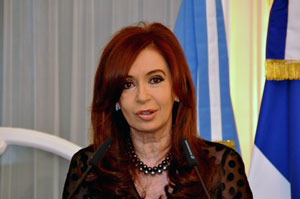
Argentina’s President Cristina Fernández de Kirchner Photo: Demotix
Argentina has an extraordinary number of newspapers, magazines, radio and TV stations. Greater Buenos Aires, the largest urban centre where 13.5 million people live has 18 newspapers, 37 TV channels (five analogue and 32 digital), seven news channels, and 550 AM and FM radio stations. Does this mean that it is a thriving market, with highly educated, enlightened audiences, where the development of the media is directly linked to prosperity?
No. The reason Argentina boasts a huge proliferation of media organisations is strictly political.
(more…)