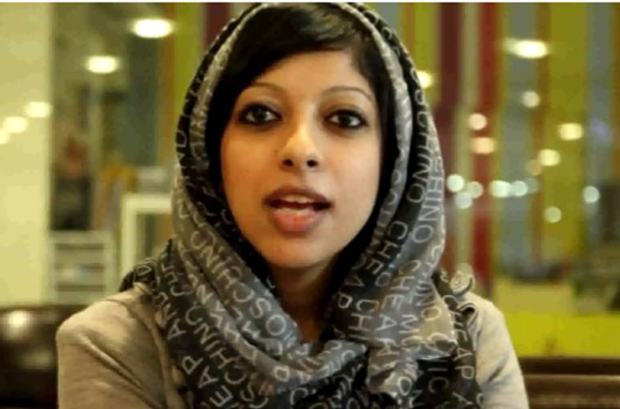
On 7 April 2016, Bahraini foreign minister Sheikh Khaled bin Ahmed al-Khalifa told the US State Department during meetings with Secretary of State John Kerry that activist Zainab Al-Khawaja, who was imprisoned on 14 March along with her one-year-old son Abdulhadi, would be freed.
One month on, we are still waiting for her release.
Index on Censorship has repeatedly expressed concerns over the detention and treatment of Al-Khawaja. After being taken into custody, she was transferred to the Isa Town Detention Center, which has been criticised for its poor sanitation and regular outbreaks of Hepatitis C, to serve out her prison term. She was initially denied food for herself and her son.
In October 2015, Bahrain’s appeals court confirmed her conviction for insulting the king of Bahrain by tearing up a photograph of him and reduced her three-year prison sentence to one year.
“Zainab Al-Khawaja is serving prison term based on charges related to her right to freedom of expression and assembly,” said Index’s senior advocacy officer Melody Patry. “Her imprisonment violates international human rights standards and every day she spends in jail brings into question Bahrain’s commitment to democracy and the rule of law.”
“We call on Bahrain to keep the promise made to the US State Department a month ago to release Zainab Al-Khawaja with no further delay,” Patry added.
The Al-Khawaja family, who have been active in Bahrain’s pro-democracy movement, and have been harassed and targeted by authorities.
Al-Khawaja’s father, Abdulhadi Al-Khawaja, head of the 2012 Index Award-winning Bahrain Center for Human Rights, is serving a life sentence for the role he played in the 2011 demonstrations in Bahrain.
Bahrain must now adhere to its promise and free Zainab Al-Khawaja.
When we read about displaced people in the press, we usually hear about Syrian refugees fleeing IS or the one person per second displaced by natural disasters. We are less likely to be made aware of those who have become stateless through forced displacement.
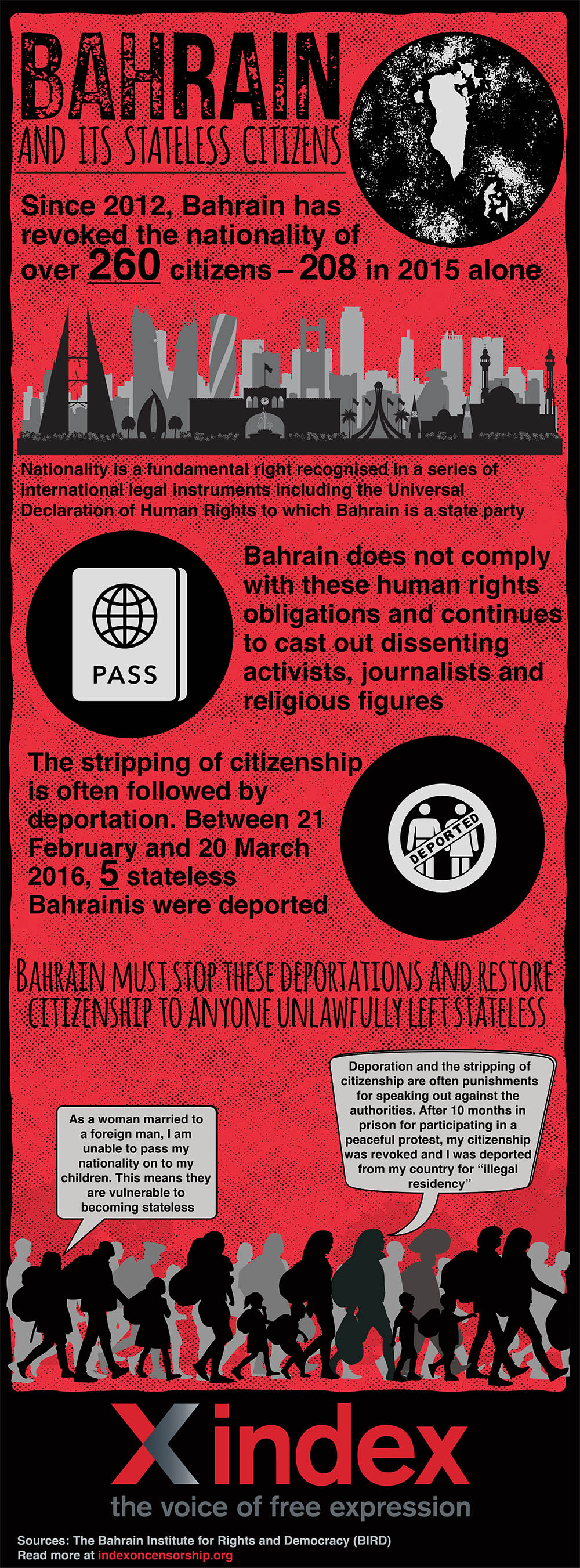
Nationality is something most of us take for granted, but for the 10 million people worldwide who are effectively stateless, the issue is much less trivial.
Nationality is a fundamental right recognised in a series of international legal instruments, including the Universal Declaration of Human Rights and the International Covenant on Civil and Political Rights to which Bahrain is a signatory. The country repeatedly fails to comply with these obligations.
In 2014, new amendments to the country’s 1963 citizenship law further increased the power of the ministry of the interior and gave judges the authority to make anyone convicted under Bahrain’s anti-terrorism act, which fails to properly define terrorism, stateless.
In the case of Sayed Alwadaei, director of advocacy at the Bahraini Institute for Rights and Democracy (BIRD) and 71 others who were deprived of citizenship in January 2015, their “crimes” included vague terms such as “inciting and advocating regime change” to “defaming brotherly countries”.
Speaking to Index on Censorship, Alwadaei said: “Bahrain is setting up a dangerous precedent. No state has rendered as many of its citizens stateless in 2015. These revocations are politically motivated, and are becoming more common because they got away with it in 2012.”
“I was targeted because of my activism, and Bahrain considers human rights advocates as terrorists,” he added. “As I was not inside the country to face imprisonment, my nationality was the only way they could inflict pain on me. It was used as a tool to cause the maximum damage to stop my human rights work.”
While Alwadaei has not let the authorities take his identity, it does mean he is now stateless. “For my family, it means my infant son can’t have Bahraini citizenship, although his mother is also Bahraini.”
The danger for those made stateless inside Bahrain’s borders is that they do not have access to jobs, schools or health care and their bank accounts are closed, Alwadaei explains. “The people revoked of citizenship are at high risk of deportation by the court; many already have been under charges of ‘illegal residency’.”
These instances are also increasing. Between 21 February and 20 March 2016, five stateless Bahrainis were deported. One of these was Hussain Khairallah, whose citizenship had been revoked since 2012. He had been a union organiser and one of the medics who treated wounded protesters during the Bahrain’s Bloody Thursday in February 2011 when security forces launched a pre-dawn raid to clear a protest camp at Pearl Roundabout in Manama.
Hussain Khairallah who I tweeted about has been deported by force by the #Bahrain regime from his country, rendered stateless
Index on Censorship calls for the immediate release of human rights activist Zainab Al-Khawaja, who was arrested on Monday 14 March 2016 with her one-year-old son Abdulhadi.
“Zainab Al-Khawaja is facing retaliation for exercising her right to freedom of expression,” said Index’s senior advocacy officer Melody Patry. “Bahraini authorities have been harassing her and her family for years and this arrest — based on absurd charges — further shows Bahrain’s determination to silence its critics.”
Zainab Al-Khawaja is a prominent human rights activist and is currently facing a prison sentence of three years and one month linked to various court cases against her, including for tearing up a photograph of the king and insulting a police officer.
The conditions of Al-Khawaja’s detention at the Isa Town women’s prison are concerning. There is a risk of contracting Hepatitis C in the section of the prison she and Abdulhadi are being held; and she was told to make sure she doesn’t give her baby any water in the prison that is not bottled. Since her incarceration earlier this week, Al-Khawaja has had muscle spasms in her back due to the stress of the arrest and from carrying her baby and bags. She was taken to the hospital on Thursday 17 March, given an injection and a back brace she has wear at all times, her sister, Maryam Al-Khawaja reported.
The Al-Khawaja family have been heavily involved in Bahrain’s pro-democracy movement, and have been continuously targeted by authorities.
Al-Khawaja’s father, Abdulhadi Al-Khawaja, is the head of the 2012 Index Award-winning Bahrain Center for Human Rights and has been serving a life sentence since 2011 for the role he played in the country’s ongoing protest movement which started that year.
A Bahraini court sentenced Ibrahim Sharif, former secretary-general of the secular, left-wing National Democratic Action Society, on 24 February to a year in prison over a speech made in 2015 calling for change in the kingdom.
Sharif was convicted on a charge of inciting hatred while acquitted on charges of promoting the toppling of Bahrain’s government.
Sharif’s lawyer, Sami Syadi, said he plans to appeal the ruling, and that he believed the time his client had already served would count toward his sentence.
Sharif was first sentenced to five years in prison in 2011. While in prison, he was tortured, held in solitary confinement for 56 days, and wasn’t allowed to contact his family or lawyer. He served four years and three months before being released on a royal pardon on 19 June 2015.
A month after his release, he made a speech in July during the annual commemoration of the killing of 16-year-old Hussam alHaddad by security forces in 2012. In it, he criticised the government for using violence to put down demonstrators, who were engaged in peaceful protests.
“In our case, there is no going back to building a wall of fear,” he said. “The government is only strong when we are cowards and is weak when we are courageous.”
He was subsequently re-arrested for the speech and spent seven months in custody before yesterday’s sentence.
Speaking to Index on Censorship before the ruling, his wife Farida Ghulam said: “Unfortunately, based on the last seven months of trials, it seems that the government is unwilling to entertain the basic right of freedom of speech and that Ebrahim may be sentenced again”
Index on Censorship calls for the immediate release of Ibrahim Sharif. His wife has previously written about the family’s ordeal in Index on Censorship, here and here.