17 Dec 2014 | Magazine, Volume 43.04 Winter 2014
[vc_row][vc_column][vc_custom_heading text=”Packed inside this issue, are; an interview with fantasy writer Neil Gaiman; new cartoons from South America drawn especially for this magazine by Bonil and Rayma; new poetry from Australia; and the first ever English translation of Hanoch Levin’s Diary of a Censor; plus articles from Turkey, South Africa, South Korea, Russia and Ukraine.”][vc_row_inner][vc_column_inner width=”1/2″][vc_column_text]
Also in this issue, authors from around the world including The Observer’s Robert McCrum, Turkish novelist Elif Shafak, and Nobel nominee Rita El Khayat consider which clauses they would draft into a 21st century version of the Magna Carta. This collaboration kicks off a special report Drafting Freedom To Last: The Magna Carta’s Past and Present Influences.
[/vc_column_text][/vc_column_inner][vc_column_inner width=”1/2″][vc_single_image image=”62427″ img_size=”full”][/vc_column_inner][/vc_row_inner][vc_column_text]
Also inside: from Mexico a review of its constitution and its flawed justice system and Turkish novelist Kaya Genç looks at recent intimidation of women writers in Turkey.
[/vc_column_text][/vc_column][/vc_row][vc_row][vc_column][vc_custom_heading text=”SPECIAL REPORT: DRAFTING FREEDOM TO LAST” css=”.vc_custom_1483550985652{margin-right: 0px !important;margin-left: 0px !important;border-bottom-width: 1px !important;padding-top: 15px !important;padding-bottom: 15px !important;border-bottom-color: #455560 !important;border-bottom-style: solid !important;}”][vc_column_text]
The Magna Carta’s past and present influences
1215 and all that – John Crace writes a digested Magna Carta
Stripsearch cartoon – Martin Rowson imagines a shock twist for King John
Battle royal – Mark Fenn on Thailand’s harsh crackdown on critics of the monarchy
Land and freedom? – Ritu Menon writes about Indian women gaining power through property
Give me liberty – Peter Kellner on democracy’s debt to the Magna Carta
Constitutionally challenged – Duncan Tucker reports on Mexico’s struggle with state power
Courting disapproval – Shahira Amin on Egypt’s declining justice as the anniversary of the military takeover approaches
Digging into the power system – Sue Branford reports on the growth of indigenous movements in Ecuador and Bolivia
Critical role – Natasha Joseph on how South African justice deals with witchcraft claims
[/vc_column_text][/vc_column][/vc_row][vc_row][vc_column][vc_custom_heading text=”IN FOCUS” css=”.vc_custom_1481731813613{margin-right: 0px !important;margin-left: 0px !important;border-bottom-width: 1px !important;padding-top: 15px !important;padding-bottom: 15px !important;border-bottom-color: #455560 !important;border-bottom-style: solid !important;}”][vc_column_text]
Brave new war – Andrei Aliaksandrau reports on the information war between Russia and Ukraine
Propaganda war obscures Russian soldiers’ deaths – Helen Womack writes about reports of secret burials
Azeri attack – Rebecca Vincent reports on how writers and artists face prison in Azerbaijan
The political is personal – Arzu Geybullayeva, Azerbaijani journalist, speaks out on the pressures
Really good omens – Martin Rowson interviews fantasy writer Neil Gaiman, listen to our podcast
Police (in)action – Simon Callow argues that authorities should protect staging of controversial plays
Drawing fire – Rayma and Bonil, South American cartoonists’ battle with censorship
Thoughts policed – Max Wind-Cowie writes about a climate where politicians fear to speak their mind
Media under siege or a freer press? – Vicky Baker interviews Argentina’s media defender
Turkey’s “treacherous” women journalists – Kaya Genç writes about dangerous times for female reporters, watch a short video interview
Dark arts – Nargis Tashpulatova talks to three Uzbek artists who speak out on state constraints
Talk is cheap – Steven Borowiec on state control of South Korea’s instant messaging app
Fear of faith – Jemimah Steinfeld looks at a year of persecution for China’s Christians
Time travel to web of the past and future – Mike Godwin’s internet predictions revisited, two decades on
[/vc_column_text][/vc_column][/vc_row][vc_row][vc_column][vc_custom_heading text=”CULTURE” css=”.vc_custom_1481731777861{margin-right: 0px !important;margin-left: 0px !important;border-bottom-width: 1px !important;padding-top: 15px !important;padding-bottom: 15px !important;border-bottom-color: #455560 !important;border-bottom-style: solid !important;}”][vc_column_text]
Language lessons – Chen Xiwo writes about how Chinese authors worldwide must not ignore readers at home
Spirit unleashed – Diane Fahey, poetry inspired by an asylum seeker’s tragedy
Diary unlocked – Hanoch Levin’s short story is translated into English for the first time
Oz on trial – John Kinsella, poems on Australia’s “new era of censorship”
[/vc_column_text][/vc_column][/vc_row][vc_row][vc_column][vc_custom_heading text=”COLUMNS” css=”.vc_custom_1481732124093{margin-right: 0px !important;margin-left: 0px !important;border-bottom-width: 1px !important;padding-top: 15px !important;padding-bottom: 15px !important;border-bottom-color: #455560 !important;border-bottom-style: solid !important;}”][vc_column_text]
Global view – Jodie Ginsberg writes about the power of noise in the fight against censorship
Index around the world – Aimée Hamilton gives an update on Index on Censorship’s work
[/vc_column_text][/vc_column][/vc_row][vc_row][vc_column][vc_custom_heading text=”END NOTE” css=”.vc_custom_1481880278935{margin-right: 0px !important;margin-left: 0px !important;border-bottom-width: 1px !important;padding-top: 15px !important;padding-bottom: 15px !important;border-bottom-color: #455560 !important;border-bottom-style: solid !important;}”][vc_column_text]
Humour on record – Vicky Baker on why parody videos need to be protected
[/vc_column_text][/vc_column][/vc_row][vc_row][vc_column][vc_custom_heading text=”SUBSCRIBE” css=”.vc_custom_1481736449684{margin-right: 0px !important;margin-left: 0px !important;border-bottom-width: 1px !important;padding-bottom: 15px !important;border-bottom-color: #455560 !important;border-bottom-style: solid !important;}”][vc_column_text]Index on Censorship magazine was started in 1972 and remains the only global magazine dedicated to free expression. Past contributors include Samuel Beckett, Gabriel García Marquéz, Nadine Gordimer, Arthur Miller, Salman Rushdie, Margaret Atwood, and many more.[/vc_column_text][vc_row_inner][vc_column_inner width=”1/2″][vc_single_image image=”76572″ img_size=”full”][/vc_column_inner][vc_column_inner width=”1/2″][vc_column_text]In print or online. Order a print edition here or take out a digital subscription via Exact Editions.
Copies are also available at the BFI, the Serpentine Gallery, MagCulture, (London), News from Nowhere (Liverpool), Home (Manchester), Calton Books (Glasgow) and on Amazon. Each magazine sale helps Index on Censorship continue its fight for free expression worldwide.
 SUBSCRIBE NOW[/vc_column_text][/vc_column_inner][/vc_row_inner][/vc_column][/vc_row]
11 Nov 2013 | Americas, News
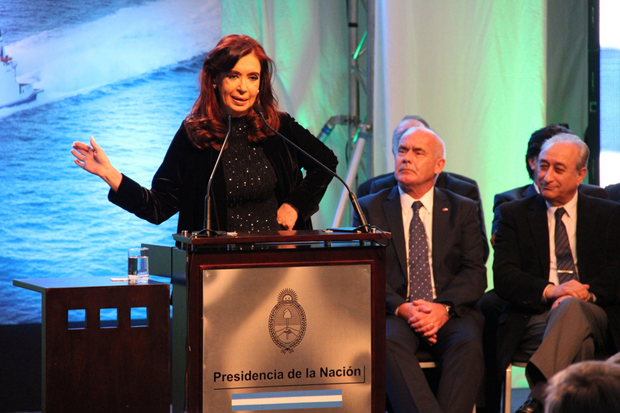
While president Cristina Fernández de Kirchner’s government took a hit during midterm elections, Argentina’s supreme court ruled her restrictions on the country’s media were constitutional. (Photo: Claudio Santisteban / Demotix)
The Argentinian supreme court recently ruled to uphold the country’s controversial media law. The decision represents a big victory for President Cristina Fernández de Kirchner, who argued that the law helps break up the power concentrated in the hands of Argentina’s biggest media conglomerate Grupo Clarín. Opponents, however, says it stifles freedom of expression and press as it would force media companies to sell off some of their outlets. Concerns have also been raised about the law being a way of punishing Clarín, which fell out with the government after negative coverage during tax protests in 2008.
This is only the latest chapter in the ongoing story of the media business in some Latin American countries, with left wing governments and private companies locked in a decade-long fight for control of what will be shown on TV, heard on the radio, printed in newspapers, and posted on websites. New communications laws, persecution of journalists and closure of television networks, however, shows who is really in charge.
Governments like Venezuela and Argentina are waging war against big media companies, while more moderate ones, like Brazil, are using milder means to try and balance the power of communication in their countries. But far from being presented as a straightforward issue of freedom of expression, most of these cases have two opposing and radical interpretations.
On one side, there is the pro-government camp. They believe the governments are democratising the media, which has traditionally been in the hands of the few. In Brazil, for example, eight families control almost 80% of all traditional media companies. The aforementioned Grupo Clarín owns national and regional newspapers, radios, TV channels and more.
Those opposing these measures, however, say they amount to censorship. Again, a good example comes from Argentina: there are some rumours that Kirchner’s administration is trying to suffocate Grupo Clarín by not allowing big chain stores to advertise in their papers. There is also the infamous case of the the closure of Venezuela TV channel RCTVI in 2010.
Both sides talk of freedom of expression, arguing they want to show what is better for the public. But the public – those with the most to benefit from a good and transparent media – are not being allowed to decide for themselves. This is not happening just in Argentina and Venezuela, but across the continent – in Ecuador, Nicaragua and Bolivia, and, albeit in a much gentler way, in Brazil.
Professor Mirta Varela, specialist in history of the media at the University of Buenos Aires, is among those who believe governments are not repressing the big companies or trying to dominate the industry. “The measures taken have shown the political and economic power of the main companies, the spurious origin of their economic growth and their relationship with the dictatorship”, she explains, referencing Grupo Clarín and the military regimes that held power in almost all the Latin American countries from 1960 to 1980. But she also sees some problems with this polarisation: “There is a little room to set a new agenda; to make independent criticism, not overtly for or against the government.”
Cecilia Sanz works for Argentinian TV show “Bajada de línea”, which roughly translates to “Under the Line”. The show is hosted by Uruguayan Victor Hugo Morales, a well-known journalist connected to what Sanz calls “the progressive governments” in Latin America. Here she groups together a number of different left-leaning governments from across the continent – from moderates Lula da Silva and Dilma Rousseff in Brazil, to the more radical Evo Morales in Bolivia and Rafael Correa in Ecuador.
The show comments on the state of the media in Latin America, mainly arguing against the big private companies. “Our main goal is to put in context and show how the media owners have the intention, above all else, to accomplish their economic objectives,” she says. “The are using ‘freedom of expression’ as an excuse for this”. She mentions the case of powerful Mexican TV Azteca, which according to her, supports all the candidates from the hegemonic party PRI, and Chilean paper “El Mercurio”, which used to attack Chilean ex-president Salvador Allende in the 1970s – again putting very different cases in the same group.
The more radical of these “progressive governments” accuse the media industry of trying to destabilise the authorities or to encourage coups d’état. Venezuela’s putsch in 2002 is always mentioned. In this case factions of the media was directly fighting against Hugo Chávez – so Chávez took them off the air.
“This is an insult to the audience because in all of cases it is about the most popular media channels”, counters Claudio Paolillo, president of the freedom of press and expression commission of SIP, Sociedad Interamericana de Prensa (the Inter-American Press Society). “No one has put a gun to the audience’s head to force them to choose what to read, listen or watch, and on what channel.”
Paolillo says the government engages in “Goebbels’ style” propaganda, sustained by public resources, to oppress independent or critic media and journalists. He adds that, ironically, these radical “progressive governments” act like the conservative military regimes of the past. “It is an ideological posture. They want to nationalise communications media as if it was a regular business that offers services or products.”
Paolillo says SIP is against Latin Americas state-controlled monopolies or oligopolies, but reaffirms it is the audience that has the real power to decide what to watch, and where. If they want to watch the same news program, the government shall not interfere. “Unfortunately in Argentina as in Venezuela (and we must add here Ecuador, Nicaragua and Bolivia), governments have created their own media companies, expropriated and bought private ones – in some cases even working through a figurehead”, he complains.
Brazilian political scientist Mauricio Santoro brings up another common problem in the region – organised crime targeting reporters in Mexico and Colombia. But he says this is not a new situation. In his opinion, what is new, is “progressive governments” using the power of the state to control its opponents.
“The alternative proposed by these leftist governments is not based on the construction of an alternative model that privileges pluralism and gives a voice to social and community movements. It is about breaking business groups and giving power to a state press that acts like a government representative and not a public one.”
Worried about the poor quality of the media across Latin America, Santoro suggests the continent needs a more dynamic media, more capable of listening and understanding the true necessities of the people of a region going through “profound change”.
“Looking at the local scene”, he asks, “are we able to find any country where the traditional media meets this expectation?”
Not really.
This article was originally posted on 11 Nov 2013 at indexoncensorship.org
12 Jul 2013 | Digital Freedom
Whatever happens to the NSA whistleblower, the repercussions of his actions will endure
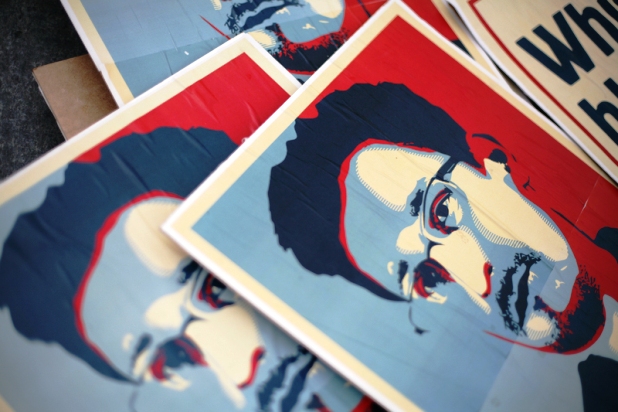
Edward Snowden placards at a protest in Berlin (David von Blohn/Demotix)
This is a guest post by Daniel Keane
Edward Snowden’s leaks have exposed an ideological chasm between the partisans of free information and liberty and the guardians of state security. They have also asked demanding questions of the public at large: when does intelligence gathering become an unwarranted intrusion into private lives? Is the first responsibility of an intelligence agent to the country he serves or to a — self defined — greater good? Can we have a free society without people who do dirty work like spying on our emails?
Public reaction in the polls remains mixed, with a Huffington Post/YouGov’s poll this week finding that 38 per cent of Americans believe Snowden did the wrong thing, while 33 per cent believing the contrary. However a survey released by Quinnipiac showed that 55 per cent of Americans believed Snowden was a whistle blower rather than a traitor.
Snowden also denied in interviews published that he gave any information to the Russian or Chinese governments while in transit there. Allegations of leaking information to these authorities arose from the New York Times, which claimed China had ‘drained the contents of Snowden’s laptops’. Snowden claimed he “never gave any information to either government.”
Snowden also declared in an interview given before he left his home in Hawaii with German newspaper ‘Der Spiegel’ that the NSA is “in bed together with the Germans the same as with most other Western countries” and that the USA and Israel co-wrote Stuxnet, the malicious computer virus utilised against an Iranian nuclear site.
These revelations made by Snowden come as a shock to the public consciousness and this is certainly reflected in the activities of pressure groups in the US and the UK. The Electronic Privacy Information Center, based in Washington DC, has filed an emergency petition to the US Supreme Court in order to halt the NSA’s logging of the nation’s telephone records.
Meanwhile in the UK, human rights group Liberty has filed a claim to the Investigatory Powers Tribunal against the British Intelligence Services for their role in the PRISM or Tempora surveillance programmes. It remains to be seen, however, whether both of these attempts to halt or impair mass surveillance will be successful: the US Supreme Court is unlikely to do away with a programme seen as vital to domestic security, while the IPT makes its decisions in private leaving any reform in Britain largely improbable.
If he reaches asylum, possibly in Nicaragua, Venezuela or Bolivia, Snowden could continue to leak crucial information regarding the NSA. The Obama administration finds itself in a crisis should he evade extradition: the inevitable slew of secrets weakening their international credentials.
Furthermore as Snowden reveals more regarding the collaboration of the US with Western European states, countries like Britain and France face a public dilemma as we learn more about the undermining of our personal liberties. These governments risk being whisked into undesirable public debate regarding the legitimacy of organisations such as GCHQ.
Even if Snowden returned to America to face trial the issue would not disappear. People will want to hear what he will say in court.
Many governments probably wish Edward Snowden was condemned to perpetual Limbo in Sheremetyevo Airport. But whatever happens, the repercussions of his actions are sure to endure for a long time as the debate between liberty and security rages ever on.
4 Jul 2013 | In the News
INDEX MAGAZINE
Index magazine: The Multipolar Challenge to Free Expression
Coming up in the next issue of Index on Censorship magazine, out Monday, is a special report on the shifting world power balance and the implications for freedom of expression.
(Index on Censorship)
BELARUS
Freedom of Expression in 2013: What Would Thomas Jefferson Do?
In 1787, Thomas Jefferson wrote, “Were it left to me to decide whether we should have a government without newspapers, or newspapers without government, I should not hesitate a moment to prefer the latter.”
(German Marshall Fund
BRAZIL
Demonstrators move Brazil’s lethargic politicians to action
Brazil’s mass protests represent a new force in the country’s politics. The wave of demonstrations —sparked by increasing transit fares — have shaken the country’s lethargic leaders, Rafael Spuldar reports
(Index on Censorship)
CHINA
Why China’s Internet Censors Can’t Get Enough of Edward Snowden
These are good days for China. Not so much for the United States — or Sino-American relations.
(World Crunch)
China censorship makes U.S. press freedom shine
Back in the late 1980s a purchaser of the English version of the China Daily, an approved Chinese newspaper, eventually would become baffled. It had a status among some foreigners as a glimpse of daily life among 1.5 billion Chinese citizens. What was amazing about it was the absence of any mention of bad news in its pages. There were no reports of divorces, frauds, robberies, rapes, crashes, murders, executions, the usual grist of some local newspapers in the States. It did, however, contain the recent scores of the Cubs.
(Illinois Times)
EUROPEAN UNION
Index on Censorship calls on the EU to protect whistleblowers’ right to freedom of expression
Following reports that some European countries have prevented a plane carrying the Bolivian President Evo Morales into their airspace, Index on Censorship calls on EU members to honour their commitments to freedom of expression.
(Index on Censorship)
IRELAND
Former Army ranger sues ‘Sunday World’
Seamus Griffin claims newspaper defamed him by suggesting he was involved in illegal purchase of arms and that he trained Seychelles police to become assassins
(Irish Times)
GLOBAL
Defending a free and open internet
In just the last decade, broadband Internet revolutionized every form of communication for 2.5 billion people across the globe. The transition from clunky 20th century technologies like landlines, fax machines and the printing press to mobile computing and e-commerce produced explosive economic growth, new frontiers in health and education and unlimited ways for people to connect, share and express themselves.
(Al Arabiya)
55 Charts That Prove Governments Are Increasingly Censoring Your Internet
Since 2009, Google has been lauded for publishing “transparency reports” on government requests to take information offline. Each time a government official asks for a search result to be blocked or a YouTube video to be removed, Google marks down the request and discloses the number of such takedowns each nation has asked for every six months or so.
(Huffington Post)
UNITED KINGDOM
Stormont must give us a libel law fit for modern age
MLAs will today be told that reform of Northern Ireland’s outdated law is needed or else the province will lose out on investment, writes Mike Harris
(Index on Censorship)
Shepreth village newsletter ‘freedom of speech’ row
A row has broken out over a village newsletter after a council said it wanted to check letters and emails from the public before they were published.
(BBC)
UNITED STATES
WE’RE PROTESTING TO RESTORE THE FOURTH AMENDMENT
“The right of the people to be secure in their persons, houses, papers, and effects, against unreasonable searches and seizures, shall not be violated…” JOIN A PROTEST IN YOUR AREA JULY 4TH
(Restore the Fourth)
McCain Slams Efforts To Curb Rampant Campus Sexual Harassment As Violating Free Speech
Over the past month, conservatives and libertarians have criticized efforts to curb sexual harassment on college campuses as “de-eroticizing universities” and claimed they violate free speech. Now, Sen. John McCain has jumped on the bandwagon in a letter to Attorney General Eric Holder.
(Think Progress)
EU trade talks expected, despite spying allegations
The European Union confirmed Tuesday that free-trade negotiations with the United States would kick off as planned next week, despite widespread concerns about alleged US eavesdropping that targeted EU diplomats.
(Boston Globe)
Previous Free Expression in the News posts
July 3 | July 2 | July 1 | June 28 | June 27 | June 26 | June 25 | June 24 | June 21 | June 20
