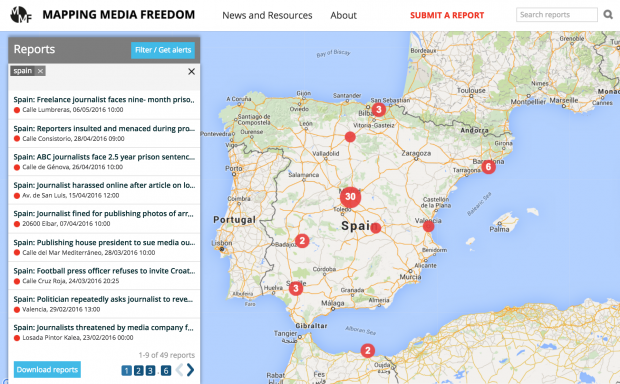
When Axier López, the 37-year-old reporter for the Basque-language magazine Argia, opened the mailbox at his home in Barakaldo early April, he discovered he’d become the first journalist in Spain to be punished under the Public Security Law.
He was ordered to pay €601 (£466) for photos of an arrest he published on Twitter without state permission on 7 March.
“It is a fine similar to a parking ticket,” López told Mapping Media Freedom. “Signed by a local government representative, it claims I committed a crime by putting on-duty police officers in danger.”
The photos in question were taken when López was in the city of Eibar covering the arrest of a woman who had previously refused to appear in court. In 2007 she had participated in a protest against the forced closure of a local youth organisation which the state and court linked to a Basque separatist terrorist group. The woman was accused of blocking a road.
The so-called “gag law” under which López was fined came into force on 1 June 2015. It bans coverage of on-duty police officers without prior police permission and prohibits the publication of any clue as to their identity. The Spanish centre-right government said the purpose of the law is to protect officer security.
“What is the problem if we track and inform the public about events involving police officers?” López asked. “Policemen are paid with public money, so I don’t see a problem if they appear in media content.”
“Almost every day you can see arrests of different people on TV, where police officers appear in front of the camera, but they punished only us,” he added.
Journalists in Spain have recently come under mounting legal pressures related to their work.
The journalists had published their article in July 2014, a year after police investigators intercepted the phone conversation between two mafioso. The general attorney had claimed they revealed details of a secret police investigation.
“Charges, in this case, were really severe,” said Elsa González, president of the Spanish Federation of Journalist Associations (FAPE), the main journalist body in the country. “A journalist has to publish information if it’s in the public interest.”
González added that according to a poll by Madrid’s Association of Journalist (APM), last year only 23.2% of reporters with permanent contracts and 22.2% of freelancers said they never received pressure to modify information in their reports. APM said the pressure could come from multiple angles, including political and corporate powers, public institutions and advertisers.
On 26 April Prisa issued a statement on its website stating that its president had taken legal action against the outlets for “clear defamatory intent” by linking Cebrián to the Panama Papers “in which he categorically does not appear”.
The centre-right daily newspaper El Mundo, a competitor of Prisa’s left-leaning daily El País, then reported that journalists who work for Prisa publishing house were prohibited from engaging with the three media outlets.
Nacho Cardero, director of El Confidencial, told Mapping Media Freedom that Cebrián has yet to take any formal action.
“At the moment there are no actions against any of the three media sources and furthermore, the intention to expel contributors of El Confidencial, La Sexta or Eldiario.es from his group, hasn’t occurred,” said Cardero. “However, Prisa has closed the door to Ignacio Escolar, director of Eldiario.es.”
López believes all these cases serve to spread fear among journalists. Meanwhile, his appeal against his fine has been refused. It could have been reduced to €300 (£232) if he had paid in 15 days. “However, we are not going to pay because we were doing our job,” he said.
“I don’t know where we can go in the legal process,” López added. “But it is important that the debate on this law is open and that we resist in order to prevent possible fear in other journalists.”
Mapping Media Freedom approached Cebrián for comment but received no response.
London, 17 May 2016: The Formula One Group leadership should urge the Azerbaijani government to release unjustly imprisoned activists and journalists ahead of the European Grand Prix in Azerbaijan, said the Sport for Rights coalition today.
Azerbaijan will host its first Formula One European Grand Prix race on 17-19 June 2016 in the capital, Baku. The Azerbaijani government has sought to host a number of high-profile sports and other events in recent years, including the inaugural European Games in 2015, while cracking down on human rights activists and critical journalists, as event organisers stayed silent.
“Formula One leadership has a crucial opportunity to press the Azerbaijani government to make concrete steps to improve its human rights record ahead of the Baku Grand Prix”, said Jane Buchanan, associate director for Europe and Central Asia, at Human Rights Watch. “If it remains silent, Formula One risks condoning the government’s efforts to benefit from the prestige of international events, while silencing domestic critics, without consequences”.
Sport for Rights is a coalition of international human rights groups working to draw attention to the dramatic human rights situation in Azerbaijan. The coalition campaigns for the protection of human rights in Azerbaijan and calls on international sporting organisations to press for better human rights safeguards in countries hosting major sporting events.
In recent years, the government of Azerbaijan has undertaken a systematic crackdown on journalists, media outlets, and independent activists. The authorities have arrested or imprisoned dozens on politically motivated charges, including Azerbaijan’s best-known investigative journalist, Khadija Ismayilova, and opposition politician Ilgar Mammadov. The government has also forced numerous independent groups critical of the government to cease operations.
The Formula One Group has explicitly acknowledged its human rights responsibilities, in a policy that states it is “committed to respecting internationally recognised human rights in its operations globally”.
In a letter to Bernard Ecclestone, Chief Executive of Formula One Group, the groups urge Formula One to speak out publicly against the Azerbaijan government’s crackdown on critics and call for the release of those wrongly imprisoned.
“It’s commendable that Formula One group recognises its human rights responsibilities, but the policy has little meaning unless the leadership insists on respect for fundamental human rights protections in the countries that host the Grand Prix” said Rebecca Vincent, coordinator of the Sport for Rights campaign. “If the Azerbaijani government wants the reputational boost of being a global sporting host, it must also recognise its obligations to allow independent media and activists to speak freely, even if it doesn’t always like the message”.
The Azerbaijani government has taken some positive steps in 2016, including releasing at least 16 activists and journalists imprisoned on politically motivated charges. However, many outstanding, extremely serious concerns remain, and the government continues to harass and detain critics, the Sport for Rights coalition said.
In the letter to Formula One Chief Bernie Ecclestone, the coalition called the Formula One Group to take a number of essential steps, including calling on the Azerbaijani authorities to:
Unconditionally release unjustly imprisoned journalists and activists, including Ismayilova and Mammadov, as well as journalist Seymur Hezi and blogger Ilkin Rustemzade;
Quash the convictions of all recently released activists and journalists and stop additional prosecutions of independent journalists and activists;
Cease unjust interference with the operation of independent organisations;
Ensure journalists attending the Baku Grand Prix can operate without interference while covering a range of topics.
The coalition noted that during the 2015 European Games in Baku, the government prevented numerous leading international journalists from covering the Games, without any penalty or consequences from the Games’ organisers.
“Formula One Group has a chance to support the critical voices remaining in Azerbaijan and ensure the Grand Prix doesn’t repeat the human rights failures of the European Games”, said Emin Huseynov, director of the Institute for Reporters’ Freedom and Safety. “By using its unique position, the Formula One group can ensure that the legacy of the Grand Prix in Azerbaijan is not greater repression”.
For more information, please contact:
For Human Rights Watch, in New York, Jane Buchanan (English, Russian): +1-646-644-4847, or [email protected]. Twitter: @JaneMBuchanan
For Human Rights Watch, in Tbilisi, Giorgi Gogia (English, Georgian, Russian): +995-577-42-12-35 (mobile); or [email protected]. Twitter: @Giorgi_Gogia
For Sport for Rights, in London, Rebecca Vincent (English, Azerbaijani): +44 (0)7583 137751 (mobile); or [email protected]. Twitter: @rebecca_vincent
For the Institute for Reporters’ Freedom and Safety, in Geneva, Emin Huseynov (English, Azerbaijani, Russian): +41 (0) 788788428 (mobile); or [email protected]. Twitter: @EminAzerbaijan
Bernard Ecclestone
Chief Executive
Formula One Group
6 Princes Gate
Knightsbridge
London SW7 1QJ
17 May 2016
Dear Mr Ecclestone,
We, the undersigned members of the Sport for Rights coalition, are writing to you in advance of the Baku European Grand Prix in June to provide details on Azerbaijan’s deeply troubling human rights record and steps that we believe Formula One Group can take to ensure its compliance with its human rights responsibilities.
Sport for Rights is a coalition of international non-governmental organisations working together to promote human rights in Azerbaijan. As Azerbaijan hosts and bids to host international sporting events, with the media spotlight, prestige, and reputational boost that those events can bring to a host country, we are consistently calling on international sporting organisations and others to take meaningful action consistent with their human rights responsibilities as well as use the opportunity of sporting events to press for better human rights protections.
In the run-up to the European Grand Prix in Baku, the Azerbaijani authorities have continued with their human rights crackdown to silence critical voices. We urge you to use the European Grand Prix as an opportunity to speak out against the crackdown and call for the release of jailed journalists and activists.
Formula One Group’s Responsibilities
Formula One Group states that it “is committed to respecting internationally recognised human rights in its operations globally”. The policy also states that Formula One Group will take steps to “understand and monitor through our due diligence processes the potential human rights impacts of our activities”, “identify and assess, by conducting due diligence where appropriate, any actual or potential adverse human rights impacts with which we may be involved”, “consider practical responses to any issues raised as a result of our due diligence”, and “engage in meaningful consultation with relevant stakeholders in relation to any issues raised as a result of our due diligence”. Sport for Rights welcomes this explicit acknowledgement and statement of Formula One Group’s human rights responsibilities.
As you will be aware the United Nations Guiding Principles on Business and Human Rights (Ruggie Principles) and the Organisation for Economic Cooperation and Development (OECD) Guidelines for Multinational Enterprises, issued in 2011 both provide that entities such as Formula One Group bear responsibilities to carry out effective human rights due diligence, to avoid contributing to adverse human rights impacts and to address any that arise.
Grave Human Rights Situation in Azerbaijan
As you may also be aware, in recent years, the government of Azerbaijan has undertaken a dramatic crackdown on journalists, media outlets and civil society leaders and independent organisations. Specifically the authorities have:
Arrested or imprisoned dozens of human rights defenders, journalists, bloggers, youth activists, politicians and others on politically motivated charges, prompting others to flee the country or go into hiding.
Frozen the bank accounts and sealed the offices of NGO leaders targeted in the crackdown, forcing these NGOs to stop operations function.
Launched a spurious, overbroad, two-year criminal investigation implicating foreign donors and dozens of their grantees, forcing the donors to stop their crucial support to independent civil society.
Adopted legislative amendments and regulations on non-governmental organisations that severely and groundlessly interfere with organisations’ ability to operate, including by restricting access to international funding.
Recently, the authorities have taken some positive, but limited steps. In March 2016, the authorities pardoned or conditionally released at least 16 human rights defenders, activists, and journalists imprisoned on politically motivated charges. In April 2016, the government also finally allowed leading activist, Leyla Yunus, and her husband, Arif Yunus, to travel abroad for medical treatment. The Yunuses had earlier been released on suspended sentences from prison, where their fragile health conditions had deteriorated precipitously since their arrests on politically motivated charges in 2014, charges levied in retaliation for their activism.
However, many outstanding, extremely serious concerns remain, and the crackdown on independent voices has not ended.
The criminal records of the recently released activists have not been expunged and some continue to face restrictions, including travel bans and frozen bank accounts. Other prominent activists and journalists arrested on politically motivated charges remain behind bars. They include:
Khadija Ismayilova, Azerbaijan’s best known investigative journalist;
Ilgar Mammadov, opposition REAL movement leader, whose release has been ordered five times by the Council of Europe Committee of Ministers, in order to implement the May 2014 European Court of Human Rights ruling on his case;
Seymur Hezi, journalist with the opposition daily “Azadliq”;
Ilkin Rustemzade, blogger and youth activist
On 30 March 2016, authorities detained 79-year-old writer Akram Aylisli at the Baku airport for 12 hours, questioned him, and prevented him from travelling. Authorities later charged him with violently resisting authorities, and he faces up to three years’ imprisonment if convicted.
On 20 April 2016, the Azerbaijani authorities opened a criminal investigation against Meydan TV, a leading independent online broadcast news outlet, only able to operate out of Germany, with correspondents and other staff based in Azerbaijan. The Azerbaijani prosecutor’s office named 15 journalists in the investigation, at least seven of whom remain in the country under travel bans, and face the threat of politically motivated trials and imprisonment.
In addition, the Azerbaijani government has not committed to amending the restrictive legislation regulating NGOs and NGO funding. In December 2015, the Ministry of Justice adopted new regulations granting the ministry nearly uninhibited powers to conduct inspections at non-governmental organisations.
Role of Formula One Group
In light of this deeply troubling human rights situation, we encourage you to use your prominent role within Formula One racing to guarantee a positive legacy from the European Grand Prix in Baku and ensure that the race is not stained by severe violations of press freedom and human rights.
Specifically, in advance of the opening of the Grand Prix in Baku on 17 June 2016, we urge you to:
Publicly and privately call for the unconditional release of imprisoned journalists and activists, including Khadija Ismayilova, Ilgar Mammadov, Seymur Hezi, Ilkin Rustemzade and others unjustly imprisoned. Such a call would be particularly meaningful from you personally, as the recognised global leader of Formula One racing;
Call on the authorities to quash the convictions of all freed activists, drop the political prosecutions of independent media outlets, organisations, and individuals, unfreeze civil society organisations’ bank accounts, and allow civil society to function without undue legislative or other restrictions on funding or other activities;
Urge the authorities to refrain from repression and any further politically motivated arrests and prosecutions of independent journalists and activists;
Insist that the authorities guarantee that all international and Azerbaijani journalists and bloggers can operate without interference in advance of and during the European Grand Prix in Baku while covering a range of topics. During the 2015 European Games in Baku, the government interfered with the entry of several leading international journalists, including those accredited to cover the games, without penalty or consequences, sending a very troubling signal that such actions are acceptable for hosts of international sporting events.
In addition, we would welcome more information on and strongly encourage Formula One Group to publicly disclose the responsible parties, timeline, terms, specific actions, indicators, and outcomes of its due diligence procedure undertaken in relation to the European Grand Prix in Baku, including information on consultation with stakeholders, in line with the UN Guiding Principles on Business and Human Rights requirements and their call for transparency as an essential element of meaningful due diligence.
Finally, representatives from the Sports for Rights coalition would welcome the opportunity to meet you in the coming weeks to discuss these issues in more detail.
Sincerely,
Rebecca Vincent, Coordinator, Sport for Rights campaign
Katie Morris, Head of Europe and Central Asia Programme, ARTICLE 19
Alice Klein, President, Canadian Journalists for Free Expression
Robert Hårdh, Executive Director, Civil Rights Defenders
Nina Ognianova, Europe and Central Asia Program Coordinator, Committee to Protect
Journalists
Maran Turner, Executive Director, Freedom Now
Mary Lawlor, Executive Director, Front Line Defenders
Danuta Przywara, President of the Board, Helsinki Foundation for Human Rights
Hugh Williamson, Director, Europe and Central Asia Division, Human Rights Watch
Melody Patry, Senior Advocacy Officer, Index on Censorship
Emin Huseynov, Director, Institute for Reporters’ Freedom and Safety
Jesper Højberg, Executive Director, International Media Support
Brigitte Dufour, Director, International Partnership for Human Rights
Petra Havlikova, Project Coordinator of the Women’s Rights Are Human Rights
Programme, NESEHNUTI
Pepijn Gerrits, Executive Director, Netherlands Helsinki Committee
Berit Lindeman, Senior Advisor, Norwegian Helsinki Committee
Karin Karlekar, Director, Free Expression Programs, PEN America
Ann Harrison, Programme Director, Writers in Prison Committee, PEN International
Emma Hughes, Strategy Director, Platform
Ivana Skalova, Head of the East European Program, People in Need
Aleksandra Antonowicz-Cyglicka, Head of Programme, Action for the Global
South, Polish Green Network
Łukasz Biernacki, Managing Director, You Aid Foundation
On social media Thai journalist Pravit Rojanaphruk’s amused disobedience to his military-assigned “attitude adjusters” serves to make them look outdated and slightly ridiculous. But in reality the ex-senior reporter of The Nation has faced a systematic harassment that would silence most others.
Rojanaphruk is an outspoken critic of Thailand’s lèse majesté law, which bans any criticism of the monarchy, and one of the few voices still speaking against the military rule which has presided over Thailand since 2014.
“In Thailand, most people think of the beach, mountain, sand, sea and smiles,” he said to Index. “But the reality is that for those who disagree with the military regime, they are being repressed. They are under a dictatorship and find it still ongoing.”
Humour is a powerful tool for him, as is social media, he says, since it’s a lot harder to silence than traditional media.
“Social media is vibrant, it’s instantaneous and it’s widespread. There is no single centre.”
This is a frightening prospect for a military government trying to retain control, and his popularity on social media has gained Rojanaphruk the repeated attention of the junta.
“People kept retweeting or sharing my Facebook and they find it very disturbing. Particularly the fact that I am doing it bilingually. So they feel that right away it’s not just the Thai but the world would also care about what’s happening in Thailand.”
After his second detention his employer of 23 years, the English-language paper The Nation, quietly asked him to leave his position as senior reporter. Rojanaphruk tweeted his resignation, saying: “Thanks to The Nation for everything. After discussing with management I agreed to resign to save the paper from further pressure.”
But this did not slow Rojanaphruk down. He is now writing for Bangkok-based news siteKhaosod English, and still getting in trouble with his attitude adjusters.
“They forced me to attend a meeting, but they gave me the choice of where. So I chose Starbucks. And I paid for them.”
He tweeted this incongruous meeting, the military junta dressed in cammo, drinking fruit smoothies.
“You don’t run away, you try to fight and do what you can to roll back repression, to roll back the trend against freedom of expression.”
His next self-appointed challenge is to take on the new junta-sponsored draft constitution.
When we spoke to Rojanaphruk, he had just posted three possible responses to the draft on Twitter and Facebook.
“I took three photographs. One with a thumbs up sign in front of the physical draft charter. Second one with a three finger, and the third one the middle finger,” he said.
“So they are very upset about my giving the middle finger.”
For this he would likely face further pressure, he said. But he refused to give in to censorship and to stop questioning the military rule that many others have now let slide.
“The battle is to defend this remaining freedom and as we speak, the physical freedom to assemble in public for any political gathering is already gone. Academic freedoms have been curbed,” he said.
“I think it’s an obligation to do something, to do whatever you can as a journalist to defend freedom of speech, freedom of expression. Not just for the media, for the society in general. And you think you, that by any chance well equipped to do something about it, you should give it a try.”
Mada Masr is an Egyptian online news site formed just before the military coup in July 2013 by 24 friends and journalists. Published in both English and Arabic, the site aims to offer an alternative to newspapers censored by state-owned printing and distribution facilities and media owned by industrial conglomerates. Wanting to represent in practice what Egypt was trying to achieve, Mada aims to be entirely democratic and is owned and run by its original founders and the journalists who write for it.
Editor-in-chief, Lina Attalah is well-known Egyptian media figure and former editor of Egypt Independent, which was shut down in April 2013 by the management of Al-Masry Media Corporation. When the editorial team tried to release a final edition explaining why, it was also pulled just before going to print.Attalah published it anyway,with the promisethat “In keeping with our practice of critical journalism, we use our final issue to reflect on the political and economic challenges facing Egyptian media, including in our own institution.” Many of the founders of Mada Masr are former employees of Egypt Independent.
Since its formation, Mada Masr has seen Egypt go throughthe popular uprising against Islamist President Mohammed Morsi, the military’s overthrow of Morsi and the subsequent violent crackdown on Muslim Brotherhood protesters, and the spread of terrorist violence in the country. Mada’s reporters work in a country with 186 laws restricting freedom of the press and expression.
In November 2015, Mada journalist Hossam Bahgat was summoned by Egypt’s military intelligencedetained for two days, after he wrote a story about the prosecution of about two dozen military officers for allegedly plotting a coup. The arrest was condemned globally, and Bahgat was eventually released, after which Mada published hisstatement describing the detention.
With many investors are politically aligned with the military regime, and those that weren’t facing huge pressure, funding has been a problem for Mada Masr. Valuing its independence above all else, Mada has come up with some innovative fundraising ideas, including, apop-up marketplace launched in April which sells designer clothes and urban crafts.
One of Mada’s new editorial initiatives is to create networks of citizen journalists to bring in more local reporting — and readers — throughout Egypt’s governorates.
“We have established a cooperative media organisation independently, at a time when media are controlled and only made possible through either the state or wealthy businessmen,” said Lina Attalah. “We are experiencing some deal of fear while doing our jobs every day.”
But Mada Masr has not allowed this to guide them towards self-censorship, she says. “With our minds and hearts grappling with being progressive and practical, we build our institution with an ambition to respond to that which we critique in our coverage.”
“I want us, down the line, many, many years to come, to be a reference of what happened.”