“Impunity is a great threat to press freedom in Russia,” said Melody Patry, Index on Censorship’s Senior Advocacy Officer. “Failing to use appropriate measures to investigate the murder of Akhmednabi Akhmednabiyev is not only a denial of justice, it sends the tacit message that you can get away with killing journalists. When perpetrators are not held to account, it encourages further violence towards media professionals.”
Statement
On the 2nd anniversary of the murder of independent Russian journalist, Akhmednabi Akhmednabiyev, we, the undersigned organisations, call for the investigation into his case to be urgently raised to the federal level.
Akhmednabiyev, deputy editor of independent newspaper Novoye Delo, and a reporter for online news portal Caucasian Knot, was shot dead on 9 July 2013 as he left for work in Makhachkala, Dagestan. He had actively reported on human rights violations against Muslims by the police and Russian army.
Two years after his killing, neither the perpetrators nor instigators have been brought to justice. The investigation, led by the local Dagestani Investigative Committee, has been repeatedly suspended for long periods over the last year and half, with little apparent progress being made.
Prior to his murder, Akhmednabiyev was subject to numerous death threats including an assassination attempt in January 2013, the circumstances of which mirrored his eventual murder. Dagestani police wrongly logged the assassination attempt as property damage, and only reclassified it after the journalist’s death, demonstrating a shameful failure to investigate the motive behind the attack and prevent further attacks, despite a request from Akhmednabiyev for protection.
Russia’s failure to address these threats is a breach of the state’s “positive obligation” to protect an individual’s freedom of expression against attacks, as defined by European Court of Human Rights case law (Dink v. Turkey). Furthermore, at a United Nations Human Rights Council (HRC) session in September 2014, member States, including Russia, adopted a resolution (A/HRC/27/L.7) on safety of journalists and ending impunity. States are now required to take a number of measures aimed at ending impunity for violence against journalists, including “ensuring impartial, speedy, thorough, independent and effective investigations, which seek to bring to justice the masterminds behind attacks”.
Russia must act on its human rights commitments and address the lack of progress in Akhmednabiyev’s case by removing it from the hands of local investigators, and prioritising it at a federal level. More needs to be done in order to ensure impartial, independent and effective investigation.
On 2 November 2014, 31 non-governmental organisations from Russia, across Europe as well as international, wrote to Aleksandr Bastrykin calling upon him as the Head of the Investigative Committee of the Russian Federation, to raise Akhmednabiyev’s case from the regional level to the federal level, in order to ensure an impartial, independent and effective investigation. Specifically, the letter requested that he appoint the Office for the investigation of particularly important cases involving crimes against persons and public safety, under the Central Investigative Department of the Russian Federation’s Investigative Committee to continue the investigation.
To date, there has been no official response to this appeal. The Federal Investigative Committee’s public inactivity on this case contradicts a promise made by President Putin in October 2014, to draw investigators’ attention to the cases of murdered journalists in Dagestan.
As well as ensuring impunity for his murder, such inaction sets a terrible precedent for future investigations into attacks on journalists in Russia, and poses a serious threat to freedom of expression.
We urge the Federal Investigation Committee to remedy this situation by expediting Akhmednabiyev’s case to the Federal level as a matter of urgency. This would demonstrate a clear willingness, by the Russian authorities, to investigate this crime in a thorough, impartial and effective manner.
Supported by
ARTICLE 19
Albanian Media Institute
Analytical Center for Interethnic Cooperation and Consultations (Georgia)
Association of Independent Electronic Media (Serbia)
The Barys Zvozskau Belarusian Human Rights House
Belorussian Helsinki Committee
Center for Civil Liberties (Ukraine)
Civil Society and Freedom of Speech Initiative Center for the Caucasus
Crude Accountability
Helsinki Citizens’ Assembly – Vanadzor (Armenia)
Helsinki Committee of Armenia
Helsinki Committee for Human Rights in Serbia
Helsinki Foundation for Human Rights
The Human Rights Center of Azerbaijan
Human Rights House Foundation
Human Rights Monitoring Institute
Human Rights Movement “Bir Duino-Kyrgyzstan”
Index on Censorship
International Partnership for Human Rights
International Press Institute
Kharkiv Regional Foundation -Public Alternative (Ukraine)
Kazakhstan International Bureau for Human Rights and Rule of Law
Moscow Helsinki Group
Norwegian Helsinki Committee
PEN International
Promo LEX Moldova
Public Verdict (Russia)
Reporters without Borders
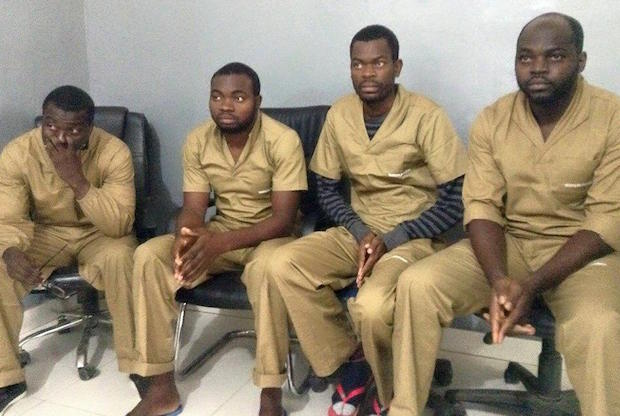
How is it possible that people who cannot manage even the most basic protest, without being violently clamped down and detained, could have the means to organise a coup d’état? This is a pertinent question sent in by a reader of my website, Maka Angola, following the detention of 15 activists in Angola in late June.
The young people had formed a study group. They armed themselves with books on peaceful forms of protest in order better to defend their ideas. This posed an even greater threat to those in power who, according to various analysts, are more afraid of freedom of thought than of guns.
On Wednesday 24 June, the attorney general, Army General João Maria de Sousa, confirmed the detention of 15 youths for allegedly preparing acts of collective disobedience to overthrow the government, and unseat President Dos Santos. “These acts constitute crimes against the security of the state, as a crime of rebellion. As such, the competent bodies of the state must take action to avert the worst,” General João Maria de Sousa told the press.
The group were reading the famous book by US academic Gene Sharp, From Dictatorship to Democracy: A Conceptual Framework for Liberation. The book’s blurb describes it as “a blueprint for nonviolent resistance to repressive regimes.” The youth were reportedly brainstorming peaceful strategies to protest against the rule of Dos Santos.
Maka Angola has decided to find out about these 15 people jailed as “coup plotters”, and has compiled profiles of each one on the site. An extract follows here.
Inocêncio António de Brito “Drux” Age: 28 years Occupation: Student and head of Scout group at a Catholic church
“My son only knows how to manipulate a pen, he does not know how to handle a gun. Will he be able to make a coup with a pen?” wonders Marta Mulay, the mother of Inocêncio de Brito.
She says the arrest of her son “is an injustice. He is innocent of everything that he is accused of. Inocêncio disagrees with the president’s governance. He just simply wants to help to open the minds of the people because the country is in bad shape. As a family, we demand his immediate release”.
In turn, his sister, Marcelina de Brito, told us how he was taken back to his home after being arrested at the meeting. She says the police shoved a black bag over his head so that he could not see where he was being taken. She confirmed that the police seized his computer, telephone and all his books and university notebooks.
Mbanza Hamza
Age: 30
Occupation: Primary school teacher
Since 2011, Mbanza Hamza has been one of the main victims of the brutality inflicted by the police and security forces on the youth movement that has protested against the regime of President dos Santos. In 2012, MPLA-controlled militias broke his skull and collarbone during a raid on a house where youths were meeting to plan a demonstration.
Mbanza lives with his two children in his mother’s house. His mother, Leonor Odete João, has no fear about expressing her disgust at her son’s detention. “My son’s strength is his conscience. The books he reads are what’s scaring the president …The danger here is studying, it’s what my son is learning. He has freedom of conscience and freedom of choice.”
She added: “Since my son was arrested I haven’t been eating, just weeping.”
She condemns the way in which police from the Criminal Investigation Service (SIC) arrived at her house without a warrant for the searches and arrests they carried out. “They took my computer, they took my phone and my younger son’s. They even took my women’s magazines and newspapers that I have kept. They took all the papers they could find.”
José Gomes Hata “Cheik Hata” Age: 29 years Occupation: Hip-hop artist
Cheik Hata is one of the promoters, with Hitler Samusuku, of the hip-hop group Third Division. His lyrics are considered to be revolutionary. The verses are about rebellion – rebellion of the youngsters who feel robbed, oppressed and betrayed – and they speak about the reality of life in Angola, bluntly and without any fear.
“Wake up, let’s do it/Negative thoughts, devilish acts/results in violations, corruption and murder/in general, men possessed without mercy/More percentage to Zé (…)/”, sings the rapper in the music track “Half man, half animal”, from the record Project Does Not Vote.
Domingos da Cruz Age: 31 years Occupation: Professor at the Independent University of Angola
Because of his intellectual role and as the main speaker during debates of new forms of peaceful activism, the authorities consider Domingos da Cruz as one of the “ringleaders” of the alleged coup-plotting. He is the author of the book Tools to Destruct the Dictator and Prevent New Dictatorship: Political Philosophy to the Liberation of Angola. The work has been used as a manual in the young people’s meetings and may be considered an adaptation of the activist model propagated by the US academic Gene Sharp, in his book From Dictatorship to Democracy: A Conceptual Framework for Liberation. This book has been internationally used as an instruction manual for non-violent strategies against dictatorships.
However, the contents of Domingos da Cruz book is not as bombastic as the title suggests. In general, the 184-page work defends non-violent struggle, including civil disobedience, as the best way for Angolans to achieve their freedom and implement true democracy. The author is against the use of violence and insists on safeguarding human lives. On the possibility of a coup, for example, to overthrow the dictatorship, for example, Da Cruz argues that coups represent a setback in the process of change and tend to give rise to a new dictatorship. He does not promote the idea of change based on external support. He is against it.
To pursue Da Cruz, the judicial bodies are clinging to the title of his works.
According to his sister, four police agents, last Sunday 21 June 2015 ransacked Da Cruz’s house, “including the bathroom and water buckets”. They took everything that was written on paper.
The other detainees include: Hitler Jessia Chiconda “Samusuku”, a student and hip-hop artist; Osvaldo Caholo, a lieutenant in the National Air Force and assistant teacher of African history; Nelson Dibango, a computer technician; Albano Evaristo Bingobingo “Albano Liberdade”, a driver; Arante Kivuvu, a student; Manuel Baptista Chivonde Nito Alves, a student; Luaty “Ikonoklasta” Beirão, a rapper; Sedrick de Carvalho, journalist; Fernando Tomás “Nicola Radical”, technician; Nuno Álvaro Dala, university lecturer; and Benedito Jeremias, a student.
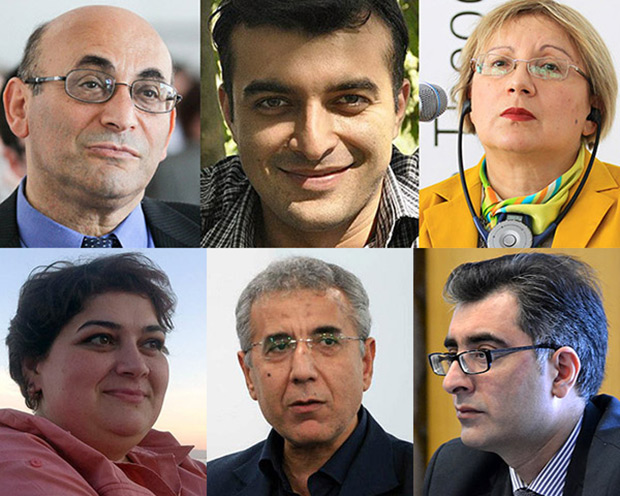
From top left: Arif Yunus, Rasul Jafarov, Leyla Yunus, Khadija Ismayilova, Intigam Aliyev and Anar Mammadli – some of the government critics jailed on trumped up charges in Azerbaijan
On the eve of the inaugural European Games, taking place in Baku, Azerbaijan, activists from Amnesty International and Platform have been banned from entering the country. Both organisations have been highly critical of President Ilham Aliyev’s government, and its continuing targeting, jailing and prosecution of activists and journalists. Amnesty was set to present its findings on the state of human rights in Azerbaijan at an event in the capital on 10 June.
Emma Hughes of London-based NGO Platform was travelling to Baku on Tuesday afternoon with a press accreditation. After landing she was taken off the plane by security for questioning, where she was told she was on a “red list”. Her passport was taken away and she was held overnight at the airport before being deported. CCTV images of Hughes in detention surfaced in Azerbaijani media on Tuesday.
Platform has been campaigning against British oil company BP’s involvement in the oil rich former Soviet state. Platform’s new book — All that Glitters — Sport, BP and Repression — written by Hughes, will be released on 12 June, the opening day of the games.
“I’m being detained on the orders of the BP-Aliyev regime. I may get deported, but over 100 political prisoners in Azerbaijan face years in jail until the oil-funded regime falls. Civil society has been stamped on hard in Baku. Journalists, lawyers, academics, writers and activists have all found themselves behind bars. And yet the Oil Games carry on regardless. The future of this country is imprisoned, yet BP still work hand in hand with this regime,” Hughes said from Baku airport before her deportation.
Amnesty was set to present findings from a research trip they undertook in March at the briefing Azerbaijan: the Repression Games, with four staff members preparing to travel to Baku on the morning of 10 June. Amnesty was informed on Tuesday 9 June, via the Azerbaijani embassy in London, that “Azerbaijan is not in a position to welcome the Amnesty mission to Baku at the present time”, and suggested to postpone the trip until after the games.
Naomi Westland, who works on issues around sports and human rights at Amnesty, was one of the staff members hoping to present in Baku. Speaking from Tiblisi, Georgia, she said everything from visas and plane tickets; to venues, speakers and guests for the briefing had been arranged before the last-minute government U-turn.
“Amnesty being barred proves all the criticism levelled at Azerbaijan has been absolutely right. There has been an intense crackdown on human rights ahead of the European Games. This proves the Azerbaijani authorities want to create a criticism free zone while the world’s media is in attendance. The games are a massive PR exercise to present Azerbaijan as a modern, dynamic, progressive state. Behind the scenes, the reverse is the case. Amnesty has become victims of the repression meted out in Azerbaijan,” Westland told Index.
The banning of Platform and Amnesty comes after a Human Rights Watch researcher, Giorgi Gogia, was denied entry and detained in March at Baku airport for 30 hours, before being deported.
The human rights situation in Azerbaijan has deteriorated in the months leading up to the games. Since last summer, the country’s most prominent critical voices — including investigative journalist Khadija Ismayilova, human rights activists Leyla and Arif Yunus, human rights lawyer Intigam Aliyev and pro-democracy campaigner Rasul Jafarov — have been jailed on charges widely dismissed as trumped up and politically motivated. Critics believe the government of President Ilham Aliyev is using the games as and international image laundering exercise.
Politicians, high-level Olympic officials and athletes have in recent weeks faced mounting pressure to use the games to take a stand on the crackdown. The campaigning group Sports for Rights — initiated by Jafarov before his arrest — has called on European leaders to make their attendance of the games conditioned on the release of political prisoners, while Lord Coe, chairman of the British Olympic Association, has been urged to use the games to show support for fundamental rights and freedoms in Azerbaijan. Council of Europe’s human rights commissioner Nils Muižnieks has encouraged games participants to user their platforms to speak out about human rights situation.
Mr Ilham Aliyev
President of the Republic of Azerbaijan
Azerbaijan Avenue 7
1005 Baku
Republic of Azerbaijan
Fax: +994124923543 and +994124920625
Email: [email protected]
Mr President,
We, the undersigned members and partners of the Human Rights House Network (HRHN) and the South Caucasus Network of Human Rights Defenders, are dismayed by the sentences upheld against human rights defender Rasul Jafarov and against human rights lawyer Intigam Aliyev, two prominent and internationally respected voices of the Azerbaijani civil society. We call upon the Azerbaijani authorities, through you, Mr President, to put an end to the unprecedented repression against civil society.
We call upon you to immediately and unconditionally release all human rights defenders, journalists and activists currently detained, including and especially human rights defenders Leyla and Arif Yunus, Rasul Jafarov, Intigam Aliyev and the journalist Khadija Ismayilova. Anar Mammadli must also be released, as his detention is solely due to his non-governmental organisation’s monitoring of elections in the Azerbaijan.
During the summer and fall of 2014 the main leaders of civil society were arrested. Many others decided to flee the country, rather than facing court hearings, of which the outcome is well known in advance. A few others have been forced into hiding.
On 22 April 2015, the Court for Grave Crimes in Baku sentenced Intigam Aliyev to 7 years and 6 months of detention on bogus charges of illegal business, misappropriation, tax evasion, abuse of office and forgery. Although Intigam Aliyev’s defence brought documentation to the court that all his grants were registered, as of the entry into force of such an obligation for NGOs in Azerbaijan, in violation of basic principles in regard to freedom of association as found by the Council of Europe’s Venice Commission. We denounce the sentencing of Intigam Aliyev and believe the charges brought against him are politically motivated, and a direct consequence of his human rights work .
Intigam Aliyev is one of the most widely-respected human rights lawyers in Azerbaijan and leader of the Legal Education Society, an organization that both promotes awareness of the law and provides legal support to individuals and organizations, The Legal Education Society is a member of the Human Rights House Azerbaijan. Intigam Aliyev is also a lawyer active regionally, including by his participation in the Human Rights House Network’s International Law in Advocacy Programme.
Intigam Aliyev has strived for the legal protection of victims of human rights violations for more than 15 years and has to date represented them in proceedings before the European Court of Human Rights in more than 200 cases (around 40 cases are currently awaiting decision). When he was detained, he was defending more than 140 people in the Court. By detaining Intigam Aliyev the Azerbaijani authorities also deprive their citizens the right to appeal and seek justice before the Court.
In detention, Intigam Aliyev’s health condition has deteriorated and remains inadequately addressed by detention authorities. His conditions prior to his pre-trial detention since 8 August 2014 have continuously gotten worse, giving a strong indication that in fact the medication he is receiving in detention only addresses his pain and not his illness. We believe Intigam Aliyev’s detention conditions might have irremediable consequences on his health.
In the backdrop of an unprecedented repression against civil society in Azerbaijan, charges were also brought against many other human rights defenders, journalists and activists in Azerbaijan, either sentenced or held on pre-trial detention, such as Leyla Yunus, and her husband, Arif Yunus, Anar Mammadli, Rauf Mirkadirov and Hilal Mammadov, Tofiq Yaqublu, Ilgar Mammadov, various NIDA activists, as well as investigative journalist Khadija Ismayilova. Charges are also brought against many human rights NGOs, such as the Institute for Reporters’ Freedom and Safety (IRFS) and human rights defenders either forced into hiding, such as IRFS’s leader Emin Huseynov, or have left the country.
On 16 April 2015, the human rights defender Rasul Jafarov was sentenced to 6.5 years imprisonment, also on similar charges as Intigam Aliyev. The court ignored that out of the many so-called “victims” who were interrogated by the court did in fact have no knowledge of any damage supposedly committed by Rasul Jafarov against them. We also denounce the sentencing of Rasul Jafarov and believe the charges brought against him are politically motivated, due to his human rights work.
Rasul Jafarov is a widely respected human rights defender and advocate on the issue of wrongful imprisonment in Azerbaijan. After forming the Human Rights Club in December 2010. He is the initiator of the human rights and democracy campaign “Sing for Democracy,” as well as “Art for Democracy” and later in preparation of the upcoming European Olympic Games to be held in Baku in June 2015, the campaign “Sport for Rights.”
We call upon the Azerbaijani authorities, through you, Mr President, to put an end to the unprecedented repression against civil society in your country. We specifically call upon you to immediately and unconditionally release all above mentioned civil society actors, and drop all charges
held against them.
Yours sincerely,
Human Rights House Azerbaijan:
• Human Rights Centre of Azerbaijan
• Due to the risk of retaliation against Azerbaijani human rights defenders, we decided not to indicate the names of other Azerbaijani NGOs who would be signing this letter.
Barys Zvozskau Belarusian Human Rights House in exile, Vilnius (on behalf of the following NGOs):
• Belarus Watch (ByWatch)
• Belarusian Association of Journalists
• Belarusian Helsinki Committee
• Belarusian PEN Centre
• City Public Association “Centar Supolnasc”
• Human Rights Centre “Viasna”
Human Rights House Belgrade (on behalf of the following NGOs):
• Lawyers Committee for Human Rights YUCOM
Education Human Rights House Chernihiv (on behalf of the following NGOs):
• Chernihiv Public Committee of Human Rights Protection
• Center of Humnistic Tehnologies “AHALAR”
• Center of Public Education “ALMENDA”
• Human Rights Center “Postup”
• Local Non-governmental Youth organizations М’АRТ
• Transcarpathian Public Center
• Ukrainian Helsinki Human Rights Union
Human Rights House Kyiv (on behalf of the following NGOs):
• Association of Ukrainian Human Rights Monitors on Law Enforcement
• Center for Civil Liberties
• Civil Service
• Human Rights Information Center
• Institute of Mass Information
• International Women’s Rights Center
• Kharkiv Human Rights Protection Group
• Social Action Center
• Ukrainian Helsinki Human Rights Union
• Ukrainian Legal Aid Foundation
Human Rights House Oslo (on behalf of the following NGOs):
• Human Rights House Foundation
• Norwegian Helsinki Committee
Human Rights House Tbilisi (on behalf of the following NGOs):
• Georgian Centre for Psychosocial and Medical Rehabilitation of Torture Victims
Human Rights House Voronezh (on behalf of the following NGOs):
• Charitable Foundation
• Civic Initiatives Development Centre
• Confederation of Free Labor
• For Ecological and Social Justice
• Free University
• Golos
• Interregional Trade Union of Literary Men
• Lawyers for labor rights
• Memorial
• Ms. Olga Gnezdilova
• Soldiers Mothers of Russia
• Voronezh Journalist Club
• Voronezh-Chernozemie
• Youth Human Rights Movement
Human Rights House Zagreb (on behalf of the following NGOs):
• APEO/UPIM Association for Promotion of Equal Opportunities for People with Disabilities
• B.a.B.e.
• CMS – Centre for Peace Studies
• Documenta – Centre for Dealing with the Past
• GOLJP – Civic Committee for Human Rights
• Svitanje – Association for Protection and Promotion of Mental Health
Helsinki Foundation for Human Rights (HFHR), Poland
Index on Censorship, United Kingdom
Public Association for Assistance to Free Economy, Azerbaijan
Resource Centre for Human Rights, Moldova
Copies to:
• Office of the Commissioner for Human Rights of the Council of Europe
• Private Office of the Secretary General of the Council of Europe
• Delegation of the Council of Europe in Azerbaijan
• United Nations Special Rapporteur on the situation of human rights defenders
• United Nations Special Rapporteur on the rights to freedom of association and peaceful assembly
• Office for Democratic Institutions and Human Rights of the Organisation for Security and
Cooperation in Europe (OSCE ODIHR)
• Cabinet of Commissioner Johannes Hahn for European Neighbourhood Policy and Enlargement
Negotiations
• Delegation of the European Union in Azerbaijan
• Subcommittee on Human Rights of the European Parliament
• Diplomatic community in Baku, Brussels, Geneva, New York and Strasbourg
• Various ministries of foreign affairs and parliamentary committees on foreign affairs
About the Human Rights House Network (www.humanrightshouse.org)
The Human Rights House Network (HRHN) unites 90 human rights NGOs joining forces in 18 independent Human Rights Houses in 13 countries in Western Balkans, Eastern Europe and South Caucasus, East and Horn of Africa, and Western Europe. HRHN’s aim is to protect, empower and support human rights organisations locally and unite them in an international network of Human Rights Houses.
The Human Rights House Azerbaijan is one of the members of HRHN and served as an independent meeting place, a resource centre, and a coordinator for human rights organisations in Azerbaijan. In 2010, 6’000 human rights defenders, youth activists, independent journalists, and lawyers, used the facilities of the Human Rights House Azerbaijan, which has become a focal point for promotion and protection of human rights in Azerbaijan. The Human Rights House Azerbaijan ceased all its activities following an order of the Ministry of Justice of the Republic of Azerbaijan on 10 March 2011.