6 Aug 2014 | Academic Freedom, News, United States
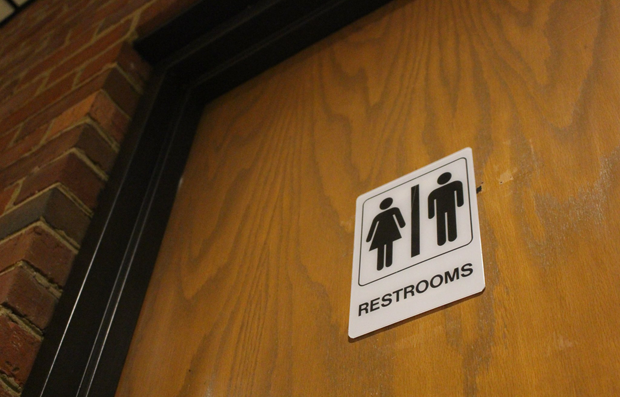
(Photo: Georden West)
A women’s university considered to be one of the most restrictive on transgender issues in the US is reconsidering its approach.
Rated as the strictest of any US university on transgender policies by the Chronicle of Higher Education, Hollins University currently forbids students from making any legal or biological step toward becoming male.
But a university official says the school is considering the addition of gender-neutral bathrooms to make the campus more welcoming and to support its students on the transgender spectrum.
Founded in 1842, Hollins University has attracted many now famous names including writers Annie Dillard and Margaret Wise Brown, US Poet Laureate Natasha Trethewey and White House correspondent Ann Compton.
However, in the past few years its restrictive policy on the retention of transgender students has attracted national attention from activists and academics.
The current policy states that any student who “’self identifies’ as a male and initiates any of the following processes: 1) begins hormone therapy with the intent to transform from female to male, 2) undergoes any surgical process (procedure) to transform from female to male or 3) changes her name legally with the intent of identifying herself as a man,” will not be allowed to graduate from the university. After substantial criticism, Hollins agreed to re-evaluate its policy and drafted a new version in 2013. The current policy also maintains the university’s position against allowing female-to-male students and adds that any student who chooses to undergo sex reassignment “will be helped [by university officials] to transfer to another institution.”
The issue of gender-neutral spaces has become increasingly contentious and polarising with the emergence of a new transgender-equality group on campus called EqualiT*. Its appearance was marked by mysterious flyers in bathroom stalls and on announcement boards calling for the addition of gender-neutral bathrooms. Soon a blog and a Facebook page also appeared, and the group began to stage events, including a candlelight vigil to commemorate Transgender Awareness Day. Due to the sensitive nature of the organisation, the group has remained mainly anonymous in hopes of protecting its transgender members. Some students fear that, if exposed, transgender students will lose their scholarships or be expelled from the university. The university has not taken any action against students who are legally and biologically female, but some students say they self-censor because they are worried about what may happen.
With a student population of less than 600, low retention rates and a high-priced tuition cost of over $46,000 per year, critics question whether the university can afford to alienate any portion of its student demographic.
The forced removal of transgender students from Hollins presents not only financial and academic challenges but a threat to students’ safety. Forty-five per cent of transgender university students in the US reported experiencing verbal, physical or sexual abuse due to their gender identity according to a 2011 study by the National Center for Transgender Equality. Many transgender students attending all-female institutions regard the environment as safe and welcoming and fear for their safety in transferring to a coeducational environment. A study in 2006 revealed that one in twelve transgender people is murdered in the United States, and many more experience severe verbal harassment and physical violence.
“I believe creating gender neutral safe spaces should be at the forefront of the actions Hollins is taking right now,” said Cal Thompson, a transgender student who graduated in the spring of 2014. “Everyone needs a safe space for personal business. We don’t want to use the gendered bathrooms just as badly as the cisgendered don’t want us.”
Despite the relative safety transgender students feel at Hollins, students still find the university a challenging place to explore individual gender identities. Perhaps one of the most substantial of these challenges is in the lack of gender-neutral spaces, specifically bathrooms. Because of the requirement for students to remain female during their time at Hollins, students who identify as transgender are prohibited from using the men’s restroom.
“Using the bathroom at Hollins was uncomfortable,” said Lee Collie, a 2013 graduate, known as Leanna during his time at Hollins. “Even if you flip the sign to ‘male’ when you walk in, girls walked in all the time and said, ‘Oh, it’s just Lee,’ which meant that they didn’t really see me as a male.”
Hollins’ Dean of Students, Patty O’Toole told Index, “As we continue to renovate our facilities, when appropriate we are considering developing gender-neutral bathrooms.” With regards to facilities in residence halls, students in each community can collectively determine facility-usage and associated language, O’Toole said. Bathroom usage in residence halls is indicated by a paper sign for each hall’s bathroom, which can be flipped over to indicate different users. Thus, some facilities may be labelled with “men” and “women,” while others may use “residents” and “guests.” No other official steps have been taken to utilise gender-neutral language.
A number of students disagree with the student organisation’s position, including current student Deborah Birch, class of 2016. “I don’t think that there should gender-neutral bathrooms on campus. You apply to Hollins knowing that it is an all-women’s institution. If want to change your biological make-up to transition from female to male, you should choose to attend another institution.”
Though transgender graduate Lee Collie likes the idea of gender-neutral restrooms, he also worries about respecting the larger campus community, specifically those with opposing ideals. “I would probably limit them to the dorms or specific floors, because we have professors and visitors who may not feel comfortable.”
Hollins is not the only US institution struggling over whether it should create gender-neutral bathrooms. Recently Illinois State University has attracted media attention through its decision to change its family bathroom to an all-gender bathroom. Although the change was not specifically requested by any students or faculty, ISU officials made the change in efforts to remain proactive and to promote inclusivity among all members of campus. Over 150 universities across the United States have instituted similar changes in campus facilities, including New York University, Ohio State University and UCLA. Even fellow women’s universities like Smith College in Massachusetts and Agnes Scott College in Georgia have begun to embrace the issue, with the addition of gender-neutral restrooms and more progressive policies.
Collie, a former vice president of the university’s student government association, stated that the policy at Hollins may be strict, but he is glad that Hollins has a policy and acknowledges the existence of transgender students on campus. Other women’s universities have yet to adopt any policy on the matter.
Dean of Students, Patty O’Toole explained that the 2011 policy was originally created by the university’s Board of Trustees in response to students on the transgender spectrum who were seeking a written policy. “Hollins wanted to support those students. The focus of the policy is not strictness but clarifying our institutional mission.”
Collie supported the university’s actions and its mission as a women’s institution, despite the personal challenges he faced, and related the support and camaraderie he experienced at the university. “Hollins has never punished me for being or identifying as male. It isn’t that they’re trying to stop someone from being who they really are, but it is Hollins standing true to itself as well.”
This article was published on August 6, 2014 at indexoncensorship.org
26 Jun 2014 | About Index, Campaigns, Statements, Ukraine
President Petro Poroshenko
11 Bankova street
01220 Kyiv
Ukraine
26 June 2014
Mr President,
We, the undersigned members and partners of the Human Rights House Network (HRHN), condemned in the strongest terms human rights violations which took place throughout Ukraine since 29 November 2013, and now call upon you to extend the mandate of the International Criminal Court investigations (taking into account events in Crimea and Eastern Ukraine) and to ratify the Rome Statute, in order to encourage such investigations, as an essential part of bringing peace to the country.
We welcome the repeated pledges of Ukrainian authorities to investigate all human rights violations committed since 29 November 2013 and hold those accountable, throughout the country and irrespective of which side the violator belongs to in the ongoing armed conflict in East Ukraine. The current situation of impunity must end.
The International Criminal Court is the only international body able to not only document grave human rights violations, amounting to core international crimes (war crimes, crimes against humanity, or genocide), but also investigate individuals responsible for such crimes. In order to restore peace and strengthen trust into State institutions, those responsible for such human rights violations have to be held accountable. We have for a long time called for a comprehensive reform of the judicial system in the country, which still remains to be initiated. Unfortunately, the national judicial system now shows its limits and in our view it is clear that it does not have the adequate knowledge, independence and resources to investigate all human rights violations since 29 November 2013 throughout the country.
Therefore, it is necessary to activate the international justice system, based on the complementarity principle, to guarantee that investigation into core international crimes committed by all parties in Ukraine, including by members of law enforcement and State agents, is credible and transparent, bringing those responsible to justice.
The Court’s jurisdiction should however not be limited in time, as it is now. On 17 April 2014, the Government of Ukraine indeed lodged a declaration under Article 12(3) of the Rome Statute accepting the jurisdiction of the ICC over crimes committed on its territory from 21 November 2013 to 22 February 2014.[3] We now call upon the Government to issue a declaration extending ICC jurisdiction from 21 November 2013 until the date of the entry into force of the Rome Statute for Ukraine.
We also call upon the authorities in Ukraine to accede to the Rome Statute as soon as possible. By doing this, Ukraine will make an important step to permanently depart from the culture of impunity that is prevailing.
In addition to the investigation into human rights violations, and action taken to end the use of violence in the country, Ukraine needs to undertake a massive reform of its legislation and practice in many fields. Ukraine’s law enforcement agencies have needed radical reform for a long time now: It is not about changing the names of institutions and units or about window-dressing, but about systemic changes, starting from the principles for establishing and structuring enforcement agencies, and ending with approaches to evaluating their performance.
We therefore support Ukraine’s efforts to propose a resolution at the United Nations Human Rights Council’s on-going session, although we deeply regret the draft resolution’s silence about the role of civil society in the country and the need for an investigation by the Court.
In Ukraine, human rights NGOs have proven their strong commitment to the rule of law and the respect of all human rights for all people, as well as their high level of professionalism and excellence. No country can build a sustainable future without full inclusion of civil society in decision-making, especially Ukraine in its present situation. Furthermore, States and leaders in all sectors of society must acknowledge publicly the important and legitimate role of human rights defenders in the promotion of human rights, democracy and rule of law, and avoid stigmatisation, as stated by the Human Rights Council resolution 22/6 of 21 March 2013.
Finally, we also welcome the reference in the draft resolution on Ukraine at the Human Rights Council to the extremely worrying human rights situation in Crimea and join Ukrainian authorities, the United Nations, the Organisation for Security and Cooperation in Europe, and other international voices, in condemning the enforcement of legislation of the Russian Federation on the territory of Crimea, at variance with the United Nations General Assembly resolution 68/262.
The role of civil society is essential in documenting human rights violations in Crimea and providing support to victims of such violations. A field mission has been launched by Ukrainian and Russian human rights defenders in co-operation, with which we expect full cooperation by all governmental agents in Ukraine.
On this background, we call upon you Mr President and the Government, with no further delay, to issue a declaration to extend the jurisdiction of the International Criminal Court from 21 November 2013 until the date of Ukraine’s accession to the Rome Statute either through appeal of the competent body of the Government or by adopting the Draft Law #4081a.
We further call upon you to:
- Take all necessary measures to support the work of human rights NGOs, journalists and bloggers and other media, including by investigating any threats, intimidation, harassment and violence against them, including arbitrary detentions, abductions, attacks and killings;
- Strongly and publicly acknowledge the important and legitimate role of human rights defenders in the promotion of human rights, democracy and the rule of law as an essential component of ensuring their protection; In line with United Nations Human Rights Council resolution 22/6 of 21 March 2013, paragraph 5
- Ensure that the reform process in the country, as well as all dialogue about the future of the country, is inclusive and transparent, giving space to civil society.
Sincerely,
Human Rights House Kyiv (on behalf of the following NGOs):
- Association of Ukrainian Human Rights Monitors on Law Enforcement (Association UMDPL)
- Centre for Civil Liberties
- Human Rights Information Center
- Institute of Mass Information
- Kharkiv Human Rights Protection Group
- La Strada Ukraine
- NGO “For Professional Journalism” – Svidomo
- Ukrainian Helsinki Human Rights Union
Education Human Rights House Chernihiv (on behalf of the following NGOs):
- Chernihiv Public Committee of Human Rights Protection
- Center of Humnistic Tehnologies “AHALAR”
- Center of Public Education “ALMENDA”
- Human Rights Center “Postup”
- Local Non-governmental Youth organizations М’АRТ
- Transcarpathian Public Center
- Ukrainian Helsinki Human Rights Union
Azerbaijan Human Rights House (on behalf of the following NGOs):
- Association for Protection of Women’s Rights – APWR
- Azerbaijan Human Rights Centre (AHRC)
- Institute for Peace and Democracy
- Human Rights Centre
- Legal Education Society
- Legal Protection and Awareness Society
- Media Rights Institute
- Public Union of Democracy Human Rights Resource Centre
- Women’s Association for Rational Development (WARD)
Barys Zvozskau Belarusian Human Rights House in exile, Vilnius
- Belarusian Association of Journalists
- Belarusian PEN Centre
- Belarusian Helsinki Committee
Human Rights House Belgrade (on behalf of the following NGOs):
- Belgrade Centre for Human Rights
- Helsinki Committee for Human Rights, Serbia
- Human Rights House Belgrade and Lawyers’ Committee for Human Rights –YUCOM
Human Rights House London (on behalf of the following NGOs):
- Index on Censorship
- Vivarta
Human Rights House Tbilisi (on behalf of the following NGOs):
- Article 42 of the Constitution
- Caucasian Centre for Human Rights and Conflict Studies (CAUCASIA)
- Georgian Centre for Psychosocial and Medical Rehabilitation of Torture Victims
- Media Institute
- Human Rights Center
- Union Sapari – Family Without Violence
Human Rights House Oslo (on behalf of the following NGOs):
- Human Rights House Foundation
- Norwegian Helsinki Committee
- Health and Human Rights Info
Human Rights House Voronezh (on behalf of the following NGOs):
- Civic Initiatives Development Centre
- Confederation of Free Labor
- For Ecological and Social Justice
- Free University
- Golos
- Interregional Trade Union of Literary Men
- Lawyers for labor rights
- Memorial
- Ms. Olga Gnezdilova
- Soldiers Mothers of Russia
- Voronezh Journalist Club
- Roronezh – Chernozemie
- Youth Human Rights Movement
Human Rights House Yerevan (on behalf of the following NGOs):
- Helsinki Citizens’ Assembly – Vanadzor
- Journalists’s Club Asparez
- Public Information and Need of Knowledge – PINK
Human Rights House Zagreb (on behalf of the following NGOs):
- APEO / UPIM Association for Promotion of Equal Opportunities for People with Disabilities
- B.a.B.e.
- CMS – Centre for Peace Studies
- Documenta – Centre for Dealing with the Past
- GOLJP – Civic Committee for Human Rights
- Svitanje – Association for Protection and Promotion of Mental Health
The Rafto House in Bergen – Norway (on behalf of the following NGOs):
The House of the Helsinki Foundation For Human Rights – Poland (on behalf of the following NGOs):
- Helsinki Foundation for Human Rights, Poland
Copies have been sent to:
- Mr Oleksandr Turchynov, Chairman of Verkhovna Rada
- Office of the Commissioner for Human Rights of the Council of Europe
- Private Office of the Secretary General of the Council of Europe
- Chairman of the Organisation for Security and Cooperation in Europe (OSCE)
- OSCE Special Monitoring Mission to Ukraine
- OSCE’s Office for Democratic Institutions and Human Rights
- United Nations Human Rights Monitoring Mission in Ukraine
- Delegation of the European Union in Ukraine
- Subcommittee on Human Rights of the European Parliament
- Diplomatic community in Kyiv, Brussels, Geneva and Strasbourg
- Various ministries of foreign affairs and parliamentary committees on foreign affairs
About the Human Rights House Network (www.humanrightshouse.org)
The Human Rights House Network (HRHN) unites 87 human rights NGOs joining forces in 18 independent Human Rights Houses in 13 countries in Western Balkans, Eastern Europe and South Caucasus, East and Horn of Africa, and Western Europe. HRHN’s mandate is to protect, empower and support human rights organisations locally and unite them in an international network of Human Rights Houses.
The Human Rights House Kyiv and the Education Human Rights House Chernihiv are members of HRHN. 10 independent Ukrainian human rights NGOs are members of both Human Rights Houses.
The Human Rights House Foundation (HRHF), based in Oslo (Norway) with an office in Geneva (Switzerland), is HRHN’s secretariat. HRHF is international partner of the South Caucasus Network of Human Rights Defenders and the emerging Balkan Network of Human Rights Defenders.
HRHF has consultative status with the United Nations and HRHN has participatory status with the Council of Europe.
30 Apr 2014 | About Index, Azerbaijan Letters, Campaigns, Statements
Minister Usubov Ramil Idris oglu
Minister of Internal Affairs of the Republic of Azerbaijan
Azerbaijan Avenue 7
1005 Baku
Republic of Azerbaijan
Email: [email protected]
Prosecutor General Zakir Bakir oglu Garalov
Nigar Rafibayli street 7
1001 Baku
Republic of Azerbaijan
Email: [email protected]
Mr Minister, Mr Prosecutor General,
We, the undersigned members and partners of the Human Rights House Network (HRHN) and the South Caucasus Network of Human Rights Defenders, express our deep concern over the persecution and hindrance of free movement of human rights defender Leyla Yunus and her husband Arif Yunus. We call upon you to put an end to the attacks, detention and harassment of human rights defenders and to take steps in order to foster a safe environment for human rights defenders, in line with Azerbaijan’s international obligations and commitments, including as a member of the Council of Europe.
On 28 April 2014 Leyla Yunus and her husband, the historian Arif Yunus, were prevented from leaving the country at Baku’s airport. She then was detained and interrogated by the police regarding the case of the arrested journalist Rauf Mirkadirov and questioned about the relation between the journalist and the Institute for Peace and Democracy. She was released only in the after-noon on 29 April 2014. Searches were conducted in the office of the Institute for Peace and Democracy, and continued in the private home of Leyla Yunus until the night of 29 April 2014. According to Leila Yunus, she was humiliated during the search by the officers. The official grounds on which Leyla Yunus and Arif Yunus were prevented from leaving the country and detained are unclear, as well as the grounds on which the searches are being carried out.
Leader of the Institute for Peace and Democracy, Leyla Yunus is a well-known Azerbaijani human rights defender. Her NGO is a member of the South Caucasus Network of Human Rights Defenders and has from the very start in 1995 worked on the issue to release political prisoners and to establish rule of law in Azerbaijan. Leyla Yunus has within several projects worked to establish dialogue between civil society actors in the South Caucasus. She is a Chevalier of the National Order of the Legion of Honour, as a tribute for her longstanding work promoting human rights.
We are worried that the persecution is related to her outspoken criticism in the past few days against the detention of Rauf Mirgadirov, the investigative journalist of the leading Russian-language newspaper Zerkalo (Mirror), who is now facing charges of treason for his efforts in the peace building process of the Nagorno-Karabakh conflict. Rauf Mirkadirov participated in the numerous joint projects between the Institute for Peace and Democracy and Armenian NGOs.
Under Azerbaijan’s commitments within the Organisation for Security and Cooperation’s Misnk Group, we strongly believe that public diplomacy and cooperation between civil society in the South Caucasus contributes to efforts aiming at finding a peaceful solution to the Nagorno-Karabakh conflict.
As the Commissioner for Human Rights of the Council of Europe Nils Muižnieks stated on his Facebook page, “this is an additional example showing the extent of intimidation and repression of critical voices in Azerbaijan, a problem which I have repeatedly highlighted […] and asked the Azerbaijani authorities to address.”[1]Azerbaijan should indeed guarantee the right to freedom of expression of all human rights defenders and critical voices, in line with its obligations as a member of the Council of Europe.
Furthermore, authorities should prevent the use of unreliable evidence and unwarranted investigations against human rights defenders, as laid out in the United Nations Human Rights Council resolution 22/6 of 21 March 2013.
We are extremely worried to see that human rights defenders, including journalists and bloggers, are persecuted, attacked and detained due to their work. In addition to Leyla Yunus, the Chairperson of the Election Monitoring and Democracy Studies Centre (EMDS) Anar Mammadli, the Executive Director of EMDS Bashir Suleymanli and Elnur Mammadov, president of the Volunteers of International Cooperation, are facing court trials[2].
Ahead of the Chairmanship of the Council of Europe by the Republic of Azerbaijan, we call upon you to put an end to the crackdown of the civil society and to take steps in order to foster a safe environment for human rights defenders.
We further call upon you to report to the Council of Europe on your plans to investigate the acts of the State agents, which prevented Leyla Yunus and Arif Yunus from leaving the country and later detained them and to end all persecutions against them and other human rights defenders.
Sincerely,
Human Rights House Azerbaijan (on behalf of the following NGOs):
- Azerbaijan Lawyers Association
- Institute for Reporters’ Safety and Freedom
- Legal Education Society
- Media Rights Institute
- Women Association for Rational Development
Belarusian Human Rights House in exile, Vilnius (on behalf of the following NGOs):
- Belarusian PEN Centre
- Belarus Watch
- City Public Association “Centar Supolnaść”
- Human Rights Centre “Viasna”
Human Rights House Belgrade (on behalf of the following NGOs):
- Belgrade Centre for Human Rights
- Lawyers Committee for Human Rights YUCOM
- Civic Initiatives
- Helsinki Committee for Human Rights in Serbia
- Policy Centre
Human Rights House Kiev (on behalf of the following NGOs):
- Association of Ukrainian Human Rights Monitors on Law-Enforcement
- Human Rights Information Centre
- Center for Civil Liberties
- Kharkiv Human Rights Protection Group
Free Word Centre London (on behalf of the following NGOs):
- Index on Censorship
- Vivarta
Human Rights House Sarajevo (on behalf of the following NGOs):
- Helsinki Committee for human Rights in Bosnia and Herzegovina
Human Rights House Tbilisi (on behalf of the following NGOs):
- Georgian Centre for Psychosocial and Medical Rehabilitation of Torture Victims – GCRT
- Caucasian Center for Human Rights and Conflict Studies
- Human Rights Centre
- Union Sapari
- Article 42 of the Constitution
- Media Institute
Human Rights House Oslo (on behalf of the following NGOs):
- Health and Human Rights Info
- Human Rights House Foundation
- FIAN Norway
Human Rights House Voronezh (on behalf of the following NGOs):
- Charitable Foundation
- Civic Initiatives Development Centre
- Confederation of Free Labor
- For Ecological and Social Justice
- Free University
- Golos
- Interregional Trade Union of Literary Men
- Lawyers for labor rights
- Memorial
- Ms. Olga Gnezdilova
- Soldiers Mothers of Russia
- Voronezh Journalist Club
- Voronezh-Chernozemie
- Youth Human Rights Movement
Human Rights House Yerevan (on behalf of the following NGOs):
- Armenian Helsinki Association
- Helsinki Citizens’ Assembly-Vanadzor
- Journalists’ Club “Asparez”
- Democracy Today
Human Rights House Zagreb (on behalf of the following NGOs):
- APEO/UPIM Association for Promotion of Equal Opportunities for People with Disabilities
- B.a.B.e.
- CMS – Centre for Peace Studies
- Documenta – Centre for Dealing with the Past
- GOLJP – Civic Committee for Human Rights
- Svitanje – Association for Protection and Promotion of Mental Health
Rafto Foundation, Norway
Helsinki Foundation for Human Rights, Poland
Public Union of Democracy Human Rights Resource Centre, Azerbaijan
Legal Protection and Awareness Society, Azerbaijan
Copies have been sent to:
- Ministry of Justice of the Republic of Azerbaijan
- Presidency of the French Republic
- Ministry of Foreign Affairs of the French Republic
- Office of the Commissioner for Human Rights of the Council of Europe
- Private Office of the Secretary General of the Council of Europe
- Chairman of the Committee of Ministers of the Council of Europe
- Delegation of the Council of Europe in Azerbaijan
- UN Special Rapporteur on human rights defenders
- Office for Democratic Institutions and Human Rights of the Organisation for Security and Cooperation in Europe (OSCE ODIHR)
- Delegation of the European Union in Azerbaijan
- Subcommittee on Human Rights of the European Parliament
- Diplomatic community in Baku, Brussels, Geneva and Strasbourg
- Various ministries of foreign affairs and parliamentary committees on foreign affairs
About the Human Rights House Network (www.humanrightshouse.org)
The Human Rights House Network (HRHN) unites 90 human rights NGOs joining forces in 18 independent Human Rights Houses in 13 countries in Western Balkans, Eastern Europe and South Caucasus, East and Horn of Africa, and Western Europe. HRHN’s aim is to protect, empower and support human rights organisations locally and unite them in an international network of Human Rights Houses.
The Human Rights House Azerbaijan is one of the members of HRHN and served as an independent meeting place, a resource centre, and a coordinator for human rights organisations in Azerbaijan. In 2010, 6’000 human rights defenders, youth activists, independent journalists, and lawyers, used the facilities of the Human Rights House Azerbaijan, which has become a focal point for promotion and protection of human rights in Azerbaijan. The Human Rights House Azerbaijan has been closed after the Ministry of Justice of the Republic of Azerbaijan ordered all activities to be been ceased on 10 March 2011.
The Human Rights House Foundation (HRHF), based in Oslo (Norway) with an office in Geneva (Switzerland), is HRHN’s secretariat. HRHF is international partner of the South Caucasus Network of Human Rights Defenders and the Balkan Network of Human Rights Defenders.
HRHF has consultative status with the United Nations and HRHN has participatory status with the Council of Europe.
[1]Statement available at https://www.facebook.com/HumanRightsHouseNetwork/posts/10152035306640965.
[2]Further information on those cases available at http://humanrightshouse.org/Articles/20033.html.
16 Apr 2014 | Greece, News, Politics and Society
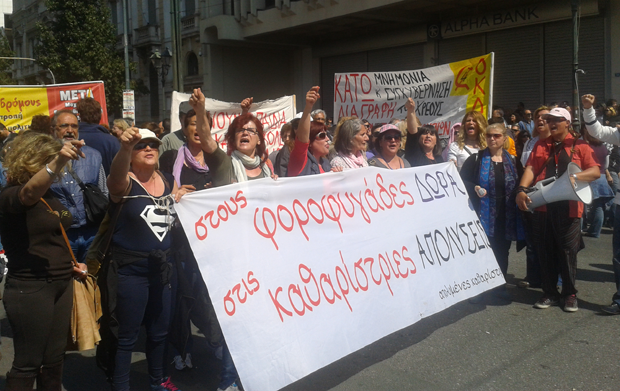
Greek protesters voiced their opposition to further austerity measures on Wednesday 9 April as Greece returned to international finance markets. (Photo: Christos Syllas for Index on Censorship)In a televised address last Thursday, Greek Prime Minister Antonis Samaras thanked the Greek people for the sacrifices they endured during the past four years as the country underwent the harshest austerity measures since emerging from World War II. While hailing the country’s return to the international finance markets after a four-year absence, the prime minister and the coalition government glossed over policies that have resulted in a negative environment for free expression — whether through protests or the press.
Along with the “world of labor” being constantly undervalued, the policies put in place are having a huge impact on the freedom of speech. In a more precise manner, the non-dominant anti-state and anti-government political discourse produced by certain political spaces such as the radical left and anarchists poses a serious threat to the government propaganda. Political dissidents are being targeted, arrested and systematically abused for protesting against the government. At the same time, press freedom is under attack when attempting to speak about the costly agreements with the troika. Also, recent struggles for education came face to face with police interference and student profiling.
The economic implications of the Greek austerity drive are falling mostly on the working class, who are losing hard won benefits without their unions taking a clear stand against the rollbacks. The government is currently legislating a new round of liberalization measures.
On 9 April, an anti-austerity strike was held in Athens with thousands of people rallying against government policies. Although the strike lacked the mass participation and intensity of past rallies, as in 2012, demonstrators managed to manifest their dissent against sweeping socio-econonic measures.
According to the latest data from the Hellenic Statistical Authority, Greece’s unemployment in January 2014 was 26.7%, up from 26.5% a year ago and down from 27.2% in December. The same figure back in January 2009 was at 8.9%. The economic downfall can be clearly seen at the unemployment rate among 15-24 years old and 25-34 years old: 56.8% and 35.5% respectively.
Workfare policies through voucher programmes, initially introduced as a government solution to unemployment, exploit the large reserve of unemployed while undermining the ability to collectively bargain working conditions and pay.
“It is a dead end. If you take a closer look today -a day of strike-, you will see that many coffee shops and sales shops are open. Austerity measures, up to now, seem to be effective in dividing working class people and overturn any social struggle. There’s still a long way to fight properly…”, a 29 year-old protester, who has been unemployed for two years, told Index on Censorship.
Human rights abuses against immigrant workers — the most undervalued part of workforce in Greece — confirm the agenda of a police state flirting with racism and xenophobia.
The dramatic escalation of refugee and migrants’ mistreatment, both by the state and the banned neo fascist party Golden Dawn is indicative. In a recent provocation some Golden Dawn followers organized an intimidating gathering outside the offices of Medecins du Monde, an NGO that provides medication and healthcare services to immigrants as well as Greeks.
However, mainstream media outlets have failed to report on the contradictions that arise from Golden Dawn’s background and relationships. Index on Censorship has thoroughly reported on the affinities of the right and the far-right political spectrum and has identified some key actors that connected ruling party New Democracy with Golden Dawn. One of them, was the former cabinet secretary Panayiotis Baltakos.
Baltakos was recently forced to resign over a leaked video, which showed him having a conversation with the spokesman of Golden Dawn Ilias Kasidiaris. In the video, Baltakos admitted that the government had to press judges to prosecute Golden Dawn’s former members of parliament.
It is worth noting that a year ago, Baltakos had allegedly said that cooperation between New Democracy and Golden Dawn in upcoming elections is “undesirable but not an unlikely possibility”.
The continuous flirting between the ruling New Deomocracy and the now-banned Golden Dawn either takes the form of a “relationship” or of a “conflict”. It is shaping the news agenda and it sets the tone ahead of the European and local elections in May.
In an e-mail interview that took place in January, Index asked Cas Mudde, assistant professor in the Department of International Relations at the University of Georgia, in whose interest is the threat of the far-right is working.
“I would expect that the far right today wins mostly from mainstream right-wing parties – in many countries they won over the left-wing voters in the late-1980s/early-1990s. At the same time, they often attract many new and former non-voters, who would probably traditionally have gone to the center-left”.
Mudde also claims, among other things, “that European politicians use the alleged threat of a far right resurgence, backed by the economic crisis thesis, to push through illiberal policies”.
In this context, on 11 April, German Chancellor Angela Merkel visited Athens. Aside from the mainstream media’s enthusiasm for the return to financial markets, few read between the lines. Merkel’s visit was a sign of support for the Greek government’s austerity measures – despite what the Greek public thinks
Experts warn that even now that “the mood has changed”, the debt crisis and the consequent austerity measures do not necessarily come to an end.
This article was published on 16 April 2014 at indexoncensorship.org
