
Groups call US Justice Department actions ‘appalling’
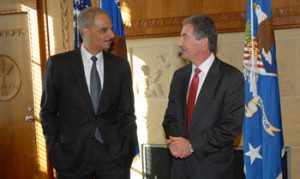
Attorney General Eric Holder and Deputy Attorney General James Coles are under fire for a subpeona of Associated Press telephone records. (Photo: DOJ)

Attorney General Eric Holder and Deputy Attorney General James Coles are under fire for a subpeona of Associated Press telephone records. (Photo: DOJ)

A group of organisations sent a letter on 24 May to US Attorney General Eric Holder demanding a full and transparent report on the Department of Justice’s secret investigations into journalists and whistleblowers.

Craig Aaron, president of Free Press, called the Justice Department’s actions “appalling”.

“This is not just a matter of concern for journalists or newsrooms; it’s an issue at the heart of our democracy”, Aaron said in a statement.

The issue unfolded as the Justice Department sought out the source of government leaks by seizing phone records from Associated Press reporters. The records were obatined through a secret subpeona, which did not give the AP the normal right to repsond to the request. The records included office and personal lines for the reporters. The Justice Department has yet to officially inform the AP why it had sought the records.

The full text of the letter:

May 24, 2013

Attorney General Eric Holder
Deputy Attorney General James M. Cole

U.S. Department of Justice
950 Pennsylvania Ave.
Washington, D.C. 20530

Dear Sirs:

More than 50 journalism and press organizations recently wrote you to voice grave concerns about the Justice Department’s subpoena of telephone records belonging to Associated Press reporters and editors. We write today as a coalition of civil rights, public interest, transparency and media reform groups to express similar concerns.

Your actions have threatened press freedom — and endangered the health of our democracy. As groups working to strengthen democratic institutions and foster more open government, we are deeply concerned that your agency’s actions will hinder efforts to make government more transparent and accountable to the public.

Following years of aggressive leak investigations, the Justice Department’s overreaching subpoena of AP phone records sets a dangerous precedent. Furthermore, it appears to violate the Department’s own rules and guidelines. The impact of the Justice Department’s actions is already being felt. AP CEO Gary Pruitt reports that sources are now less willing to talk to reporters. And journalists from newsrooms large and small have noted the chilling effects on their coverage of the government.

The latest news suggests that the subpoenas were even broader than initially reported. In addition, details are emerging about a case in which the Justice Department also seized phone records from reporters at Fox News and labeled one of its journalists a “co-conspirator” for simply doing his job.

These troubling developments raise real questions about the scope of the Department’s surveillance of journalists. At a recent congressional hearing, Mr. Holder, you couldn’t recall how many times the Justice Department has subpoenaed journalists’ records. We need to know the full extent of your Department’s crackdown against journalists.

In the digital age, reporting is no longer confined to America’s traditional newsrooms. As such, threats to press freedom threaten anyone who seeks to share information about official actions using a cellphone, social media service or website. The Obama administration promised a new era of openness and transparency. Your actions, which expand secrecy and intimidate those trying to shed more light on our government, run counter to that promise.

We demand a full accounting of the Justice Department’s targeting of journalists and whistleblowers. We need this information so that we can advocate for appropriate action to protect everyone’s constitutional rights and push for stronger legal standards to protect all types of information gathering and sharing.

The Justice Department must explain its overreach in this matter. Furthermore, we call on the Department to stop violating its existing rules and cease targeting of individuals and organizations reporting on government activity.

Sincerely,

ACCESS
Alliance for Women in Media
American Booksellers Foundation for Free Expression
American Civil Liberties Union
American Library Association
The Banyan Project
Brave New Films
Center for Democracy and Technology
ColorOfChange.org
The Committee to Protect Journalists
Common Cause
Communications Workers of America
CREDO Action
CultureStrike
Defending Dissent Foundation
Digital Media Law Project
Electronic Frontier Foundation
Fairness & Accuracy In Reporting
Freedom of the Press Foundation
Georgia First Amendment Foundation
IndyMedia
Investigative News Network
iSolon.org
Katy’s Exposure Blog
Knowledge Ecology International
LAMP: Learning About Multimedia Project
Media Alliance
The Media Consortium
Media Mobilizing Project
Mine Safety and Health News
MuckRock
National Alliance for Media Arts and Culture
National Association of Black Journalists
National Coalition Against Censorship
National Federation of Community Broadcasters
National Freedom of Information Coalition
National Hispanic Media Coalition
National Priorities Project
Native Public Media
The Newspaper Guild-CWA
OpenTheGovernment.org
Park Center for Independent Media
Participatory Politics Foundation
PEN American Center
Personal Democracy Media
Project Censored
Project On Government Oversight
Prometheus Radio Project
Public Record Media
RootsAction.org
Society of Professional Journalists
Sunlight Foundation
Tully Center for Free Speech at Syracuse University
United Republic
TheUptake.org
Utah Foundation for Open Government
Washington Civil Rights Council
Women In Media & News
Women, Action & the Media
Women’s Media Center
WRFN, Radio Free Nashville
Writers Guild of America, East
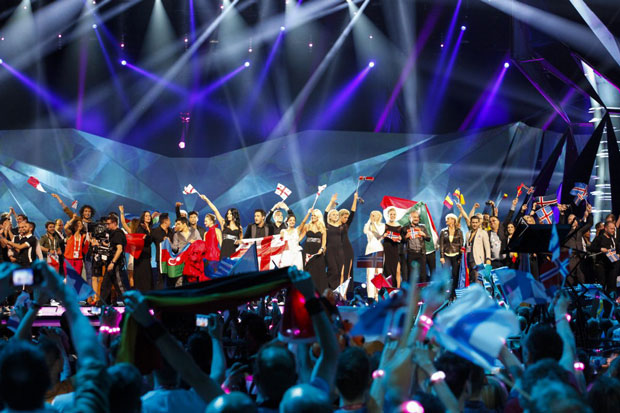

Glitz and glamour can’t hide Eurovision’s politics

The Eurovision Song Contest gives a platform to some of Europe's outliers on free expression. Photo: Sander Hesterman (EBU) / Eurovision 2013

The Eurovision Song Contest gives a platform to some of Europe’s outliers on free expression. Photo: Sander Hesterman (EBU) / Eurovision 2013

Europe will once again be swept away by a sparkly hurricane of techno beats and pompous ballads, kitschy and/or traditional costumes, wind machines, pyrotechnics, heavily accented English, awkward host banter and nul points. Yes, Eurovision takes our breath away in more ways than one.

While first and foremost a showbiz spectacle, if you look beneath the layer of sequins you’ll soon discover the political tinge to the continent’s premier singing competition. From the start in 1956, it was designed as fun way of testing out new broadcasting technology. Those partial to the occasional conspiracy theory would have you believe this was also a convenient cover for pan-European satellite testing during the Cold War, which is why NATO members Turkey and Israel were invited to the party.

With the lifting of the Iron Curtain and the inclusion of the Eastern Bloc in 1990, much was said about the healing, unifying power of the contest. Since then, even more has been said about the tendency of the late arrivals to share their points amongst themselves. The UK, for instance, have been vocal about political, neighbourhood voting being the cause of their recent Eurovision failings, rather than, say, sending entries like this. And while Eurovision, somewhat censoriously, prohibits political songs that has not stopped artists from trying to get their meaningful messages across.

The most famous recent example is perhaps Georgia’s pun-tastic 2009 offering “We Don’t Want To Put In’‘, to be performed at final in — you guessed it — Moscow. They were told to change the song or drop out, and ultimately chose the latter. Krista Siegfrids, Finland’s entrant this year, has warned she might be planting a kiss on one of her female dancers in protest at her country’s failure to adopt equal marriage legislation.

Most significantly, Eurovision gives its entrants prime time access to some 800 million viewers around the world – an unparalleled platform on which to promote their nation should they choose to. Many have jumped at the opportunity, chief among them the land of fire; Azerbaijan. As 2012 hosts, the Aliyev regime poured millions of their significant oil wealth into reforming their international reputation as a repressive hereditary dictatorship. The only problem with this otherwise foolproof plan was that they forcefully evicted  people to make room for an ambitious Eurovision-inspired urban renewal project in Baku, attacked journalists covering and speaking up about it, and generally conducted their notoriously human rights abusing business as usual. Not much has changed since the party left town a year ago — only this week, the regime announced they have extended libel laws to online speech ahead of October’s presidential election.

Before that, 2009 hosts Russia attempted to dazzle Europe and the world, with a spectacular stage show in the 25,000 capacity Indoor Olympic Arena in Moscow. However, LGBT activists seized the opportunity to shine the spotlight on the country’s poor record on gay rights, attempting to stage a Slavic-wide Pride parade on the day of the final. In a clear violation of the right to freedom of expression and assembly, the parade was banned. Many of the protesters who showed up anyway, were attacked and arrested. LGBT rights remain poor in Russia, with a 100-year ban on pride parades in Moscow announced only last year. The charm offensive of last year’s singing, dancing, baking grandma entry has this year been followed by the John-and-Yoko-esque ‘What If?‘, which among other gems, contains the lyrics “Together we can make a better place/ On this little island out in space”. Meanwhile, in Russia, internationally funded NGOs have to register as ‘foreign agents’, or risk fines and prison time.

You don’t have to host to be able to host to take full advantage of the promotional platform Eurovision. Like Belarus, you can condense your message to fit the 3-minute performance slot. In 2011, the country known as Europe’s last dictatorship sent Anastasiya Vinnikova to perform the subtly named “I Love Belarus“. Somehow, it didn’t progress to the final. Maybe the rest of Europe had some trouble reconciling the country described in the song, with its “fields full of gold” and “free, friendly and young people”, with the country where you’re put in prison for pointing out that your repressive dictator is, well, a dictator.

Also in the running this year is Hungary, the country with some of the most draconian press regulation on the continent. There’s Ukraine, where the former prime minister is serving a seven-year jail sentence for what is widely recognised as politically motivated charges. In Italy, the final will be broadcast on public broadcaster RAI, one half of the TV duopoly that poses a big threat to the country’s media plurality. In Greece, financial woes have also had a pretty detrimental effect on freedom of expression. Bulgaria’s web of cosy relationships between authorities and media leaves the country without an accurate picture of itself.

Yes, Eurovision is first and foremost one of the biggest parties in the world. However, as you’re watching the spectacle unfold on Saturday, spare a thought for the Europeans who are not as free to express themselves as their fellow countrymen on stage in Malmo.

SUPPORT INDEX'S WORK