8 Jul 2021 | Media Freedom, News, Slovenia
As Slovenia takes over the presidency of the council of the European Union, some are questioning the country’s commitment to one of the bloc’s key principles, that of the freedom of the press.
A new report by Media Freedom Rapid Response (MFRR), a coalition of non-governmental organisations that tracks press freedom in EU Member States, says Slovenia “is no longer a relative safe haven for free media” and that prime minister Janez Janša and the ruling Slovenia Democratic Party (SDS) are “undermining critical journalism, reaching for control of public service media and reshaping the media landscape to boost SDS propaganda channels while pressuring mainstream media”.
The report reveals that journalists in the country are facing rising threats of violence and women journalists in particular are facing misogynistic and sexist insults that have been legitimised by the government’s actions.
Janša, for example, has openly questioned the legitimacy of the Slovenian Press Agency (STA), which covers events in the country, and launched a vicious and completely unfounded attack on Bojan Veselinovic, its director, accusing him of murder.
Janša posted a tweet, a familiar tactic employed by the prime minister to put pressure on opposition voices online, which said: “Amazing for the EU in the 21st century that a collaborator in the murder of a journalist is still leading the STA and therefore cashes in 8,500 euros per month, more than the president of the republic.”
The allegations are unsubstantiated, but the STA is one of many opposition voices that has faced attacks this way.
Meanwhile, investigative journalist Blaž Zgaga, who questioned the government’s Covid-19 response in April, has received multiple death threats.
Slovenia’s 2006 media law is viewed as outdated and offers journalists little protections against smears and political interference.
It is clear there is a combination of the government attempting to change the media narrative, as well as defunding critical voices. It means journalists in the country are facing increasingly difficult circumstances.
The STA had its state funding revoked and will not receive it again unless it submits to direct financial oversight from the government’s communications office (though Slovenian media have since reported that funds are to be given). The move would essentially put the agency under the direct control of government communications.
It is indicative of a strategic ploy by the government to remove state funding from opposition voices, but reward its cheerleaders. The report says that “propaganda outlets parroting the party line are rewarded with lucrative advertising contracts from state institutions and companies”, for example.
Janša’s schemes have been likened to the strategy implemented by Hungarian autocrat prime minister Viktor Orbán, who has faced heavy criticism for his record on free speech, as has the government in Poland. Hungary and Poland are known to be two of the most concerning cases regarding free expression in Europe.
Ties between Janša and Orbán are known to be close, as Anuška Delić, journalist and founder of Oštro, a centre for investigative journalism, wrote in the winter 2020 edition of Index on Censorship magazine.
Motivation for Orbán’s interference in Slovenia is obvious, as he looks for supporting voices in a Europe when there is concern over his actions.
Hungarian funds, with ties to Orbán and his Fidesz party, are being funnelled into pro-SDS media outlets, which, in a country where media revenue is declining and funds are desperately sought, should be of great concern.
The outlook is not entirely bleak, the report said.
“Despite these pressures, the Slovenian independent media sector has proven to be resilient and has continued to display high-quality watchdog journalism during the pandemic. Importantly, support and solidarity between civil society, journalists’ associations and newsrooms has been strong, giving hope for the future of the media landscape in Slovenia.”
Yet not everyone is convinced.
Delić has welcomed the report’s findings, but questioned the notion that media freedom in Slovenia is not as threatened as elsewhere, and said that it will not take much for Slovenia to become the next Poland or Hungary.
“We have just witnessed a new case of meddling where the prime minister asked Val202, a public radio station, on Twitter whether it was true that they played a current protest song on Independence Day,” said Delić, who was consulted by the authors of the report. “On that day one of the speakers at the official celebration was Hungarian Prime Minister Viktor Orbán whose government’s malign influence in Slovenia is clearly portrayed throughout the report.”
As Slovenia takes on the Council presidency, the report’s authors have called on the country’s government to stop the defunding of journalism, amend current media legislation and publicly condemn threats against reporters.
25 Jun 2021 | Europe and Central Asia, France, Germany, Hungary, Media Freedom, News, Portugal
[vc_row][vc_column][vc_column_text]
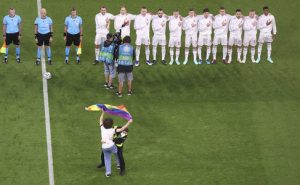
A protester with a pride flag confronts the Hungarian national team before their Euro 2020 match with Germany. Jvºrgen Fromme/DPA/PA Images
In celebration of one of football’s biggest international tournaments, here is Index’s guide to the free speech Euros. Who comes out on top as the nation with the worst record on free speech?
It’s simple, the worst is ranked first.
We round up the last of the groups today with Group F, which played the deciding matches on Wednesday.
1st Hungary
The recent Group F fixture between Germany and Hungary drew attention to Hungary’s poor record on free speech and censorship, when a protester carrying a pride flag ran on to the pitch. Hungary’s recent law, passed in June 2021, bans “the depiction or promotion of homosexuality to those under 18”. This includes teaching in schools and portrayals on television.
Prime Minister Victor Orbán was elected in 2010 and changed the constitution to take control of independent government institutions and initiated government policies to limit operations of opposition groups, journalists, and universities. According to non-profit Freedom House, the judiciary is unstable and controlled by the Prime Minister’s office, making it unusable in the struggle for free speech in Hungary. Reporters Without Borders (RSF) credit these policies for inspiring other European countries including Poland and Slovenia to institute similar restrictions on journalists.
Hungary’s coronavirus legislation gave the government almost unlimited power to handle the pandemic, a crisis which solidified Hungary as an information police-state where the prime minister can rule by decree without parliamentary oversight. Anti-scaremongering policies, meant to stop anyone “blocking the government’s anti-pandemic effort,” were used by Orbán to intimidate government critics and also temporarily suspended data protection policies. This fits with other incidents of government officials using their authority to suppress stories for their convenience.
Journalists who are caught conducting routine drone investigations in properties without express permission could get up to three years in prison under section 422 of the Hungarian criminal code, which focusses specifically on “illicit” data collection. Two journalists, Gabriella Horn and Balázs Gulyás, were threatened with this when investigating why military vehicles were present on land owned by businessman and friend of Orbán, Lőrinc Mészáros. It is a policy that shows the extent the government will go to, to side with government officials and oligarchs over journalists.
In May, journalist Júlia Halász appealed criminal charges of defamation and illegal recording for her publications after reporting on the harassment she endured while covering Hungarian diplomat, László Szabó.
Many journalists from the media company Magyar Hang reported government officials and their supporters harassing them for opposing Orbán’s reelection in 2018, and since the pandemic legislation, the head of the company, Csaba Lukács told the Committee to Protect Journalists, “reporting has become increasingly dangerous. This new legislation is a clear threat.”
In addition to government oppression, media publications face economic barriers in Hungary. Hungary’s government media council’s decisions have been criticised for being politicised because they prevented the consolidation of independent media companies while encouraging pro-government media outlets. Hungary’s largest independent newspaper closed in 2016, and the government oversaw the merger of hundreds of small media outlets in a major blow to Hungary’s media diversity.
2nd France
France may have placed at the top of the group on Wednesday, but their free speech record is mediocre. Generally, France has an independent judiciary, fair and free elections, and free and independent media that protect free speech rights in France.
In recent years, political turmoil has given France a bad record of violence against journalists. RSF described it as an overall “hostile environment for reporters.” Anti-immigrant and anti-Muslim demonstrations in France have been increasingly violent, and while covering them, journalists are often arbitrarily detained with their equipment seized or subjected to teargas grenades, flashbangs, and baton beating. At least two journalists in 2020 were called before French police and claimed to have experienced harassment under questioning. Policies implemented in 2010 make it possible for the government to claim “overriding public interest” to force journalists to break source confidentiality.
Journalists are targets of police violence during the recent large-scale protests over France’s “Global Security Law”, which makes it illegal to “maliciously share” images that may lead to the identification of a police officer. The police response to the Gilets Jaunes – or “Yellow Vests” – movement has been widely criticised for putting bystanders and journalists in harm’s way.
Journalists were the target of the worst terrorist attacks in France. Nine Journalists were killed in 2015 during the Charlie Hebdo shooting which was an attack on the satirical publication Charlie Hebdo. The gunmen identified themselves as members of the Islamist group, Al-Qaeda, and five years later, a second stabbing attack outside Charlie Hebdo is also suspect to have an Islamist terrorist motive.
In April of 2021, French Journalist Nadiya Lazzouni received a death threat with sexist and anti-Muslim slurs and proof that the sender had been watching her. She filed a complaint with the Paris prosecutor’s office but has not heard anything in response as of 15 April. For some journalists in France, both extremists and the police can be a threat to their safety.
3rd Germany
An active effort with constitutional safeguards to avoid repeating the country’s past has made Germany a stable democracy with well-protected civil liberties and political rights. Recent challenges with immigration have given a new rise to right-wing extremism and has created a more volatile environment for journalists. RSF’s 2021 report on Germany states “an independent judiciary ensures a favourable environment for journalists in Germany.” In recent years, the judiciary has been vital in preventing government policies that are harmful to journalists.
Despite the balanced government structure, Germany can still be a dangerous place for journalists. Extremists, mostly from the far right with some leftists, often use journalists as targets for violent attacks, and, especially during the Covid-19 pandemic, some politicians encouraged distrust in media outlets to promote populist agendas. In July of 2021, demonstrators protesting the Covid-19 lockdown physically blocked reporter’s cameras with their fists and shoved journalists while threatening them not to report on their protests. In May of 2021, Pro-Palestine demonstrators threw rocks and firecrackers at news crews in Berlin, and police used excessive force to prevent journalists from covering controversial evictions in October of 2020.
The Network Enforcement Act, a controversial law enacted in 2018, was brought in to regulate online hate speech and led to media companies deleting posts that would not have been considered hate speech. A majority of Germans, according to Freedom House, stated they are careful what they post online for fear of repercussions as a result.
Several government policies in response to extremism have been criticised for having unfair restrictions on journalism. In May of June 2021, their federal court ruled a law that was used to force journalists to reveal their sources was unconstitutional. Most recently in June 2021, a new law increased government surveillance and hacking power while removing judicial oversight and protections for Journalists during terrorism investigations, sparking concerns around protecting journalist sources from government retaliation.
4th Portugal
Portugal has a long history of restricting press freedom, but following the Portuguese Constitution guaranteeing freedom of expression in 1978, it has grown to be ranked ninth-best in RSF’s World Press Freedom Index of 2021. Despite a vocal minority that criticises the extent to which freedom of expression is allowed, Portugal now has a decent free speech record, but journalists are hindered by the economic downturn’s effect on their media industry. With a near-perfect score from Freedom House, Portugal earned a 96/100 for its effective political system and balanced judiciary Portuguese media outlets struggled with funding during the pandemic, and in response, Prime Minister António Costa advanced what the state planned to pay in government advertising to support the industry. Generally, public broadcasters have and struggle against commercial television outlets, which gives diverse viewpoints but some risk of populism.
Wrongful surveillance of journalists by police has been an issue. In January 2021, police were allegedly surveilling journalists illegally, without a court order, attempting to uncover their sources, and the Lisbon prosecutor’s office was exposed using electronic surveillance on two journalists in an attempt to reveal their sources in 2018. If charged for “breaching judicial secrets”, the two journalists could face up to two years in prison.
Another challenge Portugal has been facing is recent corruption scandals. In September of 2020, 17 people, including three judges, were charged with corruption. Portuguese authorities, complying with the international effort identified those involved and froze their assets, but some concerns remain around the poor resources provided to investigators and the ineffective anti-corruption and whistleblower protection legislation passed in 2019.
Other groups
Group A
Group B
Group C
Group D
Group E[/vc_column_text][/vc_column][/vc_row][vc_row][vc_column][three_column_post title=”You may also like to read” category_id=”8996″][/vc_column][/vc_row]
9 Apr 2021 | Opinion, Ruth's blog
[vc_row][vc_column][vc_column_text]
Photo: Epyc Wynn/Pixanay
I think two of the most unfashionable words in the political sphere at the moment are nuance and context. As a former politician, I completely understand why controversial and provocative statements win out; why polar positions make more entertaining viewing; why pitting people at odds with each other is more likely to inspire ongoing debate and will boost the number of Twitter likes and comments.
In other words, I know why some politicians and journalists are seeking to polarise. It boosts their profile, ensures that someone, somewhere will consider them relevant and for some even ensures that they have a payday.
But the question for me at least, is what cost is this having to our public space? Where is the place for debate rather than argument? How can we build consensus and solidarity if all we’re doing is shouting abuse at each other?
Some of the most contentious debates currently occurring in democratic societies seem to have descended into virtual screaming matches. No one is listening to each other, no one is seeking to find a middle ground and seemingly few people are seeking to build bridges – our collective focus at the moment seems to be to tear each other down.
Of course, the reality is this has always been part of our political discourse. There is a healthy tradition of challenge in our public space. But… my concern is it is no longer on the fringes of our national conversations, it now dominates and the damage that it is doing is untold.
In the last week, we have seen academics compared to the KKK, a trans writer attacked for being long-listed for a literary prize for women and a new narrative on intersectional veganism which attacks other vegans for not considering the role of white supremacy in their eating habits.
I am not saying that people don’t have the right to these views – of course they do. Index on Censorship exists to ensure everyone’s rights to free expression. But that doesn’t mean that our words and deeds don’t have impact or consequence.
We witnessed in America only this year where this form of populist politics can lead to, at the extreme end – the storming of the Capitol. This week we’ve riots on the streets of Northern Ireland, again. Anti-Chinese hate crime has spiked post-Covid. In Belarus, Hungary and Poland we witness daily the appalling impact of the combination of this political polarisation and authoritarian-leaning governments. Words have consequence.
Index was launched half a century ago to provide a published space for dissidents to tell their stories and to publish their works. As we matured we provided a platform for people to debate some of the most contentious issues of the day, from the Cold War to fatwa to vaccine misinformation. We’ve done this in the spirit of providing a genuine space for free expression, a home to ensure that the hardest issues are discussed in an open, frank but measured way. That there is a space for actual debate and engagement. It is this tradition that we seek to emulate – which is why our magazine features considered commentators and thinkers tackling some of the thorniest issues of the day.
We all need a little nuance and context in our lives.[/vc_column_text][/vc_column][/vc_row][vc_row][vc_column][three_column_post title=”You may also want to read” category_id=”41669″][/vc_column][/vc_row]
24 Mar 2021 | 50 years of Index
Elizabeth Longford’s involvement as one of the founders of Index on Censorship should come as no surprise. By the time she signed the deeds of the charity she was established as a prominent newspaper columnist and biographer and had become a regular on the radio programme Any Questions as what would now be called a celebrity pundit. Driven by a socialism forged in the Depression and her deep Catholic faith, she had an unswerving instinct for defending the underdog, despite her privileged background and her later fame as a royal biographer.
She was born Elizabeth Harman into a family of doctors and spent a comfortable childhood in Harley Street, London. At Oxford she was part of a gilded generation of intellectuals that included philosopher Isaiah Berlin, Hugh Gaitskell, who later became leader of the Labour Party, and poet Stephen Spender, her co-founder at Index. It was at Oxford too that she met her husband Frank Pakenham, later Lord Longford, describing him as “like a Greek God”.
After university, she went to work for the Workers’ Educational Trust in Stoke, where her socialism took root. She later said: “Stoke became as much a part of me in 1931 as Oxford had been for the past four years. The working-class ethos had become my own”.
When her husband took a post as a politics lecturer at Christ Church, Oxford, Elizabeth joined the local Labour Party and stood, unsuccessfully, as a candidate in Cheltenham in 1935. She admitted to an “addiction to motherhood”, but after bearing the last of her eight children, she again stood as a Labour candidate in 1950, this time in Oxford, but never did become an MP.
She had become a Catholic in 1946, following the earlier conversion of her husband. Her daughter, the historian Antonia Fraser, told Index Elizabeth was particularly affected by the treatment of the Catholic Cardinal Jozsef Mindszenty by the Communist authorities in Hungary. Mindszenty was a vocal opponent of Communism, who was the subject of a show trial in 1949. He was released from prison during the Hungarian uprising of 1956, but after the Soviet invasion crushed the revolution he was forced to flee to the American embassy in Budapest, where he lived until 1971. He was finally allowed to leave Hungary for exile in Vienna around the time that Index was founded.
Elizabeth’s career as writer began in the 1950s, when she was invited by Lord Beaverbrook to write a column on the Sunday Express. She later also wrote for the News of the World and the Sunday Times, usually on domestic subjects such as parenthood.
She was in her fifties when she turned to historical biography. Her first bestseller was Victoria RI, published in 1964 and she went on to write an acclaimed two-volume life of Wellington and works on Churchill, eminent Victorian women, Byron and the house of Windsor. She was the biographer of both the Queen and the Queen Mother.
She wrote her autobiography, The Pebbled Shore, to mark her 80th birthday in 1986 but did not stop there. Royal Throne, published in 1993, designed as a reflection on the future of the royal family coincided with the Queen’s “annus horribilis” when Charles and Diana separated. She remained, in later life, a staunch supporter of the monarchy.
Elizabeth Longford sat at the head of a dynasty of writers: her son Thomas Pakenham, daughters Antonia Fraser, Rachel Billington and Judith Kazantzis and granddaughters Eliza Packenham, Flora Fraser, Rebeca Fraser and Natasha Fraser-Cavassoni.
The one great tragedy of Elizabeth’s life was the loss of her daughter, Catherine Pakenham, in a car crash in 1969. The Catherine Pakenham prize for young women journalists was established in her memory.
Her own legacy is marked by the Elizabeth Longford Prize for Historical Biography.
But her legacy is also Index on Censorship, which continues to fight for the principles of freedom of expression and liberty of thought which she held so dear.
Flora Fraser, chair of the Elizabeth Longford Prize for Historical Biography, writes: “My grandmother believed passionately in the mission of Index on Censorship to highlight the work of fellow writers and scholars, wherever in the world they faced obstacles to freedom of expression.”
