Digital Activism Nominees – Freedom of Expression Awards 2015

Arts

arts-thumbs-on

Campaigning

advocacy-thumbs-on

Digital Activism

digital-thumbs-on

Journalism

journalism-thumbs-on

Digital Activism Nominees 2015

Recognises innovative uses of new technology to circumvent censorship and foster debate.

Tamas Bodoky

Winner

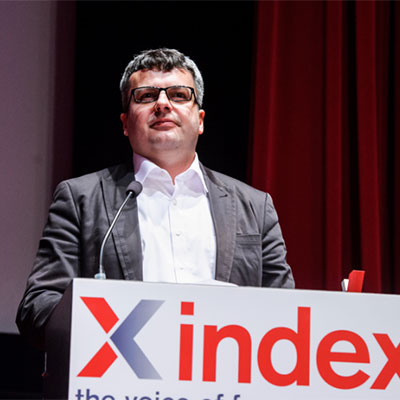
Tamas Bodoky, Atlatszo.hu

Investigative news website

Hungary

Hungarian journalist Tamás Bodoky founded the investigative news website Atlatszo.hu to promote a free press in Hungary, a country where journalists and news organisations face recently introduced media taxes, a proposed internet tax for citizens, smear campaigns and police-run office raids. Bodoky has brought together a range of crowd-sourced approaches to empower citizens in the face of this deteriorating situation for human rights, including tools to allow for anonymous reporting of corruption, to help investigate freedom of information requests (and refusals), and MagyarLeaks, a Tor-based whistleblowing service. Last year Atlatszo.hu was put on the government’s NGO blacklist, but Bodoky continues to run the site, as well as workshops to help keep investigative journalism in Hungary alive.

Acceptance speech: The independence of journalism in Hungary is under threat

Full profile: Digital activism nominee Tamás Bodoky and Atlatszo.hu

Nico Sell

Internet activist

California

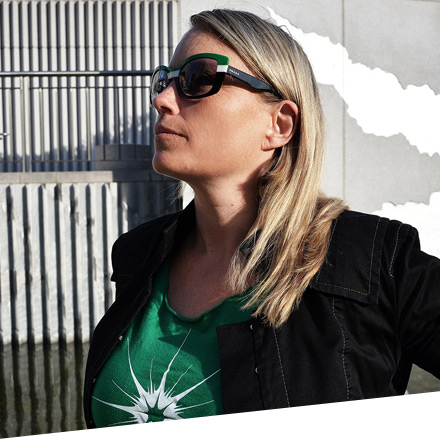
A US-based entrepreneur and activist for online privacy and secure digital communication, Sell is the CEO of Wickr, a private messaging app with watertight encryption technology. Messages sent using the app ‘self-destruct’ after a length of time adjusted by the sender – from six days to three seconds – and are then overwritten by gibberish data on the sender’s and receiver’s phones, making them impossible to recreate. Sell also speaks around the world, working to teach individuals how they can look out for their own internet privacy including every year at Defcon where Sell runs a nonprofit training camp for children and teenagers called r00tz Asylum – teaching white-hat hacking. Full profile: Digital activism nominee Nico Sell

Nico Sell
Valor por Tamaulipas

Valor por Tamaulipas

Crowd-sourced news platform

Mexico

The Tamaulipas region is top of Mexico’s most dangerous list for journalists; six journalists have been murdered there since 2010. Citizens here not only live under the cartel’s violence, but also the resultant media blackout. Journalists have been silenced. In the face of this Valor por Tamaulipas operates as a crowd-sourced news platform, offering its hundreds of thousands of social media followers up-to-date reports on cartel violence. The anonymous administrators are under constant threat. Tragically Dr María del Rosario Fuentes Rubio, co-administrator of Valor’s sister page Esperanza was kidnapped and murdered last year by cartel members, with ominous messages left from her Twitter account by her murderers. But Valor remains running, posting dozens of daily alerts to anonymously alert citizens of cartel activity. Full profile: Digital activism nominee Valor por Tamaulipas

Syria Tracker

Online mapping site

Syria

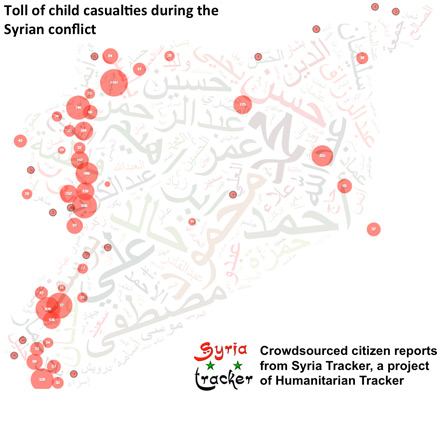
Syria Tracker is an online map that shows where human rights abuses are happening in Syria, charting exactly when and where violence such as murders, rapes and chemical attacks have taken place, as well as instances where food and water supplies have been tampered with. The site encourages civilians to anonymously report what’s going on in Syria, using encryption technology such as Tor in one of the world’s most difficult and dangerous countries for reporters. Not only does Syria Tracker allow outside relief teams to know what’s going on, the map also provides the rest of the world with otherwise non-existent accurate and up-to-date information. Crucially, by collating diverse data Syria Tracker has been able to illustrate trends in violence in Syria, such as last year’s rise in civilian deaths, suggesting they are being increasingly targeted. Full profile: Digital activism nominee Syria Tracker

Syria Tracker

Voting has now closed. The winner will be announced at the Index on Censorship Freedom of Expression Awards on March 18, 2015

Under attack: violence and intimidation stalk journalists in Europe, Index map shows

December 2014

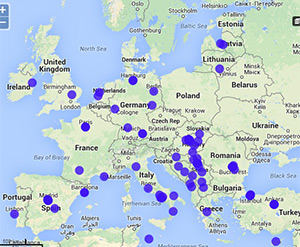
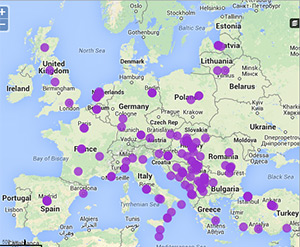
Journalists and media workers are confronting relentless pressure as they do their jobs, a survey of the first six months of incidents reported to Index on Censorship’s Mapping Media Freedom project has found.

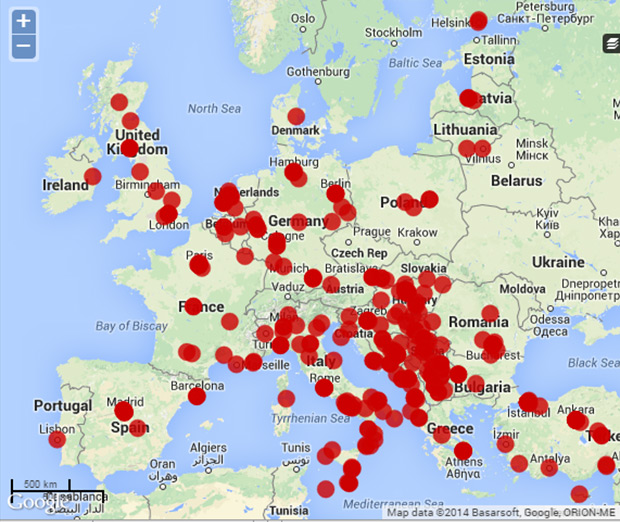
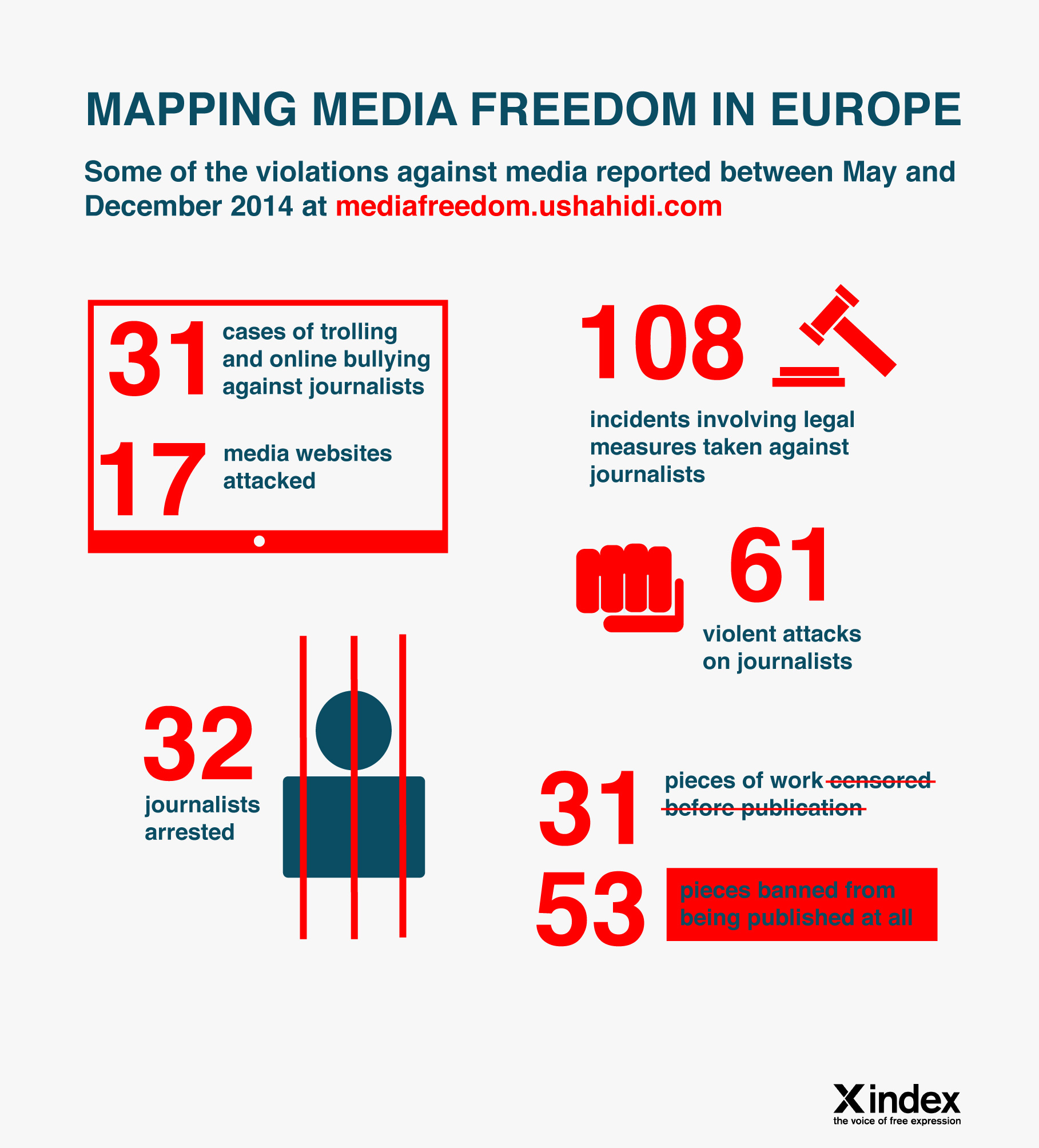
In the six months since the mapping project was launched, over 500 reports — including 61 violent attacks on journalists — from across Europe have been verified and published. Reports have come in from as far afield as Finland and Malta, Ireland and Turkey.

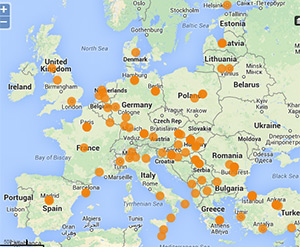
Over 150 reports have been mapped to the states of the former Yugoslavia and Italy. However, as the map shows, violations of media freedom and violent incidents against journalists are being committed across Europe, with physical violence and online harassment becoming growing problems.

The map, which was funded by the European Commission, launched on 24 May 2014 in partnership with Osservatorio Balcani e Caucaso and allows anyone — from members of the public to journalist unions — to submit reports for verification by Index’s European Union correspondents.

“Since we launched the platform, we have recorded a number of abuses against media professionals ranging from intimidation and preventing access to information, to murder. What struck me when speaking to some journalists is that too many considered receiving threats as a ‘part of the job’. It shouldn’t be. This map is an essential tool to improve the capacity of journalists, media organisations and others to confront those threats,” Index Senior Advocacy Officer Melody Patry said.

map-121014


NEWMediafreedom

This is the reality of being a journalist in Europe in 2014

Selected incidents reported to mediafreedom.ushahidi.com

jail web size Turkey: Journalist Erol Ozkoray was sentenced to 11 months and 20 days in prison for defaming President Recep Tayyip Erdogan by referring to anti-Erdogan slogans and graffiti in his book about the 2013 Gezi Park protests silenced web size Germany: Blogger Su Yutong was fired by Deutsche Welle’s Chinese service after tweeting about employee meetings, where staff were told to use restraint in their coverage of China
fist web size Hungary: Three journalists were chased with a hydraulic shovel by an employee of a rubbish dump after they tried to verify information regarding a possible leak from the EU-funded dump gavel web size France: Far-right party Front National sued and called for the resignation of journalist Guy Lagache after his TV show aired an undercover documentary about one of their municipal campaigns
bullet Albania: A masked attacker tried to shoot Artur Cani, an investigative journalist for TV News 24, near his home in Tirana fist web size Kosovo: Milot Hasimja, a journalist with the Pristina-based TV Klan, was knifed at his desk by a man apparently unhappy with a feature Hasimja did on him
fist web size Netherlands: Freelance photographer John van Ieperen was beaten by a security guard when covering the aftermath of an explosion in an apartment building that killed two residents screen web size United Kingdom: Blogger Michael Abberton who broadcast “fact checks” about the UK Independence Party said he was advised to delete a tweet about the party’s policies after being visited at home by two police officers
threat web size Serbia: Dusan Dragisic, a local businessman, threatened to cut off the nose and ears of Nenad Tomic, owner and editor-in-chief of the website Ruma fist web size Bosnia: Professor Slavo Kukic, a prominent writer and columnist, was severely beaten with a baseball bat in his office at the University of Mostar
fist web size Italy: Pino Maniaci, head of Sicilian TV station Telejato who is known for reporting on the Sicilian mafia, found his pet dogs hanged from a metal post in a yard near his office flame web size Bulgaria: The company car of bTV political journalist Genka Shikerova was set on fire outside her home in Sofia


Categorisation of violations

There are 51 different labels used to organise the incidents reported to mediafreedom.ushahidi.com

Legal measures

legal-measures
Incidents that involved the threat of or filing of legal actions

Censorship

cases-censorship
Incidents that included partial or complete censorship

Government threat

threat-government
Incidents that originated from a government representative or agency


Co-Funded by
logo_EC

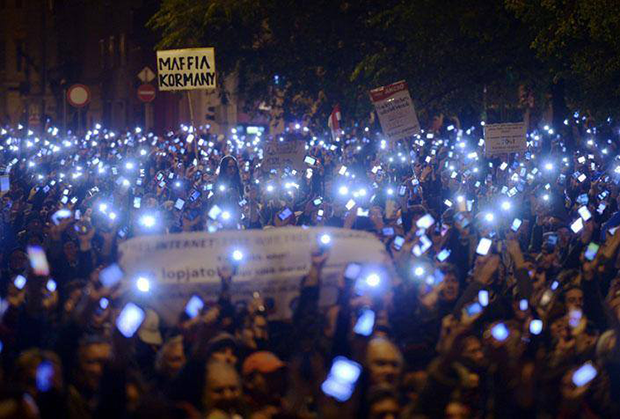
Hungarians take to the streets to protest “internet tax”

Hungarians gathered in Budapest on Sunday to protest plans to introduce a tax on internet bandwidth. (Photo: 100,000 Against the Internet Tax /Facebook)

Hungarians gathered in Budapest on Sunday to protest plans to introduce a tax on internet bandwidth. (Photo: 100,000 Against the Internet Tax /Facebook)

Barring a u-turn from the Hungarian government, demonstrators will return to the streets of Budapest this afternoon to oppose Prime Minster Viktor Orban’s plans to tax the internet

The draft law proposed by Orban’s government would levy a fee of 150 forints (£0.40; €0.50; $0.60) per gigabyte of data traffic. In the face of public outrage, ruling party Fidesz promised that the tax will be capped at 700 forints for consumers and 5,000 forints for businesses. However, this did not calm the angry protesters.

Sunday’s rally that drew thousands of people to the Hungarian captial’s city center. The peaceful protest became heated when some demonstrators marched to the Fidesz headquarters, and broke the windows of the building with old computers and peripherals.

This protest was arguably the largest anti-government demonstration since 2010, when Viktor Orban came to power. In contrast with other protests, the gatherings denouncing the internet tax were not organized by the weak, discredited and fragmented opposition.

According to the Hungarian media, the new tax was Viktor Orban’s own brainchild. He did not consult with his staff or the members of his government. The prime minister plans to use the money to raise the salaries of policemen and other employees of the interior ministry.

According to official estimates, the new tax will bring into the budget about 20 billion forints annually. While the Hungarian government is saying that the companies will pay the new tax, consumers fear that in the end the costs will be pushed onto their bills. The Association of IT, Telecommunications and Electronics Companies has already said the tax would force them to raise prices.

The protests are likely to continue because Hungarians realise this is more than just another tax. Many fear that the new tax will restrict access to information, put another burden on already impoverished small businesses and act as a curb on freedom of expression. It will also be a leash on young people who mainly use online media and who tend to be critical towards the government.

“The move… follows a wave of alarming anti-democratic measures by Orban that is pushing Hungary even further adrift from Europe,” the organisers of the Facebook group 100,000 against the internet tax said in a press release. “The measure would impede equal access to the internet, deepening the digital divide between Hungary’s lower economic groups and limiting internet access for cash-poor schools and universities,” they added. The group has drawn more than 200,000 likes.

Moreover, many people believe the plan of the tax is just a way to direct the public’s attention away from the US visa ban scandal. Recently Washington banned six Hungarian state officials from entering the United States, because of their alleged involvement in high-level corruption.

This is an unprecedented step towards a country that is member of the EU and NATO, and signals a low point between the relations of Hungary and the United States.

The tax didn’t go unnoticed in Brussels either. Neelie Kroes, vice president of the European Commission responsible for the Digital Agenda for Europe tweeted that it was “a shame for users and a shame for the Hungarian government”. Her spokesperson, Ryan Heath also criticized the tax in harsh terms during an EU Commission press briefing.

The internet tax is just another in a series of “special taxes” the Orban government introduced in the last couple of years to be able to keep the budget deficit in check. Retail, banking and energy sectors, as well as telecommunications providers are required to pay extra taxes. At the same time, the Hungarian government lowered the personal income taxes and subsidises the price of electricity and water.
hungary-map-oct282014

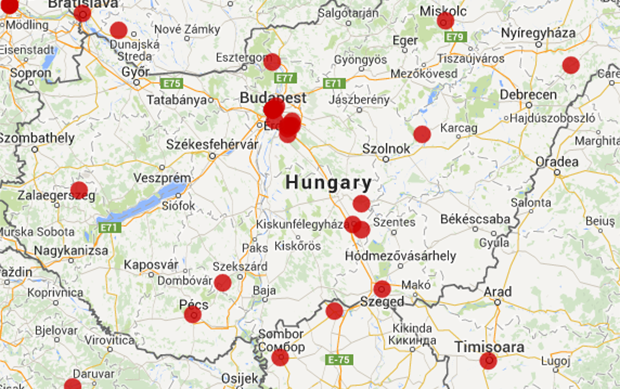
Community radio application rejected

Deputy prime minister labels investigative journalists “traitors”

Police raided the offices of NGOs, seized documents

See all media violation reports from Hungary

This article was posted on 28 October 2014 at indexoncensorship.org

About the Freedom of Expression Awards

5 awards. 16 years. Champions against censorship.

The Index Freedom of Expression Awards recognise those individuals and groups making the greatest impact in tackling censorship worldwide. Established 16 years ago, the awards shine a light on work being undertaken in defence of free expression globally. All too often these stories go unnoticed or are ignored by the mainstream press.

Each year, the awards call attention to some of the bravest journalists, writers, artists and human rights defenders in the world. The 2015 awards were no exception. We honoured Amran Abdundi, a Kenyan activist who has worked through various channels to support women who are vulnerable to rape, female circumcision and murder in northeastern Kenya. We also gave awards to Mouad “El Haqed” Belghouat, a Moroccan rapper who continues to make music about endemic corruption and widespread poverty in his country despite censorship being imprisoned three times; Tamás Bodoky, a journalist campaigning for a free press in Hungary; Rafael Marques de Morais, who has exposed government and industry corruption in Angola; and Safa Al Ahmad, a journalist who has spent three years covertly filming a mass uprising in Saudi Arabia’s Eastern Province that had, until her film, gone largely unreported.

The Freedom of Expression Awards grew naturally from the principles established by our founder, the poet Stephen Spender, who sought to give a voice to those facing censorship behind the Iron Curtain and beyond. Index had long championed writers and artists fighting threats to free expression by publishing their work in our magazine, or through our own reporting. Recognising their work through our Freedom of Expression Awards was a natural next step.

In Azerbaijan, where I have come from, telling the truth can cost a journalist their life.
That is the price that my colleagues in Azerbaijan are paying for the right of the Azerbaijani people to know the truth about what is happening in their country.

For the sake of this right we accept that our lives are in danger, as are the lives of our families.
But the goal is worth it, since the right to truth is worth more than a life without truth.”
— Idrak Abbasov, Award winner, 2012

Who is eligible

Anyone involved in tackling free expression threats – either through journalism, advocacy, arts or using digital techniques – is eligible for the awards. Index invites nominations from the public via its website and through social media platforms. Other non-governmental organisations are also invited to suggest nominees, and individuals and groups can also self-nominate. There is no cost to applying.

We shortlist on the basis of those who are deemed to be making the greatest impact in tackling censorship in their chosen area, with a particular focus on those who are tackling topics that are little covered or tackled by others, or who are using innovative methods to fight censorship.

Nominations are now closed. The shortlist will be announced on 27 January 2015.

The categories?

Advocacy – recognises campaigners and activists who have fought censorship and challenge political repression. This award is sponsored by Doughty Street Chambers.

Arts – recognises artists and producers whose work asserts artistic freedom and battles repression and injustice.

Digital Activism – recognises innovative uses of new technology to circumvent censorship and foster debate. This award is sponsored by Google.

Journalism – for impactful, original, unwavering investigative journalism across all media. This award is sponsored by The Guardian.

The judges

Each year Index recruits an independent panel of judges with expertise in advocacy, arts, journalism and human rights to work on the shortlisting of nominees. This year’s judges include journalist and campaigner Mariane Pearl and human rights lawyer Keir Starmer. Previous judges include playwright Howard Brenton, philanthropist Sigrid Rausing, and broadcaster Samira Ahmed.

The timeline

Nominations opened on October 14 and remained open until November 20, 2014. Nominations are now closed. The nominee shortlist will be announced on January 27. Judges make their final awards selection in February. The Digital Advocacy winner is decided by public vote. The winners of the awards will be announced at the 2015 Index Freedom of Expression Awards on March 18.


SUPPORT INDEX'S WORK