Hungarian journalist Tamás Bodoky founded the investigative news website Atlatszo.hu to promote a free press in Hungary, a country where journalists and news organisations face recently introduced media taxes, a proposed internet tax for citizens, smear campaigns and police-run office raids. Bodoky has brought together a range of crowd-sourced approaches to empower citizens in the face of this deteriorating situation for human rights, including tools to allow for anonymous reporting of corruption, to help investigate freedom of information requests (and refusals), and MagyarLeaks, a Tor-based whistleblowing service. Last year Atlatszo.hu was put on the government’s NGO blacklist, but Bodoky continues to run the site, as well as workshops to help keep investigative journalism in Hungary alive. He is the recipient of the 2015 Index on Censorship Freedom of Expression Award for Digital Activism.
Atlatszo.hu is calling on all those who believe that the independence of journalism in Hungary is under threat. All those who agree that politics and business interests have sunk their claws into everyday life. All those who know that taxpayer money is vanishing. We are calling on you to help us let the world know the truth.
Almost four years ago Atlatszo.hu pledged to tackle the uphill battle represented by these challenges.
As a watchdog NGO for investigative journalism, we set out to promote transparency and freedom of information in Hungary.
Atlatszo.hu – “atlatszo” means transparent in Hungarian – produces investigative reports, accepts information from whistleblowers, files freedom of information requests, and commences freedom of information lawsuits in cases where those requests are refused.
We are only a small group of journalists, lawyers and IT-specialists. But since the beginnings we have won more than 60 percent of FOI lawsuits we initiated. In fact we have been so successful in the courtrooms that in 2013 the governing majority introduced a bill to curtail FOI legislation which was dubbed “Lex Átlátszó” by the Hungarian press.
Looking back to 2011, when Atlatszo.hu was founded, I remember that many journalists dismissed the effort and were quite sure it wouldn’t last. We ignored these critics. We were confident that this was the way to go; to position ourselves outside the mainstream media, and to seek out alternative communication channels — because all of the main journalistic platforms were and still are severely constrained.
In Hungary, domestic journalism has come to represent the interests of local oligarchs. Multinational media firms are busy appeasing the political and economic powers that be. The advertising sector is a powerful censorship instrument – too often used to exert pressure. And every year since we started, the situation has become dramatically worse.
Now, the ruling political elite is pushing out its full arsenal. From business regulation to media control. From forcing personnel changes to diverting media outlets by prescribing countless directions. State funded public media has been reduced to a propaganda tool.
Most recently, the Hungarian government sparked a row over the foreign funding of local NGOs. The row has escalated to the extent that even groups advocating simple environmental concerns, or campaigning against corruption, are now being targeted. The only tangible reason to be found is that the government doesn’t appreciate funding going to any organization it doesn’t fully approve of.
I look at all of this, I look at my country, and I say one simple thing. I say Atlatszo will not be defeated. Hungary can have a fair and just democracy. Yes, it still can be done.
Thank you.
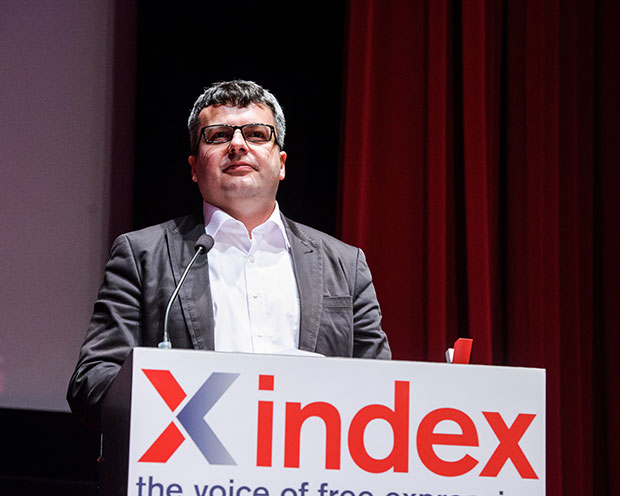
Journalist Tamas Bodoky (Photo: Alex Brenner for Index on Censorship)
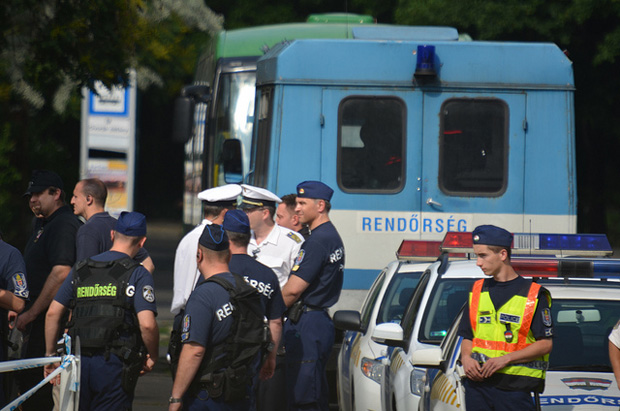
Photographs revealing the identity of police officers can now legally be published in Hungary.
A recent ruling of the Hungarian Constitutional Court means that news organisations can now publish unaltered photographs showing the faces of police officers without gaining prior consent
Since 2007, the Hungarian Judicial System considered the personal privacy of police officers to hold greater importance than them being published in the public interest.
Hungarian journalists regularly masked the faces of the police, or manipulated the image so that the officers could not be identified.
The Constitutional Court ruled that if the photograph is taken in a public place, shows the subject in an unbiased manner, and there is clear public interest involved in distributing the picture, then it can be published without the consent of the officer.
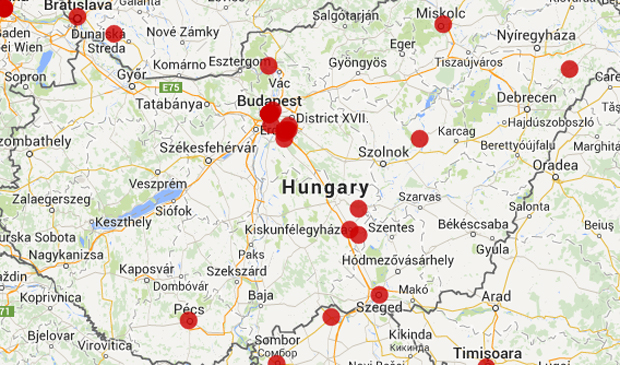
People “working together with foreign intelligence services” have been labelled “traitors” by Hungarian Deputy Prime Minister Zsolt Semjen. The comment comes after news site index.hu published a series of investigations exposing how Ukrainians and Russians are using fraudulent techniques to get Hungarian citizenship, and then travelling in Europe with Hungarian passports. The incident follows a spate of cases of government censorship and intimidation over the past year, tracked by Index on Censorship‘s media freedom mapping project.
Earlier this month, two Hungarian non-governmental organisations (NGOs) who received money from the Norwegian government under a 20-year-old deal to help strengthen civil society in the poorer parts of Europe, were raided by police officers from the National Bureau of Investigation.
Ökotárs and Demnet are just two NGOs who have recently come under attack in Hungary. A government “blacklist” of the 13 “most wanted” organisations was leaked in May. The total number of groups under investigation is at 58 and growing, and includes human rights and watchdog organisations like the Roma Press Centre, Labrisz Lesbian Association and Hungarian Civil Liberties Union (HCLU).
A campaign has been launched by a group of Hungarian volunteers through the site Blacklisted Hungarians, encouraging the international community to show their support for the case on social media by using the hashtag #ListMeToo to share content and media coverage.
In addition to this, rapper László Pityinger, known as Dopeman, is at the centre of an ongoing criminal investigation, after he kicked the detached head of a statue symbolising the Hungarian Prime Minister Viktor Orbán. The rapper spoke at a demonstration arranged by political group Szolidaritás last October, during which the audience toppled and decapitated the statue.
He will be represented by HCLU. Dalma Dojcsák, the group’s political liberties program officer and freedom of speech expert, told Index they are trying to convince the police that Pityinger has not committed a crime.
“The police officer conducting the investigation implied that they think the same, but the prosecutors may force the case through the system until it gets to trial. We don’t know if it is going to happen,” Dojcsák said.
“In Hungary, prior, direct censorship is rare — it only happens in public service media that is ruled by the government. However, self-censorship is common among journalists, out of fear of legal procedures and losing state financed advertisement,” she added.
Hungarian NGOs are facing a rough summer: The Government Control Office (KEHI) has launched a series of investigations into grants they received from the Norway Financial Mechanism. Now the Council of Europe’s Commissioner for Human Rights, Nils Muižnieks, has written to János Lázár, Minister of the Prime Minister’s Office to express concern over the situation.
In the letter, Muižnieks told Lázár that he had been informed by several parties that audits were being conducted over the grants. A forthcoming report will further detail the monitoring that Muižnieks was conducting around media freedom in the country. For his part, Lázár has responded to the letter from the COE commissioner.
As Index reported on July 8, the government controls come after a long smear campaign with members of the Fidesz government accusing these NGOs to be proxies for “foreign interests”, and that Norway is using the program to exert direct political influence on Hungary.
“There is panic and uncertainty in the Hungarian civil society. In this respect, the controls are very effective, even if there will be no consequences,” says Tamas Bodoky, editor-in-chief of Atlatszo.hu, an investigative journalism outlet also targeted by the KEHI audit.
Atlatszo.hu decided not to comply with the government inspection, regarding it as unlawful. They say that KEHI is an agency overseeing government financial matters, and does not have the authority to investigate financing for NGOs. However, they have nothing to hide, so they published all relevant records concerning the use of funds on the website of their partner organisation, Asimov Foundation.
A number of NGOs followed Atlatszo’s example, but it is unclear what the repercussions of this decision might be. According to Bodoky, KEHI could freeze their bank accounts, suspend their VAT number, and fine them as well.
It is difficult to portray these NGOs as strongly opposing the Fidesz rule. Some of the organisations receiving grants from the Norway Financial Mechanism have been involved in anti-government protests, but others have fruitful cooperation with the government. The vast majority of grant recipients have no political involvement at all.
Bodoky believes the government controls are a small-time retaliation for the decision of the Norwegian government to suspend the payments from the EEA and Norway Grants. This fund represents the financial contribution of Norway, Iceland and Liechtenstein towards reducing economic and social disparities in the European Economic Area (EEA).
Hungary was set to receive 20 billion euros in the 2014-2020 period from this fund. However, the Hungarian government recently made important changes to the system by which EU and Norway development grants are administered. They did not consult with the donors. As a result the Norwegian government suspended the payments.
This measure did not affect the considerably smaller NGO Fund, operated by a Hungarian consortium of NGOs. The overall objective of this fund is to “strengthen civil society development and enhance contribution to social justice, democracy and sustainable development”.
The programme focuses on projects dealing with the human rights of minorities, good governance, combating racism and xenophobia, combating discrimination, social exclusion, gender inequalities and gender-based violence.
Some members of the NGOs administering the fund appear to have links to Politics Can Be Different (LMP), a small liberal party. Apparently this was the reason why State Secretary Janos Lazar, the “strong man” of the Fidesz government decided to write an open letter to the official representative of the Fund’s donors, Vidar Helgesen, Norway’s Minister of EEA and EU Affairs, accusing the Norway government of intervention into the internal affairs of Hungary.
Deputy State Secretary Nandor Csepreghy said in an interview that the Hungarian government would prefer Norway’s Civil Fund to provide financial support through the Hungarian government, whose “legitimacy comes from society and the voters”. Csepreghy believes that any other scheme can be interpreted as a direct involvement into Hungary’s internal political affairs.