20 Jun 2014 | Egypt, News, Politics and Society
 It is still hot in the shade of the palm trees and stuccoed buildings on the American University in Cairo’s (AUC) downtown campus. Groups of refugees sit around on wicker chairs.
Everyone is here to learn about journalism. Munzalak is a new organization that aims to get refugees living in Egypt involved in the media and in command of their own voice. The name translates to “your comfortable place,” like a home from home – the one you were forced to leave.
Every weekend Munzalak hires out a room at AUC. Refugees are invited to come along and learn the basics of journalism for free. Aurora Ellis, a news editor for an international news agency, runs the workshops with aim of producing “articles that deal with refugee issues and with the refugee experience.”
The ultimate aim is to give refugees a space to voice their experiences. A blog on Munzalak’s website publishes pieces written by refugees (with the option of writing under a pseudonym) while training goes on and – organizers hope – more people join.
Similar initiatives have existed. The Refugee Voice was a newspaper based in Tel Aviv run by African asylum seekers and Israelis inside Israel and founded in April 2011, but is no longer published. Radar, a London-based NGO, also trains local populations in areas around the world (including Sierra Leone, Kenya and India) with the aim of connecting isolated communities.
“We’re being given the opportunity to write about our experiences…I can write about my experiences, and interview other refugees about theirs,” says Edward, a Sudanese refugee who arrived in Cairo earlier this year.
“We have several basic problems – in housing, security, education and health.” He quietly tells stories of life in Egypt; harassment and assault in the streets and pervasive racism (even, he says, from some people who are there to help). “We live a separated life. We are here by force only.”
Ultimately, Edward wants to write a history of the Nuba Mountains, the war-torn area straddling the border between Sudan and South Sudan, where he was born in over 25 years ago. Edward carries a notebook with ideas for this book – scribbled notes of a people and culture disappearing; histories of war and exodus. Edward sees his journalism as self-preservation, telling stories that other people don’t want to be told. He most admires Nuba Reports, a non-profit news source staffed by Sudanese reporters, which aims to break reporting black-spots while humanitarian crises and fighting continues on the ground.
Some activists working alongside refugees see initiatives like this as an important way to break the silence.
“Before June 30, refugees were always neglected in the national media. They were only included [the media] if they were being used as scapegoats,” says Saleh Mohamed from the Refugee Solidarity Movement (RSM) in Cairo. Famous examples include right-wing TV host Tawfik Okasha calling for Egyptians to arrest and attack Syrian and Palestinian refugees on sight. Syrians and Palestinians arrested by security forces have been routinely referred to as “terrorists” by the authorities, a narrative often repeated verbatim by pro-regime newspapers. “Now I think the media wants to keep refugees in the shadows and not talk with them,” Mohamed adds. “You never hear about refugees.”
But Munzalak is not without its risks and challenges. Staying independent but still being able to attract funding and support is one thing. Another is security.
Last Sunday 13 Syrians were sentenced to five years in prison after protesting in March 2012 against Bashar al-Assad. They were charged with illegal assembly and “threatening…security [forces] with danger,” something the defendants all denied, according to state-run newspaper Al-Ahram. A UNHCR official last year had told Syrian refugees to stay away from domestic politics – a warning that could feasibly include journalism as well.
Although historically repressive towards journalists during the rule of Hosni Mubarak, the Supreme Council of the Armed Forces (SCAF) and the Muslim Brotherhood’s Mohamed Morsi, Egypt’s media landscape has taken a significant nosedive since the July coup. Several journalists have been killed in the violence; Mayada Ashraf, a young reporter for Al-Dostour became the latest casualty after she was shot in the head during a protest, allegedly by a police sniper; while reporters remain behind bars and on trial for doing their job.
So is it a good idea to get refugees involved?
Mohamed says that street reporting and visibly working as journalists could put refugees – like Edward – “in danger.” Their legal ability to work also depends on what refugee status they have.
“But otherwise they can talk about themselves rather than waiting for journalists to approach them instead…They definitely need a voice.” But for some refugees, other priorities come first.
Jomana is a 20-year-old Syrian refugee and media studies undergraduate, originally from Aleppo. She visited Munzalak once and liked the idea, but is more concerned about getting a job and paying her way than talking about her experiences – which, like so many Syrian refugees in Egypt nowadays, are harsh. Of almost 184,000 refugees living in Egypt, according to mid-2013 figures from the United Nations Refugee Agency (UNHCR), around 130,000 of that number are Syrians.
“I don’t have enough money to continue my studies so I will have to leave,” she explains plainly. Jomana’s home was bombed out during the war and they fled the country with just their passports, arriving in Cairo over two years ago. Eventually her father went back to Aleppo to try and restart his old factory, but returned to find rubble. He came back to Cairo to economic uncertainty, incitement and political instability. “Other people are going back to Syria and dying there. Those that stay [here] aren’t dying from bombing or from fighting…but from hunger.”
Munzalak might help, but for some refugees, not in the most crucial of ways.
“It means I can express my opinion freely,” Jomana says, “but will I get paid for my opinion?”
This article was published on June 20, 2014 at indexoncensorship.org
22 May 2014 | Czech Republic
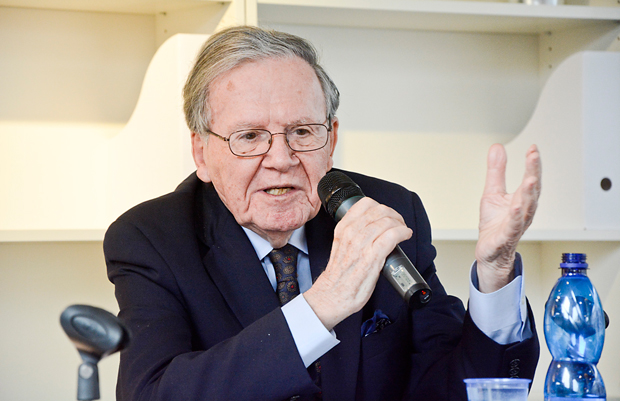
Peter Demetz (Photo: Prague Book Fair)
Emeritus Yale University professor and author Peter Demetz was awarded the Jiri (George) Theiner prize at the Prague Literary Festival this year.
George’s son Pavel, the prize organiser, said Demetz received the award because “all his life he has remained intellectually honest in his demystification of views which sometimes became popular such as the notion of magical Prague, rather stressing the reality of Czech history, as well as his life-long commitment to Czech literature in American and German environments and as translator of Frantisek Halas´ and Jiri Orten´s poetry”.
Theiner set up the prize in memory of his father’s work, as a former editor of Index on Censorship magazine he brought attention to Czech writing and writers during the communist era. He said: “Almost five years ago I discussed with the director of World of Books (Prague Book Fair), Dana Kalinova, the possibility of making this prize an important permanent fixture at the annual book fair. Looking back I realised that George Theiner´s reputation here was as solid as it was in other countries, despite the fact that he left in 1968.
The jury this year was chaired by Lenka Jungmannova (professor at the Institute of Czech Literature, Academy of Sciences), Martin Putna (literary historian, professor at Prague´s Charles University and critic), Jiri Gruntorad (guardian of the largest samizdat collection in central and eastern Europe, dissident persecuted in the 1970´s and 1980´s) and Ivan Biel (documentary film-maker and lecturer in Film Studies). Next year’s jury was also announced and will include Karel Schwarzenberg (a former Czech foreign minister, one of Havel´s closest aides and supporter of dissidents before 1989 whilst living in Austria), Michal Priban (academic at the Institute of Czech Literature, Academy of Sciences), Vladimír Pistorius (samizdat publisher who successfully made the transition into becoming a ´straight´ book publisher) and Jan Bednar (radio journalist and commentator, signatory of Charter 77, between 1985 and 1992 and who worked for the BBC in London).
Theiner said that they received between 35 and 60 nominations each year from all over the world. The criteria stated that the recipient (or organisation) had made a major long-term contribution to the promotion of Czech literature overseas, with an expectation that they have also made a contribution to freedom of speech and human rights in general. Other prize winners include Andrzej Jagodzinski, translator of Havel, Hrabal, Kundera, journalist as well as a leading member of the democratic opposition on Poland); Ruth Bondy (an Israeli of Czech origin, survivor of Auschwitz and Bergen-Belsen who worked as a journalist on the Hebrew daily Davar; and Paul Wilson (a Canadian who lived in Czechoslovakia as a young man before being thrown out in 1977 for collaborating with dissidents and, above all, the band Plastic Pepople of the Universe, translator of Skvorecky, Klima, Havel, Hrabal, radio producer, editor and writer).
Theiner said: “One of the most positive aspects that has come out of the activity surrounding the prize has been the link made between old and new Index on Censorship. It was a real joy to welcome to Prague at the first prize-giving the founding editor Michael Scammell along with some of his old colleagues such as Philip Spender, Haifaa Khalafallah and others. Four years later the present editor Rachael Jolley joined us and moderated a discussion following the award-giving ceremony on freedom after the fall of the Berlin Wall, a reflection on the democratisation of society and freedom of expression in literature and journalism. It´s great to see that the bridge-building that George Theiner was so adept at is still going strong.”
This article was published on May 22, 2014 at indexoncensorship.org
8 May 2014 | Europe and Central Asia, News

Eurovision contestant Teo, in the music video for this year’s Belarusian entry Cheesecake (Image: Yury Dobrov/YouTube)
If you want a Eurovision of the future, imagine a faux-dubstep bassline dropping on a human falsetto, forever. That was how it felt watching YouTube footage of this year’s entrants in the continent’s greatest song-and-dance-spectacle.
The Eurovision Song Contest, born of the same hope for the future and fear of the past as the European Union, is approaching its 50th year. And strangely, it’s doing quite well. In spite of fears that the competition would end up as an annual carve up between former Soviet states, recent years have in fact seen a fairly equal spread of winners throughout the member states of the European Broadcasting Union (who do not actually have to be in Europe; a fact often missed by anti-Zionists who somehow see a conspiracy in the fact that Israel is a regular entrant in the competition is that channels in countries such as Libya, Jordan and Morocco are also members of the EBU, and technically could enter if they wish. Morocco did, in 1980). Since 2000, the spread of winners between Western Europe, the former Soviet states, and the Balkans and Turkey have been pretty much even.
While some of the geopolitics will always be with us — Turkey and Azerbaijan united in their hatred of Armenia, Cyprus and Greece douze-pointsing each other at every opportunity — the once-derided contest has in fact functioned as a genuine competition. Year in, year out, the best song in the competition tends to win, while the laziest entrants, not taking the event seriously as a songwriting competition (yes, we’re looking at you, Britain), tend to fall behind and then complain that Europe doesn’t “get” pop music.
The best songs and singers triumph, by and large. But Eurovision still does have a political edge.
Take Tuesday’s semi-final in Copenhagen. Russia’s entry, Shine, performed by the Tolmachevy Sisters and described by Popbitch as sounding like “almost every Eurovision song you’ve ever imagined” contained some unintentionally ominous lines:
Living on the edge / closer to the crime / cross the line a step at a time
Add an “a” to the end of that “crime”, and you’ve got the Kremlin’s current foreign policy neatly summed up in a single stanza.
I am not suggesting that the Tolmachevys were sent out to justify Putin’s expansionism. Nonetheless, the Copenhagen crowd were keen that Russia should know what the world thought of its foreign policy and domestic human rights record: as it was announced that Russia had made Saturday’s grand final, the arena erupted in jeering. The dedicated Eurovision fan is clearly not just a poppet living in a fantasy world of camp. They are engaged with the world, and particularly the regressive policies of countries such as Russia, Azerbaijan and Belarus, perhaps more so than your average European.
When Sweden’s Loreen won the competition in Baku, capital of Azerbaijan, in 2012, she pledged to meet the country’s human rights activists. That same year, BBC commentator “Doctor Eurovision” (he actually is a doctor of Eurovision) made explicit references to Belarus’s disgraceful dictatorship, rather than simply giggle at the funny eastern Europeans.
This raises an interesting question about how we engage with dubious regimes.
Before the Baku Eurovision in 2012, there was some discussion over whether democratic countries should boycott the competition, sending a message to Aliyev’s regime.
“No,” Azerbaijani civil rights activists told Index on Censorship. “Let the world come and see Azerbaijan.” They felt that for most of the world, most of the time, they are citizens of a far away country of whom we know nothing. They wanted to take their chance while the world was looking. I think they got it right. As discussed last week, Azerbaijan is engaged in a massive international PR campaign, but to most people in the world since that Eurovision and the attention it raised for the country’s opposition, it has not been able to entirely disguise its atrocious record on free speech and other rights.
On Friday, the International Ice Hockey Federation’s world championship will open in Belarus. Though there was some discussion of boycotting that event, it has died down. Nonetheless, journalists from Europe and North America will be covering the event, and fans will travel too.
Belarus’s macho dictator Alexander Lukashenko is a keen ice hockey fan, and will be aiming to sweep up the glory of hosting a major international sporting event, not long after the country hosted the world track cycling championships in 2013.
Ice hockey fans and sports journalists are generally not the type of people who go in for Eurovision. But maybe they should try to take a leaf out of the Song Contest supporters book. Have a look at the country around them, learn a little about the politics, and spread the word about the side the dictators don’t want us to see.
Autocrats try to use these international competitions to control the world’s view of them. We should beat them at their own games.
This article was posted on May 8, 2014 at indexoncensorship.org
11 Apr 2014 | Digital Freedom, News

(Illustration: Shutterstock)
State surveillance has been much publicised of late due to Snowden’s revelations, but allegations against the NSA and GCHQ are only one aspect of the international industry surrounding wholesale surveillance. Another growing concern is the emergence and growth of private sector surveillance firms selling intrusion software to governments and government agencies around the world.
Not restricted by territorial borders and globalised like every other tradable commodity, buyers and sellers pockmark the globe. Whether designed to support law enforcement or anti-terrorism programmes, intrusion software, enabling states to monitor, block, filter or collect online communication, is available for any government willing to spend the capital. Indeed, there is money to be made – according to Privacy International, the “UK market for cyber security is estimated to be worth approximately £2.8 billion.”
The table below, collated from a range of sources including Mother Jones, the Electronic Frontier Foundation, Bloomberg, Human Rights Watch, Citizen Lab, Privacy International and Huffington Post, shows the flow of intrusion software around the world.
| Surveillance Company |
Country of Origin |
Alleged Countries of Use |
| VASTech |
South Africa |
Libya (137) |
| Hacking Team |
Italy |
Azerbaijan (160), Egypt (159), Ethiopia (143), Kazakhstan (161), Malaysia (147), Nigeria (112), Oman (134), Saudi Arabia (164), Sudan (172), Turkey (154), Uzebekistan (166) |
| Elbit Systems |
Israel |
Israel (96) |
| Creative Software |
UK |
Iran (173) |
| Gamma TSE |
UK |
Indonesia (132) |
| Narus |
USA |
Egypt (159), Pakistan (158), Saudi Arabia (164) |
| Cisco |
USA |
China (175) |
| Cellusys Ltd |
Ireland |
Syria (177) |
| Adaptive Mobile Security Ltd |
Ireland |
Syria (177), Iran (173) |
| Blue Coat Systems |
USA |
Syria (177) |
| FinFisher GmbH |
Germany |
Egypt (159), Ethiopia (143) |
Note: The numbers alongside the alleged countries of use are the country’s ranking from 2014 Reporters without Borders World Press Freedom Index 2014.
While by no means complete, this list is indicative of three things. There is a clear divide, in terms of economic development, between the buyer and seller countries; many of the countries allegedly purchasing intrusion software are in the midst of, or emerging from, conflict or internal instability; and, with the exception of Israel, every buyer country ranks in the lower hundred of the latest World Press Freedom Index.
The alleged legitimacy of this software in terms of law enforcement ignores the potential to use these tools for strictly political ends. Human Rights Watch outlined in its recent report the case of Tadesse Kersmo, an Ethiopian dissident living in London. Due to his prominent position in opposition party, Ginbot 7 it was discovered that his personal computer had traces of FinFisher’s intrusion software, FinSpy, jeopardising the anonymity and safety of those in Ethiopia he has been communicating with. There is no official warrant out for his arrest and at the time of writing there is no known reason in terms of law enforcement or anti-terrorism legislation, outside of his prominence in an opposition party, for his surveillance. It is unclear whether this is part of an larger organised campaign against dissidents in both Ethiopia and the diaspora, but similar claims have been filed against the Ethiopian government on behalf of individuals in the US and Norway.
FinFisher GmbH states on its website that “they target individual suspects and can not be used for mass interception.” Without further interrogation into the end-use of its customers, there is nothing available to directly corroborate or question this statement. But to what extent are private firms responsible for the use of its software by its customers and how robustly can they monitor the end-use of its customers?
In the US Electronic Code of Federal Regulations, there is a piece of guidance entitled Know Your Customer. This outlines steps to be undertaken by firms to identify what the end-use of its products is. This is a proactive process, placing the responsibility firmly with the seller to clearly identify and act on abnormal circumstances, or ‘red flags’. The guidance clearly states that the seller has a “duty to check out the suspicious circumstances and inquire about the end-use, end-user, or ultimate country of destination.”
Hacking Team has sold software, most notably the Remote Control System (RCS) to a number of countries around the world (see above). Citizen Lab, based out of the University of Toronto, has identified 21 countries that have potentially used this software, including Egypt and Ethiopia. In its customer policy, Hacking Team outlines in detail the lengths it goes to verify the end-use and end-user of RCS. Mentioning the above guidelines, Hacking Team have put into practice an oversight process involving a board of external engineers and lawyers who can veto sales, research of human rights reports, as well as a process that can disable functionality if abuses come to light after the sale.
However, Hacking Team goes a long way to obscure the identity of countries using RCS. Labelled as untraceable, RCS has established a “Collection Infrastructure” that utilises a chain of proxies around the world that shields the user country from further scrutiny. The low levels of media freedom in the countries purportedly utilising RCS, the lack of transparency in terms of the oversight process including the make-up of the board and its research sources, as well as the reluctance of Hacking Team to identify the countries it has sold RCS to undermines the robustness of such due diligence. In the words of Citizen Lab: “we have encountered a number of cases where bait content and other material are suggestive of targeting for political advantage, rather than legitimate law enforcement operations.”
Many of the firms outline their adherence to the national laws of the country they sell software to when defending their practices. But without international guidelines and alongside the absence of domestic controls and legislation protecting the population against mass surveillance, intrusion software remains a useful, if expensive, tool for governments to realise and cement their control of the media and other fundamental freedoms.
Perhaps the best way of thinking of corporate responsibility in terms of intrusion software comes from Adds Jouejati of the Local Coordination Committees in Syria, “It’s like putting a gun in someone’s hand and saying ‘I can’t help the way the person uses it.’”
This article was posted on 11 April, 2014 at indexoncensorship.org
