19 Jun 2014 | Azerbaijan Statements, Campaigns, Digital Freedom, Digital Freedom Statements
The following is a transcript of a joint oral statement, led by ARTICLE 19 and supported by several IFEX members, that was read aloud today, 19 June 2014, at the 26th UN Human Rights Council session in Geneva:
Thank you Mr. President,
Two years ago this Council affirmed by consensus that “the same rights that people have offline must also be protected online, in particular freedom of expression”.
In 2014, the outcome document of Net-Mundial in Brazil recognised the vital role of the internet to achieve the full realisation of sustainable development goals. 31 UN Special Rapporteurs recently affirmed that guaranteeing the free-flow of information online ensures transparency and participation in decision-making, enhancing accountability and the effectiveness of development outcomes.
Development and social inclusion relies on the internet remaining a global resource, managed in the public interest as a democratic, free and pluralistic platform. States must promote and facilitate universal, equitable, affordable and high-quality Internet access for all people on the basis of human rights and net-neutrality, including during times of unrest.
The blocking of communications, such as the shutdown of social media in Malaysia, Turkey, and Venezuela is a violation of freedom of expression and must be condemned. Dissent online must be protected. We deplore the detention of Sombat Boonngamanong in Thailand, who faces up to 14 years imprisonment for using social media to urge peaceful resistance to the recent military coup in the form of a three-finger salute.
One year after the Snowden revelations, this Council must recognise that trust in the internet is conditional on respect for the rights to freedom of expression and privacy online, regardless of users’ nationality or location. Any mass (or dragnet) surveillance, which comprises collection, processing and interception of all forms of communication, is inherently disproportionate and a violation of fundamental human rights.
The targeted interception and collection of personal data must be conducted in accordance with international human rights law, as set out in the necessary and proportionate principles. Critical and intermediate infrastructure must not be tampered with for this end, nor should any system, protocol or standard be weakened to facilitate interception or decryption of data.
ARTICLE 19 urges the Human Rights Council to take action to comprehensively address these challenges.
Thank you.
Signed,
ActiveWatch – Media Monitoring Agency
Africa Freedom of Information Centre
Albanian Media Institute
Arabic Network for Human Rights Information
ARTICLE 19
Association of Caribbean Media Workers
Bahrain Center for Human Rights
Cairo Institute for Human Rights Studies
Cambodian Center for Human Rights
Canadian Journalists for Free Expression
Center for Independent Journalism – Romania
Center for Media Freedom and Responsibility
Egyptian Organization for Human Rights
Foro de Periodismo Argentino
Foundation for Press Freedom – FLIP
Freedom Forum
Human Rights Watch
Index on Censorship
Institute for the Studies on Free Flow of Information
International Press Institute
Maharat Foundation
Media, Entertainment and Arts Alliance
Media Institute of Southern Africa
Media Rights Agenda
National Union of Somali Journalists
Norwegian PEN
Pacific Islands News Association
Pakistan Press Foundation
PEN Canada
Privacy International
Reporters Without Borders
Southeast Asian Press Alliance
South East European Network for Professionalization of Media
West African Journalists Association
World Association of Community Radio Broadcasters – AMARC
Access
Alternative Informatics
Asian Forum for Human Rights and Development (FORUM-ASIA)
Association for Progressive Communications (APC)
Bangladesh Internet Governance Forum
Bangladesh NGOs Network for Radio and Communications (BNNRC)
Barys Zvozskau Belarusian Human Rights House
Big Brother Watch
Bir Duino (Kyrgyzstan)
Bits of Freedom
Bolo Bhi Pakistan
Bytes For All
Center for e-parliament Research
Centre for Internet & Society
Center for National and International Studies, Azerbaijan
Center for the Development of Democracy and Human Rights, Russia
Chaos Computer Club
CIVICUS: World Alliance for Citizen Participation
Digital Rights Foundation, Pakistan
Electronic Privacy Information Center
English Pen
European Centre for Not-for-Profit Law (ECNL)
Helsinki Citizens’ Assembly – Vanadzor
Human Rights Monitoring Institute, Lithuania
International Centre for Not-for-Profit Law (ICNL)
International Federation for Human Rights (FIDH)
Kazakhstan International Bureau for Human Rights and Rule of Law
Kenya Human Rights Commission
Liberty
OpenMedia.org
Open Net Korea
Open Rights Group
Panos Institute West Africa
Samuelson-Glushko Canadian Internet Policy & Public Interest Clinic (CIPPIC)
Simon Davies, publisher of “Privacy Surgeon”
Thai Netizen Network
Zimbabwe Human Rights Forum
13 Feb 2014 | Belarus, News
Join Index at a presentation of a new policy paper on media freedom in Belarus on 19 February, 2014, 15.00 at the Office for Democratic Belarus in Brussels.
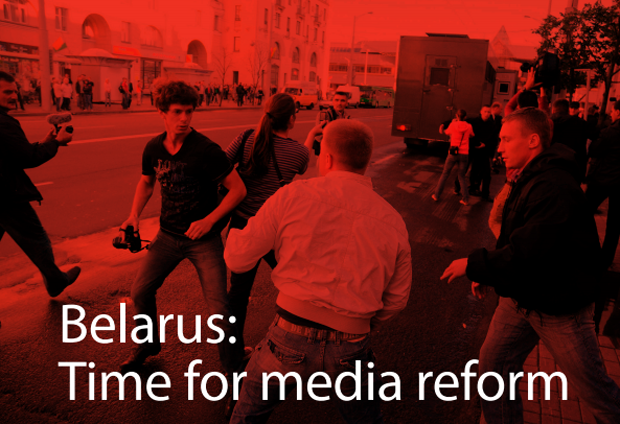
This article is the fourth of a series based on the Index on Censorship report Belarus: Time for media reform.
One of the greatest chills on the freedom of expression in Belarus is the disappearance, murder, suspicious suicide and impunity against media workers that has demonstrated the very real physical risks that those who practice independent journalism in Belarus face. Since the beginning of Alexander Lukashenko’s presidency, a number of journalists have been murdered or died in suspicious circumstances to considerable international condemnation. Journalists today inside Belarus still face physical violence and threats. A number of high profile journalists have fled the country to protect their personal safety.
No progress has been made on investigations of the deaths of the journalists Dzmitry Zavadski (disappeared on 7 July 2000), Veranika Charkasava (brutally murdered on 20 October 2004), Vasil Hrodnikau (found dead on 18 October 2005), Aleh Biabenin (found dead on 3 September 2010). The public still has no clear answers over the circumstances of their deaths, nor have any of the perpetrators of these crimes been brought to justice. Zavadski’s body has never been found and instigators of his murder has never been identified and tried; Charkasava’s murderer has never been found and the investigation into the case was suspended; details of Hrodnikau’s and Biabenin’s cases have led their family and colleagues to question official results of the investigations. The European Parliament has called for a full investigation into Biabenin’s death.
“As long as even one journalist is prosecuted or intimidated for critical speech, the whole media community feels threatened and the chilling effect remains,” said the OSCE Representative on Freedom of the Media, Dunja Mijatović, during her official visit to Minsk in June 2013. Unfortunately, physical violence against journalists and preventing them from conducting of their professional duties have become one of the major concerns over the past several years in Belarus.
Detentions of journalists
The constitution of Belarus grants any citizen the right to gather and impart information. Moreover, Article 34 of the Law “On Mass Media” provides for the right of a journalist to be present “in the area of armed conflicts or emergencies, mass actions, in places of other socially important events and transmit information from there.”
Despite of these legal provisions, the arbitrary detention of journalists and the interference into their professional activities continues unabated, especially during street actions by civil society and the opposition. For instance, at least 24 journalists were detained and at least 21 were attacked and injured by the riot police on 19 December 2010 in Minsk while they covered a major rally by the opposition in Independence Square that protested against the results of the presidential election.
Monitoring by the Belarusian Association of Journalists noted at least 265 cases of the detention of journalists in Belarus in 2011-2013.
In 2011 there were 160 of such cases, and at least seven instances of use of physical violence by the police against journalists. The most significant number of detentions happened during the summer of 2011, during peaceful street actions organised by the Revolution Through Social Networks movement. At least 103 instances of detentions of journalists across the country were noted. The arrests were brutal; the police prevented reporters from filming the rallies, in some cases by using excessive force and damaging journalists’ professional equipment. At least 22 journalists who were detained while covering the actions were summoned to courts for alleged “participation in unsanctioned actions”, 13 of them served actual administrative arrests, and the rest were sentenced to fines.
In 2012, 60 cases of detention of journalists, distributors of non-state press and social media activists were noted. In most cases the detentions lasted for 2-3 hours, but in several cases they led to fines and detention for up to 15 days. At least 13 journalists received official warnings of prosecutors’ offices in 2012; most of them were warned for cooperation with foreign media without accreditation. At least four journalists were summoned for interrogation by the KGB.
In 2013 45 instances of journalists’ detentions have been noted as of November. Four of them led to administrative arrests of 3 to 12 days each. Prosecutors’ offices issues at least eight official warnings to journalists for their activities.
Leaders of the Belarusian Association of Journalists, Zhanna Litvina and Andrei Bastunets, met the head of Minsk city police Aliaksandr Barsukou on 23 October 2013 to discuss the issue of the police interference in journalists’ professional activities. During the meeting Barsukou noted the number of detentions of journalists decreased in comparison with 2011-2012. Just a week after the meeting, seven journalists were detained by the police in Minsk while covering the Mourning Marathon, an event to commemorate victims of Stalin’s repressions.
Travel restrictions
Several journalists and media experts were banned for travelling abroad by the authorities of the country in 2012. It became a new form of pressure on independent media community.
Zhanna Litvina, the chairperson of the Belarusian Association of Journalists, Andrei Dynko, the editor of Nasha Niva newspaper, and Mihas Yanchuk, a representative of Belsat TV channel, were denied the right to leave the country. Litvina was not allowed out at the Minsk National Airport; Dynko and Yanchuk were forced to leave trains on the borders with Lithuania and Poland respectively by Belarusian border guards. No legal grounds for such restrictions were provided; the ban was lifted only in September after appeals of the persons affected to courts. Officers of the department of citizenship and migration explained the situation as a software glitch. It is noteworthy that the alleged bug disproportionately affected independent journalists, opposition leaders and civil society activists.
Restrictions of activities of foreign correspondents
The authorities use different methods to restrict the distribution of information about Belarus’ internal situation abroad. Reporters for Belsat TV channel and Radio Racyja, a media operator based in Poland that broadcasts in the Belarusian language, have both been refused official accreditation to operate within Belarus. European broadcasters have also been affected. In March 2012 camera crews of SVT (Sweden) and TV3 (Estonia) television channels were detained in Minsk, despite both having being officially accredited in Belarus.
Several foreign journalists faced obstacles during the September 2012 parliamentary elections. Three hundred fifty foreign reporters were officially accredited to cover the elections, but four journalists from Germany and Sweden were denied entry visas. Two more Swedish journalists, Erik Von Platen and Gustaff Andresson, had to spend 16 hours at the Minsk International Airport before their accreditation was confirmed and their visas were issued. It is unclear what criteria the authorities apply to issue visas for foreign correspondents.
On the same day, 21 September 2012, Amos Roberts, Australian SBS TV journalist, was searched at the customs of the Minsk airport as he was trying to leave Belarus after a week of legitimate work in the country. His professional equipment was confiscated; the procedures of a search and confiscation were not followed. The journalist was allowed to leave the country the following day, but his equipment was not returned to him until one year later, in October 2013.
Physical safety of journalists and impunity remain serious problems that have a chilling effect of media freedom in Belarus. The most acute issue is police interference with journalistic activities and arbitrary detentions of reporters that cover mass street actions. At least 265 cases of the detention of journalists in Belarus in 2011-2013 are noted. The police chiefs are reluctant to recognise and address the problem, despite constant calls from Belarusian and international organisations.
Physical violence against journalists: Recommendations
The practice of arbitrary detention of journalists, including those that cover street actions, should be immediately stopped.
All cases of interference of the police and other state officials into legitimate journalistic activity should be investigated, and those responsible should be brought to account.
Part 1 Belarus: Europe’s most hostile media environment | Part 2 Belarus: A distorted media market strangles independent voices | Part 3 Belarus: Legal frameworks and regulations stifle new competitors | Part 4 Belarus: Violence and intimidation of journalists unchecked | Part 5 Belarus must reform its approach to media freedom
A full report in PDF is available here
This article was published on 13 February 2014 at indexoncensorship.org
12 Feb 2014 | Belarus, News
Join Index at a presentation of a new policy paper on media freedom in Belarus on 19 February, 2014, 15.00 at the Office for Democratic Belarus in Brussels.
This article is the third of a series based on the Index on Censorship report Belarus: Time for media reform.
Despite the constitutional guarantees and international obligations, Belarusian laws, by-laws and practices of their implementation seriously restrict the media freedom. The Law “On Mass Media” and practices of its implementation have negative effects on media diversity, including complicated procedure of compulsory registration of media outlets. The law can be used to push independent newspapers to the verge of being closed down. The procedure of accreditation and laws on state secrets are also used to restrict access to information.
Law “On mass media”
The Law “On Mass Media” was adopted in 2008 and came into force on 8 February 2009, despite concerns voiced by the Belarusian Association of Journalists and the office of the OSCE Representative on Freedom of the Media. Five years after the law came into force, the fears of civil society and international organisations have proved to be well-founded. In particular, the following provisions of the law have been assessed to be restrictive:
• new media outlets have to apply for permission to be registered, which is an impediment to the right of freedom of expression;
• the process of licensing of broadcast media is non-transparent;
• the process of accreditation restricts journalists’ access to information;
• activities of a media outlet can be suspended or cancelled on the basis of a court appeal by the Ministry of Information, with no regard to proportionality or freedom of expression; the process to cancel a broadcasting license is even simpler;
• the government of the country receives the right to regulate activities of “media that are distributed via internet”, although there is no definition of online media in the law.
Registration of media outlets
The compulsorily registration of the print media, which has a chilling effect of media freedom, is still used in Belarus.
Article 13 of the media law provides for obligatory registration of any printed publication with a circulation of more than 299 copies. The registration process in Belarus has two stages; it is necessary to register an editorial board as a legal entity, and then to apply for registration of a media outlet. The law is arbitrary and presents a barrier to new entrants to the media market.
Editors of new media outlets must have higher education and at least five years of experience as editor-in-chief of a registered media. This is an arbitrary provision that makes it difficult for new media outlets to establish themselves. There are also additional restrictions that the Ministry of Information imposed in its decrees No. 17 and 18 of 7 October 2009, although they are not provided for in the law. There is a general rule that a company that is a unitary enterprise can be registered at its founder’s home address. Editorial boards of mass media that are unitary enterprises don’t have such right as the Ministry of Information demands them to have separate offices in non-residential premises.38
In 2010-2012 the ministry of information issued 105 refusals to register new media outlets. “These are not draconian measures. We have the media law; we have always acted and will continue to act within the framework of this law,” commented Aleh Praliaskouski, the Minister of Information.
Newspapers with a circulation of less than 300 copies are not obliged to register, but their activities are also regulated and controlled by the state. Each publication with a circulation of more than ten copies has to send at least five copies to state regulatory bodies according to “an obligatory mailing list.” Moreover, state bodies, first of all public prosecutors’ offices, demand such small-circulation publication to register as legal entities, thus obliging them to rent offices, pay taxes and employ editors according to the rules of the ministry of information. On several occasions the local prosecutors’ offices has issued warnings to publishers of such small-circulation media. These restrictions contradict the approach set out by the United Nations Human Rights Committee that stated that the requirements for the obligatory registration for small-circulation publications that are not issued on a regular basis is excessive; it has chilling effect of freedom of expression and it cannot be justified in a democratic society.
Suspension and closing down of media outlets
Possibility of suspension and closure of media outlets is still a major problem despite changes in the law. The previous media law provided for a possibility to close down a media outlet by a court decision if the media violated Article 5 of the law at least twice within a year. Article 5 of the media law contained a list of ten particular violations that could lead to a court appeal against a media outlet.
In the new Law “On Mass Media” this article is omitted, but this is not necessarily an improvement. On the contrary, Article 51 of the present media law allows for the closing down of any media outlet after any two (or, in some cases, even after one) warning, issued by the ministry of information or a prosecutor’s office, for any infringement, even a minor one.
In 2010-2012 the ministry of information issued 180 official warnings to mass media; two of them, Narodnaya Volia and Nasha Niva, were on the verge of being closed down. The ministry withdrew its claims, but the legal framework that allows closing media outlets down is still in place.
Case study: Appeals against Narodnaya Volia and Nasha Niva
In 2011 the ministry of information appealed to the supreme economic court with a legal claim to close down two leading independent newspapers Narodnaya Volia and Nasha Niva.
Prior to the appeal the ministry issued three warnings to Nasha Niva. Two of them were issued for articles over the reaction of the Belarusian authorities to a Russian documentary called “God Batska” (a reference to the title of Francis Ford Coppola’s Godfather movie and a Belarusian word “batska” meaning “father”), in which president Lukashenko was criticised. The film was broadcast by the Russian NTV television channel in 2010-2011 to considerable public interest. One more warning was issued for an article about a bomb blast in the Minsk underground on 11 April 2011; according to the minister Aleh Praliaskouski, the reason for the warning was “improper coverage of the bombing.”
Narodnaya Volia received four official warnings before the appeal. The last one was issued for an article called “Goebbels-TV is on air” and was a critique of a highly sensationalist documentary broadcast by state television about events after the presidential election of 19 December 2010 in Minsk that accused the opposition of organising mass riots.
The newspapers appealed against the warnings and a court examination of their cases was postponed. While it was on hold, on 6 July 2011 the ministry of information issued one more warning to each of the two newspapers stating that Nasha Niva did not publish its subscription index in a single issue and that Narodnaya Volia had printed the wrong number of issues.
In July 2011 the Ministry of Information withdrew its court appeals to close the newspapers down. The decision to withdraw the appeal was arguably due to the significant public response to the case, including reactions from the international community. It is worth mentioning, that Narodnaya Volia and Nasha Niva were the two independent newspapers that were returned to the state press distribution systems in 2008; at that time it had been presented as a step forward by the authorities of Belarus in order to normalise their relations with the EU.
Despite the court appeals against the newspapers being withdrawn, each of the publication was fined 14 m roubles (about £1,800) for violation of Article 22.9 of the administrative code (“violation of the media legislation by a mass media outlet iteratively within a year after a previous written warning”).
Regulation of online media
While online media in Belarus are able to operate relatively freely, the authorities of the country reiterate their commitment to introduce tougher regulation for information websites to duplicate restrictions media face offline. It already resulted in restricting the access to several independent news websites that are included in an official black list.
Articles 11 and 17 of the media law provide for the registration of “mass media that are distributed via the internet global computer network” while giving space for the council of ministers to develop particular regulations. At the same time, the law provides no definition of online media. No governmental decree on the regulation of online media has ever been actually published, despite the law being in force for five years.
The current definition in the law allows the government to in theory consider many different types of websites as “mass media that are distributed via the internet global computer network”; including corporate websites that publish updates and personal blogs. Presidential decree No. 60 (On the Measures to Improve the Use of the National Segment of the Internet Network), signed on 1 February 2010, marked a new set of challenges to online free speech.
About 20 different by-laws and governmental decrees have been adopted since to regulate the implementation of different provisions of the decree No. 60. None of them specifically addresses online media outlets, but they influence activities of Belarusian websites. In particular, the present legislation provides for the following regulations:
• all Belarusian websites that provide services to citizens of Belarus must be moved to the national .by domain zone and be physically hosted on servers, located in the country;
• customers of internet cafes are obliged to register and present their passports before they can go online;
• internet service providers must identify all internet connections and store data about their customers and websites they visit; ISPs are also obliged to install technical system for search and surveillance in the internet, System for Operative Investigative Activities (SORM), that the police and security services officers have access to;
• “lists of limited access” of websites are introduced; the sites on the list are banned from access from computers at state bodies, educational institutions, public libraries, etc.
Governmental regulation of online media may be introduced in the near future. According to Belarus’s deputy information minister Dzmitry Shedko, “the most influential Belarusian websites may be given the mass media status.” The Deputy Minister stated in November 2013 a working group had been set up to address this issue. The ministry is taking a restrictive approach to regulation of online media. Only representatives of government agencies have been included in the working group. The deputy minister has argued the regulations are a necessity to make “the most popular and influential websites accountable for distributing any kind of information”, including a possibility of revocation of registration for breaking the regulations.
As Sedko reiterated in his letter to Index in November 2013, “at the moment the ministry of information is considering the issue in detail in order to elaborate an optimal decision to be suggested to the council of ministers.”
Independent media experts have noted that the proposals will not create additional opportunities for the journalists of online publications. In line with the practice of the current law, the regulation seems to be intended to introduce additional responsibilities for online media outlets to restrict their coverage in a similar manner to that of the printed press.
Possible media law reforms
The authorities of the country have been quite reluctant to discuss or implement recommendations on reforms of media-related legislation. Nor have there been changes to the implementation of the law to bring the practices of public bodies in line with international standards. In particular, the country’s officials have stated they do not recognise the mandate of the UN Special Rapporteur on the Situation of Human Rights in Belarus, Miklós Haraszti, and will not cooperate with him.
Dunja Mijatović, the OSCE Representative on Freedom of the Media, was able to make an official visit to Minsk in June 2013 and welcomed “the readiness of the authorities to intensify dialogue and co-operation with her office on much needed improvement of the media freedom situation.”
Still, the analysis presented in this policy paper shows the overall developments in the media field are no more positive than a few years ago. The authorities of Belarus show little sign of wishing to discuss reforms of the media field with civil society. Attempts by the Belarusian Association of Journalists to apply to the standing commission on human rights, national relations and mass media of the house of representatives of the national assembly to hold an open and public discussion on media-related laws and their implementation in Belarus were rejected. As was BAJ’s proposal to the national parliament to discuss reform of the media law with international experts, in particular the OSCE.
Andrei Naumovich, the chair of the standing commission, replied to BAJ on 15 February 2013, that all the suggestions were “considered in detail with the ministry of information.” According to the ministry, “at present the Law ‘On Mass Media’ functions stably, it allows solving current practical problems in activities of mass media, and fosters the advancing development of information field of the country.” Naumovich informed BAJ the parliamentary commission “considers initiating of amendments to the media laws to be unreasonable.”
Index on Censorship approached the ministry of information of Belarus in October and November 2013 to discuss media reform. The ministry did not reply to a request for a meeting in Minsk. The ministry responded in a letter with Shedko, deputy minister, stating that the ministry “conducts systematic analysis and monitoring” of implementation of media-related legislation in the country; it also “considers suggestions of citizens and legal entities on these issues” and “initiates amendments in the media law, when necessary” though gave no specific examples of this. In January 2014 Usevalad Yancheuski, the head of the principle ideological department of the presidential administration, informed BAJ that the ministry of information “is requested to invite representatives of journalistic organisations” to be involved in the work on possible amendements to the media law, but it has led to no particular steps so far.
Accreditation and state secrets laws as means of restriction of access to information
There are various ways in which access to information for journalists is restricted in Belarus. The main two of them are the accreditation of journalists and the use of secrecy laws.
The procedure of accreditation is understood by state bodies as a permission they are entitled to grant – or to reject – to a journalist for receiving official information from them.
Additional barriers to access to information are created by the laws on state secrets and state service. These laws contain vague and broad definitions of data that can be declared a state secret. More than 60 different state bodies and institutions have the right to attribute certain information to be a state secret; the list of organisations includes the ministry of information, the ministry of culture, the ministry of education, the National State Television and Radio Company and regional authorities. Loosely-defined provisions in these laws allow for the restriction of access to information of public interest by labelling certain data as a “state secret”.
Criminal defamation
Criminal defamation is chilling to freedom of expression. A prison sentence may lose a journalist their job, while a criminal record may make them unemployable in the future. Belarus continues to criminalise defamation, even though the UN special rapporteur on freedom of expression has called for its decriminalisation.
Six articles of the Criminal Code provide for criminal liability for libel and defamation, while offering additional protection to state officials, including the president of the country. These articles have been used against journalists. In July 2011 the journalist Andrzej Poczobut received a three-year suspended jail sentence for libelling the president. A year later he faced similar charges again. The journalist spent ten days in detention in June 2012. In 2013 the new criminal case against him was cancelled and all charges were dismissed.
A criminal case against the journalist Mikalay Petrushenka was initiated in 2012. He was charged with insult of a state official; his article for Nash-dom.info website allegedly contained “public insult” of a deputy head of Orsha local authority. Linguistic experts who analysed the text found no insulting words or expressions there; the case was dropped in October 2012.
Belarusian law provides not only for criminal, but also administrative and civil liability for defamation. It can be noted as a positive development that in recent years there have been no administrative or civil libel cases against media or journalists were initiated by Belarusian officials.
Anti-extremism laws used to put pressure on media and journalists
Anti-extremist legislation has been used in Belarus to curtail media freedom. The current law “On Counteraction to Extremism” came into force in 2007. It contains vague and ambiguous definitions of terms “extremism” and “extremist materials” that allow for its arbitrary implementation.
On 10 January 2011 the ministry of information cancelled the broadcasting license of Avtoradio for distribution of information that the ministry considered “public appeals for extremist activity” after the authorities broadcast an election appeal by opposition candidate Andrei Sannikov during the 2010 presidential elections. The appeal contained the phrase “the fate of the country is determined not in a kitchen, but on the square” a phrase the authorities deemed as an appeal to extremism. All attempts of Avtoradio to appeal against the decision were unsuccessful.
In October 2012 the authorities started a full-scale tax inspection of ARCHE magazine. The department of financial investigations blocked bank accounts of the magazine, thus making its further issuing impossible. In two pieces shown by state television Valery Bulhakau, the editor of ARCHE, was in fact accused of “dissemination of extremist literature”. That slander campaign forced Bulhakau to temporarily leave the country. Later the case was dropped.
Forty-one copies of Belarus Press Photo album were confiscated on 12 November 2012 by Belarusian customs officers on the border between Belarus and Lithuania. The KGB, state security committee, appealed to court with a request to consider the album to be “extremist material”. According to the KGB, the photos “reflect only negative aspects of life of the Belarusian people with authors’ personal insinuations” and thus they “humiliate citizens of Belarus” and “belittle the authority of the state power.” The publication that contained the best press photos by Belarusian photo reporters was considered extremist by Ashmiany District court on 18 April 2013; all the confiscated copies of the album were destroyed. In September 2013 the ministry of information cancelled the publishing license of Lohvinau Publishing House which was the publisher of Belarus Press Photo album. The publisher appealed against the decision, but in November 2013 the supreme economic court of Belarus upheld the decision by the mnistry of information to cancel the licence of the Lohvinau Publishing House.
Other laws are also used to persecute journalists for their legitimate professional activities. In August 2012 Anton Suriapin, a journalism student, was charged with assisting an illegal crossing of the Belarusian border. He had posted photos on his blog of teddy bears dropped by parachute over Belarus by a Swedish PR firm to protest over the lack of media freedom in the country. He was arrested and detained by the KGB for more than a month, but later released. On 29 June 2013 the KGB announced that a criminal case against Anton Suriapin was dropped, and he was cleared of all charges.
Recent years have seen no improvements of the media-related legislation in Belarus, despite continuous calls for reforms from civil society of the country and international community. The media law remains restrictive; it fails to foster the development of pluralistic and independent news media through a complicated procedure of compulsory registration of new media outlets and possibilities for the state to close down existing media even for minor infringements. The authorities clearly look into expanding the restrictive regulation to online news media, while access to some independent websites is already restricted in Belarus. The procedures of journalists’ accreditation and laws on state secrets are used to restrict access to information. Criminal defamation and anti-extremist laws are used to curtail free speech. Despite the recent talks between Belarus’s Foreign Ministry and the Office of the OSCE Representative on Freedom of the Media, the authorities of the country remain reluctant even to discuss any possible legal reforms of the media field with civil society.
Media-related legal framework: Recommendations
The Law “On Mass Media” must be reformed, in particular:
• to secure independent self-regulation of journalism, allowing reporters of both online and offline news media, including freelance journalists, to operate freely;
• registration procedures for new media outlets should be simplified to lift all the artificial restrictions for entering the media market;
• a possibility of extrajudicial closing down of media should be eliminated; the Ministry of Information should not have the authority to impose sanctions on media, including initiating of cases of closure of media outlets.
Six articles of the Criminal Code providing for criminal liability for defamation should be abolished:
• Article 188 “Libel”
• Article 189 “Insult”
• Article 367 “Libel in relation to the President of the Republic of Belarus”
• Article 368 “Insulting the President of the Republic of Belarus”
• Article 369 “Insulting the representative of the authorities”
• Article 369–1 “Discrediting the Republic of Belarus”
Equal and full access to information should be ensured for all journalists of both online and offline media. The institute of accreditation should not be used to restrict the right to access information. In particular, the existing ban for cooperation with foreign media without an accreditation should be lifted as it contradicts the Constitution of Belarus and its international commitments in the field of freedom of expression.
Several provisions of the presidential Decree No 60 of 1 February 2010 on regulating the internet should be dropped in line with the recommendations in “Belarus: Pulling the Plug“, along with various other edicts related to the implementation of the decree. In particular, owners of websites should be free to register them at any domain and host them in any country. News websites should not be black-listed and blocked.
Part 1 Belarus: Europe’s most hostile media environment | Part 2 Belarus: A distorted media market strangles independent voices | Part 3 Belarus: Legal frameworks and regulations stifle new competitors | Part 4 Belarus: Violence and intimidation of journalists unchecked | Part 5 Belarus must reform its approach to media freedom
A full report in PDF is available here
This article was published on 13 February 2014 at indexoncensorship.org
14 Jan 2014 | About Index, Campaigns, Press Releases, Statements
Dean Spielmann
President
European Court of Human Rights
Council of Europe
F-67075 Strasbourg cedex
France
13 January 2014
Re: Grand Chamber referral in Delfi v. Estonia (Application no. 64569/09)
Index’s coverage: European ruling spells trouble for online comment
Dear President Spielmann and members of the panel:
We, the undersigned 69 media organisations, internet companies, human rights groups and academic institutions write to support the referral request that we understand has been submitted in the case of Delfi v. Estonia (Application No. 64569/09). Signatories to this letter include some of the largest global news organisations and internet companies including Google, Forbes, News Corp, Thomson Reuters, the New York Times, Bloomberg News, Guardian News and Media, the World Association of Newspapers and News Publishers and Conde Nast; prominent European media companies and associations including the European Newspaper Publishers’ Association, Sanoma Media Netherlands B.V. and the European Publishers Council; national media outlets and journalists associations from across the continent; and advocacy groups including Index on Censorship, Greenpeace, the Center for Democracy and Technology and ARTICLE 19.
We understand that the applicant in the above-referenced case has requested that the chamber judgment of 10 October 2013 be referred to the Grand Chamber of the Court for reconsideration. We are writing to endorse Delfi’s request for a referral due to our shared concern that the chamber judgment, if it stands, would have serious adverse repercussions for freedom of expression and democratic openness in the digital era. In terms of Article 43 (2) of the Convention, we believe that liability for user-generated content on the Internet constitutes both a serious question affecting the interpretation or application of Article 10 of the Convention in the online environment and a serious issue of general importance.
The case involves the liability of an online news portal for third-party defamatory comments posted by readers on the portal’s website, below a news item. A unanimous chamber of the First Section found no violation of Article 10, even though the news piece itself was found to be balanced and contained no offensive language. The portal acted quickly to remove the defamatory comments as soon as it received a complaint from the affected person, the manager of a large private company.
We find the chamber’s arguments and conclusions deeply problematic for the following reasons.
First, the chamber judgment failed to clarify and address the nature of the duty imposed on websites carrying user-generated content: what are they to do to avoid civil and potentially criminal liability in such cases? The inevitable implication of the chamber ruling is that it is consistent with Article 10 to impose some form of strict liability on online publications for all third-party content they may carry. This would translate, in effect, into a duty to prevent the posting, for any period of time, of any user-generated content that may be defamatory.
Such a duty would place a very significant burden on most online news and comment operations – from major commercial outlets to small local newspapers, NGO websites and individual bloggers – and would be bound to produce significant censoring, or even complete elimination, of user comments to steer clear of legal trouble. The Delfi chamber appears not to have properly considered the implications for user comments, which on balance tend to enrich and democratize online debates, as part of the ‘public sphere’.
Such an approach is at odds with this Court’s recent jurisprudence, which has recognized that “[i]n light of its accessibility and its capacity to store and communicate vast amounts of information, the Internet plays an important role in enhancing the public’s access to news and facilitating the dissemination of information generally.”[1] Likewise, in Ahmet Yildirim v. Turkey, the Second Section of the Court emphasised that “the Internet has now become one of the principal means of exercising the right to freedom of expression and information, providing as it does essential tools for participation in activities and discussions concerning political issues and issues of general interest”.[2]
Secondly, the chamber ruling is inconsistent with Council of Europe standards as well as the letter and spirit of European Union law. In a widely cited 2003 Declaration, the Committee of Ministers of the Council of Europe urged member states to adopt the following policy:
“In cases where … service providers … store content emanating from other parties, member states may hold them co-responsible if they do not act expeditiously to remove or disable access to information or services as soon as they become aware … of their illegal nature.
When defining under national law the obligations of service providers as set out in the previous paragraph, due care must be taken to respect the freedom of expression of those who made the information available in the first place, as well as the corresponding right of users to the information.”[3]
The same position was essentially adopted by the European Union through the Electronic Commerce Directive of 2000. Under the Directive, member states cannot impose on intermediaries a general duty to monitor the legality of third-party communications; they can only be held liable if they fail to act “expeditiously” upon obtaining “actual knowledge” of any illegality. This approach is considered a crucial guarantee for freedom of expression since it tends to promote self-regulation, minimizes the need for private censorship, and prevents overbroad monitoring and filtering of user content that tends to have a chilling effect on online public debate.
Thirdly, it follows from the above that the Delfi chamber did not thoroughly assess whether the decisions of the Estonian authorities were “prescribed by law” within the meaning of Article 10 § 2. Under the E-Commerce Directive and relevant judgments of the Court of Justice of the European Union (CJEU), it was not unreasonable for Delfi to believe that it would be protected by the “safe harbour” provisions of EU law in circumstances such as those of the current case.[4] The chamber ruling sets the Court on a potential course of collision with the case law of the CJEU and may also give rise to a conflict under Article 53 of the Convention.
Finally, the chamber ruling is also at odds with emerging practice in the member states, which are seeking innovative solutions to the unique complexities of the Internet. In the UK, for example, the new defamation reforms for England and Wales contain a number of regulations applicable specifically to defamation through the Internet, including with respect to anonymous third-party comments. Simply applying traditional rules of editorial responsibility is not the answer to the new challenges of the digital era. For similar reasons, related among others to the application of binding EU law, a recent Northern Ireland High Court judgment expressly chose not to follow the Delfi chamber ruling.[5]
For all these reasons, we strongly urge the Court to accept the applicant’s request for a referral that would allow the Grand Chamber to reconsider these issues, taking into account the points raised by the signatories in this letter. There is no question in our minds that the current case raises “a serious question affecting the interpretation” of Article 10 of the Convention as well as “a serious issue of general importance” (Art. 43).
Sincerely,
Algemene Vereniging van Beroepsjournalisten in België
American Society of News Editors
ARTICLE 19
Association of American Publishers, Inc
Association of European Journalists
Bloomberg
bvba Les Journaux Francophones Belges
Center for Democracy and Technology
Conde Nast International Ltd.
Daily Beast Company, LLC
Digital First Media, LLC
Digital Media Law Project, Berkman Center for Internet & Society – Harvard University
Digital Rights Ireland
Dow Jones
Electronic Frontier Finland
Estonian Newspapers Assocation (Eesti Ajalehtede Liit)
EURALO (ICANN’s European At-Large Organization)
European Digital Rights (EDRi)
European Information Society Institute (EISi)
European Magazine Media Association
European Media Platform
European Newspaper Publishers’ Association (ENPA)
European Publishers Council
Federatie van periodieke pers, the Ppress
Forbes
Global Voices Advocacy
Google, Inc.
Greenpeace
Guardian News & Media Limited
Human Rights Center, Ghent University
Hungarian Civil Liberties Union
iMinds-KU Leuven, Interdisciplinary Centre for Law and ICT
Index on Censorship
International Press Institute
Internet Democracy Project
La Quadrature du Net
Lithuanian Online Media Association
Mass Media Defence Center
Media Foundation Leipzig
Media Law Resource Center
Media Legal Defence Initiative
National Press Photographers Association
National Public Radio
Nederlands Genootschap van Hoofdredacteuren
Nederlands Uitgeversverbond (NUV)
Nederlandse Vereniging van Journalisten
Net Users’ Rights Protection Association
News Corp.
Newspaper Association of America
North Jersey Media Group, Inc
NRC Handelsblad
Online News Association
Open Media Coalition – Italy
Open Rights Group
Panoptykon
PEN International
PEN-Vlaanderen
Persvrijheidsfonds
Raad voor de Journalistiek
Radio Television Digital News Association
Raycom Media, Inc.
Reporters Committee for Freedom of the Press
Sanoma Media Netherlands B.V.
Telegraaf Media Groep NV
The New York Times Company
Thomson Reuters
Vlaamse Nieuwsmedia
Vlaamse Vereniging van Journalisten
Vrijschrift
World Association of Newspapers and News Publishers
[1] Times Newspapers Ltd v. the United Kingdom (Nos. 1 and 2), Judgment of 10 March 2009, para. 27. See also Editorial Board of Pravoye Delo and Shtekel v. Ukraine, Judgment of 5 May 2011.
[2] Judgment of 18 December 2012, para. 54.
[3] Declaration on freedom of communication on the Internet, 28 May 2003, adopted at the 840th meeting of the Ministers’ Deputies.
[4] The CJEU has ruled, with reference inter alia to Article 10 ECHR, that an Internet service provider cannot be required to install a system filtering (scanning) all electronic communication passing through its services as this would amount to a preventive measure and a disproportionate interference with its users’ freedom of expression and information. See Scarlet v. Sabam, Case C-70/10, Judgment of 24 November 2011; and Netlog v. Sabam, Case C-360/10, Judgment of 16 February 2012.
[5] J19 & Anor v Facebook Ireland [2013] NIQB 113 (15 November 2013), at http://www.bailii.org/nie/cases/NIHC/QB/2013/113.html.