
“You’ll Never Walk Alone”: The words that comfort Andrei Aliaksandrau
[vc_row][vc_column][vc_column_text]

Journalist and former Index colleague Andrei Aliaksandrau
Few things can better describe the spirit of Liverpool fans better than the words etched in gold above the Shankly gates.
When Richard Rodgers and Oscar Hammerstein sat down to write the musical Carousel and its anthem, You’ll Never Walk Alone, they did not envisage it becoming a hymn for the masses, cascading down the creaking terrace of the Kop for decades after they penned its stirring lyrics.
It has provided hope in times of sorrow and ecstasy in times of glory at Anfield. Now it is giving comfort to a Belarusian journalist wrongly locked in a jail cell.
Journalist and Liverpool fan Andrei Aliaksandrau previously worked in the UK at the charity Index on Censorship – where I now work on placement from Liverpool John Moores University – for a number of years before returning to his native Belarus. The organisation, set up 50 years ago this year, aims to help those wrongly imprisoned and persecuted for daring to express their views or for telling the truth about what is happening in countries with oppressive regimes. Little did Andrei know; he would one day require our help.
Andrei was detained – along with his girlfriend Irina – in January this year and faces up to 15 years in prison in his home country due to a charge of high treason. His ‘crime’ was helping friends and colleagues pay off the oppressive fines given to them by the Belarusian authorities for their peaceful protests or covering demonstrations as journalists in the unrest following elections last August.
It is an act of generosity that Liverpool fans can recognise as the sort of community spirit and care for your fellow citizen that served them so well after the Hillsborough Disaster and through other projects such as Fans Supporting Foodbanks. Bill Shankly, who was known for welcoming many a supporter to his home, would surely have approved.
The situation in Belarus is dire. The president, Alexander Lukashenko (known often as “Europe’s last dictator”), has been in power since 1994, after the break-up of the Soviet Union of which the country was previously a part. Lukashenko declared himself winner of the 2020 elections with 80% of the vote. Opposition leader Svetlana Tikhanovskaya disputed the result and was forced to flee to Lithuania. Following the election, the UK and many other governments said they would not accept the outcome, yet Lukashenko acts with impunity because of ongoing support from Russian leader Vladimir Putin.
Outrage over the result erupted in countrywide protests, demanding Lukashenko step down. But these demonstrations were met with a mass crackdown. Journalists, activists, lawyers and other regular citizens have been arrested and detained by the thousands. Over 1,000 were arrested in a single day in November alone.
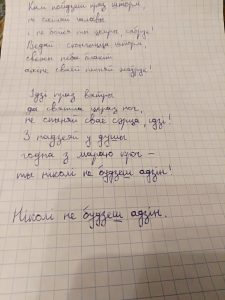
Andrei’s translation of the lyrics of Liverpool FC anthem You’ll Never Walk Alone
As of 6 July, the number of those arrested stands at more than 35,000. According to the Belarusian Association of Journalists (BAJ), 29 reporters, including Andrei, remain in captivity and 87 have been arrested since January 2021. They have been arrested because Lukashenko does not like what they are writing.
The conditions in Belarusian jails are appalling and a number of those detained have been tortured.
And yet, our former colleague Andrei has seemingly remained upbeat and has not cowed in the face of a regime that wants him silenced. Indeed, it seems that the famous words of Rodgers and Hammerstein have steeled another in times of adversity.
The connection, aside from the fact the song is indeed the club’s official anthem, is obvious. People in Liverpool have faced years of adversity and strife, be it through the bombing of the docks in the Second World War, the strikes of the 1970s and 1980s, or the dreadful injustice of the Hillsborough Disaster in 1989, their ability to draw resilience from a few lines of a musical written in 1945 has always been remarkable.
So, when a Liverpool fan watches, thousands of miles away, as his home country is torn apart by greed and corruption, it is little wonder that his own resolve derives from the very same words.
In a letter to Andrei Bastunets in April, chairperson of the BAJ, the jailed Aliaksandrau offered words of comfort to his close friend, quipping “It turned out so funny. As I went to jail, Liverpool stopped playing properly!”
Even though it was Aliaksandrau behind bars, it was Bastunets receiving reassurance. Aliaksandrau wrote: “In general, there were many reasons to repeat the club’s anthem to myself – You’ll Never Walk Alone.”
“Words of support from letters (sometimes – with the results of the matches) made me sing [and] play it in my head. One day it got to the point where I caught myself mumbling the club’s anthem in Belarusian. It seemed a bit pompous – but it is a hymn.”
“But it seemed to me that it was somehow in tune with the moment, [with my] feelings or mood. So, I decided to share it with you. As an Arsenal fan (sorry for this) you will understand me. At least [you know] what they sing about in Liverpool. And – you will never be alone!”
Andrei’s words remained upbeat despite the Belarusian regime making it even more difficult for Aliaksandrau since his arrest.
Those detained in the country must be released after six months unless they are charged and Andrei was expecting to be released around now, perhaps with a fine as others have been. But the authorities have now slapped the treason charges on him and he faces an uncertain future.
It was also announced in mid-July that Andrei’s lawyer Anton Gashinsky had his license revoked by the authorities. The prominent human rights lawyer also counts among his clients Sofia Sapega, the girlfriend of Roman Protasevich, the journalist who was recently arrested after his Ryanair flight was forcibly redirected by the Belarusian authorities when flying over Belarusian airspace after a faked bomb scare.
Dzmitry Navazhylau, Andrei’s friend and former colleague at Belapan news agency, where Aliaksandrau worked as deputy director, spoke of his friend’s sheer joy that could be found from watching his team.
“Liverpool FC, without exaggeration, is Andrei’s love,” said Navazhylau. “He is one of few Belarusians to have LFC Official Membership. He watched all Liverpool games on the internet with English commentary.”
Andrei used his time in the UK to good effect, he says.
“While working in London, he was lucky enough to see the Reds play live. At one point, there was no way to get a ticket to Anfield. Therefore, Andrei bought a season ticket for Fulham’s home games. He bought a season ticket for another club’s matches to attend one game of his favourite team! But it was worth it!”
Navazhylau recalls: “The most memorable match we watched together was the 2019 UEFA Champions League Final – Liverpool against Tottenham Hotspur. We were dressed in Liverpool kits, chanting, and singing “You’ll Never Walk Alone”. When Salah and Origi scored their goals, and especially after the final whistle, Andrei was as happy as a child.”

Andrei and his friend Dzmitry Navazhylau
It is unknown exactly when his fascination with the Reds began, but it is clear that his upbringing was in a household that was football mad. According to his friend and fellow journalist Kanstantin Lashkevich, Andrei’s father is “probably the only amateur statistician who tracks Belarusian lower-level leagues results”.
Like many fans, Andrei has spent a great deal of time, effort and money has been spent following his team over the years and it is a love for football and club that many on Merseyside can relate heavily to, as is his particular admiration for manager Jürgen Klopp and midfielder James Milner. He also travelled to Munich in 2019, as a journalist, to cover Liverpool’s quarter final Champions League tie with Bayern Munich.
And yet the reality is that, immortal as the words of You’ll Never Walk Alone are, they should not be used to sustain the sanity and goodwill of a man who has given much of his career to the protection of others.
Andrei’s situation is a reminder of how the day-to-day lives of people in a supposed democracy can deteriorate and why protests and free speech are so vital to protecting our individual rights and liberties.
When around 10,000 Liverpool fans marched out of a home game against Sunderland in 2016, protesting the rise of ticket prices, nobody was arrested.
When any person in the UK has to face the courts, for whatever reason, they do not have their legal representation forcibly removed from them.
But both of these things did happen to Andrei Aliaksandrau, whose only crime, many would argue, was embodying the spirit of what it is to be a Liverpool fan.
So how can Liverpool fans help Andrei realise he is not ‘walking alone’? You can sign the petition calling for the release of Andrei and his girlfriend – https://freeandreiandirina.org/ – and write to your local MP calling on the UK government to do more than just condemning the actions of ‘Europe’s last dictator’.
This article was originally printed in issue #276 of Liverpool FC fanzine Red All Over The Land. It has been published online with the kind permission of John Pearman. You can buy a copy outside Anfield on matchdays, or online here.[/vc_column_text][/vc_column][/vc_row][vc_row][vc_column][three_column_post title=”You may also like to read” category_id=”172″][/vc_column][/vc_row]
Why journalists and dissidents turn to Telegram
[vc_row][vc_column][vc_column_text]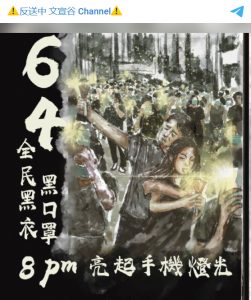 As you scroll through your Telegram feed, one image jumps out.
It shows crowds of young Hong Kongers, all dressed in black, at a protest, holding their smartphones aloft like virtual cigarette lighters from a Telegram channel called HKerschedule.
The image is an invitation for young activists to congregate and march to mark the anniversary of the Tiananmen massacre on 4 June. Wearing black has been a form of protest for many years, which has led to suggestions that the authorities may arrest anyone doing so.
Calls to action like this have migrated from fly posters and other highly visible methods of communication online.
Secure messaging has become vital to organising protests against an oppressive state.
Many protest groups have used the encrypted service Telegram to schedule and plan demonstrations and marches. Countries across the world have attempted to ban it, with limited levels of success. Vladimir Putin’s Russia tried and failed, the regimes of China and Iran have come closest to eradicating its influence in their respective states.
Telegram, and other encrypted messaging services, are crucial for those intending to organise protests in countries where there is a severe crackdown on free speech. Myanmar, Belarus and Hong Kong have all seen people relying on the services.
It also means that news sites who have had their websites blocked, such as in the case of news website Tut.by in Belarus, or broadcaster Mizzima in Myanmar, have a safe and secure platform to broadcast from, should they so choose.
Belarusian freelance journalist Yauhen Merkis, who wrote for the most recent edition of the magazine, said such services were vital for both journalists and regular civilians.
“The importance of Telegram has grown in Belarus especially due to the blocking of the main news websites and problems accessing other social media platforms such as VK, OK and Facebook after August 2020,” he said.
“Telegram is easy to use, allows you to read the main news even in times of internet access restrictions, it’s a good platform to quickly share photos and videos and for regular users too: via Telegram-bots you could send a file to the editors of a particular Telegram channel in a second directly from a protest action, for example.”
The appeal, then, revolves around the safety of its usage, as well as access to well-sourced information from journalists.
In 2020, the Mobilise project set out to “analyse the micro-foundations of out-migration and mass protest”. In Belarus, it found that Telegram was the most trusted news source among the protesters taking part in the early stages of the demonstrations in the country that arose in August 2020, when President Alexander Lukashenko won a fifth term in office amidst an election result that was widely disputed.
But there are questions over its safety. Cooper Quintin, senior security researcher of the Electronic Frontier Foundation (EFF), a non-profit that aims to protect privacy online, said Telegram’s encryption “falls short”.
“End-to-end encryption is extremely important for everyone in the world, not just activists and journalists but regular people as well. Unfortunately, Telegram’s end-to-end encryption falls short in a couple of key areas. Firstly, end-to-end encryption isn’t enabled by default meaning that your conversations could be intercepted or recovered by a state-level actor if you don’t enable this, which most users are not aware of. Secondly, group conversations in Telegram are never encrypted [using end-to-end encryption], lacking even the option to do so, unlike other encrypted chat apps such as Signal, Wire, and Keybase.”
A Telegram spokesperson said: “Everything sent over Telegram is encrypted including messages sent in groups and posted to channels.”
This is true; however, messages sent using anything other than Secret Chats use so-called client-server/server-client encryption and are stored encrypted in Telegram’s cloud, allowing access to the messages if you lose your device, for example.
The platform says this means that messages can be securely backed up.
“We opted for a third approach by offering two distinct types of chats. Telegram disables default system backups and provides all users with an integrated security-focused backup solution in the form of Cloud Chats. Meanwhile, the separate entity of Secret Chats gives you full control over the data you do not want to be stored. This allows Telegram to be widely adopted in broad circles, not just by activists and dissidents, so that the simple fact of using Telegram does not mark users as targets for heightened surveillance in certain countries,” the company says in its FAQs.
The spokesperson said, “Telegram’s unique mix of end-to-end encryption and secure client-server encryption allows for the huge groups and channels that have made decentralized protests possible. Telegram’s end-to-end encrypted Secret Chats allow for an extra layer of security for those who are willing to accept the drawbacks of end-to-end encryption.”
If the app’s level of safety is up for debate, its impact and reach is less so.
Authorities are aware of the reach the app has and the level of influence its users can have. Roman Protasevich, the journalist currently detained in his home state after his flight from Greece to Lithuania was forcibly diverted to Minsk after entering Belarusian airspace, was working for Telegram channel Belamova. He previously co-founded and ran the Telegram channel Nexta Live, pictured.
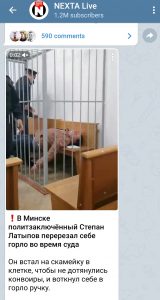
Nexta’s Telegram page
Social media channels other than Telegram are easier to ban; Telegram access does not require a VPN, meaning even if governments choose to shut down internet providers, as the regimes in Myanmar and Belarus have done, access can be granted via mobile data. Mobile data is also targeted, but perhaps a problem easier to get around with alternative SIM cards from neighbouring countries.
People in Myanmar, for instance, have been known to use Thai SIM cards.
The site isn’t without controversy, however. Its very nature means it is a natural home for illicit activity such as revenge porn and use by extremists and terror groups. It is this that governments point to when trying to limit its reach.
China’s National Security Law attempts to censor information on the basis of criminalising any act of secession, subversion, terrorism, and collusion with external forces, the threshold for which is extremely low. It has a particular impact on protesters in Hong Kong. Telegram was therefore an easy target.
In July 2020, Telegram refused to comply with Chinese authorities attempting to gain access to user data. As they told the Hong Kong Free Press at the time: “Telegram does not intend to process any data requests related to its Hong Kong users until an international consensus is reached in relation to the ongoing political changes in the city.”
Telegram continues to resist calls to share information (which other companies have done): it even took the step of removing mobile numbers from its service, for fear of its users being identified.
Anyone who values freedom of expression and the right to protest should resist calls for messaging platforms like Telegram to pull back on encryption or to install back doors for governments. When authoritarian regimes are cracking down on independent media more than ever, platforms like these are often the only way for protests to be heard
[/vc_column_text][/vc_column][/vc_row][vc_row][vc_column][three_column_post title=”You may also want to read” category_id=”581″][/vc_column][/vc_row]
Hijack, arrest, torture: Belarusian journalists under attack
[vc_row][vc_column][vc_single_image image=”116804″ img_size=”full” add_caption=”yes”][vc_column_text]The diversion of a Ryanair plane to Minsk over the weekend on the orders of Belaruisan president Alexander Lukashenko and the subsequent detention of independent journalist Roman Protasevich is the latest incident in a clampdown on independent media in the country.
Protasevich, working for Telegram channel Belamova, has been living in exile in Poland and Lithuania since 2019 because of concerns for his safety. His name appears on the List of Organizations and Individuals Involved in Terrorist Activities published by the State Security Committee (KGB), an includion which led him to referring to himself as “the first ever terrorist journalist” on his Twitter account.
Belarusian citizens increasingly have to go to independent media outlets such as Belamova, Nexta, Tut.by and others to find out the truth about what is happening in their country.An opinion poll conducted by Chatham House and released in February 2021 found that independent were by far the most trusted media.
As a result, president Alexander Lukashenko wants them shut down.
It is clear from the actions against Protasevich and others that the Belarusian authorities are trying to silence dissenting voices, constantly increasing the level of pressure on independent press representatives and grossly violating the right of their citizens to information. In official discourse, there are constant references to the “information war” against the state.
This latest actions of the Lukashenko regime ramps up what was already unprecedented pressure on the country’s journalists. RSF’s World Press Freedom Index shows that Belarus is Europe’s most dangerous country for those working in the media.
According to data from the Belarusian Association of Journalists (BAJ), there were more than 480 arrests of journalists in 2020. In 62 of these cases, journalists said they were subject to violence, including some cases of torture. In Minsk, at least three journalists were injured by rubber bullets as a result of police using firearms against peaceful protesters. Since the beginning of 2021, there have been 64 arrests, 38 searches and 5 attacks.
These figures represent the industrial scale judicial prosecution of journalists producing independent coverage of post-election developments in Belarus. Many have been sentenced to short jail terms or have been fined, some of them several times.
In 2020, Belarusian judges sentenced journalists in 97 cases to short jail terms (so-called ‘administrative arrests’), ranging from three to fifteen days. They are typically charged with alleged ‘participation in an unsanctioned demonstration or disobeying police’. Journalists report that the conditions of detention are inhumane – it is very cold, the lights are constantly left switched on, there is a lack of bed linen and hygiene items; many have to sleep on the floor.
A number of journalists are being held under more serious criminal charges simply for doing their job: three journalists have already been convicted.
The journalist Katsiaryna Barysevich, of influential online outlet Tut.by, was tried along with whistleblower doctor Artsyom Sarokin. Sarokin was given a fine and a suspended sentence of two years’ imprisonment. Barysevich was sentenced to six months’ imprisonment. In Barysevich’s case, the reason given was alleged ‘disclosure of confidential medical information causing grave consequences’ under the criminal code. She had published an exposé into a cover-up of the death of peaceful protester Raman Bandarenka.
The other two journalists, Belsat TV journalists Katsiaryna Andreyeva and Daria Chultsova, have been sentenced to two years in prison for supposedly ‘organising actions that grossly violate public order’. Andreyeva and Chultsova conducted a live broadcast of the violent dispersal of peaceful protesters paying tribute to Bandarenka in his neighbourhood.
On 16 February this year, the police raided the apartments of BAJ deputy chairs Aleh Aheyeu and Barys Haretski, along with at least six more BAJ members in different cities. They were investigating a criminal offence of ‘organising and preparing activities that grossly violate public order, or actively participating in them’. The BAJ office was searched and then closed by the police for almost a month.
As I write, there are 34 journalists and media workers behind bars being prosecuted for exercising their right to freedom of expression.
Of that number, 15 were detained by the Belarusian authorities after they began an unprecedented attack on Tut.by, Belarus’ most influential independent news website, on 18 May. The Belarusian Financial Investigation Department (DFR) launched a criminal case against Tut.by staff members for “large-scale tax evasion”, sending its agents to search the Tut.by editorial office in Minsk and its regional branches. The offices of related companies Hoster.by, Av.by, and Rabota.by in Minsk have been also raided. Investigators have also targeted the homes of a number of Tut.by journalists who work for the website and other staff members interrogated.
On the same day, the Ministry of Information of the Republic of Belarus blocked Tut.by and its mirror sites. The decision was taken on the basis of a notification from the General Prosecutor’s Office, which had established ‘numerous facts of violations of the Law on Mass Media’ and, specifically, the publication of materials coming from the Bysol Foundation, an unregistered fundraising initiative in support of victims of political repression in Belarus. Belarusian legislation prohibits the media from disseminating materials on behalf of unregistered organisations.
On 21 May, during an online press conference, Tut.by co-founder Kirill Voloshin, said: “At the moment we cannot restore the portal in the form of a mirror. The reason is that employees and owners do not have access to servers; there are no backups.”
Tut.by is one of more than 80 independent information websites blocked by the Ministry of Information since August 2020. Despite this, most of them continue to play a role in informing Belarusian citizens. Tut.by continues its work on social media and through two Telegram channels.
A number of journalists have been forced to flee Belarus but continue to work from abroad. Freelance journalist Anton Surapin is among them, who was recognised by Amnesty International as the “most absurd political prisoner” in the world in 2012 for his part in the so-called “teddy bears case” – a publicity stunt which saw stuffed bears dropped from a plane to draw attention to freedom of expression restrictions in the country.
When asked about the reasons for his departure, Surapin said: “I believe that now in Belarus there is a simply catastrophic situation in the field of human rights in general, and for journalists in particular. My colleagues are shot at, they are hunted by the security forces, they are imprisoned and deprived of their constitutional right to carry out professional activities.”
The barely credible seizure of Protasevich is not just about silencing him as a journalist – it is a message from Lukashenko that all dissenting voices in the independent media are fair game.[/vc_column_text][/vc_column][/vc_row][vc_row][vc_column][three_column_post title=”You may also want to read” category_id=”172″][/vc_column][/vc_row]