26 Jan 2015
Arts Award Nominees 2015
Recognises artists whose work asserts artistic freedom and battles repression and injustice.
 |
Winner
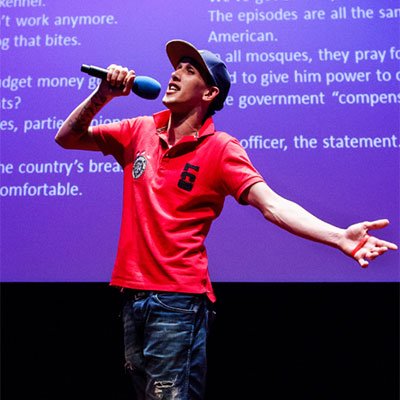
Mouad “El Haqed” Belghouat
Rapper
Morocco
“I am talking in the name of the people / Those who spoke up, and those who were stepped on / I am talking to you with no fear, and I will take the consequences.” Moroccan rapper and human rights activist El Haqed (roughly translated as ‘the enraged’) has not only seen his songs censored and his album banned but also been imprisoned three times since 2011 – including a one-year jail term for lyrics critical of the police in his song Dogs of the State. Imprisoned for four months in 2014, after seeing witnesses at his trial stopped from testifying and key pieces of evidence barred, El Haqed continues to make music about endemic corruption in the Moroccan state and widespread poverty in his country.
Acceptance speech: El Haqed: I will fight for freedom, equality and human rights for ever
Full profile: Arts nominee Mouad ‘El Haqed’ Belghouat
|
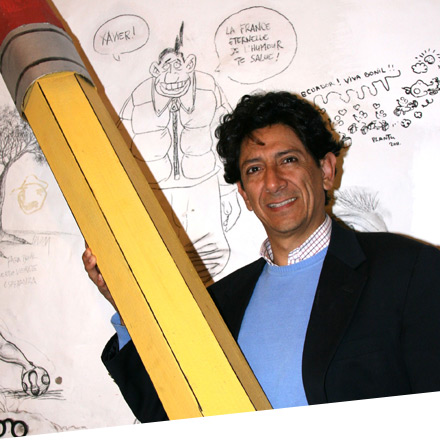
Xavier “Bonil” Bonilla
Cartoonist
Ecuador
Ecuadorian cartoonist Xavier Bonilla, aka Bonil, has repeatedly faced legal action, fines and smear campaigns from his country’s government. In 2013 President Rafael Correa introduced the Communications Act in Ecuador, ostensibly allowing government the right to decide what journalistic work was or wasn’t appropriate. The first to be targeted by this legislation, Bonil and El Universo newspaper were sued for publishing a cartoon about a heavy-handed raid on a journalist’s house. When the court fined the paper nearly £61,000 and ordered Bonil to draw a “retraction cartoon”, Bonil responded in his famously sarcastic style. With Bonil now involved in a second case against him, his refusal to back down in this cat-and-mouse with Correa has earned him a reputation as one of South America’s most fearless cartoonists. Full profile: Arts nominee Xavier “Bonil” Bonilla
|
 |
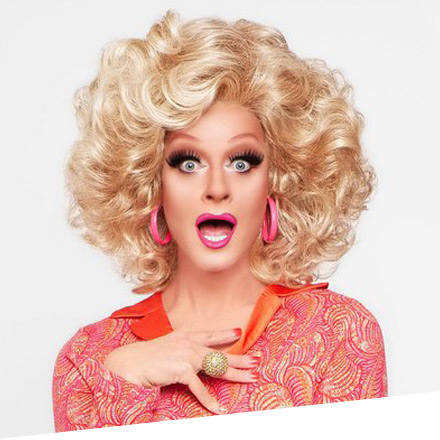 |
Rory “Panti Bliss” O’Neill
Performance artist
Ireland
Dublin-based drag queen and stand-up comedian Panti caused waves in the Irish media, and later Irish and European parliaments, for naming, on-air, two columnists and a Catholic lobbying group as examples of homophobia within Ireland’s media. The TV station hosting Panti backed down to legal threats, but O’Neill didn’t, taking to the stage of Dublin’s Abbey Theatre as Panti to eloquently defend his statements. The speech has had hundreds of thousands of YouTube views, and O’Neill’s subsequent show High Heels in Low Places both tells the story and details the difficulties gay people face in Ireland, a country in which homosexuality was a criminal act until 1988. Full profile: Arts nominee Rory “Panti Bliss” O’Neill
|
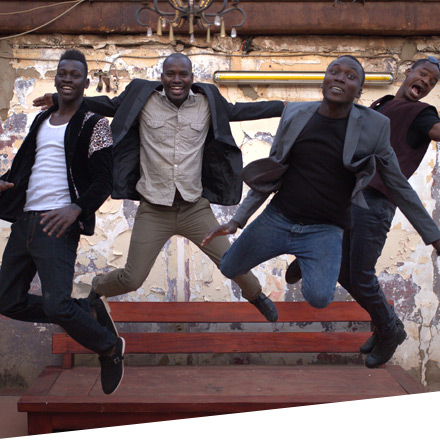
Songhoy Blues
Musicians
Mali
Fleeing North Mali after Islamist groups captured the area and imposed strict sharia law banning all secular music, four musicians who met as refugees came together to form the band Songhoy Blues. Calling for an end to the conflict, their music plays to an audience made up of both Songhoys and Tuaregs – two previously feuding North Malian groups now expelled from their homes by insurgent Islamist groups. After signing with Africa Express and collaborating with artists including Damon Albarn and the Yeah Yeah Yeahs in 2013, they began a worldwide tour last year. Their debut album, Music In Exile, will be released in February 2015. Full profile: Arts nominee Songhoy Blues
|
|
8 May 2014 | Europe and Central Asia, News

Eurovision contestant Teo, in the music video for this year’s Belarusian entry Cheesecake (Image: Yury Dobrov/YouTube)
If you want a Eurovision of the future, imagine a faux-dubstep bassline dropping on a human falsetto, forever. That was how it felt watching YouTube footage of this year’s entrants in the continent’s greatest song-and-dance-spectacle.
The Eurovision Song Contest, born of the same hope for the future and fear of the past as the European Union, is approaching its 50th year. And strangely, it’s doing quite well. In spite of fears that the competition would end up as an annual carve up between former Soviet states, recent years have in fact seen a fairly equal spread of winners throughout the member states of the European Broadcasting Union (who do not actually have to be in Europe; a fact often missed by anti-Zionists who somehow see a conspiracy in the fact that Israel is a regular entrant in the competition is that channels in countries such as Libya, Jordan and Morocco are also members of the EBU, and technically could enter if they wish. Morocco did, in 1980). Since 2000, the spread of winners between Western Europe, the former Soviet states, and the Balkans and Turkey have been pretty much even.
While some of the geopolitics will always be with us — Turkey and Azerbaijan united in their hatred of Armenia, Cyprus and Greece douze-pointsing each other at every opportunity — the once-derided contest has in fact functioned as a genuine competition. Year in, year out, the best song in the competition tends to win, while the laziest entrants, not taking the event seriously as a songwriting competition (yes, we’re looking at you, Britain), tend to fall behind and then complain that Europe doesn’t “get” pop music.
The best songs and singers triumph, by and large. But Eurovision still does have a political edge.
Take Tuesday’s semi-final in Copenhagen. Russia’s entry, Shine, performed by the Tolmachevy Sisters and described by Popbitch as sounding like “almost every Eurovision song you’ve ever imagined” contained some unintentionally ominous lines:
Living on the edge / closer to the crime / cross the line a step at a time
Add an “a” to the end of that “crime”, and you’ve got the Kremlin’s current foreign policy neatly summed up in a single stanza.
I am not suggesting that the Tolmachevys were sent out to justify Putin’s expansionism. Nonetheless, the Copenhagen crowd were keen that Russia should know what the world thought of its foreign policy and domestic human rights record: as it was announced that Russia had made Saturday’s grand final, the arena erupted in jeering. The dedicated Eurovision fan is clearly not just a poppet living in a fantasy world of camp. They are engaged with the world, and particularly the regressive policies of countries such as Russia, Azerbaijan and Belarus, perhaps more so than your average European.
When Sweden’s Loreen won the competition in Baku, capital of Azerbaijan, in 2012, she pledged to meet the country’s human rights activists. That same year, BBC commentator “Doctor Eurovision” (he actually is a doctor of Eurovision) made explicit references to Belarus’s disgraceful dictatorship, rather than simply giggle at the funny eastern Europeans.
This raises an interesting question about how we engage with dubious regimes.
Before the Baku Eurovision in 2012, there was some discussion over whether democratic countries should boycott the competition, sending a message to Aliyev’s regime.
“No,” Azerbaijani civil rights activists told Index on Censorship. “Let the world come and see Azerbaijan.” They felt that for most of the world, most of the time, they are citizens of a far away country of whom we know nothing. They wanted to take their chance while the world was looking. I think they got it right. As discussed last week, Azerbaijan is engaged in a massive international PR campaign, but to most people in the world since that Eurovision and the attention it raised for the country’s opposition, it has not been able to entirely disguise its atrocious record on free speech and other rights.
On Friday, the International Ice Hockey Federation’s world championship will open in Belarus. Though there was some discussion of boycotting that event, it has died down. Nonetheless, journalists from Europe and North America will be covering the event, and fans will travel too.
Belarus’s macho dictator Alexander Lukashenko is a keen ice hockey fan, and will be aiming to sweep up the glory of hosting a major international sporting event, not long after the country hosted the world track cycling championships in 2013.
Ice hockey fans and sports journalists are generally not the type of people who go in for Eurovision. But maybe they should try to take a leaf out of the Song Contest supporters book. Have a look at the country around them, learn a little about the politics, and spread the word about the side the dictators don’t want us to see.
Autocrats try to use these international competitions to control the world’s view of them. We should beat them at their own games.
This article was posted on May 8, 2014 at indexoncensorship.org
4 Apr 2014 | About Index, Campaigns, Press Releases
World leaders must commit to keeping invasive surveillance systems and technologies out of the hands of dictators and oppressive regimes, said a new global coalition of human rights organizations as it launched today in Brussels.
The Coalition Against Unlawful Surveillance Exports (CAUSE) – which includes Amnesty International, Digitale Gesellschaft, FIDH, Human Rights Watch, the New America Foundation’s Open Technology Institute, Privacy International, Reporters without Borders and Index on Censorship – aims to hold governments and private companies accountable for abuses linked to the US$5 billion and growing international trade in communication surveillance technologies. Governments are increasingly using spying software, equipment, and related tools to violate the right to privacy and a host of other human rights.
“These technologies enable regimes to crush dissent or criticism, chill free speech and destroy fundamental rights. The CAUSE coalition has documented cases where communication surveillance technologies have been used, not only to spy on people’s private lives, but also to assist governments to imprison and torture their critics,” said Ara Marcen Naval at Amnesty International.
“Through a growing body of evidence it’s clear to see how widely these surveillance technologies are used by repressive regimes to ride roughshod over individuals’ rights. The unchecked development, sale and export of these technologies is not justifiable. Governments must swiftly take action to prevent these technologies spreading into dangerous hands” said Kenneth Page at Privacy International.
In an open letter published today on the CAUSE website, the groups express alarm at the virtually unregulated global trade in communications surveillance equipment.
The website details the various communication surveillance technologies that have been made and supplied by private companies and also highlights the countries where these companies are based. It shows these technologies have been found in a range of countries such as Bahrain, Brazil, Côte d’Ivoire, Egypt, Ethiopia, Libya, Nigeria, Morocco, Turkmenistan, UAE, and many more.
“Nobody is immune to the danger communication surveillance technologies poses to individual privacy and a host of other human rights. And those who watch today, will be watched tomorrow” sadi Karim Lahidji, FIDH President. “The CAUSE has been created to call for responsible regulation of the trade and to put an end to the abuses it enables” he added.
Although a number of governments are now beginning to discuss how to restrict this trade, concerns remain. Without sustained international pressure on governments to establish robust comprehensive controls on the trade based on international human rights standards, the burgeoning proliferation of this intrusive technology will continue – fuelling even further abuses.
“There is a unique opportunity for governments to address this problem now and to update their regulations to align with technological developments” said Tim Maurer at New America’s Open Technology Institute.
“More and more journalists, netizens and dissidents are ending up in prison after their online communications are intercepted. The adoption of a legal framework that protects online freedoms is essential, both as regards the overall issue of Internet surveillance and the particular problem of firms that export surveillance products,” said Grégoire Pouget at Reporters Without Borders.
“We have seen the devastating impact these technologies have on the lives of individuals and the functioning of civil society groups. Inaction will further embolden blatantly irresponsible surveillance traders and security agencies, thus normalizing arbitrary state surveillance. We urge governments to come together and take responsible action fast,” said Wenzel Michalski at Human Rights Watch.
The technologies include malware that allows surreptitious data extraction from personal devices; tools that are used to intercept telecommunications traffic; spygear used to geolocate mobile phones; monitoring centres that allow authorities to track entire populations; anonymous listening and camera spying on computers and mobile phones; and devices used to tap undersea fibre optic cables to enable mass internet monitoring and filtering.
“As members of the CAUSE coalition, we’re calling on governments to take immediate action to stop the proliferation of this dangerous technology and ensure the trade is effectively controlled and made fully transparent and accountable” said Volker Tripp at Digitale Gesellschaft.
NGOs in CAUSE have researched how such technologies end up in the hands of security agencies with appalling human rights records, where they enable security agents to arbitrarily target journalists, protesters, civil society groups, political opponents and others.
Cases documented by coalition members have included:
• German surveillance technology being used to assist torture in Bahrain;
• Malware made in Italy helping the Moroccan and UAE authorities to clamp down on free speech and imprison critics;
• European companies exporting surveillance software to the government of Turkmenistan, a country notorious for violent repression of dissent.
• Surveillance technologies used internally in Ethiopia as well as to target the Ethiopian diaspora in Europe and the United States.
21 Jan 2014 | Middle East and North Africa, News
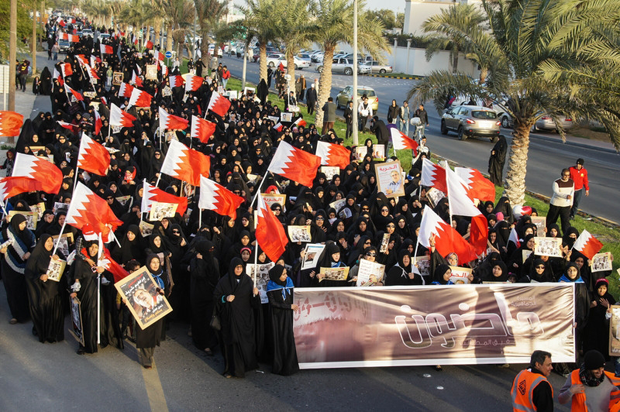
A pro-democracy protest in Bahrain, where activists have been jailed for inciting protests through their online activities (Photo: Moh’d Saeed / Demotix)
One hundred and forty characters are all it takes.
Twitter users from Marrakech to Manama know—call for political reforms, joke about a sensitive topic, or expose government abuse and you could end up in jail. Following the overthrow of Muammar Qaddafi and Zine el-Abidine Ben Ali, authorities in Libya and Tunisia unblocked hundreds of websites and dismantled the state surveillance apparatus. But overall, internet freedom in the region has only declined in the three years since the Arab Spring as authoritarian leaders continue to crack down on any and all threats to their ever-tenuous legitimacy.
As the online world has become a fundamental part of Arab and Iranian societies, leaders are waking up to the “dangers” of social media and placing new restrictions on what can be read or posted online. This shift has been most marked in Bahrain, one of the most digitally-connected countries in the world. After a grassroots opposition group took to the streets to demand democratic reforms, authorities detained dozens of users for Twitter and Facebook posts deemed sympathetic to the cause. Similarly, several prominent activists were jailed on charges of inciting protests, belonging to a terrorist organization, or plotting to overthrow the government through their online activities.
Conditions in Egypt—where social media played a fundamental role in mobilising protesters and documenting police brutality—continued to decline over the past year. In only the first six months of Mohammad Morsi’s term, more citizens were prosecuted for “insulting the office of the president” than under Hosni Mubarak’s entire 30-year reign. Cases have now been brought against the same bloggers and activists that were instrumental in rallying the masses to protest against Mubarak (and later Morsi) in Tahrir Square, while countless others were tortured by Muslim Brotherhood thugs or state security forces.
Even in the moderate kingdoms of Morocco and Jordan, state officials are looking to extend their existing controls over newspapers and TV channels to the sphere of online media. Ali Anouzla, a website editor in Morocco, faces terrorism charges in the latest attempt by the state to silence him and his popular online newspaper, Lakome. Access to independent journalism is even worse in Jordan, where over 200 news sites have been blocked for failing to obtain a press license. The government instituted burdensome requirements in a bid to deter any views that counter the state-sponsored narrative.
If governments are beginning to pay attention, it is because online tools for social mobilisation and individual expression are having a profound impact. Social media accounts were set up for every candidate in Iran’s 2013 presidential elections, despite the fact that Twitter, Facebook, and YouTube are all blocked within the country. In Saudi Arabia – which now boasts the highest Twitter and YouTube usage per capita of any country in the world – social media has been used to promote campaigns for women’s right to drive, to highlight the mistreatment of migrant workers, and to debate sensitive subjects such as child molestation. Citizen journalism was vital in documenting chemical weapons use in Syria, and a new online platform alerts local residents of incoming scud missiles. Nonetheless, Iran, Saudi Arabia, and Syria rank as some of the least free countries in the world in terms of internet freedom according to Freedom House’s Freedom on the Net study.
Remarkably, the country that has made the most positive strides over the past three years, was once among the most repressive online environments in the region – Tunisia. Protest videos from the town of Sidi Bouzid led to an intense crackdown on online dissidents by the Ben Ali regime. Digital activists even enlisted the help of Anonymous, the hacktivist group, to rally international media attention, provide digital security tools, and bring down government websites. Since then, Tunisian authorities have ceased internet censorship, reformed the regulatory environment, and ceded control of the state-owned internet backbone. Tunisia is now the only country in the region to have joined intergovernmental group the Freedom Online Coalition.
So while the snowball effect of social media contributed to the overthrow of several despots, many of the region’s internet users conversely find themselves in more restrictive online environments than in January 2011. Authoritarian governments now know exactly what the face of revolution looks like and, over the past three years, have shown their commitment to counter the internet’s potential to empower citizens and mobilise opposition. Users in liberal democracies may joke about the insignificance of “liking” a post on Facebook or uploading a video to YouTube, but in a region where your social media activity can make you an enemy of the state, 140 characters can lead to serious repercussions.
This article was posted on 21 January 2014 at indexoncensorship.org