Street artists use anonymity to accentuate the message
In the latest issue of Index on Censorship magazine, The Unnamed: Does anonymity need to be defended?, Index’s contributing editor for Turkey, Kaya Genç, explores anonymous artists in Turkey. In the piece the artists discuss how vital anonymity is in allowing them to complete their more controversial work. The Index on Censorship youth advisory board have taken inspiration from this piece for their latest task, in which they investigate anonymous art around the world.
Keizer by Constantin Eckner
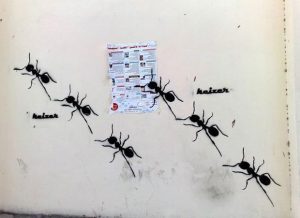
Ants feature in Keizer’s work to sybolise “the forgotten ones, the silenced, the nameless, those marginalised by capitalism”. Image: Keizer
Prior to the January 25 Revolution political street art was anything but common in Egypt, yet it has proliferated in public spaces in the aftermath of the revolution. One of the most productive street artists in Cairo is Keizer, who has gained popularity and notoriety in recent years. Like Banksy and other street artists, he uses the well-known stencil technique to empower his fellow countrymen, and people in general, with his thought-provoking work. He likens people to ants, which are featured in most of his graffiti. Keizer explains on his Facebook account that the ant “symbolises the forgotten ones, the silenced, the nameless, those marginalised by capitalism. They are the working class, the common people, the colony that struggles and sacrifices blindly for the queen ant and her monarchy.”
Asked about the reason for protecting his identity, Keizer said: “I am very concerned over my safety and the repercussions of street art which I’ve already had a taste of, especially with this current regime. Including death threats,
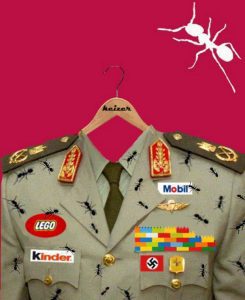
Egyptian street artist Keizer has gained popularity in recent years. Image: Keizer
my twitter account was hacked twice. In the past five years of working on the street I’ve been caught once. I came out of it with a few bumps and bruises, nothing major. I consider myself lucky that I came out one day later.
“You can imagine that being caught here is very different than being caught in Europe. There is no proper procedure and that makes you a victim of the person handling you, and the uncertainty of what comes next. Graffiti is a grey area here, they don’t have any definition or classification for it in the books, so they make it up as they go along, taking you for the fear ride. It’s all under vandalism, so they can make it look small or escalate it to exaggerated levels. For instance, you can be dubbed as a political traitor; it can be considered racketeering; they can glue your name to any political movement unpopular with the people…etc.”
Tall walls, low profiles: Icy and Sot by Layli Foroudi
Icy and Sot describe themselves as stencil artists from Tabriz, Iran. As for their identities, they reveal only that they are brothers, born in 1985 and 1991. Their work is created under pseudonyms in countries around the world, including Iran, USA, Germany, Norway, and China, on legal and illegal walls as well as in galleries.
The anonymous duo, who paint on themes like human rights, censorship, and justice, say that charges against artists in Iran make going public risky.
“Pseudonyms help us to keep a low profile,” the brothers explained in an interview with ArtInfo, “Being arrested in Iran is completely different, because they charge you with crimes that you have not even committed, like Satanism or political crimes.”
Their work often uses striking human faces in black and white to make statements about politics and the environment, to call for peace, and to direct messages at the government of Iran. In 2015, Icy and Sot used their art to protest for freedom of expression in Iran, prompted by the arrest and 18-month imprisonment of Atena Farghadani, an Iranian artist who was detained for publishing a cartoon that satirised the Iranian government as animals. In solidarity, they stenciled a tribute piece depicting Farghadani with a backdrop of protesters on a wall in Brooklyn.
Maeztro Urbano’s fight to change a criminal image by Ian Morse.
In the most recent data, Honduras has the highest homicide rate in the world, with 84 intentional homicides per 100,000 people in 2013. The prominence of drug trafficking and ubiquity of poverty does not improve its reputation.
To some Hondurans, their country’s international image has done nothing but hurt citizen’s attempts to improve daily life in the country’s bustling cities and lively cultural centers. Maeztro Urbano and his friends became the face of an urban street art project to disrupt the atmosphere of crime and reveal another side of the country outside of the headlines.
His projects range from adjusting street signs promoting gender equality to vandalising billboards with corrupt politicians, to wall graffiti showing the effect of violence on children. Working his day shifts in the advertising industry, Maeztro Urbano said he wants to contribute more to his country than proliferating consumerism.
“Change should start within society. With each individual,” El Maestro – as he is also called – told The Creators Project. “To have respect for the lives of others, to respect the right to sexual diversity, to a better education.”
“If we don’t change that as a society and as individuals, we will never be able to change as a country.”
Assailants in Honduras have not been very hospitable to those reporting on crime or those wishing to express their identity. Faced with police harassment and shootings from unknown attackers, Maeztro Urbano chooses to wear a mask while he works to spread messages of hope around the country.
Bleeps.gr: Over a decade of political artivism in Athens by Anna Gumbau.
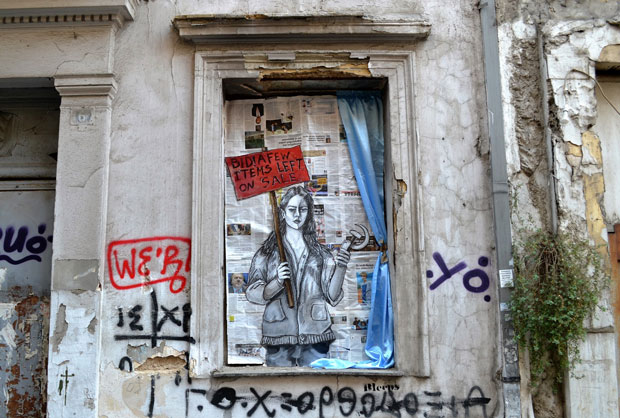
Bleeps.gr is one of Greece’s most prominent street artists, having painted murals on the streets of Athens for over 10 years. Image: Bleeps.gr
“I have been radically oriented to the political discourse, utilising the public sphere, and I am not afraid or discouraged”, Bleeps.gr, one of the most prominent Greek street artists, told Index.
Bleep.gr has been designing murals, that are mostly critical of the austerity policies imposed to Greece, on the streets of Athens for over 10 years. The Greek social turmoil has had a strong influence on his artwork, not only in his scenes, but even in his methods. “I buy very cheap materials and can’t afford those impressive equipment to create a mural”, he said in an interview with Street Art Europe.
Bleeps.gr chooses to use a pseudonym as an attempt to challenge “the institutionalised perception of the identity”, he told Index. While he is not afraid of the state authorities, he points at art institutions, such as galleries, exhibitions and festivals, who reject and exclude his art. “Most of the censorship I have received has come from other artists, especially the ones related to systemic initiatives, who in the past years have removed all of my works from the city center” he said. Greek political street artists often suffer from the exclusion of art galleries and exhibitors; in the summer of 2013, the CRISIS? WHAT CRISIS? street art festival in Athens, which celebrates the value of street art in the current political happenings, invited 20 artists from different European countries but failed to invite any Greek artists.
Nevertheless, Bleeps.gr stresses the fact that the internet “has provided a virtual field of allocation”, and most of the political street art discourse happens there.
Bleeps.gr highlights the mechanisms of such institutions to “absorb street artists” and make them become part of the art “business”, adding: “the majority of them nowadays serve gentrification policies and turn policies and turn political art into a spectacle for tourist pleasure”.
King of Spades by Sophia Smith-Galer.
The security forces removed the KSA King caricature from Jal el Dib, so make you spread it online.. #Lebanon pic.twitter.com/2yCK0QAE
— عاصي +2 (@jeanassy) February 19, 2013
When it comes to anonymous artists, the art tends to speak far louder than any speculation into the artist themselves. This anonymous artist in Lebanon is no Arab Banksy that lurks tantalisingly close to the limelight; this artist could quite literally be anyone, and the lack of anybody claiming the piece as their own is revelatory of the grave reality of artists in developing countries that test the patience of despots and tyrants.
Despite its tired and no longer relevant label “Paris of the Middle East”, even the dazzlingly artistic city of Beirut, Lebanon, can’t quite get away with hanging something like this banner, depicting the late Saudi Arabian monarch King Abdullah bin Abdul Aziz as a brutal King of Spades. Shortly after its creation in 2013, the Lebanese state prosecutor ordered an investigation to reveal the source of these posters after complaints from Saudi Ambassador Ali Awad Asiri.
It seems that nobody got caught, and nor do I particularly want to dwell on what would have happened to the artist if they had. But in the Middle East, such a daring artistic expression must be forbidden fruit in a region of gagged political artistry; demonstrated no better than in this mysterious artist who gambled with the assumed impunity of that gentleman with the bloodied scimitar.
Dede Bandaid by Shruti Venkatraman.
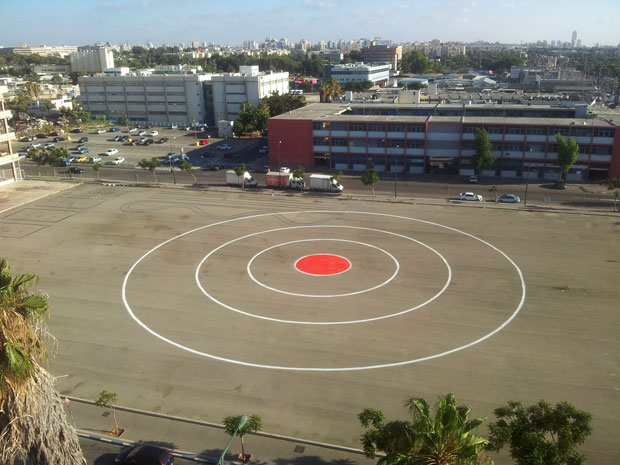
One of Dede Bandaid’s most well known works, a missile target painted in the middle of a large car park, a reference to the Gaza conflict in 2014. Image: Dede Bandaid / Wikicommons
Dede Bandaid is an anonymous Israeli artist who has added colour to Tel Aviv’s streets with thought provoking and politically relevant street art. His artistic career began in 2000 during his compulsory military service, and most of his earlier pieces demonstrated a clear anti-establishment sentiment. His more recent works, following the end of his stint in the military, aim to communicate social and political messages. One of his most well known works is a missile target painted in the middle of a large car park, a reference to the Gaza conflict in 2014.
Dede enjoys using public spaces as a canvas as this approach allows freer and more controversial expression, while also being accessible to and viewable by a larger audience especially when the street art is photographed and its images are circulated online. He also makes use of traditional symbols of peace, like the white dove, and frequently incorporates Band-Aids that represent healing and remedy in his artwork, with “Bandaid” being the pseudonym he signs on all his pieces. Over time, Dede’s style has evolved from stencilling to free-hand painting and collage and he interestingly also exhibits certain pieces in galleries across the world.
Cabbage Walker in Kashmir by Niharika Pandit.
Walking a cabbage in #Kashmir – to #protest the absurdity of #warhttps://t.co/0Uc2DBL6tm #India #Pakistan #art pic.twitter.com/1EycmuKKVD
— Marianna Tzabiras (@mtzabiras) February 18, 2016
A pheran-clad man walks around with a cabbage on a leash in the neighbourhoods of Srinagar, Kashmir. This performance act that he presents is inspired by Chinese artist Han Bing’s “Walking the Cabbage” social intervention work. While Bing chose to walk the cabbage to reflect on the changing values in the Chinese society, where once cabbage was a subsistence food product but is now only embraced by the poor, in Kashmir, this anonymous artist aims to normalise the cabbage walking to show the absurdity of militarisation in the region. Both the performances employ cabbage as an element of satire to expose the irony inherent in what how elitism and militarisation come to be normalised in societies across the world.
The Kashmiri Cabbage Walker writes on his blog, “I as a Kashmiri am willing to recognise walking the cabbage as part of the Kashmiri landscape but I will never accept the check posts, the bunkers, the army camps, the torture centers, the barbed wire, the curfews, the arrests, the toxic environment of conflict and war, as part of the same.”
This performance artist chooses to remain anonymous as it helps in focusing on the message and not the messenger. The Kashmiri Cabbage Walker says that he represents all Kashmiri lives under militarisation thereby revealing the artist’s identity becomes unimportant here.
Cracked pavements in Budapest by Fruzsina Katona.
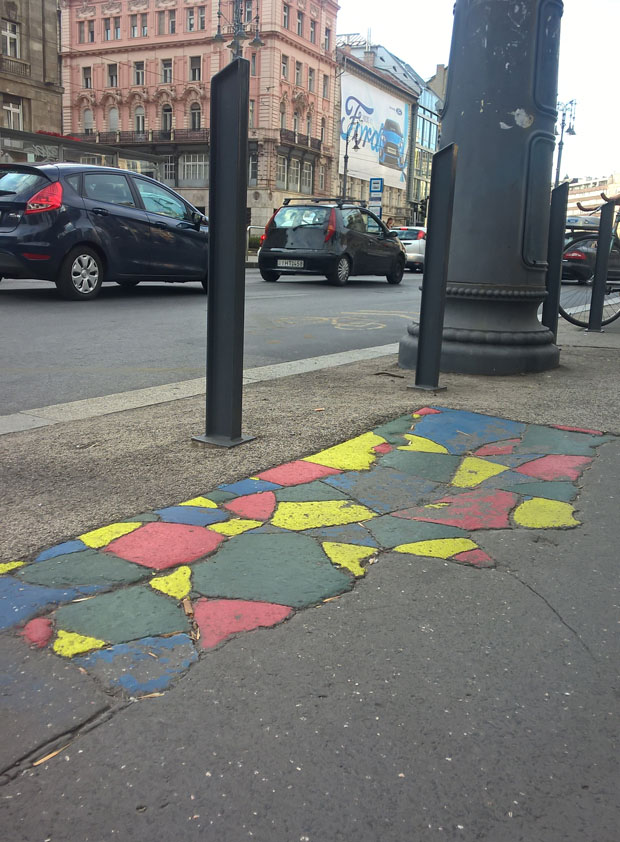
Anonymous volunteers have joined the satirial political party the Two-Tailed Dog party (MKKP) to paint cracked pavement on the streets of Budapest. Image: Fruzsina Katona
Anonymity does not necessarily mean that one is trying to hide his or her identity. Sometimes the identity of the person is utterly irrelevant. In Budapest, several anonymous volunteers are painting the streets of the city.
The pavement on the streets of the Hungarian capital are falling apart, ruining the image of the city and endangering those who walk on it. Authorities are known to do very little to fix the problem, but something had to be done. Hungary’s satiric political party, the Two-Tailed Dog party (MKKP) called for action and its artsy, anonymous volunteers started colouring the cracked pavement pieces resulting in dozens of cheerful spots across the city.
Unfortunately, there are some who find quarrels in a straw, and the police were called on the ad-hoc artists while they were peacefully decorating the pavement in a touristic neighbourhood. Now the volunteers are being prosecuted with vandalism.
But we still do not know their identity or how many of them are out decorating. All we know is that now we look at colourful patches of pavements while running our errands, instead of the sad and ugly cracked pavements.
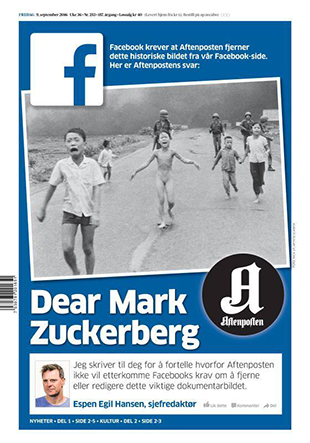 Index on Censorship, a global organisation that campaigns for free expression, fully supports the action of Norway’s Aftenposten newspaper in refusing a request from Facebook to remove an iconic photo of the Vietnam War that features a naked child running from a napalm attack.