12 Apr 2016 | Awards, mobile
Indonesian comedian Sakdiyah Ma’ruf, a nominee for the 2016 Index on Censorship Freedom of Expression Award for arts, was born to conservative Muslim family in Java and went on to become one of very few female stand-up comedians in the country to appear on national TV.
British comedian Shazia Mirza, the host of this year’s awards, talks to her about tackling no-go subjects, trying to win family approval, and how the stand-up scene is growing for women in Indonesia.
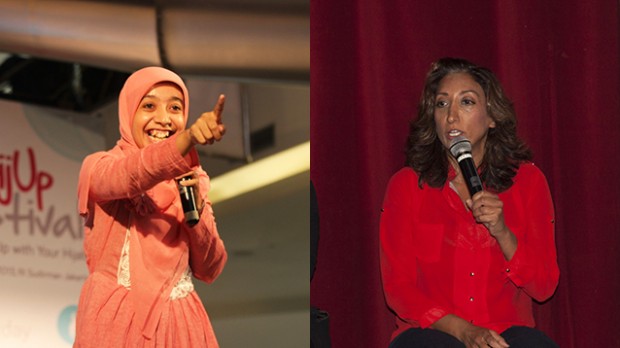
Sakdiyah Ma’ruf (left) and Shazia Mirza (right)
SHAZIA: Have your parents come to watch you do stand-up?
SAKDIYAH: My parents came to one of my shows once. It was in 2012 in one of the biggest theatres in Jakarta. I invited them to the show because it was held in a “dignified” building. I wanted to help my parents, and especially my dad, see that I was doing a “dignified” job.
I was very nervous. It was a full house. But I didn’t care whether the audience liked me or not, as long as I could get at least silent approval from my dad.
Since the show, my dad has supported me in my career as a comedian – not fully perhaps – but from this moment on, he knew that stand-up was something I did and would continue to do – in addition to the other “real jobs” I have.
I remember my parents saying they were pretty nervous about how the audience would respond to me. Perhaps my dad thought he could accept what I was doing if I gained approval from at least half of the audience.
The truth is that it isn’t always easy to get out of the house to perform. In June 2015 I was invited to open for a good friend of mine who is one of the biggest stand-up comics in Indonesia. He called me in April for the gig and it took me almost a month just to craft the right sentence to ask for my dad’s permission to perform.
SHAZIA: Do you say exactly what you want to? Or do you think: “No I can’t say that, people might get upset”
SAKDIYAH: The truth is that I rarely say exactly what I want to. I mean, can you imagine expressing all those voices in your head to the audience?
I say what I believe in; what I have experienced; what I am concerned about; what I like; what I don’t like; what I’m angry about… For me, comedy is always about telling the truth. You can’t be genuinely funny without being completely honest with yourself and your audience.
But I do self-censor, I self-censor all the time! I’m not afraid to talk about taboo topics like religion, race relation, a bit of sex etc – but only if it helps me to be honest with myself and my audience to be honest with themselves. I make sure I craft my jokes on these topics in a way that is truly funny; otherwise I’ll just sound like another girl complaining about how unfair life is.
I also make sure I’m being fair. I fact-check before I talk about something, so that I don’t just make things worse.
SHAZIA: Are you the only woman in Indonesia doing stand-up?
SAKDIYAH: No, of course not. I was the first, but the number is now growing. Every year there are new female stand-up comics performing on TV or participating in competitions.
SHAZIA: Do you feel pressure to talk about “heavy” subjects, like Islamophobia and terrorism, in your comedy? Or do you prefer to talk about lighter things sometimes – like shopping, dating, going on holidays.
SAKDIYAH: I want to talk about the issues that matter to me, things I can relate to, things that are part of who I am and what I have experienced.
I love talking about Muslims and the way they practice and interpret their religion. I talk about Islamophobia, violence towards women, the idea and construction of femininity and masculinity, my ethnicity.
Yeah, sometimes I feel such pressure to talk about “heavy” topics, but for what it’s worth, I think there is no such thing as a “light” topic in comedy. With a great comedian, even jokes about a refrigerator can bring new insights on humanity.
And I guess this is what is so beautiful about comedy: it helps us get to know who we are who others are as well. Every individual has multiple identities. I have been perceived as this Muslim girl fighting against fundamentalism through her comedy. While this is true, I do not want to just be seen as some kind of a “comedy jihadist” fighting against fundamentalists. I have layers to my identity, just like everybody else.
SHAZIA: Do you receive letters and emails from people who have seen your performances? What kind of things do they say? What do women say?
SAKDIYAH: Yes, I do. A woman once asked me whether I am a “true” Muslim. Perhaps she considered my jokes too daring or inappropriate for a Muslim woman to tell. She asked me all these questions about whether I really wear the hijab every day and whether I pray five times a day.
I like getting these kinds of responses. I feel like these people genuinely care about me or at least about Muslim women in general.
8 Apr 2016 | Magazine, mobile, Student Reading Lists
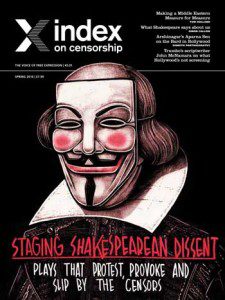
Order your copy of the Staging Shakesearean dissent here.
Order your copy of Index on Censorship here
To mark the release of the spring 2016 issue of Index on Censorship magazine Index has compiled a reading list of articles from the magazine archives covering the censorship of theatre. The latest issue, Staging Shakespearean Dissent, takes a look at how Shakespeare’s plays have allowed directors to tackle issues that would have otherwise been censored in countries around the world.
Egoli — City of Gold
August 1982 vol. 11 no. 4
Performances of South African play Egoli, by writer Matsemela Manaka, went ahead at a Johannesburg theatre without being censored, yet the printed version – an extract of which is featured in this article – was banned. Egoli, which means “city of gold”, focuses on the plight of migrant mine workers in South Africa. Its two characters, John Moalusi Ledwaba and Hamilton Mahonga Silwane, were in prison at the same time: one for a political crime, the other for rape and murder. Now they work in the gold mines, while their families attempt to farm in the “homelands”.
Read the full article here.
Knife edge
March 2015 vol. 44 no. 1
Lucien Bourjeily’s 2013 play Will It Pass or Not? was banned by Lebanon’s censorship bureau, yet his 2015 play For Your Eyes Only, Sir was approved after some minor changes, despite the play including scenes from its banned prequel. Aimée Hamilton talks to Bourjeily about why his new play escaped the censors when his previous one didn’t, and what inspired it; and For Your Eyes Only, Sir is translated into English for the first time for Index on Censorship magazine.
Read the full article here.
Oh! How I miss the termite
July 1979 vol. 8 no. 4
Despite government assurances that it was lifting restrictions on Brazilian stage productions in April 1979, theatres were among the most censored over the next decade. Every play had to be submitted to the censor in Brasilia before it was staged, and a complete rehearsal had to take place in the presence of a censor of the town in which the play was being performed. In December 1978 one of Brazil’s best know playwrights Plínio Marcos, notorious for having 18 of his works suppressed without performance, wrote the play Oh! How I Miss the Termite to be read only, believing he could not get the play performed publicly.
Read the full article here.
My Temptation
November 1986 vol. 15 no. 10
In an interview with Czech exile Karel Hvizdala, for inclusion in a book of interviews he was working on, Czechoslovakian playwright Vaclav Havel, who was unable work in his profession in his own country – where nothing he had written had been published or performed since 1969 – speaks about his latest plays Largo Desolato and Temptation.
Read the full article here.
A censored life
February 1985 vol. 14 no. 1
Karel Kyncl tells the story theatre and film actress Vlasta Chramostová, her Living Room Theatre, and how Shakespeare was used as a form of resistance. In the 1960s and 70s Czechoslovakian actors put on performances of Macbeth in houses, which they called Living Room Theatre. However, Shakespeare was seen as an enemy of socialism by Czechoslovakia police, who began to harass the actors. The actors continued to perform despite pressure from the police but eventually some of these actors were driven into exile.
Read the full article here.
Shame in Birmingham
May 2005 vol. 34 no. 2
Janet Steel discusses the censorship Gurpreet Kaur Bhatti faced when the British-Pakistani playwright attempted to put on her production Behzti at the Birmingham Repertory Theatre. The local Sikh community called for the play to be banned, stating it incited racial hatred, which led to Bhatti receiving threats because of her work.
Read the full article here.
Nan Levinson: Bowdler revisited
March 1990 vol. 19 no. 3
Nan Levinson discusses censorship of Romeo and Juliet in textbooks in American schools. Artist Janet Zweig read an article written by a student about the discrepancies between the play in his school textbook and the version he saw on stage. Over 300 lines had been cut from the play, the majority of which contained sexual references. Zweig spoke to publishers and found the publishers that didn’t cut lines from the textbook didn’t sell as many as those who did. She went on to make a book from the 336 lines that were cut from the textbooks, part of which is featured in this article.
Read the full article here.
Dame Janet Suzman: Stage directions in South Africa – June 2014 vol. 43 no.2
Dame Janet Suzman’s 1987 production of Othello in South Africa caused a huge amount controversy due the production showing a relationship between a black man and a white woman during the apartheid. Many people left the production in protest and sent threatening letters, however the play escaped being banned or censored because it was Shakespeare. In this article Suzman discusses why she chose to put on such a controversial production and how through Shakespeare they escaped the censors.
Read the full article here.
The fate of Tang Xianzu
November 1998 vol. 27 no. 6
The long awaited revival of a 400-year-old classical opera, in rehearsal at Shanghai’s Kunju Theatre, was called off by the Shanghai Bureau of Culture. It accused the director of introducing “archaic, superstitious and pornographic” elements into his production and vetoed its export first to New York and subsequently to France, Australia and Hong Kong. Mu Dan Ting, (Peony Pavilion), had not been performed in its entire act since it was written by Tang Xianzu in 1598 during the Ming Dynasty, as it was written out of classical repertoire under the communists. However director Yang Lian believes this time round its banning has more to do with political manoeuvering than the nature of the opera itself.
Read the full article here.
Theatre Censorship
August 1980 vol. 9 no. 4 23-28
“Censorship in the theatre has always been more petty and strict than censorship in general – that of literature, for instance. Sadly, it has often been the finest examples of Russian drama that have not reached the stage until several years – sometimes decades – after they were written.” Anna Tamarchenko discusses the censorship of Russian theatre throughout the years.
Read the full article here.
Order your copy of Index on Censorship here or take out a digital subscription via Exact Editions (just £18 for the year, with a free trial).
4 Apr 2016 | Awards, Fellowship, Fellowship 2016, Middle East and North Africa, Syria
A Syrian-native who was studying journalism in London when war broke out in Syria in 2013, Zaina Erhaim decided to return permanently to report and train citizen journalists in the war-ravaged country. Between the violence and deadly misogyny of IS and the bombing raids of Russian allies of Assad the danger of living in the region as a female reporter is immense. However, Erhaim has trained hundreds of journalists, including many women.
In this photo essay, Erhaim explains her work and her life in Syria.
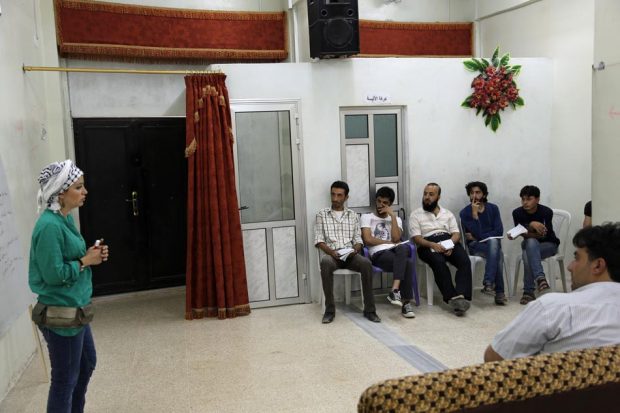
After the revolution in 2011, many Syrians became citizen journalists to report the regime’s crackdown on the demonstrations. Without any background in journalism or reporting, hundreds of activists became the main source of news and information for the rest of the world. I felt a responsibility to pass the knowledge and skills I had in journalism to them, and this is the first training I did in the suburbs of Edlib. Two of the trainees passed these skills to 40 other activists, some of whom are now publishing features and reports for the Syrian media.
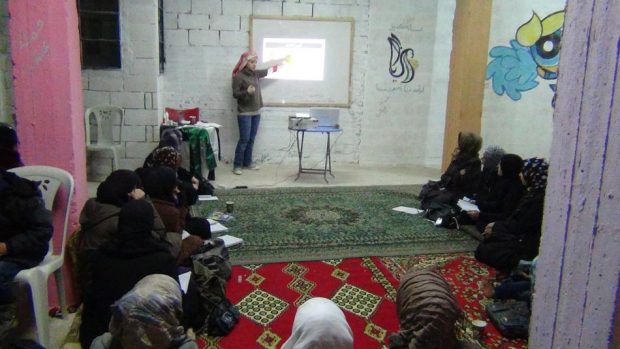
There were only a couple of female citizen journalists living in the rebel-held areas in the northern Syria, so I decided to offer the training to those interested in learning (unlike the men who, who were mostly already citizen journalists). I was surprised how many women were actually interested. Some are now making a living from writing for our website Damascus Bureau and other websites, which turned their conservative, closed-minded husbands from opposing to supporting their work.
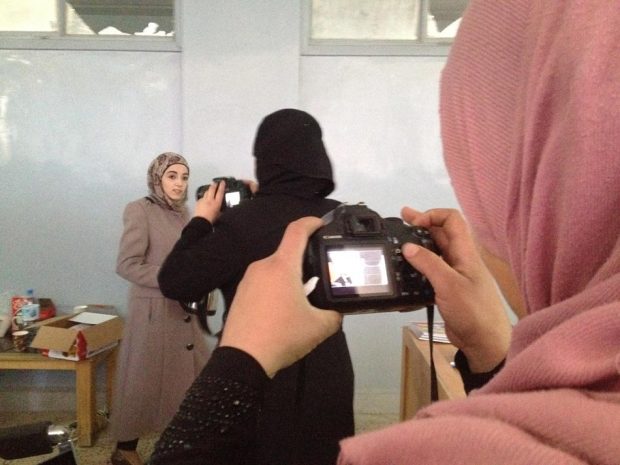
Writing was the easier choice for the women interested in being citizen journalists as it could be done anonymously with no need to grab attention holding a camera in the street, but some wanted to learn.
The woman in this picture – a schoolteacher – told me: “I want to report myself for the school instead of asking for a male citizen journalist to come whenever we have an activity, and I know the women teachers would speak to me much more comfortably in an interview.”
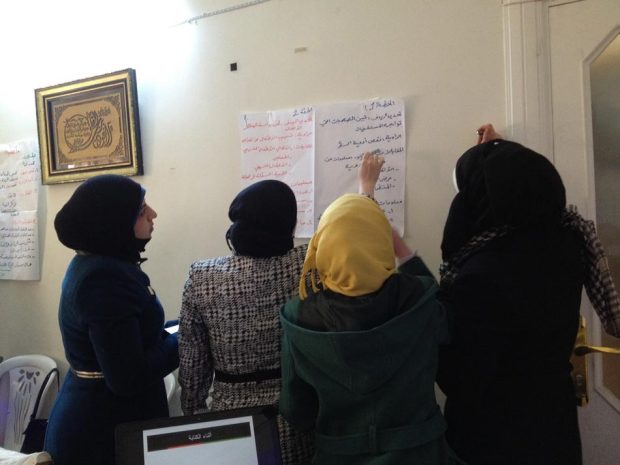
Besides journalism, through the Institute for War and Peace Reporting, we’ve established women-only internet cafes where women can come and learn how to use social media, surf the internet and use the computer. All means of communication have been cut by the regime for years, and the satellite internet cafes existed are male dominated. This means women are disconnected, so providing these centres is like giving them a window into the world.
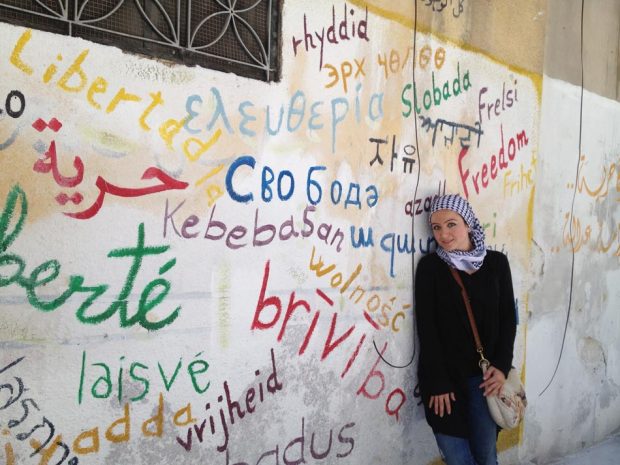
Some might consider me biased because I stand with the freedom revolution in my home. On my blog, my slogan is: “I am biased to humanity and I am proud to be so.” I don’t think any journalist can be impartial when reporting about IS or Kim Jong-un’s crimes, so why with Assad? I was interrogated by his military security forces in 2008 because of an article I wrote and because I was active in a civil society organisation. I am forbidden from going home to Damascus, because I am a journalist and not a propagandist.

To document the human side of our war I started filming people, streets, life behind the frontline, death and horror. I chose to document the heroines who are facing extra difficulties because they are women, so I made five short films and named them Syria’s Rebellious Women.
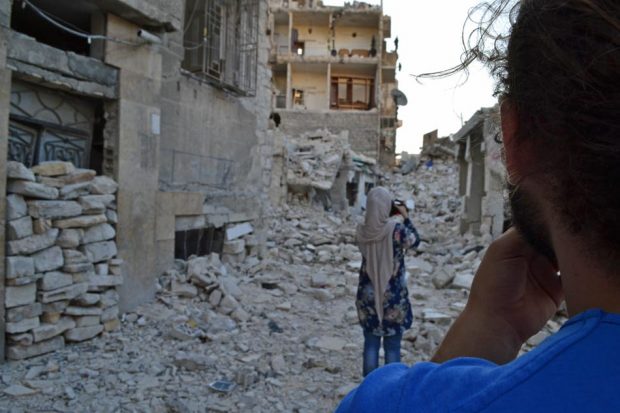
“You pass the Kalaase massacre mark then turn right you will find me waiting for you there… .” Somehow destroyed buildings and massacres become part of the daily view and even marks to guide people to places. At this particular spot, I got engaged. Someone wrote “Heaven” on the wreckage with an arrow directed to the sky. There we exchanged our vows to keep loving life and to not forget the sacrifices of those who have gone in order for us to live free in a democratic country.
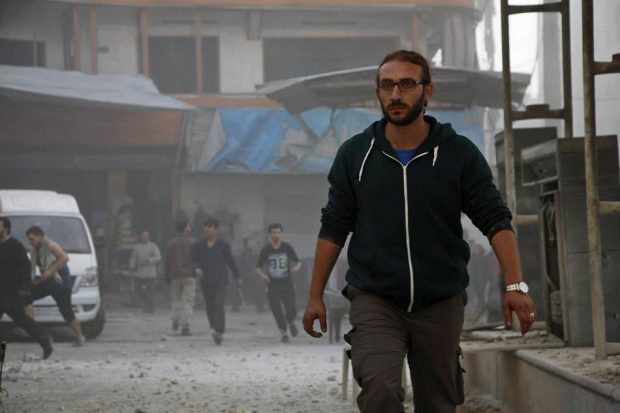
This is my husband Mahmoud, doing what he does every day: running toward bombed areas to rescue victims and provide first aid to those who need it. He has been injured many, most recently two weeks ago in a Russian air attack in Kallaseh grocery market. Three bits of shrapnel are still in his leg. Despite being a pioneer activist, a giving person who is ready to give his life for to protect and help people he doesn’t even know, and in spite of his work for international organisations, his visa to the UK has been rejected fearing that he “won’t leave the UK”.
Related:
30 Mar 2016 | News
Peter Kellner is president of YouGov and a contributor to Index on Censorship magazine. Kellner discusses the results of a YouGov survey about rights across seven European democracies and the United States. Full results are available here.
As far as I know, North Korea is the only significant country whose citizens have never been polled. Everywhere else, it is possible to discover what people think on at least some issues; and in the world’s democracies we can ask about the most sensitive social and political topics and obtain candid answers. In less than a century, and in many countries less than half a century, opinion polls have given people a voice of a kind they never had before.
It is against this backdrop that I chose the topic for my final blog for YouGov, before stepping down as president. The rise of polling in different countries has accompanied the spreading of democracy and human rights. We can do something that our grandparents never could: find out which human rights matter most to people – and to do it, simultaneously, in a number of countries. In this case we have surveyed attitudes in seven European democracies and the United States.
This is what we did. We identified thirty rights that appear in United Nations and European Council declarations, in the British and American Bills of Rights and, in some cases, are the subject of more recent debate in one or more countries. To prevent the list being even longer, we have been selective. For example, we have omitted “the right of subjects to petition the king”, and the right of people not to be punished prior to conviction, which were promised by Britain’s Bill of Rights. Matters requiring urgent attention in one era are taken for granted in another.
Even so, thirty is a large number. So we divided the list into two, and asked people to look at each list in turn, selecting up to five of the 15 rights from each list that “you think are the most important”. This means that respondents could select, in all, up to ten rights from the thirty. This does not mean that people necessarily oppose the remaining rights, simply that they consider them less important than the ones they do select.
This is what we found:
- The right to vote comes top in five of the eight countries (Britain, France, Sweden, Finland and Norway), and second in two (Denmark and the United States – in both cases behind free speech). Only in Germany does it come lower, behind free speech, privacy, free school education, low-cost health care and the right to a fair trial.
- In all eight countries more than 50% select free speech as one of the most important rights. It is the only right to which this applies.
- Views vary about the importance of habeas corpus – the right to remain free unless charged with a criminal offence and brought swiftly towards the courts. It is valued most in Denmark (by 49%) and the United States (40%). In Britain, where habeas corpus originated in the seventeenth century, the figure is just 27%.
- Rights to free school education and low-cost health care are selected by majorities in six of the eight countries. The exceptions are France and the United States. In the US, this reflects a different history and culture of public service provision. In France, unlike the other six European countries we surveyed, financial rights (to a minimum wage and a basic pension) come higher than the rights to health and education.
- France is out of line in three other respects. It has by some margin the lowest figure for the right to live free from discrimination – and the highest figures for the right to a job and the “right to take part with others in anti-government demonstrations”
- Few will be surprised that far more Americans than Europeans value the right to own a gun (selected by 46% of Americans, but by no more than 6% in any European country) and “the right of an unborn child to life” (30%, compared with 13% in Germany and no more than 8% in any of the other six countries).
- The French and Americans are also keener than anyone else on “the right to keep as much of one’s own income as possible with the lowest possible taxes”. In the case of the United States, this is consistent with limited expectations of public-sector provision of health, education and pensions. With France it’s more complex: public services do not rank as high as in the six other European countries, but jobs, pay and pensions matter a lot. In their quest for security, income AND low taxes, many French voters appear to make demands on the state that seem likely to lead to disappointment. Perhaps this, as well as the lingering memory of France’s revolutionary past, explains the enthusiasm of so many French voters on both Left and Right to mount anti-government demonstrations.
- In Europe, property rights matter less than social rights. In Germany only 6% regard ‘the right to own property, either alone or in association with others’ as one of their most valued human rights. The figures are slightly higher for France (14%) and Britain (16%) and higher still in the four Scandinavian countries (20-29%). Only in the United States (37%) is it on a par with the rights to free school and low-cost health care.
- There are striking differences in views to rights that are matters of more recent controversy. In most of the eight countries, significant numbers of people value “the right to communicate freely with others” (e.g. by letter, phone or email) without government agencies being able to access what is being said). Four in ten Germans and Scandinavians regard this as one of their most important rights, as do 35% of Americans. But it is valued by rather fewer French (29%) and British (21%) adults.
- Much lower numbers choose the right of gay couples to a same-sex marriage: the numbers range from 10% (Finland) to 19% (US). This is a clear example of a reform that, separate YouGov research has found, is now popular, or at least widely accepted – but not considered by most people to be as vital a human right as the others in our list.
- In six of the eight countries, many more people value “the right of women to have an abortion” than “the right of an unborn child to life”. The exceptions are France, where both rights score just 13%, and the United States, where as many as 30% choose the right of an unborn child to life as a key human right, compared with 21% who value a woman’s right to an abortion. The countries with the strongest support for abortion rights are Denmark and Sweden.
Those are the main facts. Each of them deserves a blog, even a book, to themselves. It’s not just the similarities and differences between countries that are significant, but the variations between different demographic groups within each country. (For example, British men value free speech more than women, while women place a higher priority on the rights to free schooling and low-cost health care. Discuss…)
Nor does this analysis tell us about direct trade-offs. How far are people willing to defend free speech in the face of social media trolls – and habeas corpus when the police and security services seek greater powers to fight terrorism? (Past YouGov surveys have generally found that, when push comes to shove, most people give security a higher priority than human rights.)
The results reported here, then, do not provide a complete map of how human rights are regarded in the eight countries we surveyed. But they do give us a baseline. They tell us what matters most when people are invited to consider a wide range of rights that have been promoted over recent decades and, in some cases, centuries. It is, I believe, the first survey of its kind that has been conducted.
It won’t be the last. Understanding public attitudes to human rights, like promoting and defending those rights, is a never-ending task. It is also a vital one, just like giving voters, customers, workers, patients, passengers, parents – indeed all of us in our different guises – a voice in the institutions that affect our lives. Which has been the purpose of YouGov for the past fifteen years and will continue to be so.
See the full results of the survey.
This article was originally posted at yougov.co.uk and is posted here with permission.