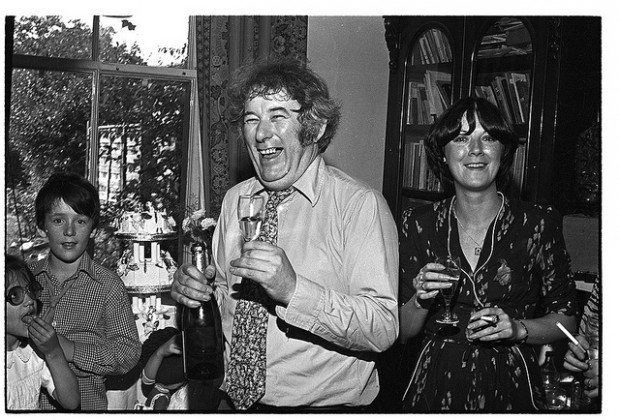
Seamus Heaney with his family and at a party at home in Dublin, 1979. Photographer: Bobbie Hanvey
It’s the 17th annual World Poetry Day, which was first declared by Unesco in 1999 to help meet the world’s aesthetic needs by promoting the reading, writing and teaching of poetry. This year, Unesco director-general Irina Bokova said: “By paying tribute to the men and women whose only instrument is free speech, who imagine and act, Unesco recognises in poetry its value as a symbol of the human spirit’s creativity. […] The voices that carry poetry help to promote linguistic diversity and freedom of expression.”
One poet of this calibre was Seamus Heaney.
The Irish poet, playwright and lecturer was as prolific a translator of poetry as he was a writer. In September 1998, his translation of Gile na Gile, a poem written by Irish language poet Aodhagán Ó Rathaille (1670–1726) was published exclusively in Index on Censorship under the title The Glamoured.
“It is a classic example of a genre known as the aisling (pronounced ashling) which was as characteristic of Irish language poetry in the late seventeenth and eighteenth centuries as rhymed satire was in England at the same time,” Heaney wrote in Index. “The aisling was in effect a mixture of samizdat and allegory, a form which mixed political message with passionate vision.”
This month, Heaney, who died in August 2013, offers us a gift from the afterlife: the publication of his translation of Aeneid’s Book VI, the Roman poet Virgil’s epic on mythic Trojan Aeneas’s journey to Hades. In the poem, Sibyl of Cumae, a guide to the underworld, “chanted menacing riddles” in an attempt to confuse our hero:
Then as her fit passed away and her raving went quiet,
Heroic Aeneas began: ‘No ordeal, O Sibyl, no new
Test can dismay me, for I have foreseen
And foresuffered all. But one thing I pray for
Especially: since here the gate opens, they say,
To the King of the Underworld’s realms, and here
In these shadowy marshes the Acheron floods
To the surface, vouchsafe me one look,
One face-to-face meeting with my dear father.
In the introduction to Aeneid’s Book VI, published posthumously, Heaney describes the poem – which he began working on in 1986 after the death of his father – as “like classics homework, the result of a lifelong desire to honour the memory of my Latin teacher at St Columb’s College, Father Michael McGlinchey”.
St Columb’s is a Roman Catholic grammar school for boys in Derry. Heaney formed part of the school’s “golden generation” in the 1940s and 1950s, which included the dramatist Brian Friel and politician John Hume.
When I attended St Columb’s between 1999 and 2006, pupils were reminded of the school’s alumni illustrissimi — especially Nobel laureates Heaney and Hume — at many a class, assembly and function. One of the highlights of my time as a pupil was attending an after-school discussion with Heaney and the classicist Peter Jones. They spoke of the positive effect reading poetry has on thought processes and the irrelevancy of the poet’s intention when a reader encounters the poem. It is, he said, our own unique experience with a work that truly matters.
Afterward, Heaney signed my copy of Redress of Poetry, a collection 10 lectures he gave between 1989 and 1994 while a professor of poetry at Oxford.
“Poetry cannot afford to lose its fundamentally self-delighting inventiveness, its joy at being a process of language as well as a representation of things in the world,” Heaney writes in the opening chapter. “[P]oetry is understandably pressed to give voice to much that has hitherto been denied expression in the ethnic, social, sexual and political life.”
Redress of Poetry’s predecessor, the collection of literary criticism essays from 1978-1987 titled Government of the Tongue, discusses in much more depth those who have been denied such expression in their political and social lives. The book is perhaps best known for its celebration of poets of the Eastern Bloc, the former communist states of central and eastern Europe. The discovery of poets such as Czesław Miłosz, Osip Mandelstam, Joseph Brodsky and Zbigniew Herbert had an impact on Heaney’s own work. As a Northern Irish Catholic, Heaney could easily identify with the religion, culture and history of Polish poets Miłosz, whose work was banned by Poland’s communist government, and Herbert, who organised protests against censorship in the Eastern Bloc.
One poem Heaney references is Miłosz’s Child of Europe, which reads:
We, from the fiery furnaces, from behind barbed wires
On which the winds of endless autumns howled,
We, who remember battles where the wounded air roared in
paroxysms of pain.
We, saved by our own cunning and knowledge.
It brings to mind the experiences of many in Northern Ireland. Throughout the Troubles, Heaney was known for expressing both clarity and humanity amid chaos. He tells a story in Government of the Tongue, however, of his personal difficulties in creating art amid violence. He was on his way to a recording session at the BBC studios in Belfast sometime in 1972 with folksinger David Hammond when the pair heard bombs go off.
“[T]he very notion of beginning to sing at the moment when others were beginning to suffer seemed like an offence against their suffering,” he wrote.
This tension in the poet’s mind seemingly had no bearing on his ability to capture the mood of an entire nation through his work. In The Cure at Troy, Heaney’s telling of Sophocles’ Philoctetes, the story of how Odysseus tricked Achilles’ son into joining the Greek forces at Troy, expressed the hope felt by many in his country in 1991, a year of ceasefires and all-party talks.
The poem contains the often-quoted and poignant words:
History says, don’t hope
On this side of the grave.
But then, once in a lifetime
The longed-for tidal wave
Of justice can rise up,
And hope and history rhyme
[vc_row][vc_column][vc_column_text]While journalists and citizens fled, Syrian-native Zaina Erhaim returned to her war-ravaged country and the city of Aleppo in 2013 to ensure those remaining were not forgotten. She is now one of the few female journalists braving the twin threat of violence from both ISIS and the president, Bashar al-Assad.
Erhaim has trained hundreds of journalists, many of them women, and set up independent media outlets to deliver news from one of the world’s most dangerous places. In 2015 Erhaim filmed a groundbreaking documentary, Syria’s Rebellious Women, to tell the stories of women who are helping her country survive its darkest hour.
“In 10 years time, I want a young woman who looks on the internet to find out what happened in Syria to find evidence of the roles women played.” — Zaina Erhaim[/vc_column_text][/vc_column][/vc_row][vc_row][vc_column][vc_basic_grid post_type=”post” max_items=”12″ style=”load-more” items_per_page=”4″ element_width=”6″ grid_id=”vc_gid:1501491286724-cd18e683-18e7-6″ taxonomies=”8091″][/vc_column][/vc_row]
This column was originally submitted to Today’s Zaman, but was rejected by the new management. Doğu Ergil is a Turkish sociologist, political scientist and academic, and was a columnist for Today’s Zaman.
The numerical figures of the reality of Syrian refugees in Turkey is as follows: 2.2 million of the 4.3 million displaced Syrians who have been registered as persons of concern by the Office of the United Nations High Commissioner for Refugees (UNHCR) currently reside in Turkey. There is an estimated 0.4 million who have settled in various parts of Turkey relying on their own financial resources. The total number of Syrian refugees in Turkey is higher than the entire population of six of the EU’s 28 member states.
What truly scares Europe in terms a massive influx of “others” who can neither be assimilated nor accommodated is not sufficiently evaluated in Turkey. This is due to two factors. First the incumbent government wanted to win the hearts and minds of the Syrian asylum seekers fleeing from a tyrant who they believed would quickly wither away.
The return of the displaced people with gratitude and love for Turkey and its leadership would boost Ankara’s desire to shape the future of Syria and the Levant. Hence their warm welcome was accompanied by thoughts of temporary duress with large dividends to follow.
Secondly, the people of Turkey were influenced by the rekindled ideological rhetoric of Islamic brotherhood/solidarity and reclaiming the old territories of the Ottoman past. However, as years passed and the calculations over Syria changed, the permanence of Syrian refugees became apparent just as the realisation of the magnitude of humanitarian, social, economic and security challenges.
The big question is whether Turkey alone can bear the burden of hosting more than 2.5 million refugees without outside/international aid and support. Here comes the EU threatened by an unprecedented influx that it can neither accommodate nor assimilate. Neither Turkey’s capabilities nor Europe’s political stance have been amenable to a sustainable management of the current refugee crisis.
Consequently, this week necessity brought Turkish and EU leaderships to work out a sustainable process whereby Turkey will build the capacity to host most of the Syrian refugees and Europe will take in a limited number of them through a gradual filtering system. In return, the EU will help Turkey to carry the burden of hosting millions of refugees.
Another matter of bargaining was the lifting of visa requirement for Turkish citizens in the Schengen area. Indeed the Turkish leadership feel discriminated against on this issue when compared with other EU applicant countries (i.e., Western Balkan countries) or with third countries concerning the restrictive EU visa policy. They have concrete expectations from Brussels in this respect.
In fact, a political deal was reached in 2012 for the readmission into Turkey of third-country irregular migrants who enter the EU via Turkey in return for visa liberalisation for Turks traveling to the EU. This agreement is of great sentimentality in the overall EU-Turkey relationship given the fact that the latter’s membership seems to be farfetched.
These issues were the issues discussed by the Turkish prime minister and accompanying officials with EU representatives in Brussels this week. So far information obtained indicates that any passage of refugees further west from the Balkan countries they have reached will be obstructed. This means the so called “the Balkan corridor” will be closed.
Already a series of countries on the route have prevented the entry of migrants of Middle Eastern origin. Brussels does not want individual initiative by member states. Otherwise the crisis cannot be handled effectively. For example Macedonia allows only a limited number of refugees from Greece each day. This leads to a swelling of the number of refugees on the border towns of Greece like Idomeni, where nearly 10,000 wait on. The EU promised 700 million euros to Greece in relief.
What the EU wants is for Turkey to readmit those refugees who are not given legal rights of entry. As German Chancellor Angela Merkel has said, the 3 billion euros earmarked for Turkey can be used to build schools for refugee children and development of employment opportunities for the adults. But these piecemeal and incomplete initiatives are no panacea for either Turkey or the humanitarian crisis born out of the dismal conditions of the Middle East.
First of all given the conditions in the Middle East, namely Syria and Iraq, the return of the displaced people is not a possibility in the short term or even the medium term. Secondly, without peace and stability in the home countries, more asylum seekers will be knocking on the doors of Turkey and Europe.
So it is the mutual responsibility of mankind to end the root causes of the ongoing conflicts and stop the misery of their fellow men and women. We will see if humanity, especially “civilised countries,” will show this acumen and conscientious behavior.
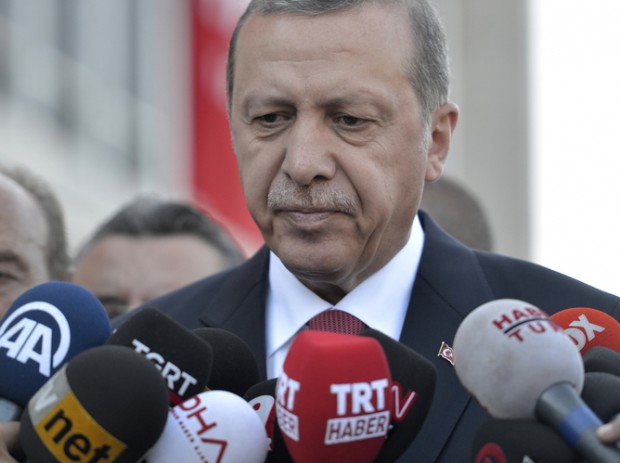
Turkish President Recep Tayyip Erdogan speaks at a rally in Istanbul, 20 September 2015. Credit: Orlok / Shutterstock
Turkey’s government and courts have demonstrated their unwillingness to adhere to basic values on press freedom and media pluralism. From judicial harassment and seizing media companies to silencing Kurdish and critical media, Turkey’s government has been used by President Recep Tayyip Erdogan to silence critical voices in the country.
The European Charter on Freedom of the Press is a non-binding guideline on press freedom, signed on 25 May 2009 in Hamburg by 48 editors-in-chief and leading journalists from 19 European countries. It consists of 10 articles on media freedom, and if we take it as an ideal for which countries should operate, we see no country in the EU is perfect. However, Turkey finds itself in a unique position of being consistently in breach of every single one on an almost weekly basis.
Article 1 Freedom of the press is essential to a democratic society. To uphold and protect it, and to respect its diversity and its political, social and cultural missions, is the mandate of all governments.
Index on Censorship’s Mapping Media Freedom has verified over 200 violations of media freedom in Turkey since the project began in May 2014. The seizure of the Zaman Media Group, which owns Zaman and Today’s Zaman, on 4 March was just the latest in a long line of assaults against media diversity in the country. Any respect for diversity seemed to be dispersed like the crowds of supporters who gathered at Zaman’s headquarters, who were then set upon by police with water cannons and tear gas.
Article 2 Censorship is impermissible. Independent journalism in all media is free of persecution and repression, without a guarantee of political or regulatory interference by government. Press and online media shall not be subject to state licensing.
A day after the takeover of Zaman, trustees were appointed by the authorities to Cihan News Agency in another bid to silence criticism of Erdogan. Cihan said on its website late on Monday 7 March that an Istanbul court would appoint an administrator to run the agency on a request from a state prosecutor. Interference by the government is now systemic in the Turkish media.
Article 3 The right of journalists and media to gather and disseminate information and opinions must not be threatened, restricted or made subject to punishment.
Opposition journalists are routinely punished in Turkey. Barış İnce, a former editor of Birgün who still writes for the leftist daily, was sentenced on 8 March to 21 months in prison for “insulting” Turkish President Recep Tayyip Erdoğan. A week previously, on 2 March, journalist Arzu Yıldız attended a hearing at Ankara criminal court for “insulting” Erdogan, former Justice Minister Kenan İpek and Justice Minister Undersecretary Basri Bağcı. Yıldız explained that she is being tried for a retweet, and not for something that she personally wrote.
Article 4 The protection of journalistic sources shall be strictly upheld. Surveillance of, electronic eavesdropping on or searches of newsrooms, private rooms or journalists’ computers with the aim of identifying sources of information or infringing on editorial confidentiality are unacceptable.
On 9 February, Claus Blok Thomsen, a Danish journalist working for daily newspaper Politiken, was detained by Turkish authorities at the Istanbul airport and then barred from entering Turkey. He was travelling to the country to report on refugees at the Turkish-Syrian border. At the airport, Thomsen allegedly identified himself as a journalist and then the police forced him to open his phone and computer, undermining the confidentiality of his sources.
Article 5 All states must ensure that the media have the full protection of the law and the authorities while carrying out their role. This applies in particular to defending journalists and their employees from harassment and/or physical attack. Threats to or violations of these rights must be carefully investigated and punished by the judiciary.
Rather than having the full protection of the law, Turkish journalists often find themselves at its mercy. Nineteen journalists have so far been arrested or detained in the country this year alone, many of them on terror-related charges. This includes Nazım Daştan, a reporter for Dicle News Agency (DİHA), which reports in Kurdish, who was charged with spreading terrorist propaganda on Facebook in February.
Article 6 The economic livelihood of the media must not be endangered by the state or by state-controlled institutions. The threat of economic sanctions is also unacceptable. Private-sector companies must respect the journalistic freedom of the media. They shall neither exert pressure on journalistic content nor attempt to mix commercial content with journalistic content.
Threats to the economic livelihood of the media are commonplace in Turkey. On 3 November 2015, 58 journalists were dismissed from İpek Media Group when it was unlawfully seized in a government-led police operation in late October. Sound familiar? When Zaman was taken over, editor-in-chief Abdülhamit Bilici was fired without remuneration by the new trustees. Many other members of staff were let go also.
Article 7 State or state-controlled institutions shall not hinder the freedom of access of the media and journalists to information. They have a duty to support them in their mandate to provide information.
Article 8 Media and journalists have a right to unimpeded access to all news and information sources, including those from abroad. For their reporting, foreign journalists should be provided with visas, accreditation and other required documents without delay.
Turkish authorities rejected a permanent press accreditation application filed by Norwegian daily Aftenposten’s correspondent Silje Rønning Kampesæter, on 9 February 2016. Turkish authorities have not issued any written statement on the reason for the rejection. The application also affects her residence permit in Turkey.
Article 9 The public of any state shall be granted free access to all national and foreign media and sources of information.
Over the past two decades, right to know laws have become commonplace in the European Union. In Turkey, the principle has yet to catch on. In the wake of the bomb that ripped through Ankara killing 37 people on Monday, Erdogan’s government moved to block Facebook and Twitter as part of a media ban. Domestically, blanket media bans are becoming more common in Turkish media. On 17 February, the government rushed out a temporary broadcast ban after another deadly blast in Ankara. Similar measures were taken the month previously as well.
Article 10 The government shall not restrict entry into the profession of journalism.
This week, Erdogan has claimed the definition of a terrorist should be changed to include terrorist “supporters”. It was clear who the president had in mind: “Their titles as an MP, an academic, an author, a journalist do not change the fact they are actually terrorists.” By treating critical journalists like terrorists, Erdogan is effectively redefining their profession.

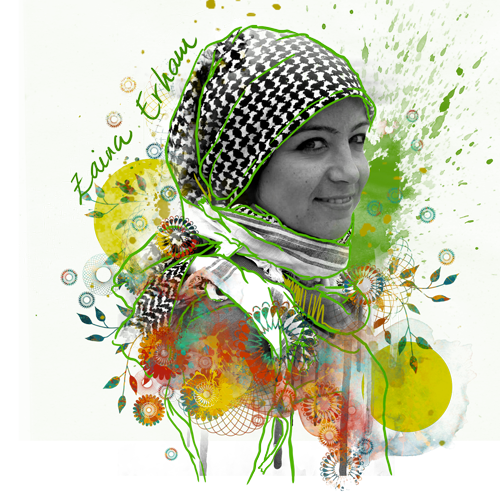 While journalists and citizens fled, Syrian-native Zaina Erhaim returned to her war-ravaged country and the city of Aleppo in 2013 to ensure those remaining were not forgotten. She is now one of the few female journalists braving the twin threat of violence from both ISIS and the president, Bashar al-Assad.