13 May 2014 | Asia and Pacific, News, North Korea
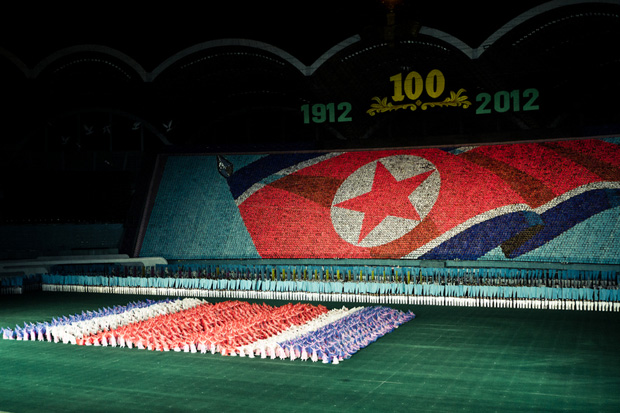
Gymnasts at Arirang festival in Pyongyang, North Korea (Image: Roman Kalyakin/Demotix)
Jang Jin-sung, formerly poet laureate for North Korea, is one of its highest-ranking defectors and most vocal critics. A meteoric career that saw him also become chief propagandist in the United Front Department, engaging in counter-intelligence and psychological warfare against South Korea, he was also one of Kim Jong Il’s inner circle — a dreamlike life of privilege shattered when he found the bodies of famine victims lying in the streets of his home town. Facing almost certain death for the crime of mislaying a prohibited text, he dramatically escaped to China in 2004 and defected to South Korea. Based on his insights from working in the elite, he argues that the official narrative of North Korea being run under the absolutist genius of the Kim dynasty and the Korean Workers Party, is a lie. Power was not harmoniously transferred upon Kim Il Sung’s death in 1994 to his son, Kim Jong Il — instead Kim Jong Il had long before usurped his father with the support of the clandestine Organisation and Guidance Department (OGD), while Kim Il Sung spent his last years under virtual house arrest, bamboozled by his own cult, created by his son. Kim Jong Il directed the OGD under his reign and he legitimised “every single policy and proposal, surveillance purge, execution, song and poem”, but upon his death in 2011, however, the bequest of leadership upon his son Kim Jong Un was solely symbolic; the OGD took charge. That year, Jang set up New Focus International to give insight and analysis to North Korea. This week he talked about the OGD as “the single most powerful entity in North Korea” to the All-Party Parliamentary Group on North Korea. His words were translated by NFI’s international editor, Shirley Lee, and the talk was chaired by Lord David Alton.
The OGD is “the entity that controls everything. This is where all roads end, all chains of command, and all power structures go,” Jang said. “The real power structure, nothing has changed since Kim Jong Il’s time. The OGD is still just as it is, the same men are in the same positions of power.” Yet the OGD is so secret and compartmentalised a structure, it’s only fully comprehended by the most senior leaders, and known to “less than a dozen” of the approximate 26,000 refugees out of North Korea. That lack of knowledge has meant that traditionally, outside observers omitted the OGD’s existence, basing their views on diplomatic notes, refugee testimonies and political theories which Pyongyang has successfully fed into with propaganda about the Kims’ omnipotence, to obscure its power structures. Hence, many observers interpreted the purge of Kim Jong Un’s uncle Jang Song Thaek as the new leader getting rid of his old guard to make his own power network, whereas it was really the OGD liquidating a rival. South Korea has also connived to keep a lid on knowledge of the OGD. When Hwang Jong Op, the international secretary of the Korean Workers’ Party and principal author of the state philosophy of Juche, defected and sought to tell of the OGD, the South’s then Sunshine Policy “was based on a policy of engagement that sought not to provoke the North Korean regime, [so] they actually silenced his testimony from appearing,” said Jang.
Whereupon while “every single person seen as the second, third, fourth most powerful man, has been purged or destroyed … every single powerful member of the OGD has remained”. They will stay in power as the OGD is in effect North Korea’s “human resources department, it appoints everyone”. The vetting of appointees is based on trust, and loyalty secured by cadres knowing any perception of disloyalty will imprison them, their parents and their children. “No-one is exempt from this… because no matter how big you are, if you do something wrong, you are sending your family to prison camp to rot away for the rest of their lives, never to be seen again.” As Lee put it, “you’re not going to kill your own family to change that”. Jang himself has tried many times to contact his parents in North Korea, but has never succeeded. “You can’t begin to think about what his parents may be suffering but that just makes him stronger,” said Lee.
The OGD appoints all generals and makes all military orders, with the military’s autonomy compromised like everything else by the OGD’s all-pervasive surveillance structure. Party committees of spies are installed across all sectors from diplomacy to tourism, down to each and every apartment block — “the OGD has eyes and ears everywhere”. It is backed by the OGD’s secret police and system of prison camps that the group developed into a weapon of mass terror while it usurped Kim Il Sung. He was prevented from seeing friends or family by his OGD-appointed bodyguards, a corps now numbering 100,000. He “died as a scarecrow, he was nothing,” said Lee.
As well as these physical means of control, the state seeks to monopolise all information flows and uses incredible psychological and emotional force to ensure its citizens’ loyalty. “In North Korea the only politically correct faith to have is in the cult of the Kims,” said Jang, while religious organisations like the Chosun Association or Buddhist association are run by the UFD, and Christians end up in prison camps. “The only narrative that matters is of the righteous sovereignty of the state.”
Yet for all the surface illusion of power, the nuclear weapons, the police and prison system, “it is a country that’s ruined inside, it’s a collapsed state. They do not control the price of an egg, and that is a huge deal”. Black markets have almost entirely supplanted the government monopoly of provision of goods, ranging from clothing to food, which collapsed in the mid-1990s as millions perished in the famine. This has created two classes, those loyal to the party because of their stake in the status quo; and the market class of people who were abandoned by the state and survive on the black market. Critically, this means that for promotions, status, power or material wealth, “the currency has converted from loyalty to money,” said Jang, “and that has broken the cult of North Korea for everyone”.
Economic “reforms” are really state efforts to try control the black markets, which have at times suffered violent crackdowns, for having become “a black hole that sucked in the control mechanisms of the state”. Equally, however, the regime cannot survive without them, as “the market feeds the people”. The country is also suffering from criminal activities actually sanctioned by the regime, namely counterfeit dollar bills, meth amphetamine production and computer hacking. “It’s not the world that’s suffering, the country is being destroyed by the regime’s own creations,” as government computers are hacked and fake bills and drugs run through society. Refugee statements say meth amphetamine abuse has become “just part of the ordinary life”.
Meanwhile the markets live off information. “The price of rice, the price of your life rises and falls in terms of knowing outside world information…ordinary people know it’s an advantage to listen to the outside world [information],” and Jang endorses the set up of a BBC Korea service to broadcast into North Korea. “The only way to break the dictatorship of force is by breaking that emotional monopoly over the people… There is no more effective tool that the world can do than to acknowledge that the North Korean people have the right to another narrative than that the party supplies.”
“More important is that no one in the North today believes it will last for ever,” but “the one thing that is stopping them from acting is there is no other way. Everyone is trying to do it the regime’s way”. This extends from efforts to deal with Pyongyang’s nuclear bomb program, which fail because international frameworks don’t apply to North Korea — “the only way the world can resolve the nuclear problem is seeing the regime transform. You can’t do it within their demands” — to the country’s appalling human rights record. “Those who think putting human rights on the agenda would jeopardise engagement and dialogue are wrong. North Korea is more desperate for dialogue at the state level than the West is. They [the North Korean state] need that to sustain what is happening right now.” Putting human rights atop all agendas would mean “there is nowhere left for the North Korean leadership to stand”.
“Stop looking at the regime as the agent of positive transformation,” said Jang, and engage with those with no stake in the status quo. Meanwhile, China, as the North’s sole supporter, is key to its survival and to brook any change. “China supports North Korea because it’s more convenient to support it than not,” said Jang, adding that Kim Jong Il hated China more than anybody “because he was at their mercy”, while Beijing’s anger at Jang Song Thaek’s execution was because it was “like the nightmare of Kim Jong Il would continue”. On Wednesday China warned North Korea against carrying out another nuclear test. And while China has yet to host Kim Jong Un, it has already welcomed South Korea’s President Park with open arms. Repeatedly reaffirming North Korea’s human rights record, damningly detailed by the United Nations’ Commission of Inquiry Into Human Rights in the DPRK in March, to the Chinese government may pressure them into giving up the forceful repatriation of North Korea refugees, which leads to prison or death, according to Lord Alton. “The scariest thing for China is to start to get moral blame for what’s going on in North Korea. So it will want to be seen to be doing the right thing.” On that, Jang said any retribution befalling the regime for human rights abuses, “the OGD will blame will Kim Jong Un alone”.
Again it’s an issue of perception. “In North Korea, I thought change could not come because the regime was so powerful. When I came to South Korea I learned that North Korea was not transformed because the South Koreans didn’t know it could.” Indeed, “the only thing holding North Korea back from transforming is that the world isn’t ready for it.”
The talk was organised with help from the European Alliance for Human Rights in North Korea. Jang’s book Dear Leader (UK Random House, US, Simon & Schuster) is out now.
This article was posted on May 13, 2014 at indexoncensorship.org
12 May 2014 | News, Palestine, Politics and Society, Religion and Culture
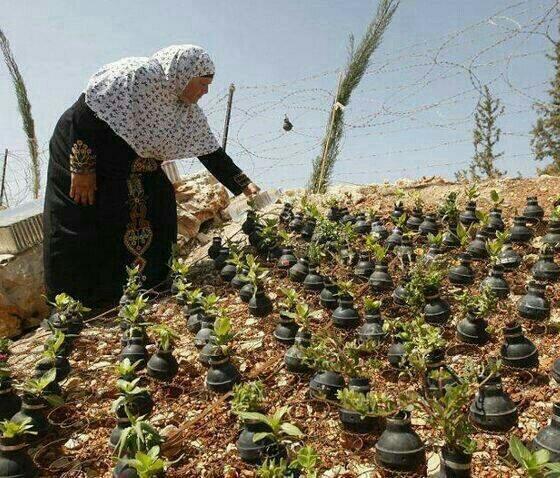
Three days ago a picture appeared on my Twitter timeline. A Palestinian woman was watering flowers inside dozens of hand grenades lined up in her little garden, surrounded by barbed-wire fences.
I froze. For minutes the picture and I looked at each other. No picture had affected me this way for a long time.
Creating life with the tools of death, in the middle of a war, in a place where every day children, women and men of all ages are being killed mercilessly, where the sound of the bombs has drowned out the songs of the birds, where pain is as intense as the oxygen in the air.
While discussions go on about where freedom of speech and expression start and end, or where you draw the line… a single picture transfixes me.
I’ve always asserted in my articles that we are in a transition from the analogue to digital world and during this transition of transformation, women will have an important role and we will not be free unless we transcend the thought patterns forcibly imposed upon us. And now, this picture in front of me, as if it was silently saying everything my words fail to express.
Planting new life in spite of ideologies, religions, borders, emotions, pain, violence, death, hatred, ruthlessness…
Silently responding by creating life from death to the sound of bombs, cries of pain, screams of fossilized politics.
At the centre of violence having the wisdom to grow flowers. At the centre of violence being able to protect the love, compassion and creativity within her. At the centre of violence, could there be any greater freedom than responding to death with life?
While thoughts and feelings are manipulated everyday with the words, concepts, ideals and hatred forcibly imposed on us, where do freedom of speech and freedom of expression start and where do they end?
I believe, in the analogue world in accordance with the traditions of patriarchy, either you become a supporter or opponent of the dominant ideology of the society we live in. And yet, in the end, isn’t it obvious that both supporters and opponents are trapped in the same loop and are forced to accept that power is only gained through violence?
To become “Man”, men are obliged not only to find their power but prove it too while women are obliged to watch them fighting it out, forced to obey their rules stuck in their endless power games. As a result, women can never protect themselves or their children. Violence continues to give birth to violence… the life given by women is brutally destroyed.
No matter how much societies have developed economically, in general, women believe that the more they can be in compliance with the patriarchal system the more they can succeed. However, they cannot stop the violence, war and hatred.
On the other hand, in this picture, one Palestinian woman expresses herself clearly even though nobody hears her thoughts, even though she is not screaming or fighting… freedom of speech grows amongst the hand grenades.
During the transition period to the digital world, those who express themselves free from the coding of the dominant system and those who defend the freedom of speech, come together through social media… in the flower garden of the Palestinian woman.
This article was published on May 12, 2014 at indexoncensorship.org
12 May 2014 | China, Laos, News, Vietnam
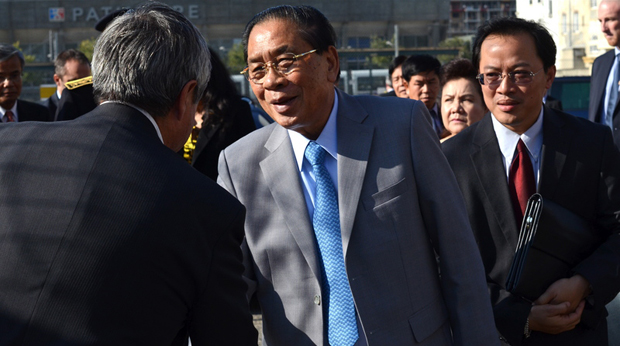
The Laotian president, Choummaly Sayasone, made a five day official visit to France in October 2013 — the first such visit in 60 years. (Photo: Serge Mouraret / Demotix)
When travellers and writers talk about Laos, they mention how peaceful it is, and how Buddhist. The people, says Lonely Planet, are some of the most chilled out in the world. People forget, as they rarely do with Vietnam or China, that it is still a communist state.
The Lao People’s Revolutionary Party (LPRP) has absolute control over the press and civil society. Professor Martin Stuart-Fox, a Laos expert with the University of Queensland, has written widely on the country’s history and government and has said that the party is little more than a crony scheme, with many of those in power now descended from the old Lao aristocracy. It is necessary to have a powerful patron, almost always in the party or closely connected to it, for success. Information is difficult to get hold of and even local journalists, who often have close ties to the government, complain publicly, if respectfully, about the impenetrability of government departments.
Freedom House writes: “Press freedom in Laos remains highly restricted. Despite advances in telecommunications infrastructure, government control of all print and broadcast news prevents the development of a vibrant, independent press.”
These media restrictions are part of a wider pattern of suppression of information, lack of transparency in business dealings, prevention of protests and cultural and religious oversight by the government and party.
However the most noticeable event of the past 18 months has been the disappearance of Sombath Somphone. At the end of 2012 the Lao development expert went missing and many of his colleagues quietly believe the government may be responsible. Little but the bare facts have been written in the local, state-owned press.
Sombath was, according to reports, well respected by both the local and international communities and hardly an anti-government firebrand. He did, however, jointly give a presentation in late 2012 to the ASEAN-Europe People‘s Forum held in Vientiane with the United Nations Development Program. A western aid source told Index on Censorship: “In my opinion — one shared by many others as well –Sombath’s statement at the AEPF was the last straw for the government. He was particularly concerned with forced resettlement, directly linked to government land grabs to provide natural resources to Chinese companies [that are] full of bribes.” The source says since Sombath disappeared any attempts at criticism of government policy, either by the press or organisations “have taken a quantum leap backwards and are currently frozen”.
The World Trade Organisation accession of last year appears not to have much of an effect in promoting a freer or transparent climate. Though the global trade body did make the right noises little concrete action was taken.
This is in contrast to Vietnam’s 2007 WTO accession. In the lead up, the Vietnamese government made public attempts at allowing more freedom of press and speech and open criticism of government policies. Once it became the 150th member crackdowns began again. A small measure of transparency in regards to the business climate has been seemingly taken in Laos.
The LPRP has been in power since 1975. Agricultural reforms began in 1978 and economic reform in 1986, known as the New Economic Mechanism, which began its transition to a more market-based economy. Vietnam instituted its own doi moi, or renovation, policy the same year.
Laos has, in the past 15 years, pursued a policy of economic growth and regional and global integration with an eye toward world affairs. Joining ASEAN in 1997 was a step forward for the small nation, though the spillover Asian financial crisis engendered a certain skepticism among leaders of the manifold benefits of globalisation.
Many smaller nations racing towards development, especially those with sometimes problematic political systems, usually host an event that is as something of a “coming out party”. Vientiane’s hosting of the 2009 Southeast Asia Games was Laos’. Longtime Asia journalist Bertil Lintner pointed out in the Yale Global Review, that though the SEA Games may not have been compelling for much of the globe they are an important regional sporting competition. Chinese and Vietnamese donors and investment built much of the needed infrastructure, such as stadiums.
Despite the rapid development and a “strong” growth outlook for 2013 – 2014, according to Euromonitor, the country still struggles under Least Developed Nation status and poverty rates are high outside the cities while access to services remains low, as do literacy rates.
Unemployment is officially at 2.6 percent of the population, but it is widely believed to be far higher and according to market research and intelligence firm Euromonitor there will be twice as many job entrants as positions for them to fill. Labour export is favoured by the government to partially solve the issue and earn currency. The poverty rate has dropped in recent years and the government’s plan has been to halve it by 2015.
Freedom of the press?
“The Ministry of Information and Culture controls all media in Laos. There is no freedom of the press and no legal protection for Lao journalists who fail to reflect the party line. Most Lao journalists are actually party members attached to the MI,” Stuart-Fox wrote for Freedom House in 2012.
“Laos is the region’s black hole for news…. Because there is no functioning independent media, there are few overt press freedom violations,” Shawn Crispin of the Committee to Protect Journalists told Index. “No local reporting is allowed whatsoever on government corruption, official abuses or factional divisions inside the ruling communist Lao Revolutionary People’s Party. These are all pervasive in Laos, but you’d never know it reading local papers on watching local TV.”
Laos enshrines freedom of speech in its constitution, written in 1991, while ensuring harsh penalties in its penal code that can easily be applied to journalists, or bloggers — though bloggers are few and generally timid. Slandering the state, distorting party and state policies, inciting disorder or propagating information or opinions that weaken the state can all be prosecuted. The vague wording means many things can, if deemed necessary, fall under this ambit.
The English language Vientiane Times largely functions as a platform for photographs of handshakes, ribbon cuttings and deeply earnest affirmations of the great friendship between Laos and whichever national delegation dropped off in the capital on its Southeast Asia tour. It is essentially a showcase organ for what the government wishes foreigners to see, and understand, about modern Laos however its often rather old-fashioned, orthodox rhetoric and complete dearth of anything interesting do not ensure an avid readership.
“The Vietnamese media is much more open, skilled, and sophisticated than the Lao media. And the Lao media are dominated by self-censorship,” a senior Lao source from Radio Free Asia said in an email to Index. “Within limits some publications in Vietnam do try to do investigative journalism. You simply won’t find that in Laos.” The source pointed out that a query on the large scale illegal logging with logs going to Vietnam might not yield much past government authority saying that the government tries to protect the environment.
The 2008 media law is theoretically more friendly to the media and transparency — journalists are guaranteed the right to seek and publish information and to access to public records — there is in practice not much more freedom. The government allows a small measure of criticism of bureaucracy or government actions but reporters have not fully tried to push barriers until they push back. Self censorship is endemic and might be one reason why reporters do not languish in prison as they do in Vietnam or China. Stories on culture and social ills are permitted to a degree, but rigorous investigation of, for example, detainment in rehabilitation centres for all drug users might be going too far.
There is also the tricky situation that government bodies rarely respond to media requests and little information is provided to reporters, though a couple of departments do apparently have a communications department. The information that is provided is expected to be used to further the government’s message and aims.
“There is an endemic culture within our society where people are wary of the news media, and adequate protection is not granted to those willing to speak out on sensitive topics. As such, accessing information is not easy, which makes presenting it even harder”, said a Vientiane Times report quoted by a Southeast Asia Press Association report from 2012.
News on HMong returning refugees, hydro plants, land clearance and illegal logging — some of the most contentious issues in the country — do not make it into the news often. Many of the issues of concern to Lao people can thus remain localised either with those directly affected or educated urban dwellers able to afford access to foreign news sources. It does not appear activist groups have mass organised online yet. Those with access to Thai media may be able to learn more — the government does not block the Thai channels whose broadcasts make it into border areas.
There have been some moves towards private media ownership, although some sources have remarked the industry is too small and rewards too low at this point for anything but a nascent media industry. “There have been a few attempts to launch more trendy, lifestyle magazines, but most have been short lived, I suspect because the relatively small market size for this does not make it economically viable,” said one anonymous source.
There are really no permanent foreign news bureaus in Laos. Though Voice of Vietnam opened a bureau in 2010 and both Radio France International and China Radio International have broadcast from Laos. It should be noted that the 2008 media law does allow foreign news but Stuart-Fox argues that the hoops foreign papers must jump through are too difficult for it to be worth their while.
Problems of censorship go beyond no free press: even if a savvy reporter could persuade an editor to run stories on corruption finding any hard data would be difficult. Party members do not have to disclose their holdings or assets meaning their ownership of firms in Laos is hard to track down. A lack of data cannot be blamed simply on wilful or mendacious opacity; there is not always the capacity for nation-wide gathering and management of statistics.
It is also worth noting, as Stuart-Fox has, that Laos historically has a lower level of literacy and literary traditions than Vietnam. Policy documents often remain unread (many laws have been drafted with foreign help but few ranking civil servants remain au fait with them) and the fierce, bookish debate of intellectuals can be less prevalent in Laos than its Confucian neighbours. On the upside, Lao officials are sometimes, he says, more amenable to friendly informal chats over a Beer Lao or two.
Laos has some two dozen newspapers and almost twice as many radio stations–useful when one considers how remote some communities are. There has been investment into telecommunications infrastructure which better connects Laos to the ASEAN region.
The Southeast Asia Press Alliance wrote in 2012: “The launching of the country’s stock market towards the end of 2010 should be seen as a welcome step towards greater access to information inside this secluded communist regime as foreign investors need a more transparent government and greater access to its policies on social and economic development.” The World Bank ranked Laos at 159 out of 189 nations for ease of doing business, up from 163 the previous year.
Not all censorship is political. Authorities and the older generation worry about the cultural shifts brought about by rapid modernisation and integration with the wider world. A decade ago young people believed Western influences were “bad” according to a survey published in a 2000 book — Laos at the Crossroads — by authors Vatthana Pholsena and Ruth Banomyong. Today, there are still moves by the government toward modesty and a “Lao” way of being that encompasses tradition and religion. Women still largely wear sins — an embroidered sarong, more or less — and until not so long ago long hair on young men was frowned upon or outright illegal — along with earrings or “eccentric clothes”. The same Vientiane Post article quoted also noted that while Western music was technically illegal in nightclubs it could be permissible provided it made up no more than 20 per cent of the music content of the venue, which had to be well-lit to prevent “indecent acts”. However Vientiane’s nightclubs seem to play largely western music or at least the bland, synth-heavy electronica found across the world.
Religious freedom
Laos is Buddhist, which the government recognises and publicly embraces. In fact, it even went so far as to argue, on more than one occasion, that Marxism and Buddhism are not so much mutually exclusive as eminently compatible. The Sangha, the Buddhist clergy, was asked as early as 1975 to study Marxism and be a kind of emissary or teacher of the doctrine especially to those in the countryside. Regimes in Southeast Asia reasserting legitimacy by linking themselves with the nation’s dominant religion is not new and serves a useful dual purpose: They are linked to something deeply esteemed by the people but also more able to control what could otherwise be a powerful dissenting force.
Christians face more persecution on the whole. Hmong Protestant Christians — as opposed to Catholic groups — possibly the more so. The Hmong were co-opted by US forces during the Secret War when the United States undertook a covert bombing of the nation to disrupt the supply chains operating through the Ho Chi Minh Trail that assisted Vietnamese forces.
It is important also to understand that though many Hmong face difficulties in the nation and are discriminated against, it is largely the Christian Hmong who face the worst persecution, similar to Central Highlands Protestants in Vietnam, who are loosely grouped under the umbrella term Degar. Both of these cases stem from involvement with and support of US forces during wartime. Lao Hmong in the United States make up a reasonable sized diaspora and the older generation not only rails against the communist government but enjoys support from US veteran’s advocate group the CPPP — which erroneously reported the murder of 72 Hmong by Vietnamese-trained Lao forces in 2011. Former leader, the late Vang Pao, went so far to plan a coup from his home in California. Many Hmong who fled to Thailand during the war years and remained in limbo were forcibly repatriated a few years ago.
According to Stuart-Fox, Hmong who have maintained their traditional animist beliefs or became party-friendly communists do not suffer the same discrimination or persecution. One woman even made it into the Politburo.
Laos’ multitudinous ethnic minorities also follow many religions and the government officially allows this and officially advocates religious freedom. However this only goes so far as preserving or allowing “good” practices. Religious ceremonies considered backward have been suppressed where possible — like slaughter of animals in rituals. “Superstition” is not kindly looked upon.
Digital freedom
Internet access is far lower than any of Laos’ neighbours with only 9 percent using it in 2011. More recent data suggests an expansion: In 2012 there were 400,000 Facebook users in Laos; up from 60,000 in 2011 in a population of over 6.5 million.
Internet use is growing in Laos but still remains confined to larger cities and towns. A report from academic Warren Mayes guesstimated there were some 50-60 internet cafes in Vientiane in 2006. He noted then online life was growing fast for young people and their interactions with the wider Lao diaspora.
Laos may yet crackdown on Facebook. Last year the communications ministry was to introduce internet regulations to allow official monitoring of the internet — though sources suggest it is already very much unofficially monitored. The director general mentioned to the Vientiane Times information on Facebook circulating regarding a crashed Lao Airlines plane was not “helpful”.
The state controls all internet service providers, and there are some reports that the government sporadically blocks web activity. “The government’s technical ability to monitor the internet is limited, though concerns remain that Laos is looking to adopt the censorship policies and technologies of its neighbors, Vietnam and China,” says Freedom House.
Much of Vietnam’s surveillance ability is already sourced from western companies such as Finn Fisher, Verint and Silver Bullet, rather than homegrown. Sources have previously told Index that Chinese private companies are more likely to assist in surveillance than the government proper; however many including the CPJ strongly suspect Chinese government involvement.
One problem for Laos is that Lao language and alphabet programs have been slow to catch up, though young people do use a phonetic, romanised script known as pasa karaoke.
Deputy Minister of Post and Telecommunications, Thansamay Kommasith, told the Vientiane Times that an “official” Lao script program was being developed, saying: “This is for unity and prosperity, using the official Lao language in those technologies for the future development of IT in Laos as well as to develop the country through them.” There are already unofficial ones being used. Vietnamese military-owned telco Viettel is to assist in the development, according to local news stories. The telco was previously linked to malware attacks within Vietnam.
Laos has plans to launch its own communications satellite. Minister of Post and Telecommunication, Hiem Phommachanh, said at a “groundbreaking ceremony” the satellite would contribute to the nation’s socio-economic development. The $250 million (£147 million) satellite will be funded by China, though Laos will hold a 30 per cent share.
Formerly message boards like Laoupdate and Laosmiles have been popular with both the younger diaspora and native Lao. The former site shut down, some suggest thanks to government pressure. The latter censored posts, explaining earnestly to the outraged users that it was to avoid trouble.
The Electronic Freedom Frontier has reported that Laos is on the Global Online Freedom Act’s blacklist, which was passed by a US House sub-committee, meaning US companies are prohibited from selling surveillance gear to repressive regimes. The EFF called it “an important step toward protecting human rights and free expression online”. US companies have sold such technology in the past to Vietnam.
Just as Laos has laws which can govern the press or activists, it has also specified similar acts in its internet laws. Article 15 (points 6 and 7) states people must “Not to use communication to defeat national stability, peace, socio-economic or cultural development of the country”; “7. Not to use the telecommunication system to defame persons or organisations.”
Staying friendly with the neighbours
Laos, neighbour to Thailand, Vietnam, Cambodia, China and Burma, has long been called land-locked for its lack of access to any sea. With so many roads being built, Chinese railway funding and Laos’ own ambition to turn itself into a goods transport corridor it’s now more often called “land-linked”. But Laos has been balancing its neighbours and acting as either a buffer or corridor for a long time.
Historically beset from three sides by China, Vietnam and Thailand the nation has learned how to balance its neighbours’ needs and demands while paying expected tribute and playing them off against one another. Laos shares religion, a measure of culture and language with Thailand, as well as strong cross-border trade and cultural products like television shows and popular music. China and Vietnam have more invested both politically and economically. China’s projects and influence are seen more in the north of the nation; Vietnam in the south.
While China cooperates with the party and offers no criticism, Vietnam has more invested in the party. Both Professor Carl Thayer of the Australian Defence Force Academy and Stuart-Fox say that Vietnam has a greater interest in the political status quo in Laos being maintained. A change in regime could have repercussions for Hanoi. Vietnam has traditionally offered more political guidance and military assistance. The two nations also have a shared wartime history. But it has been Chinese involvement in Laos that has prompted some of the few public demonstrations, though protests over land reclamation often related to dams are also growing.
For example, the New City Development would have involved 50,000 Chinese workers to build the stadium for the 2009 SEA Games. It was met with public opposition and even members of the largely party-member legislative National Assembly disapproved. There are also many towns, especially in the north, with large Chinese populations, Chinese markets and even signage in Chinese. Some in Laos have publicly wondered why, for example, Chinese workers must be imported for Chinese building projects when Laos has its own workers available.
China exerts political influence by virtue of not trying to. Unlike western aid, packages from China are not conditional upon human rights. China has a policy of non-intervention, though this is true for all nations it aids and invests in; there has been criticism of its similar policies in Africa. The two nations raised their bilateral relations to a comprehensive strategic partnership in 2009. Chinese development aid from 1997 to 2007 was estimated at $280 million and the nation provided another $330 million from 1998 – 2001, according to Thayer.
The problems already present in Laos such as lack of transparency, corruption and environmental degradation have been raised as issues in regard to Chinese investment also by western aid agencies and NGOs and concerned Lao. At the same time there are worries about Chinese goods pushing out locally-made goods.
The ongoing non-investigation
Writing in the Asia Times in February, more than a year after Somphone went missing, his wife Shui Meng Ng pointed out that his disappearance has barely been mentioned in the local press and certainly no words of distemper from the foreign press have made it into local news. Questions on his whereabouts have been met with official blandness: “We have found nothing yet, but the relevant authorities are still doing their best to investigate the case.”
The European Parliament expressed grave concern, and many foreign aid groups and private NGOs have also tried to put pressure to bear on the government to explain or transparently investigate the man’s disappearance. The government, it seems, does not care. “Tough words,” from these groups she writes “have not been followed by equally tough actions.” She described questions by resident or visiting dignitaries as an “irritation” to local officials but nothing more.“Within Lao officialdom, no one wants to hear his name, no one wants to be reminded of his disappearance, and no one dares to talk openly about him.”
Given few in Laos read much aside from the official papers it is easy enough to whitewash his disappearance. Another source speaking to Index suggested a certain laissez-faire attitude even among some local, educated aid workers, characterised with: “Well, he should have known what might happen to him for speaking up so much.”
Ng makes a useful point: The nation’s steadfast drive to greater international and regional roles is, seemingly, belied by its refusal to even acknowledge what has gone wrong, or why.
Human rights and freedom of speech are not, despite what we would often like to believe, essential for a well respected global role. But for small, hitherto forgotten and least developed nations, a respect for international norms helps ease notions of “backwardness”.
This article was published on May 12, 2014 at indexoncensorship.org
9 May 2014 | Azerbaijan, Azerbaijan News, Bahrain, China, News, Oman, Saudi Arabia, Thailand, United Arab Emirates, United Kingdom
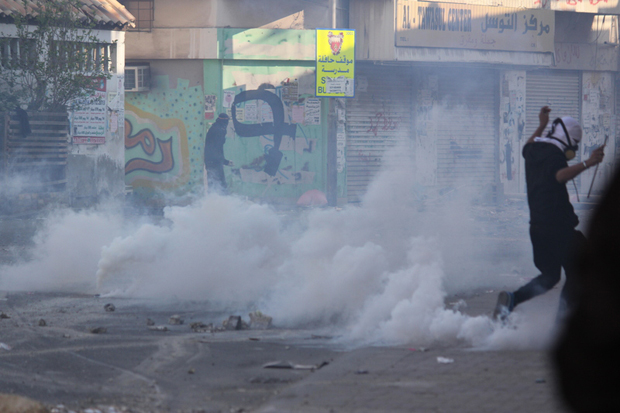
Made in Britain? Physicians for Human Rights (PHR) called for the immediate suspension of the use of excessive, indiscriminate and systematic use of tear gas against civilian protesters and densely populated Shia neighbourhoods in Bahrain (Image: Iman Redha/Demotix)
The Arab Spring has not stopped Britain from helping crush free expression and freedom of assembly by selling crowd control gear to authoritarian states including Saudi Arabia and Bahrain.
Analysis of newly-published data on export licences approved by the UK government have revealed ministers backed over £4 million of tear gas, crowd control ammunition and CS hand grenade sales over the last two years to Saudi Arabia – one of the most repressive states in the world.
The British government also allowed crowd control ammunition to be sold to Malaysia and Oman, as well as tear gas to Hong Kong and Thailand.
It gave the green light to anti-riot and ballistic shields to four authoritarian regimes listed by the Economist Democratic Index: the United Arab Emirates, Bahrain and Azerbaijan, as well as Saudi Arabia.
Its only refusal for an export licence in 2013 for equipment which could be used to suppress internal dissent was for an order of CS hand grenades and ‘tear gas/irritant ammunition’ to Turkey.
A lack of transparency across the secretive arms sector makes it difficult to establish which companies are providing the arms – or how the country in question intends to use them.
But the Geneva Convention forbids the military use of all gas weapons, meaning the UK government would have assumed the tear gas was for use against civilian protesters.
Brief explanatory notes included in the export licences data suggest all those mentioned above are primarily for use against domestic populations.
The notes typically state the licence is granted “for armed forces end use” or “for testing and evaluation by a government / military end user”.
The only exception is the note for a sizeable order of anti-protest equipment for Brazil, which makes clear the export licence is granted for “armed forces end users not involved in crowd control / public security”.
Further evidence has emerged that Britain’s leading arms firm, BAE, has signed a £360 million contract with an unnamed Middle Eastern country for the upgrade of armoured personnel carriers whose primary use is against protesters.
Industry insiders believe the improvements are being made in Saudi Arabia to a stockpile of the vehicles left in the country by the United States military.
BAE’s chairman Sir Roger Carr said contractual commitments prevented him from commenting at the defence giant’s annual general meeting in Farnborough yesterday.
He faced heckling and hissing from vocal critics in the audience who had infiltrated the two-hour question-and-answer session, but insisted BAE was “helping to preserve world peace” and that the company “are not undermining the broader international rules” of the arms trade.
Speaking afterwards, however, a member of BAE’s board suggested the “natural place for these decisions is with government” rather than the company.
“I’m not abrogating our moral responsibility,” he said, “but it’s right that the burden of these difficult decisions is on the government because, in the UK at least, this is an elected democracy.”
Britain’s parliament, at least, has proved reluctant to provide a critical voice on the UK’s arms trade.
Opponents had alleged Saudi Arabian troops which intervened to crush the Arab Spring in Bahrain had received British military training. A recent report from MPs accepted the Foreign Office’s rejection of British complicity, with ministers arguing none of the training had taken place “in a repressive way”.
The Commons’ foreign affairs committee did, however, call on the government to “adhere strictly to its existing policy to ensure that defence equipment sold by UK firms are not used for human rights abuses or internal repression”.
Its request for the government to provide further evidence that it is doing so in practice did not meet with a positive response.
Officials said the risk that export licence criteria might be broken is “factored into” the original decision to grant the licence.
The Foreign Office stated: “There are rigorous pre-licence checks and, for open licences, compliance audits at the exporters’ premises in the UK. We will continue to scrutinise carefully all arms sales to Saudi Arabia.”
Many believe the current export licence regime is not fit for purpose, however. In 2013 the UK approved military licences to a total of 31 authoritarian regimes including Russia, China, Qatar and Kuwait.
“BAE couldn’t sell the weapons they do to these countries without the support of the UK government,” Andrew Smith of the Campaign Against The Arms Trade said.
“The UK government can stop any of these exports at any time but is choosing not to because it’s putting arms company profits ahead of human rights.”
He suggested the government’s decision to exclude Bahrain from its list of ‘countries of concern’ on human rights was “politically motivated”.
And he warned arms sales went beyond small-scale arms and ammunition to include much bigger purchases like fighter jets.
“The reason the Saudis buy from Britain is not just because Britain is willing to sell arms,” Smith added, “but also because it comes with political support and the endorsement and silence of the British government.”
This article was posted on May 9, 2014 at indexoncensorship.org
