2 Dec 2013 | Croatia, News, Religion and Culture
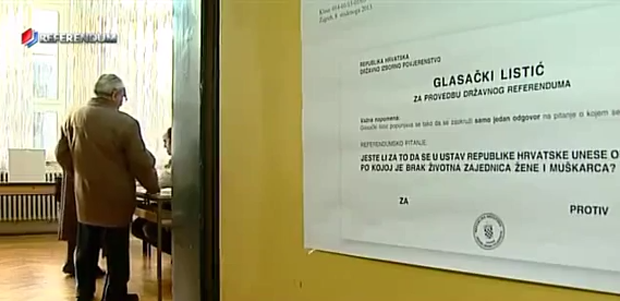
Croatians cast their votes on whether marriage should be constitutionally recognised as being between a man and a woman (Image: Mc Crnjo/YouTube)
Croatia’s voters moved Sunday to amend the country’s constitution to define marriage as being between a man and a woman. The campaign had been orchestrated by the country’s religious institutions. Sixty-five percent of voters supported a change that effectively bars gay marriage.
The campaign used some interesting and controversial tactics. Religious teachers in schools threatened students that they wouldn’t get a passing grade if they did not provide proof of their families’ support for the constitutional change. This was reported by an English language teacher from Split, the second largest city in Croatia, to the inspection body of the Ministry of Education around mid-November.
“If this is the situation in Split I believe it is even worse in smaller towns”, concluded the teacher who did not want to sign her name.
Following this, the media received numerous letters from school teachers confirming that religious teachers around Croatia were blackmailing students to make sure their family members vote “for the protection of the family” — the Catholic Church’s interpretation of the referendum question.
“If the president of the country and other public persons can talk about voting at the referendum why can’t a religious teacher do so?” commented Sabina Marunčić, senior advisor for religious education at the Croatian Education and Teacher Training Agency.
Since the call for a referendum on 8 November, the campaign has been the main topic of discussion in Croatia, despite the country facing a severe economic crisis and an unemployment rate of 20.3 per cent. While Croatian law defines marriage as a union between a man and a woman, this definition does not exist in the constitution. A recent announcement of a new law on same-sex partnerships has caused conservative movements to come together in the initiative “In the Name of Family”. They started spreading fear about gay marriage being legalised, despite the centre-left government showing no intention to do this. A 2003 law on same-sex partnerships has been seen as practically useless because it secures only a few, less important rights, and only after a relationship breaks down.
For weeks all anyone talked about was who will vote “for” and who will vote “against”, in the first national referendum in the Republic of Croatia set up by popular demand. The Social Democratic prime minister Zoran Milanović, President Ivo Josipović and numerous ministers all came forth against introducing the definition into the constitution. A large portion of powerful media was also openly against it. However, public opinion polls showed that 68 per cent of the citizens would vote for the proposal; 26 per cent against.
In the referendum campaign, the Catholic Church have firmly been advocating “for”. It has has a strong influence in the country of 4.29 million, with 86 per cent declaring themselves Catholic according to the latest census, released in 2011. The initiative “In the name of family” which has succeeded in gathering signatures of 740,000 citizens in order to hold a referendum is also linked to the Catholic Church.
“The church did not want to start the initiative for a referendum but it wholeheartedly accepted In the Name of Family, whose numerous members are conservative Catholics close to certain Croatian bishops,” says Hrvoje Crikvenec, editor of the religious portal Križ života (“Cross of Life”).
“However, I believe that the entire organisation and initiative is supported more by politics, that is, a marginal political right-wing party Hrast, than Croatian bishops. They have now become more involved in the campaign in the hope of what would for them be a positive outcome of the referendum, which would ultimately show them as winners.”
The initiative’s leaders do come from the non-parliamentary right-wing party Hrast, as well as conservative associations opposing the introduction of sex education in schools, artificial insemination and abortion. Some of them have been linked to Opus Dei, a secretive Catholic organisation which has been strengthening its presence in Croatia. In the Name of Family and the fight against a possible equal standing of homosexual and heterosexual marriages has provided them with the support of a larger portion of the public.
The Catholic Church has undoubtedly helped the success of a In the Name of Family. Signatures were gathered in front of churches and elsewhere, even in universities. Cardinal Josip Bozanić had written a note instructing priests to encourage believers in masses to attend the referendum and vote for the definition of marriage as a union between a man and a woman. Group prayers for its success were also organised throughout Croatia in the lead up to the vote.
“We can’t blame the bishops for advocating the referendum from the altar because this is a part of the church’s program. They are more entitled do so than to say who to vote for at the elections, which they also do. However, it is inadmissible for religious teachers to influence children in schools,” university professor of philosophy and political commentator Žarko Puhovski says.
Despite Croatia being a majority Catholic country, every fourth marriage ends in divorce and a decreasing number of couples are deciding to marry.
“The church’s influence on citizens is far greater regarding political than moral views. Church morality is accepted in principle, but political views supported by the church gain additional power. That is why the referendum is causing a short-term increase in the influence of the church, which has for years been weakening,” Puhovski explains.
Church leaders are often complaining about the non-existent dialogue with the current, left-wing government, especially regarding the issues they consider to be related to religion – education of children, family care and marriage.
“The ultimate success of this referendum is in showing the power of the church in Croatia. It has shown the government that it can move masses of people so in the future, the government will have to think carefully before making any decision which could harm their interests,” said a group of Roman Catholic theologists in a joint letter made public on 29 November.
“The relationship between the church and the state has mostly been disturbed by militant statements of individuals from the Catholic Church leadership, which seem to be best served with a one common mindset rather than political and worldview pluralism,” sociologist and ex-ambassador for the Holy See, Ivica Maštruko says.
“We are not dealing with a normal criticism of the current social state and relations, but bigotry, inappropriate discourse and civilisational and religious malice,” Maštruko added.
An example of such a discourse is provided by reputable former minister and theologist Adalbert Rebić who, earlier this year, was quoted as saying: “The conspiracy of faggots, communists and dykes will ruin Croatia.” Pastor Franjo Jurčević was convicted for publishing homophobic and extremist posts on his blog.
But in the campaign for the referendum the Catholic Church was joined by representatives of the other most influential religious communities in Croatia – Orthodox Christians, Muslims, Baptists and the Jewish community Bet Israel. Together they supported the referendum and invited the believers to vote in order to “secure a constitutional protection of marriage”. Religious communities in Croatia are usually rarely seen forming such shared views.
“The most interesting thing is the agreement between the Catholic Church and the Serbian Orthodox Church which have in the past twenty years completely missed the chance to initiate reconciliation, dialogue and co-existence during and after the wars in ex-Yugoslavia. Religious communities in the region can obviously agree only when they find a common enemy, which in the case of this referendum are LGBT persons,” Cirkvenec says.
Žarko Puhovski considers it indicative that religious communities in Croatia succeed in forming shared views only with regards to sexual morality.
“They have failed to reach a consensus on any other moral or political issue,” he concludes.
This article was published on 2 Dec 2013 at indexoncensorship.org
2 Dec 2013 | Middle East and North Africa, News, Saudi Arabia
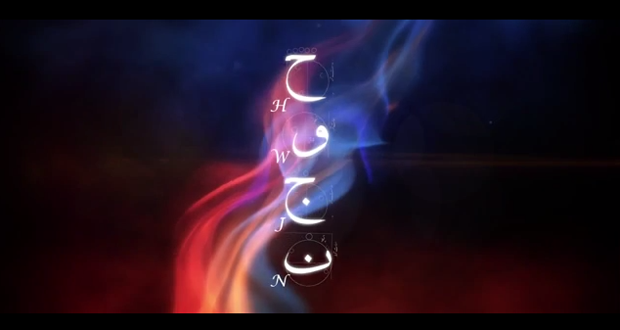
A shot from the YouTube trailer for H W J N (Image: Yatakhayaloon Sci Fi/YouTube)
A top selling Saudi Arabian science fiction novel has been removed from book shops across the country.
Last Tuesday (26 Nov) representatives from the country’s Commission for the Promotion of Virtue and Prevention of Vice — the Haya’a — raided several bookshops selling the novel H W J N by Ibraheem Abbas and Yasser Bahjatt’s, demanding it’d be taken off the shelves. H W J N is a “fantasy, sci-fi and romance” novel about a genie who falls in love with a human, and is a best-seller in Saudi Arabia.
Our source, who wishes to remain anonymous, says the book is charged with “blasphemy and devil-worshiping”. They add that the ban appears to stem from a Facebook post accusing the novel of “referencing jinn [genies] and leading teenage girls to experiment with Ouija boards”.
An official, handwritten letter was delivered to at least one book store from the government body. It stated, among other things that: “We purchased one copy of the book to review and we have counted 73 copies of H W J N by Ibarheem Abbas at your shop. You are requested not to dispose of, sell, or return these books until further notice.” The owners were also asked to “follow up” on this with the Haya’a the following day (27 Nov).
The book is reportedly still available in smaller shops, and the English version is also reportedly available in a number of stores. It is so far unknown what actions, if any, are being taken against the authors.
This article was published on 2 Dec 2013 at indexoncensorship.org
29 Nov 2013 | Academic Freedom, News, United Kingdom
In bid to address the issues surrounding people with extremist views giving talks at British campuses, Universities UK recently released new guidelines on external speakers. “Universities have to balance their obligation to secure free speech with their duties to ensure that the law is observed — which includes promoting good campus relations and maintaining the safety and security of staff, students and visitors,” says the body, which represents vice-chancellors.
This is not the first time they have spoken out about the topic. However, a set of guidelines from 2011 reads: “It is the law alone which can set restrictions on freedom of speech and expression and on academic freedom — it is for the law and not for institutions or individuals within institutions to set the boundaries on the legitimate exercise of those rights”. It appears they are calling for somewhat stricter regulation this time around. The current guidelines are also more in line with the view of the National Union of Students, which maintains that “(…) many students’ unions may wish to go further than the law on securing ‘freedom from harm’ when restricting some speaker activity.” The NUS’ own “No Platform” policy, banning certain speakers from their events, puts this theory into practice.
This is one of those topics that seems to come up at fairly regular intervals, and the outline of the debate is familiar by now. One side argues that speakers with outwardly hateful or discriminatory views don’t deserve a platform through which to legitimate them; while the other side argues that to deny them this is to deny them the right to freedom of expression, which also extends to those with whom we disagree. The following speakers have been responsible for at one point reigniting the debate, each in their own way.
1) Nick Griffin
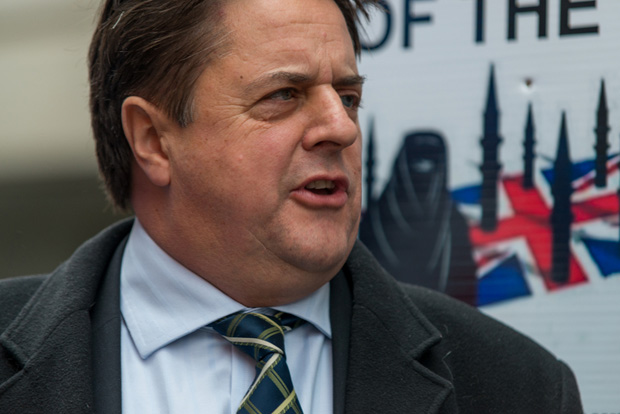
Nick Griffin outside the Old Bailey court on the first day of the trial of the murder of Lee Rigby (Image: Velar Grant/Demotix)
The most famous case in recent years was the 2007 appearance of BNP leader Nick Griffin (and Holocaust-denying historian David Irving) at an Oxford Union debate on free speech. The invitation caused massive uproar, with protesters picketing the event. “It is not just an Oxford issue, this will have ramifications for other places where the BNP are active… this is going to give legitimacy and credibility to their views,” said Student Union President Martin McClusky at the time. “I find the views of the BNP and David Irving awful and abhorrent but my members agreed that the best way to beat extremism is through debate,” argued Oxford Union president Luke Tryl. This is not only time the Nick Griffin has caused controversy as a potential university speaker. Trinity College Dublin cancelled plans to include him in a debate immigration, saying “it could not guarantee the safety and wellbeing of staff and students”.
2) Mufti Ismail Menk
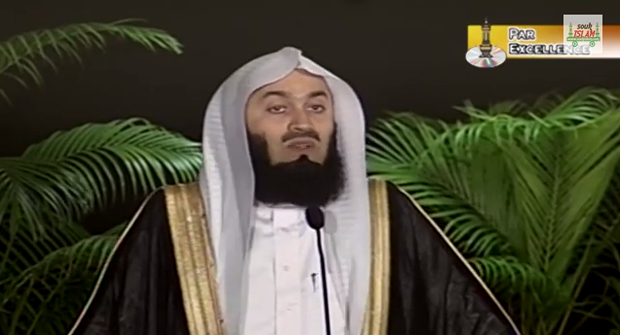
Mufti Ismail Menk giving a lecture (Image: soukISLAM/YouTube)
Islamic preacher Mufti Ismail Menk spoke at Liverpool University earlier this month. He has previously stated that gay people are “filthy” and “worse than animals”. The event was initially reported to be part of a longer tour stopping at Glasgow, Leeds, Liverpool, Leicester, Cardiff and Oxford universities. However, all except Liverpool, where he was hosted by the Islamic Society, revoked their invitation or said he had not been officially invited in the first place. Liverpool responded that it is “not the role of the university to censor people’s views”.
3) Mohamed El-Nabawy
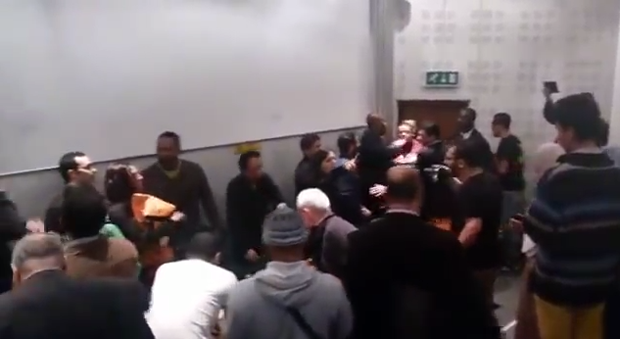
A video captured the protest that erupted when Mohamed El-Nabawy was due to speak at SOAS (Image: YouTube)
A representative of Tamaroud, the grassroots movement which played a significant role in the ousting of Egypt’s Muslim Brotherhood-backed elected government, was chased away by angry protesters prior to a scheduled talk at London’s School of Oriental and African Studies (SOAS). The protesters, who were not students, chanted and brandished posters associated with the Muslim Brotherhood at the open lecture. SOAS security had to escort El-Nabawy off campus using an emergency exit . A spokeswoman for the Palestinian Society, which had organised the talk, said: “In the pursuit of freedom of speech and expression, some people may find some of the views expressed at our events objectionable.”
4) David Gale
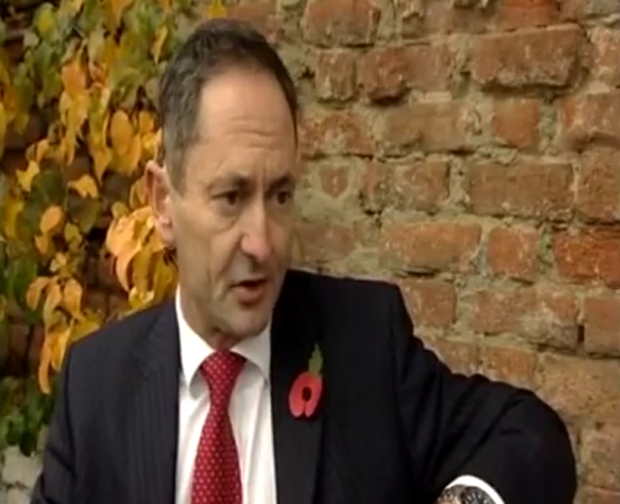
David Gale on the BBC’s Sunday Politics Show (Image: UKIPDerby/YouTube)
In 2012 the Student Union at the University of Derby banned David Gale, UKIP’s candidate for Police and Crime Commissioner, from taking part in a Q&A session at the university. The Union has a no platform policy for “individual(s) who they believe to be a member of a group with racist, fascist or extremist views”, a category the Union believed was applicable to UKIP . UKIP leader Nigel Farage weighed in on the issue at the time, saying: “It is frightening that a Derby student body is so frightened of free speech and public opinion.”
5) George Galloway
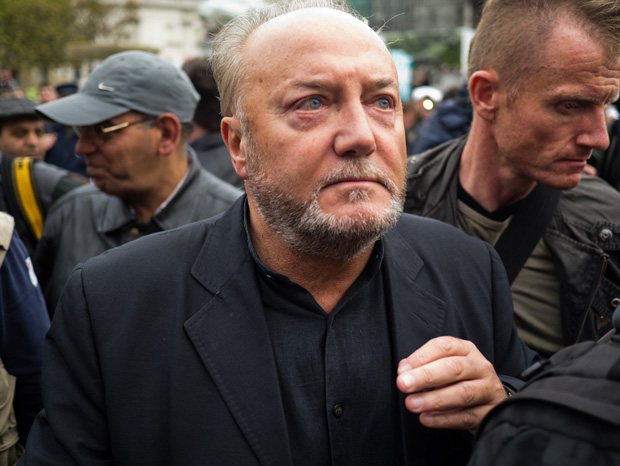
George Galloway attends an anti-war rally in 2011 (Image: Paul Soso/Demotix)
In March, George Galloway was set to speak at an event organised by the University of Chester Debating Society. However, the invitation was revoked by the Student Union, acting in line with the NUS’ No Platform policy on Galloway. This move came after the Respect Party MP was involved in a string of controversial incidents, including refusing to debate with an Israeli student at an Oxford University panel discussion. Galloway’s camp have called the policy “idiotic, anti-democratic and politically-motivated”.
6) Julie Bindel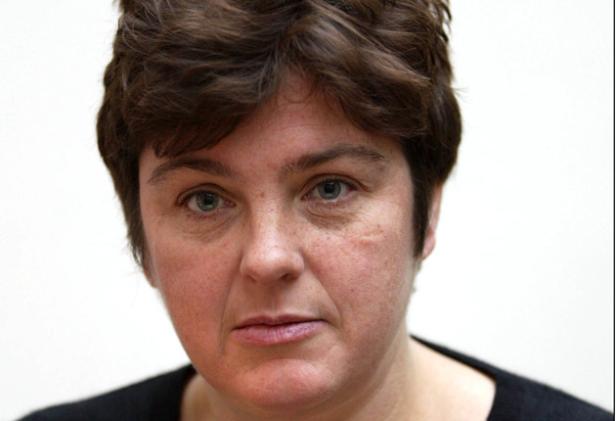
In September, the Debating Union at Manchester University (MDU) invited feminist writer and campaigner Julie Bindel to speak at their discussion on pornography. A number of people objected due to Bindel’s reported views about transexual people, which have led to the NUS implementing a No Platform policy for her. Some transexual students and their supporters “felt Julie Bindel’s transphobic statements and views made them both unwelcome at the event, and unsafe on campus, as it seemed that transphobia was being allowed and possibly encouraged,” said Loz Webb, the university’s Trans* representative. Despite this, MDU refused to replace Bindel, though she eventually chose to drop out after receiving death threats.
This article was originally posted on 29 Nov 2013 at indexoncensorship.org
22 Nov 2013 | News, Russia
This autumn the Russian authorities have made it clear that they are intent on extending the blocking of websites. In September, two prominent State Duma members of the ruling United Russia party, Robert Shlegel and Maria Maksakova, submitted amendments to an anti-piracy law, prohibiting illegal distribution of movie. These entered into force on 1 August. The deputies propose to supplement the law with measures that protect the copyright of musicians, writers and computer program developers.
In November, Andrei Lugovoi, a MP from the rightwing nationalist Liberal Democratic Party, submitted a bill proposing the extrajudicial blocking of sites containing calls for riots or extremist activities, including calls to take part in public events held deemed to be in violation of the established order. Hitherto, such sites have been subject to blocking by a court order. This initiative was met with general approval by members of the State Duma.
Extremism
Chechen prosecutor seeks to block anti-Putin article
On 23 September the Chechen Republic prosecutor announced the filing of writs against internet service providers (ISPs), demanding restrictions on access to a website publishing the anti-Putin polemic “Putin’s plan is Russia’s misfortune”. The article is on the Federal List of Extremist Materials.
Chechen prosecutor moves against ISPs over Islamist material
On 11 September the Chechen Republic prosecutor announced the filing of writs to restrict access to a website featuring the Islamist piece “Zaiavlenie komandovaniia mudzhakhidov Vilaiata Galgaiche” (Statement of the Mujahideen commanders of Vilayata Galgaiche), which is on the Federal List of Extremist Materials. The defendants were not identified in the report.
Smolensk prosecutor starts proceedings against ISP for video
On 11 September it was reported the Leninsky district prosecutor had issued a writ to the ISP MAN Set for allowing public access to videos included on the Federal List of Extremist Materials. The ISP complied with the writ and those responsible for allowing access faced disciplinary charges.
MTS receives a order to block video in Altai Republic
On 10 September the Gorno-Altaysk city court granted the Altai Republic prosecutor’s motion demanding that the ISP Mobilnye Telesystemy restrict access “to an extremist video clip posted on 16 websites”. The clip in question was not specified. The decision was made in the absence of the defendant.
Moscow court orders ISPs to block sites
On 25 September the Moscow city prosecutor reported that the Kuzminsky district court had accepted the demand of the Kuzminskaia interdistrict prosecutor that the ISPs Click and Obiedinennye Lokalnye Seti limit access to five websites that made available Hitler’s Mein Kampf. The prosecutor also demanded a block on a website containing citizens’ personal data.
Krasnodar moves against extremist posts on social network
On 25 September the Krasnodar regional prosecutor reported that the Adlersky district court in Sochi had accepted the demand of the district prosecutor that it define two Islamist texts published on the VKontakte social network as extremist.
Prosecutors move against website in Chechnya
On 11 September the Urus-Martanovsky district prosecutor filed a lawsuit demanding that ISPs limit access to a website for publishing the video Videovestnik Russkoi Molodezhi (the Youth Messenger), included on the Federal List of Extremist Materials. The case is pending.
Blogs targeted in Ulyanovsk
On 25 September the Ulyanovsk regional prosecutor reported that the Zavolzhsky district prosecutor had issued writs demanding the ISPs ER-Telecom Holding and Rostelecom cease offering access to the websites kcblog.info and t-kungurova.livejournal.com. Both are legally recognised as extremist [for being aliases] for the Chechen militants’ website Kavkazcenter.
Education and schools
Kamchatka schools told to shield students
On 13 September it was reported that the Petropavlovsk-Kamchatsky city prosecutor had issued demands that several schools install content filters to prevent access to websites containing extremist propaganda.
Lipetsk schools allowed access to banned sites
On 27 September it was reported that the Dankovskaia interdistrict prosecutor in Lipetsk region had demanded the director of Dankov Secondary School No 1 eliminate violations of the child protection law. An inspection had revealed that the internet filtering system installed on school computers was not blocking access to websites about drugs, pornography and suicide. It also allowed access to the texts of songs included in the Federal List of Extremist Materials.
Blind students ‘could read Mein Kampf’ in Omsk school
On 17 September it was reported that the Omsk city prosecutor had identified a number of violations at Boarding School No 14 for visually impaired children. In particular, the school computers allowed access to Hitler’s Mein Kampf, included on the Federal List of Extremist Materials, as well as to websites containing pornographic images, violence and drug propaganda.
University fined for banned site breach
On 3 September it was reported that the Sverdlovsk regional arbitration court had accepted the demand of a fine for B N Yeltsin Ural Federal University, issued by the Ural regional office of the watchdog Roskomnadzor. The university had failed to submit an application for an access code to the register of banned websites. As a result, students had access to resources included on the register. The court imposed a fine of 30 thousand rubles on the university. The court’s decision has not yet entered into force.
Suicide propaganda
Penza prosecutor tries to block suicide prevention
On 11th September it became known that the local Penza’s prosecutor office asked the court to block access to the website Pobedish.ru (“You win”). The website is part of Perezhit.ru group – a suicide prevention resource that works with psychologists, psychiatrists, forensic experts and the clergy.
Kaliningrad prosecutor moves against suicide sites
On 23 September it was reported that the Moskovsky district court of Kaliningrad had received a prosecutorial request that the ISP TIS-Dialo restrict access to several websites describing methods of committing suicide.
Drugs and alcohol
Facebook almost blocked for advertising smoking blends
The Russian branch of Facebook came close to being blocked for publishing advertisements for illegal smoking blends in September, according to reports from the Itar-Tass news agency, citing Facebook’s Russian press service. Facebook said users had reported the ads for smoking blends on 16 September and the company had been unable to do so because of a technical glitch. The incident followed a warning from the Federal Antimonopoly Service (FAS) that it intended to inspect social networking sites for ads for banned substances. The media watchdog Roskomnadzor subsequently warned Facebook that it had been provisionally placed on the register of banned websites and would be shut down if it did not remove the ads. Facebook announced on 19 September that it removed the offending content.
Reports filed on ISPs in Kurgan
On 18 September it was reported that the Kurgan regional office of Roscomnadzor had compiled reports on two ISPs that were not blocking access to websites advertising illegal drugs.
Yekaterinburg complains about alcohol advertising
On 17 September it was reported that Sergei Trushin, deputy head of the Yekaterinburg administration, had sent a letter to the regional office of the interior ministry requesting action against websites advertising the sale of alcohol. The Ministry of Internal Affairs shut down the sites and the people behind them were fined.
Gambling and casinos
Yekaterinburg ISP loses appeal
On 3 September it became known that the Sverdlovsk regional court had accepted the demand of the Kirovsky district prosecutor in Yekaterinburg that the ISP VympelCom-Communications block five gambling websites based on foreign servers. The demand had been accepted by a district court but the ISP had appealed.
Eight gambling sites blocked in Tomsk
On 12 September the Tomsk regional prosecutor announced that the Strezhevoy town prosecutor had filed a lawsuit against the ISP Danzer demanding restrictions on access to eight online casinos. The ISP complied by blocking the sites.
Rostelecom blocks William Hill
On 5 September Rostelecom blocked its subscribers’ access to the largest UK betting website, williamhill.com. The ISP Qwerty in Moscow and the surrounding region also blocked access to the site.
Rostelecom subscribers could not access the website’s primary domain, online casinos or online poker sites. Instead, they saw a message announcing that the domain had been blocked by court order or that the address had been placed on the register of banned websites.
Torrents and piracy
Moscow court bans 11 torrent sites
On 5 September Moscow city court accepted the claim of NTV-Profit against 11 online torrent sites — free-torrents.org, inetkino.org, rejtinga.net, nnm-club.me, hotbase.org, x-torrents.org, goldenshara.com, rutor.org, torrnado.ru, torrent-shara.org, nntt.org – that were distributing the popular Russian-made films Vor (The Thief), Krutoi Povorot (Sharp Turn) and Interny (The Interns).
Portal avoids block for streaming
On 5 September Moscow city court accepted a request by the Central Partnership Sales House requesting to block the torrent portal Rutracker.org to prevent it distributing the American films Now You See Me and Taken 2. Rutracker removed the films and avoided being blocked.
And the rest
Pussy Riot icon banned
On 9 September it was announced that the Tsentralny district court had granted a request by the Zheleznodorozhny district prosecutor of Novosibirsk to declare an icon-like image of Pussy Riot, created by the artist Artyom Loskutov, banned from distribution via the internet. The image has been added to the register of banned websites.
Block on inaccessible site demanded
On 24 September it was announced that the Yegoryevsk city court had granted the city prosecutor’s motion against Yegoryevskaia Telekommunikatsionnaia Kompaniia (Yegoryevsk Telecommunications Company) to limit access to an online casino website. Earlier, the same court had ruled in favour of the provider, but the prosecutors challenged the decision, and the Moscow regional court sent the case back for retrial. The Yegoryevsk city court ordered the provider to restrict access to the site, but the access to the website was found to already be blocked – perhaps, by the online casino’s owner or another operator. However, the court insists that Yegoryevskaia Telekommunikatsionnaia Kompaniia should be the one to implement access restrictions. The court provided no advice on how to block an already inaccessible site.
Stavropol prosecutor seeks block on e-library for one book
On 25 September the Stavropol regional prosecutor reported that the Novoaleksandrovsky district prosecutor had filed a claim in Leninsky district court against the Stavropol regional branch of Rostelecom, demanding restrictions on access to the website royallib.ru. The site provides public access to the book Skiny: Rus probuzhdaetsya (Skinheads: Rus Is Awakening) by Dimitri Nesterov, which is on the Federal List of Extremist Materials
Roscomnadzor blocks porn site
On 13 September it was reported that Roscomnadzor had included the porn site redtube.com on the register of banned websites. The reason for placing the site on the register was not specified, but it might have been because it published a cartoon entitled “Hentai school girls fucking for better grades”.
TV channel targeted in Moscow
On 6 September it was announced that the central investigations directorate of the ministry of internal affairs in the Moscow Region had demanded that the website of Dozhd (Rain) TV channel be blocked for violation of Part 2 of the Criminal Code Article 282 (“incitement to hatred or hostility and humiliation of human dignity”). TV Dozhd is the country’s most popular online TV news channel and is relatively independent. The exact nature of the material deemed objectionable was not reported. The Ru-Center domain registrar confirmed the existence of the police request, but, since the request was filled out incorrectly, the TV channel website was not blocked. Interior ministry representatives subsequently denied the reports. The administration of Dozhd also stated that they had received no such orders from the ministry of internal affairs.
Saratov ISP ordered to ban ads for bankrupt company
On 6 September it was reported that the Kirovsky district prosecutor in Saratov had filed a lawsuit against the ISP Saratovskaia Sistema Sotovoi Sviazi (SSSS) demanding that it restrict access to an internet portal advertising a bankrupt company. The ISP refused to block the relevant IP address because it was also used by three unrelated sites. In addition, the provider stated that it had no control over IP address changes, while an advertiser could always change it. However, the court granted the prosecutor’s claim and ordered the ISP to restrict access to the site.
ISPs fined in Moscow and Saratov
On 3 September it was announced that the Moscow arbitration court had fined the ISP KMC Telecom and that the Saratov regional arbitration court had fined the ISP Hemikomp for ignoring the requirement to sign up to the register of banned websites. In both cases, the decisions were made based on evidence from the media watchdog Roskomnadzor. It said the ISPs’ reluctance to register and block access to websites listed on the register was in violation of Part 3.14 of the Administrative Code (entrepreneurial activity without state registration).
Amur ISPs reported for non-compliance
On 14 September it was reported that the Amur office of Roscomnadzor had filed administrative responsibility reports against the following ISPs: Amurtelekom, A- Link, Transsvyaztelekom, Inter.kom, KRUG, GudNet, Moia Komputernaia Set, Gorodok, and Edinaia Gorodskaia Set. Roscomnadzor demanded penalties for their failure to comply with the register of banned websites. If the violation is not addressed, each provider faces a fine of up to 40,000 rubles.
Consumer protection site temporarily blocked
On 26 September it was reported that www.i-zpp.ru, a consumers’ rights website, had been added to the register of banned websites. The addition was triggered by the decision of the Salekhard city court of 18 April 2013 to block access to websites containing extremist materials. The consumer protection website had been blocked because it had the same the IP- address as extremist websites. In late September the site was, once again, accessible from Moscow.
Owner loses appeal against ban
On 20 September it became known that Vladimir Kharitonov, the owner and administrator of the website Novosti elektronnogo knigoizdaniia (News of electronic book publishing, digital-books.ru), had filed an appeal with the Moscow city court against Roskomnadzor’s decision to include it on the register of banned websites. Kharitonov had previously attempted to appeal the decision, but the Tagansky district court dismissed his appeal in March. The Moscow city court did the same in September. The owner of the website intends to appeal to the European Court of Human Rights.
Prosecutor blocks 15 Omsk sites
On 17 September it became known that the Omsk city prosecutor had succeeded in blocking 15 websites. Previously, the Tsentralny district court had dismissed the claim of the Omsk city prosecutor demanding that the local branch of Rostelecom restrict access to 15 sites selling certificates and diplomas. The prosecutor appealed the decision and the Omsk regional court overturned the lower court’s decision and ordered the internet provider to block the websites.
This article was originally posted on 22 Nov 2013 at indexoncensorship.org
