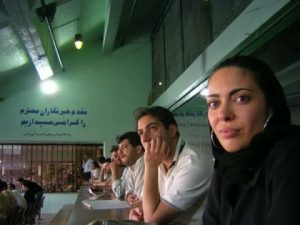
Ramita Navai in Iran in 2005, at a time when women journalists were temporarily allowed in to report on football matches
Up to 20,000 people have now been detained as a result of the protests that have wracked Iran in the past three months. Those who have been detained have been subject to physical and psychological torture, rape and been made to make forced confessions. Some, including 22-year-old Mahsa (Jina) Amini whose death sparked the current protests, have died in custody.
The British-Iranian investigative journalist and documentary maker Ramita Navai knows only too well what those who have been detained are facing. She has been detained by the Iranian authorities several times over the years.
Her first arrest came just after she had started working as Tehran correspondent for The Times and was covering the anniversary of the Islamic Revolution.
“I was at a rally with a lot of other journalists and I was interviewing some Iranians. Before I knew it, two undercover intelligence agents had taken me away; none of my colleagues saw me being taken. It was a terrifying experience. They took me to an abandoned warehouse with broken windows and flexes hanging from the ceiling and there was an armed man standing outside the room. They took all my possessions and carried a table and chairs into the room before starting with a good cop/bad cop routine. It was very manipulative psychologically and was designed to break me. They started telling me that I had been asking anti-revolutionary questions and said I had been telling people how to answer. It was all lies but I was utterly unprepared for this.”
Her interrogators asked her whether she had heard of Zahra Kazemi, a Canadian-Iranian photojournalist who had been killed in police custody shortly before Navai had arrived in Iran.
“Every journalist knew what had happened to her and they were hinting that I would suffer the same fate. I was so petrified I started sobbing.”
Navai was one of the lucky ones. A few hours after being taken, one of her journalist colleagues, Jim Muir of the BBC, noticed she was missing and started talking to the Iraniansat the rally. One whispered to him that they had seen her being taken away.
“He phoned up the Ministry of Islamic Culture and Guidance and said we know you have got her, you had better release her otherwise I am going to cause a fuss about this.”
Navai was released shortly afterwards.
Since then Navai has won numerous awards for her documentary work, including an Emmy for her PBS Frontline documentary Syria Undercover in 2012 and a Royal Television Society Journalism Award for her documentary on tracking down refugee kidnap gangs for Channel 4.
But it is Iran, the country of her birth, where her heart lies.
Her 2014 book City of Lies, which won her the Royal Society of Literature’s Jerwood Award for non-fiction, tells the stories of ordinary Iranians forced to live extraordinary lives: the porn star, the ageing socialite, the assassin and enemy of the state who ends up working for the Republic, the dutiful housewife who files for divorce, and the old-time thug running a gambling den.
Tehran, the City of Lies of the title, is described with romantic nostalgia but rails against the hypocrisy of the regime.
Navai feels there is “no turning back” from the current protests.
“This time feels very different. I think the protests are unlike anything we have ever seen. Significantly, they span all social classes, ethnicities and the protests have happened in every one of Iran’s provinces. The protests have been a unifying force, uniting Iranians of all colours against the regime. I don’t think the regime will fall imminently although I do think something has shifted and there is no going back from that. I think a very different future for Iran has now become a reality in a way that it wasn’t a year ago.”
She adds, “The most organised groups seem to be the Iranian feminist and women’s rights networks because they have been used to mobilising for such a long time. They are used to being arrested and imprisoned. They issue secret missives and are coordinating with some of the activists in prison.”
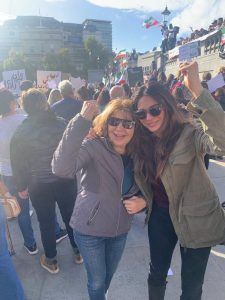
Navai and her mother Laya at a demonstration in London in support of the Iranian protests
Navai believes it is the moment for Iranian women and those of Generation Z in particular.
“The women’s groups were crushed in 2009 – they were a thorn in the side of the regime. What we are seeing now is a strengthening and a rising up,” she says. “In 2009, it was people my age who were and are very fearful of the regime. The younger generation – Generation Z – are absolutely fearless. My generation always felt like they had something to lose. The regime is brilliant at playing this game of giving people just enough freedom to shut them up. This younger generation have grown up in a very different world, a completely connected Iran in which they have been influenced by global popular culture. They know what is out there in the world. They know all the opportunities that should be open and available to them and they are angry and they are fearless.”
She believes a sexual awakening is also happening in Iran.
“We are talking about this being a women-led uprising, partly this is because this sexual awakening has changed the socio-cultural dynamics for Generation Z. In real terms, virginity is not the thing it used to be. So many couples are living together outside marriage that the Supreme Leader’s office issued an edict saying how immoral it is. These are ordinary Iranians, not just the middle and upper class. There has been this massive socio-cultural shift. Generation Z are used to different social norms and strictures and they are not going to be told what to do. They want full autonomy not only over their bodies but over their lives.”
In the intervening years, Iranian people have become even more resourceful than in previous protests.
“This is what 43 years of a repressive and censorious regime have done,” says Navai. “Most Iranians have VPNs [virtual private networks]. There are occasional blackouts – not all VPNs keep working so they have to change them. Iranian exiles are paying for that service, sending login details to Iranians within the country to help them mobilise. They have also been mobilising in quite interesting ways using social media but actually also old-fashioned meet-ups.”
The recent public expressions of protest by leading Iranians, such as the actress Taraneh Alidoosti and a women’s basketball team, are “hugely significant”, she believes.
“They are emboldening the protesters to rise up against the regime,” she says. “I also think these high-profile protests and the world’s media and social media are a really important tool for this uprising. It is the oxygen that is keeping these protests going. Without the world watching I think the regime would be far more brutal. It has already been very brutal. It hasn’t unleashed its might yet and I am scared that it will.”
In many revolutions, it is when the military switches sides, abandoning their loyalty to the leaders under pressure from the people that real change happens. Indeed, some experts have speculated that change will only come to Iran when that happens. However, there are good reasons to think that may not happen.
Iran’s regular armed forces number around 420,000 plus another 300,000 or so who are reservists who can be called up.
What is perhaps stopping them from switching their loyalty is the Islamic Revolutionary Guard Corps, set up by Ayatollah Khomeini in 1979.
“You have 100,000 to 150,000 soldiers who are the Revolutionary Guard,” says Navai. “It was set up to ensure loyalty to the Supreme Leader and the state and act as a counter-balance to monitor the ordinary forces. These Revolutionary Guardsmen are better trained, far better equipped and are far more loyal – they are ideologically motivated and answer directly to the Supreme Leader. It will be a big turning point if the army turns, however I think that could also result in a bloodbath.”
There are also the Iranian regime’s allies beyond the country’s borders – the Shia militia in Iraq and Hezbollah.
What is clear from Navai’s City of Lies is the widespread hypocrisy of the Iranian regime. It tells stories of clerics using prostitutes and the ubiquity of porn.
“This is one of many reasons that Iranians have had enough,” says Navai. “The regime is not only corrupt politically, it is corrupt morally. While the state enforces laws that govern its citizens’ most intimate affairs meanwhile people in power do as they please. You have people in power whose children are partying in Iran and across the world, doing drugs, wearing whatever they want and having normal sexual relations that are not allowed under the regime. It is this hypocrisy that people are finally fed up with.”
]Are the British Royal Family the real enemies of history? Over the decades they have actively suppressed uncomfortable narratives about themselves. Hundreds of files in the national and royal archives remain inaccessible to the general public, files that many would argue are of public interest. The result? Holes in our country’s history.
These are some of the conclusions from the team at the magazine Index on Censorship, who carried out an investigation into royal historical censorship for their Winter issue. As part of the launch of the magazine, a panel of speakers will discuss the findings alongside their experiences of trying to access historical archives. This will be a lively discussion and one with heightened importance following the death of Queen Elizabeth II in September and ahead of the coronation of Charles III in the spring.
“Are you proud of being Foreign Secretary of a country that trades with a country that actually crucifies people in public?”
Interviewer Jayne Secker had a point when she asked James Cleverly this on a Sky TV show last weekend.
The Foreign Secretary was quick to respond to the allegation.
“I have spoken with the Saudis about our long-standing principled position on the death penalty as I do with pretty much all countries around the world that maintain the death penalty. Saudi is…an important, influential country in the Middle East and it’s incredibly important that we maintain an ongoing bilateral relationship with Saudi. Some of that includes trade but also in terms of security counter-terrorism work…We have seen real changes over the last decade [but] I want to see those changes go further and faster.”
In its recently released2021 Report, the FCDO points to progress in the country’s application of the death penalty – “only” 65 individuals were executed in 2021 and the FCDO reports this is a decrease from 184 executions in 2019. The FCDO suggested this may be related to death penalty reforms announced in 2020, including a moratorium on the death penalty for drug-related offences and ‘discretionary’ crimes committed by juveniles.
This ‘leniency’ has not lasted. In the year to the end of November 2022, 144 people had been executed including 81 on a single day in March.
Many argue that Saudi’s growing importance to the UK, particularly during the war in Ukraine is blinding the UK government to human rights abuses in the country – or at least giving them cover for their current level of inaction. Saudi Arabia is the UK’s 25th largest trading partner, accounting for £13.7 billion of imports and exports of goods and services. The figure is up 25.9% year on year, meaning that there will be pressure from the Treasury and the Prime Minister to keep relations cordial.
The FCDO clearly has concerns about Saudi. In the report, it says of the country that “political space and freedom of expression remained severely restricted, and there remained a culture of self-censorship and fear”.
However, it recognised progress on women’s rights, citing the lifting of restrictions on female employment, the reform of guardianship laws and the release of prominent women’s rights defenders, including Loujain al-Hathloul.
One woman who has not been released isUniversity of Leeds student Salma al-Shehab. It is now 23 months to the day since Salma was arrested when she returned from the UK, where she was studying for a PhD in dental hygiene, to Saudi to visit her family.
Salma had infuriated the Saudi regime solely for tweeting her support for Saudi women’s rights defenders like Loujain al-Hathloul. So while the release of Loujain al-Hathloul gave the Saudi regime a few positive lines in the FCDO report, other people, like Salma, remain in prison.
Salma was later sentenced by Saudi’s notorious Specialized Criminal Court (SCC) under various parts of the country’s Counter-Terrorism Law and the Anti-Cybercrime Law for “supporting those seeking to disrupt public order, undermining the safety of the general public and stability of the state, and publishing false and tendentious rumours on Twitter.
Her sentence is 34 years in prison, longer than the sentence that would be applied to a terrorist bomber or hijacker. Like other Saudi women who fall foul of the regime, Salma has also been slapped with a travel ban for a further 34 years following her sentence.
The FCDO promises it will do more.
In the report, it says: “The UK will continue to engage closely with the Saudi authorities, particularly in areas where there is real Saudi appetite for change such as judicial reforms, women’s rights and the death penalty. The UK will continue to raise individual cases of human rights concerns with Saudi counterparts at ministerial and official level and attempt to attend these trials.” Confirming that UK engagement will be potentially guided by “areas where there is real Saudi appetite for change” enables the regime to dictate terms and raises the obvious question – what will the UK do to increase that appetite to other areas of importance, such as reform of the SCC and ending the criminalisation of online free expression?
The signs are not great.A letter we sent to James Cleverly in October along with 13 other human rights organisations elicited a weak response from the Foreign Secretary’s office. Others are also not convinced by the FCDO’s promises to press the Saudis further. The London-based NGO ALQST, established in 2014 by Saudi Arabian human rights defender Yahya Assiri, has issued its own report,Human Rights and the UK-Saudi Relationship, in the past week.
In it, ALQST says the FCDO’s report gives “an unduly generous account of the Saudi leadership’s reform programme, and accepted several claims by the authorities that observers on the ground have strongly challenged”.
It goes on to make 17 recommendations to the UK government, including exerting public and private pressure on the Saudi Arabian authorities to improve their human rights record, including on thematic issues and, crucially, individual cases of concern.
It also calls for consular and embassy officials to continue to request access to relevant trial hearings such as those involving prisoners of conscience, and the UK government should press the Saudi authorities on the issue of court access in support of the right to a fair and open trial. The likelihood of this happening is remote. In a response to a written question tabled by Conservative MP Crispin Blunt on 19 March 2020, relating to the trial of Saudi women’s rights activists in particular, the Government said “The UK attends trials of international importance in all countries where permitted. The UK, along with other embassies in Saudi Arabia, has requested and been denied access to each and every trial we have been aware of since October 2018, with the exception of the trials for those involved in the killing of Jamal Khashoggi.”
It has also called for the UK government to designate Saudi Crown Prince Mohammed bin Salman, who is on the shortlist for Index’s Tyrant of the Year poll, as an individual target for financial sanctions under the UK Global Human Rights regime.
However, the US Government’s decision to grant the prince sovereign immunity in the civil case over the murder of Khashoggi makes this recommendation seem like an exercise in wishful thinking as opposed to something with a genuine chance of success.
According to Cleverly, the UK government will not comment on incidents, instead prioritising actions. In his words “Britain has agency and leverage and we are using it to shape the course of events.” He is saying this at a time where a significant number of British citizens, or those connected to the UK, have been persecuted and detained by authoritarian states. This includes Alaa abd el-Fattah, imprisoned in Egypt, Jimmy Lai who is charged under Hong Kong’s National Security Law, as well as Index award-winner, Sophia Huang Xueqin, who, while not a British citizen, was selected for a Chevening Scholarship prior to her arrest and disappearance in China. While it was hoped that the UK government had learnt lessons from what happened to Nazanin Zaghari-Ratcliffe, whose detention in Iran was arguably prolonged by UK government actions, this frailty at the heart of the UK’s foreign policy sends a powerful signal to those seeking to silence British citizens – you can do so with very little resistance from the UK government. It also tells British journalists, researchers, academics or anyone who expresses themselves online, please do not depend on us.
If there is a single case where the UK government could really prove its intention to hold Saudi Arabia and others to account when it comes to human rights, it is that of Salma al-Shehab. It is a case where the alleged crime took place in the UK. If James Cleverly really wants to send a message to the country’s leaders that the relationship between the two countries isn’t just about trade, he should call for her immediate release.
Ever since environmental activist Deanna “Violet” Coco was handed down a 15-month sentence earlier in December, protesters in New South Wales (NSW), Australia, have rallied in solidarity and to voice their dismay. On Tuesday this week, Coco walked free from prison. The temporary reprieve came as her bail appeal was approved, while she awaits an appeal on her sentence.
In April, Coco and a handful of other protesters from Fireproof/|Floodproof Australia blocked one lane of traffic on Sydney Harbour Bridge, holding aloft a flare to signal the climate emergency. Her sentence is the first of its kind under new laws in New South Wales.
For Suelette Dreyfus, executive director at Australia-based organisation Blueprint for Free Speech, Coco’s recent release must not divert attention from the serious penalties being given to environmental protesters, and the impact on freedom of expression.
“New South Wales has been targeting environmental protesters in the past year especially,” Dreyfus said. “That includes a Conservative state government and a streak in the media that is quite anti-environmentalist.”
She describes the penalties environmental activists typically faced in the past compared to today. What could once have been a fine for a few hundred Australian dollars, has become the threat of a lengthy prison sentence. This comes after NSW introduced the Roads and Crimes Legislation Amendment Act 2022 in April, meaning protesters could be fined up to AU$22,000 or be imprisoned for up to two years for trespassing on a major road and causing damage or disruption, or for damaging or disrupting a major facility.
Alongside this, a new police unit was created to disrupt environmental protest, called Strike Force Guard.
Dreyfus called this “an extreme power that’s been given to both police and the judiciary, to silence environmental protesters”.
When Coco’s sentence was handed down, NSW premier Dominic Perrottet described it as “pleasing to see”.
“It seems to be a strange thing to want to put a peaceful young woman exercising her right to freedom of expression in prison for two years, and feel self-satisfied about it,” Dreyfus told Index.
Coco is not alone in facing the sharp end of NSW’s new laws. In April, fellow Fireproof Australia activist Andrew George interrupted a National Rugby League match by running onto the pitch with a flare, and was handed down a three-month jail sentence, which he later appealed and won. In September, Blockade Australia activist Mali Cooper was cleared of charges against them, after they blocked the Sydney Harbour Tunnel in an attempt to force systemic change after witnessing the Lismore floods. They had faced the threat of two years in prison and $22,000 in fines.
Dreyfus referred to this landscape for environmental protest as a New South Wales phenomenon, but she said there is evidence that it’s leaching to other states. Victoria and Tasmania introduced similar laws this year.
“I think that the New South Wales government is actually weaponising the law against environmental protest in that state by going for the most serious charges they think they can, rather than charges that are commensurate with the very often very minor disruption that the protesters may cause,” Dreyfus said.
“We’re not talking about people who have burned down the Sydney Opera House here. We’re talking about people who have marched peacefully, and may have marched some bit of time in the road,” she said. “It’s really a minor offence, and it’s being treated like a major offence. So, it’s definitely chilling freedom of expression. It’s not a spring chill. It’s a full-on disturbing kind of winter hail.”
She said people are not attending ordinary protests in the same way as before, referring to demonstrations of around 100 people marching along a road, where some might step off the pavement and disrupt traffic. Coco’s sentencing, she said, has dampened participation.
However, she does not believe people will be silenced in this harsh landscape: “Most protesters of that nature are resourceful. So they will find another way to express what they think is important.”
The unintended consequence of the way NSW is dealing with this issue, she said, is that they are ultimately giving a bigger microphone to the protesters. Where before, disruptive protests were encouraging people to talk about environmental issues, now people are talking about environmental issues, freedom of expression and law reform. She calls that a killer combination for positive change.
“It will be up to the civil society community to make the most of that,” she said. “That’s something that they have to decide how they’re going to embrace.”