14 Jun 2018 | Magazine, Magazine Contents, Volume 47.02 Summer 2018
[vc_row][vc_column][vc_custom_heading text=”With contributions from Mai Khoi, Jon Savage and Jonathan Tel, as well as interviews with Ian Rankin, Victoria Hislop and Maria Ressa”][/vc_column][/vc_row][vc_row][vc_column][vc_column_text]
The summer 2018 issue of Index on Censorship magazine takes a special look at the free speech issues that affect the world’s most popular tourist destinations.
We examine the journalists who are trying to expose the darker sides of paradise and the issues they encounter in doing so, including an article from a Maltese journalist, Caroline Muscat, on corruption in the country, a look at journalists living under protection due to their reporting of the drug wars in Baja California Sur and an interview with Federica Angeli, a journalist who lives under 24-hour police protection following her exposé of the mafia in the pretty Italian seaside resort of Ostia.
The issue features interviews with bestselling novelists Ian Rankin and Victoria Hislop about how they went about creating a more real depiction of the idyllic places their books are set in.
[/vc_column_text][/vc_column][/vc_row][vc_row][vc_column][vc_single_image image=”100823″ img_size=”full”][/vc_column][/vc_row][vc_row][vc_column][vc_column_text]
The special report also features new data on the relationship between free speech issues and tourism from Mark Frary.
Outside the special report, Samira Shackle discusses the current state of media freedom in Pakistan ahead of elections in the country, and music journalist and author Jon Savage writes about how current attacks on drill rap music are nothing new – the censors have been trying to suppress music trends for over a century.
Finally, we have two short stories written exclusively for the magazine, one by Turkish contributing editor Kaya Genç about a man’s musings on paradise and another by award-winning writer Jonathan Tel on the dangerous end point of facial recognition technology.
[/vc_column_text][/vc_column][vc_column][/vc_column][/vc_row][vc_row][vc_column][vc_custom_heading text=”Special report: Trouble in paradise”][vc_column_text]
Spraying bullets not sunscreen, by Stephen Woodman: Baja California Sur is at the forefront of Mexico’s drug wars. Journalists are at a great risk. The government hopes tourists don’t notice
The other side of paradise, by Meera Selva: A post civil war Sri Lanka attracts tourists, but locals were hoping for greater freedoms
Speaking out of turn, by Jan Fox: Hawaiian is an official language in this state and yet those who speak it face restrictions.
Women left out in the cold, by Johannes Nugroho: When a Balinese woman was mutilated by her husband, it created a media storm within Indonesia and shed light on domestic abuse there. And yet it barely dented its international reputation
Rocking the nation, by Marco Ferrarese: Malaysia has pitched itself as an Asian melting pot paradise. The reality is different. Just listen to the nation’s punk rockers
Stripsearch, by Martin Rowson: Carry on filtering those pictures darling. Your Instagram followers only want to see the most perfect holiday pics
Two sides of every story, by Alison Flood and Jemimah Steinfeld: Two top novelists, Victoria Hislop and Ian Rankin, talk about showing darker sides of tourist destinations in their books, and upsetting Greek Cypriots
Double vision, by Caroline Muscat: Malta’s Valletta is this year’s Europe’s Capital of Culture. The label conceals darker truths
Taking on the untouchables, by Irene Caselli: Italian journalist Federica Angeli’s life has been on the line since she reported on the mafia. She talks about how 24-hour protection affects her family life
Freedom to travel v travel towards freedom, by Mark Frary: Exclusive new data analysis for the magazine on whether tourists worry about a holiday resort’s reputation for media freedom
Fears that rain on their parades, by Silvia Nortes: Sunbathe all you like, just try to avoid offending religious sensibilities in the Spanish Canary Islands
“We’re not scared of these things”, by Miriam Grace A Go: Rappler news editor on how the newsroom continues despite the increasing threats, alongside words from their CEO Maria Ressa
Slouching away from Eden, by Kaya Genç: Turkey was once hot on the tourist trail, with major city Istanbul hailed as one of the world’s hippest. A look at its fall from grace, and why
White sands, dark deeds, by Zaheena Rasheed: The ultimate honeymoon destination is not so idyllic for the nation’s journalists, who battle corruption, fines and risk their lives as they get their stories
[/vc_column_text][/vc_column][/vc_row][vc_row][vc_column][/vc_column][/vc_row][vc_row][vc_column][vc_custom_heading text=”In focus”][vc_column_text]
After Isis lost, by Laura Silvia Battaglia: It’s becoming more dangerous, rather than less, to be a reporter in Iraq as two generations of Iraqi journalists explain. Translation by Sue Copeland
Sunshine capital, by Davion Smith: The British Virgin Islands desperately need freedom of information. One journalist reports on finding the truth against the odds
Demonising those teenage dirtbags, by Jon Savage: The current moral outcry over drill music is so last century. Adults have been scared about what the kids are singing for decades
Under the watchful eye of the army, by Samira Shackle: Elections are approaching in Pakistan, and the army has the nation’s journalists and bloggers in its sights
Liberté, egalité… autorité, by Jean-Paul Marthoz: Considered by many as the cradle of modern democracy and free speech, France isn’t practising what it has historically preached
[/vc_column_text][/vc_column][/vc_row][vc_row][vc_column][vc_custom_heading text=”Culture”][vc_column_text]
A walk in the park, by Kaya Genç: In this new short story for the magazine, an old man contemplates life and his shifting views of paradise
Georgian plain speaking, by Lasha Bugadze: The Georgian playwright and author on the censorious nature of the church in the country. Plus an extract of his new novel, translated into English for the first time by Donald Rayfield
Little big voice, by Mai Khoi: Vietnam’s “Lady Gaga” discusses always looking over her shoulder. Plus a song of hers translated and published in English for the first time
Facing the future, by Jonathan Tel: The award-winning short story writer on how much control the Chinese government actually has and a new short story about facial recognition, written exclusively for the magazine
[/vc_column_text][/vc_column][/vc_row][vc_row][vc_column][vc_custom_heading text=”Column”][vc_column_text]
Index around the world, by Danyaal Yasin: The unprecedented levels of Turkish journalists being imprisoned are being tracked by Index’s Mapping Media Freedom. Read about this and other countries of concern, plus an update on the fellowships
[/vc_column_text][/vc_column][/vc_row][vc_row][vc_column][vc_custom_heading text=”Endnote”][vc_column_text]
Game on, by Jemimah Steinfeld: Trump has jumped on the ban video games bandwagon. He called for a ban on games, rather than guns
[/vc_column_text][/vc_column][/vc_row][vc_row content_placement=”top”][vc_column width=”1/3″][vc_custom_heading text=”Trouble in paradise” font_container=”tag:p|font_size:24|text_align:left” link=”url:https%3A%2F%2Fwww.indexoncensorship.org%2F2018%2F06%2Ftrouble-in-paradise%2F|||”][vc_column_text]The summer 2018 issue of Index on Censorship magazine takes a special look at how holidaymakers’ images of palm-fringed beaches and crystal clear waters contrast with the reality of freedoms under threat
With: Ian Rankin, Victoria Hislop, Maria Ressa [/vc_column_text][/vc_column][vc_column width=”1/3″][vc_single_image image=”100776″ img_size=”medium” alignment=”center” onclick=”custom_link” link=”https://www.indexoncensorship.org/2018/06/trouble-in-paradise/”][/vc_column][vc_column width=”1/3″ css=”.vc_custom_1481888488328{padding-bottom: 50px !important;}”][vc_custom_heading text=”Subscribe” font_container=”tag:p|font_size:24|text_align:left” link=”url:https%3A%2F%2Fwww.indexoncensorship.org%2Fsubscribe%2F|||”][vc_column_text]In print, online. In your mailbox, on your iPad.
Subscription options from £18 or just £1.49 in the App Store for a digital issue.
Every subscriber helps support Index on Censorship’s projects around the world.
 SUBSCRIBE NOW[/vc_column_text][/vc_column][/vc_row]
14 Jun 2018 | Events
[vc_row][vc_column][vc_column_text]
What is hate speech? What is behind the rise of hate-speech legislation and codes? Are some words and ideas just too hateful for public life? Is policing hate speech the best way to protect equality and freedom — or is free speech, more speech, the answer?
Join Index on Censorship, LSE Law, LSE Human Rights and spiked for this free panel, Q&A and book signing, to mark the publication of Nadine Strossen’s new book.
[/vc_column_text][/vc_column][/vc_row][vc_row][vc_column][vc_custom_heading text=”Speakers” font_container=”tag:h3|text_align:left” use_theme_fonts=”yes”][vc_row_inner][vc_column_inner width=”1/4″][vc_single_image image=”100809″ img_size=”full” add_caption=”yes”][/vc_column_inner][vc_column_inner width=”1/4″][vc_single_image image=”100810″ img_size=”full” add_caption=”yes”][/vc_column_inner][vc_column_inner width=”1/4″][vc_single_image image=”100808″ img_size=”full” add_caption=”yes”][/vc_column_inner][vc_column_inner width=”1/4″][vc_single_image image=”100807″ img_size=”full” add_caption=”yes”][/vc_column_inner][/vc_row_inner][vc_column_text]
SPEAKERS:
Nadine Strossen is the author of numerous books. Her latest, HATE: Why We Should Resist it With Free Speech, Not Censorship, is out now. Nadine was the first woman national president of the American Civil Liberties Union (ACLU), serving from 1991 to 2008. She is professor of constitutional law at the New York Law School and is a frequent speaker on constitutional and civil-liberties issues.
Jodie Ginsberg is the head of UK-based freedom of expression organisation Index on Censorship. A former foreign correspondent and business journalist, Jodie worked for more than a decade for the Reuters news agency and was Reuters’ London Bureau chief. She has also worked as head of communications for Camfed, an international charity, and as an editor at Chime for Change. Follow her on Twitter: @jodieginsberg
Joanna Williams is an author, academic and the associate editor of the online magazine spiked. Her latest book is Women Versus Feminism: Why We All Need Liberating from the Gender Wars. Joanna taught in schools, and further and higher education, for over 20 years, most recently as director of the University of Kent’s Centre for the Study of Higher Education. She writes regularly for numerous other publications. Follow her on Twitter: @jowilliams293
CHAIR: Peter Ramsay is professor of law at LSE. His research interests include: the theoretical connections between criminal law, democracy and civil liberty; the protection of security interests by criminal law; the construction of the vulnerable legal subject. See more here.
This is a free panel and Q&A, which will be followed by a book signing with Nadine Strossen.
[/vc_column_text][/vc_column][/vc_row][vc_row][vc_column][vc_column_text]
When: Monday 2 July 2018, 18:30 – 20:00 BST
Where: London School of Economics, New Academic Building, Alumni theatre, Houghton Street, WC2A 2AE (Directions)
Tickets: Free. Registration required via Eventbrite.
[/vc_column_text][/vc_column][/vc_row]
11 Jun 2018 | Awards, Fellowship, Fellowship 2018, Honduras, News
[vc_row][vc_column][vc_single_image image=”100749″ img_size=”full”][vc_column_text]Two days after the publication of an investigation into alleged inappropriate behaviour by a member of a Honduran military unit involving young female students, digital newspaper Reportero de Investigacion was targeted with a misleading story that purported to be from the outlet.
The news outlet, which was founded by 2018 Freedom of Expression Awards Fellowship winner Wendy Funes, had posted an 8 June 2018 article which exposed how members of a military unit were going into schools, teaching children without parental consent or notification, collecting personal information and, in at least one case, texting sexually harassing messages under the guise of the “No Drugs, Live Better” programme. The Reportero de Investigacion article included screenshots of a text conversation between a mother and a military officer. The officer thought they were texting the woman’s daughter.
The publication drew a large amount of the attention in Honduras, which is one of the world’s most dangerous places to be a journalist.
Two days later, a faked article began appearing that used the Reportero de Investigacion logo and included screenshots from gang members who discussed the difficulties of distributing drugs, claiming they had less access after the military had begun its in-school training programme. The false article is being shared on WhatsApp groups among members of the law enforcement community in Honduras, Funes told Index on Censorship.
This is not the first time that fake news stories have been circulated in Honduras to discredit the work of investigative journalists and human rights activists and undermine their personal security.
For Funes, it is vital that the appropriate government agencies investigate these false publications. She said she will be addressing a complaint to the new Honduran Special Prosecutor for the Protection of Human Rights Defenders, Journalists, Social Communicators and Justice Operators, (FEPRODDHH), which has the responsibility for determining where the faked article purporting to be from reporterosdeinvestigación.com came from.
“For us it is necessary to carry out an investigation, although we do not have the certainty that it is a smear campaign against our newspaper, we believe that an investigation is urgent to determine the origin of the messages and the State has the tools necessary to do it.” Funes said.
Perla Hinojosa, fellowships and advocacy officer at Index on Censorship said: “It’s important to call out efforts to discredit the investigative work of journalists like Wendy. Even though this was not a direct physical threat, the spread of false information undermines Wendy’s news organisation, which seeks justice and identifies human rights abuses.”[/vc_column_text][/vc_column][/vc_row][vc_row][vc_column][vc_basic_grid post_type=”post” max_items=”12″ style=”load-more” items_per_page=”4″ element_width=”6″ grid_id=”vc_gid:1528734389898-5507b00f-068d-2″ taxonomies=”23255″][/vc_column][/vc_row]
8 Jun 2018 | Americas, Artistic Freedom, Awards, Cuba, Fellowship, Fellowship 2018, News
[vc_row][vc_column][vc_column_text]
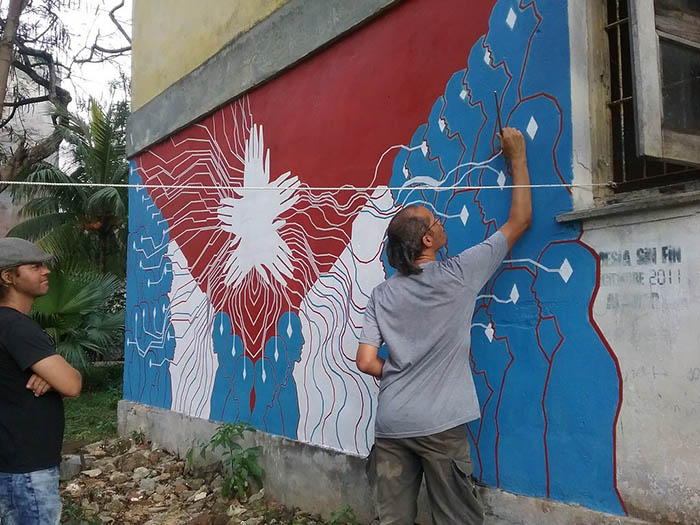
Cuban artist Yasser Castellanos
Despite official efforts to stop it in its tracks, Cuba saw the successful completion of its first independent art biennial, organised without the support of the state, on 15 May. Artist Luis Manuel Otero Alcantara and curator Yanelys Nuñez Leyva, members of the Museum of Dissidence, winner of the 2018 Index on Censorship Freedom of Expression Award for art, organised the ten-day #00Bienal de la Habana, which included over 170 artists, writers, musicians and theorists across nine different exhibitions in artists’ homes and studios around the country’s capital.
“Cuban culture is centralised culture and the government has absolute control,” Nuñez Leyva tells Index on Censorship. “The Ministry of Culture, together with all its branches such as the Union of Writers and Artists of Cuba and the National Council of Plastic Arts, are tentacles of the Ministry of the Interior, so all independent proposals, whether cultural, ecological or campaigns against gender violence, for example, are cursed with all the might of the government-controlled media.”
Even at schools pupils are served up propaganda intent on turning them against non-state-approved artists. Some art school students were shown a video portraying Otero Alcantara as a mercenary. “Such a campaign inevitably generates fear around independent projects which then suffer due to lack of both social and economic support,” Nuñez Leyva says.
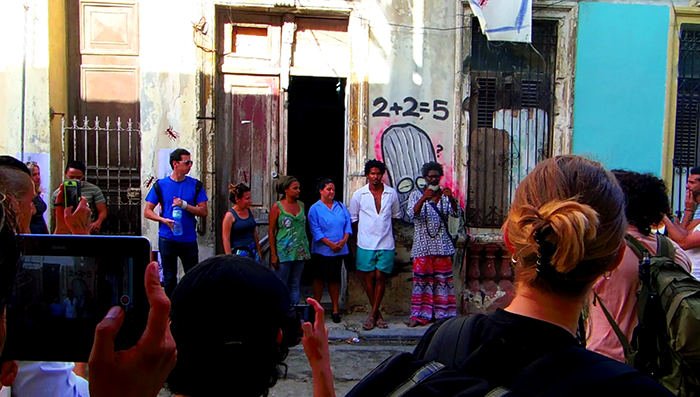
Economic support was one of the biggest obstacles for #00Bienal. “At the beginning, we thought that we would produce it with what we had at hand, but along the way we realised that we needed more,” Nuñez Leyva says. So a Gofundme campaign was set up, which raised $6,574. “But this wasn’t easy: the impact of the US blockade, our isolation from the world of networks and the impossibility of having credit cards made the process anguishing.”
Otero Alcantara was also imprisoned without cause on several occasions as part of the Cuban government’s campaign of harassment. Others who took part in #00Bienal, whether Cuban or foreign, received similar harassment. Many were even denied entry to the country, including the Cuban-American artist Coco Fusco.
When #00Biennial was announced in September 2017, the Cuban government immediately began to show its discontent through its cultural institutions. In an official declaration they branded the organisers as “unscrupulous people”. In response, #00Bienal’s first slogan was: “From the official to the unscrupulous.”
As culture is so tightly controlled in Cuba, only artists seen to be working in the interests of the regime can operate without restriction. Approved artists usually receive perks, something that gives them a higher status in society. Some artists risked all of this by taking part in #00Bienal. “The system used the worst blackmail against them because they gave the event a legitimacy that the government did not want,” Otero Alcantara says. “These artists were threatened by having their government accreditation taken away. Without this, they would find themselves without ‘official work’.”
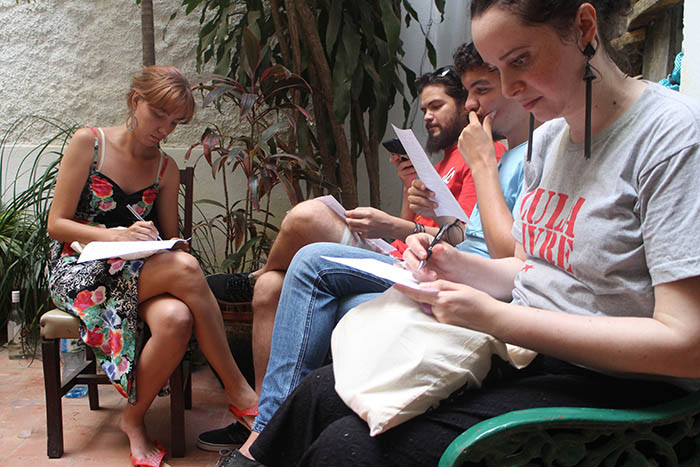
Government agents stalked the exhibitions while the organisers were accused of being in league with Cuba’s enemies. How does one respond to such accusations? “We responded by making an event that is as honest as possible, with a wide range of manifestations and artistic expressions that reflected the reality of Cuban art,” Nuñez Leyva says. “We responded with a list of more than 170 participants, not only Cubans, but from Mexico, Spain, Germany, the United States, Romania, Angola, Colombia, Denmark, Ukraine, Brazil, Venezuela, among them high-profile artists that Cuban institutions admire and collaborated with.”
The authorities even tried to prohibit the public from attending, sometimes successfully. Flyers and stickers were also confiscated. “But none of these actions were ever going to stop the energy of the event,” Otero Alcantara says.
“Despite all this pressure, the event went ahead, demonstrating that there is a group of people who are very courageous and have a real commitment culture,” Nuñez Leyva says. #00Bienal helped revive “a spirit of alternative rebellion” through the involvement of “countless numbers of totally unknown artists” that the state would never endorse.
For Otero Alcantara, the event’s success lies in the cohesion it created between artists, scholars and art enthusiasts, something that is unprecedented in the world of Cuban art. “We built an inclusive space of free creation and true collaboration between the people involved, exhibited the work of artists who were never going to have space in an official Havana Biennial and set a precedent for future projects,” he says. “This is one more step towards eliminating a fear that exists throughout Cuba.”
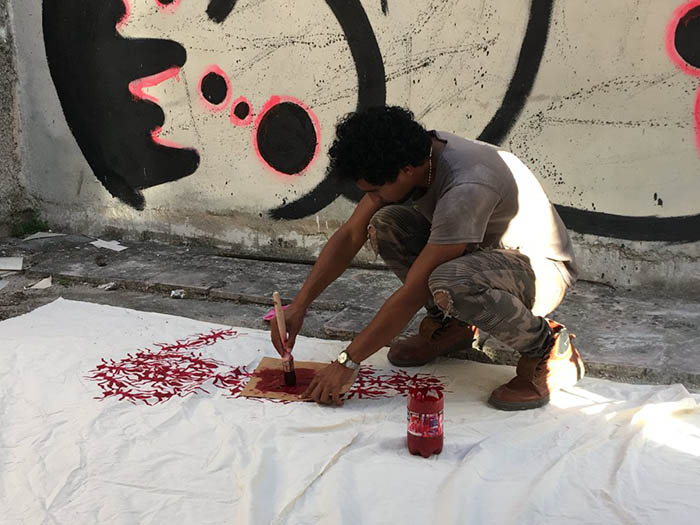
According to the organisers, the terms “revolution” or “revolutionary” have been hijacked and distorted by the Cuban regime. Such deformation has taken root so deep in the imagination of the Cuban people that just by mentioning the word “dissidence” is enough to be shunned, they explain.
“The #00Bienal was a humanistic project that brought to the fore essential values for any society such as unity, solidarity and collaboration,” Nuñez Leyva says. “The event also favoured the less privileged and created beauty and dialogue in favour of a new Cuba.”
The organisers of #00Bienal are under no illusions that life for Cuba’a dissident artists will magically become any easier under Cuba’s new president, Miguel Díaz‑Canel, who took over from Raúl Castro in April 2018. “The Cuban regime is more than any Castro,” Nuñez Leyva says. “It is a system based on a group of families that live both inside and outside the island, who have control over everything, which ultimately contributes to their own wealth.” This corrupt system relies on the deception of a people who have been left without even the strength even to protect themselves against poverty, she adds. “This situation leaves us with little hope, but we have to keep working.”
Otero Alcantara and Nuñez Leyva’s now want to show that #00Bienal wasn’t just a one-off, but is a serious project with longevity. “We will see if it is possible in two years to achieve something similar,” Otero Alcantara says.[/vc_column_text][/vc_column][/vc_row][vc_row][vc_column][vc_media_grid grid_id=”vc_gid:1528443291288-dfd45bff-0a16-7″ include=”100716,100712,100711,100710,100713,100709,100708,100707,100706,100704,100715,100705″][/vc_column][/vc_row][vc_row][vc_column][vc_column_text]
Artists, writers, musicians and theorists who took part in #00Bienal
Amaury Pacheco (Cuba), Iris Ruiz (Cuba), Coco Fusco (Cuba-USA), Tania Bruguera (Cuba), Reynier Leyva Novo (Cuba), Ernesto Oroza (Cuba), Gerardo Mosquera (Cuba), Katherine Bisquet (Cuba), Jose Ernesto Alonso, Yuri Obregón (Cuba), Alein Somonte (Cuba), Alejandro Barreras (Cuba), Anaeli Ibarra (Cuba), Alejandro Taquechel (Cuba), Ariel Maceo Tellez (Cuba), Aryam (Cuba), Aldeide Delgado (Cuba), Armando Cuspinera (Mexico), Antonio Mas (Spain), Alicia Torres (Spain), Ana Olema (Cuba), Alexis Ruiseco (Cuba-USA), Alexandru Raevschi (Germany), Andrés X (Cuba), Alain Aspiolea (Cuba), Alexandre Arrechea (Cuba), Antoni Muntadas (Spain), Biennial Project (USA), Boris González Arenas (Cuba), Colectivo Corason i uevo (Antonio A. Orta, Maykel Almenteros y Pedro Pablo Bacallao) (Cuba), Colectivo Guerrillas Girls, Celia y Yunior (Cuba), Colectivo 2.50 (Ana Gómez, Argelia Leodegarío, Marco Antonio Rodríguez, Itandehuitl Orta, Yuvia Pérez, Esmeralda Pérez) (Mexico), Carlos Manuel Álvarez (Cuba), Clara Astiasarán, Chu (Cuba), David de Omni, David León (Cuba), Danilo Maldonado (El Sexto), Diego Gil (Spain), Eliecer Jiménez Almeida (Cuba), Erish (Mexico), El Oficio (Cuba), Ernesto Hernandez Busto, Enfori García, Filipa César (Portugal), Fabián (2+2 =5) (Cuba), Francis Sánchez (Cuba), Francisco Méndez (Mexico), Francisco Masó (Cuba), Fabian Martínez, Filio Gálvez, Fredric Snitzer, Gabriel Coto (Cuba), Gerardo Stübing (España), Gean Moreno, Henri Eric Hernández (Cuba), Hamlet Lavastida (Cuba), Héctor Trujillo (Cuba), Hugo Patao, Italo Expósito (Cuba), Iván de la Nuez (Cuba), Jesús Hdez-Güero (Cuba), Jesús Benítez (Mexico), José Luis Marrero (Cuba), Josvan Gonzalez Agramonte (Cuba), Julián Yunda Yepes (Mexico), Jenifer Acuña (Cuba), Juan Melo (Colombia), Juan Carlos Alvarez Miranda (Cuba), Jean-Lorin Sterian (Romania), José Bedia (Cuba), Julio César Llopiz (Cuba), Javier Marimón, José Manuel Mesías (Cuba), Keyezua (Angola), Kevin Arrow, Lía Villares (Cuba), Luis Trápaga (Cuba), Luiso, Leandro Villanueva (Sam 33) (Cuba), Lester Dubé (Cuba), Lala Misosniky (Romania), La Alianza (Cuba), Liliam Dooley, Leandro Feal (Cuba), Lourdes Porrata, Miquel García (Spain), Marisol Maza (Mexico), Marcel Marquez (Cuba), Marianna Liosi (Germany), MO colectivo (Mariam Abrajim y Octavio Salazar) (Colombia), Magdiel Aspillaga, Mysora García, Nonardo Perea (Cuba), Natalia López (Colombia), Osmel Almaguer Delgado (Cuba), Osmany Carratalá (Cuba), Oscar Salamanca (Colombia), Orlando Hernández (Cuba), Pablo Pinto (Colombia), Polyanna Morgana (Brazil), Political Architecture: Critical Sustainability (PA:CS) (Denmark), Peter Menéndez, Rafael Carabano (Venezuela), Raúl Meriño (Cuba), Ras Yoe, Ricardo Figueredo, Rodolfo Peraza (Cuba), Rafael Domenech, Rirkrit Tiravanija, Svitlana Biedarieva (Ukraine), Soandry del Río (Cuba), Sandra Ceballos (Cuba), Santiago Alvarez Méndez (Colombia), Sandor (Cuba), Thiago Morandi (Brazil), Tomás Sánchez (Cuba), Tomas Vu, Tonel (Cuba), unx Pardo Ibarra (Colombia), Ulises Valdés (Mexico), Walfrido Valera (Cuba), Yaima Pardo (Cuba), Yasser Castellanos (Cuba), Yesica Suárez (Colombia), Yulier P. (Cuba), Yoenis Eloy Mayeta (Cuba), Yimi Konclase (Cuba), Yvelin Buenrostro (Mexico), Yucef Merhi (Venezuela), Yornel Martínez (Cuba), Yali Romagoza (Cuba), Yanier H. Palao (Cuba).[/vc_column_text][/vc_column][/vc_row][vc_row][vc_column][vc_basic_grid post_type=”post” max_items=”4″ element_width=”6″ grid_id=”vc_gid:1528443291296-0ad2c295-a239-7″ taxonomies=”104″][/vc_column][/vc_row]
