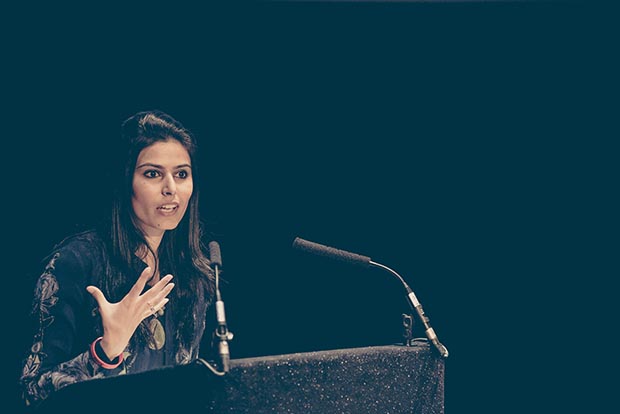
Farieha Aziz, director of 2016 Freedom of Expression Campaigning Award winner Bolo Bhi (Photo: Elina Kansikas for Index on Censorship)
Pakistan’s National Assembly passed a controversial Prevention of Electronics Crimes Bill on Thursday 11 August. The bill will permit the Pakistan Telecommunication Authority to manage, remove or block content on the internet.
Many critics say the bill is too overarching and punishments too severe. It also leaves children as young as 10 liable for punishment.
Last week, Aziz was selected by the Young Parliamentarians Forum – a bi-partisan forum with representation from all political parties – as one of the 10 Youth Champions of Pakistan. Yesterday – the day before the bill passed – each recipient was given three minutes to speak to the speaker of the National Assembly, Sardar Ayaz Sadiq, and other parliamentarians.
Yesterday, Aziz used her three minutes to criticise the bill based on the below letter to members of YPF. She emailed a similar letter to Ayaz Sadiq, who left before she gave her speech.
Dear Members of YPF,
Thank you for nominating and selecting me as one of the 10 youth champions of Pakistan.
I stand before you today apparently in recognition of efforts made to secure the rights of Internet users. I regret though that this is no moment for personal recognition or glory, not when the future of the youth of Pakistan stands threatened. What is that threat? The Prevention of Electronic Crimes Bill, which is on today’s orders of the day of the National Assembly, set to receive the approval of parliament and become law.
For over a year, not just I, but many citizens and professionals fought long and hard to fix this bill. We engaged with the government and opposition. Provided input to make the law better. We never said there shouldn’t be a law but that the law needed to respect fundamental rights and due process. While we found many allies among you – parliamentarians without whose efforts it would have been an even more difficult struggle – there were many part of the same system who labelled us as agents and propagandists.
On one occasion, the doors of parliament house were shut upon us. Stack loads of written input was disregarded and we were told we were just noise-makers who’d given nothing at all.
How I wish the certificate awarded today was actually a significantly amended version of the bill. A bill that did not trample on the rights of citizens. A bill that factored in the input we’d provided. I have come here today not for the certificate, but to ask you, if you will commit to the youth of this country beyond certificates?
The youth of this country is losing hope. I come to ask you if you will do all that is in your power to do, to restore it. If you want to give the youth of this country hope, then do not dismiss them. Do not stick labels. Do not isolate them. They don’t need certificates to give them hope. They need to see that things will be done differently – that their input will be considered and that you will constructively engage with them. That you will enter questions, and motions and resolutions on vital issues that concern citizens. That you will wage a struggle within your parties to make them see differently on issues. And that you will use your vote when it counts, and block legislation that seeks to take away our constitutionally guaranteed freedoms and rights.
If the bill is passed today, in its current form, the message that will go out to the youth of Pakistan is that there is no room or tolerance for thinking minds and dissenting voices. Should the youth inquire and raise questions, a harsh fine and long jail term awaits them. Is this the future you want to give the youth of Pakistan? If not, then when you go to the National Assembly today at 3pm, stop the bill from becoming law. Allow time to fix it.
Show the youth of this country that not only will you recognize efforts outside parliament; but that you will also honour these efforts by casting your vote to protect their rights inside parliament too. If you do this, that would be true recognition.
Thank you.
Farieha Aziz
Concerned citizen, digital rights activist and journalist
Farieha Aziz, director of 2016 Freedom of Expression Campaigning Award winner Bolo Bhi (Photo: Elina Kansikas for Index on Censorship)
The cyber crimes bill passed by Pakistan’s lower legislative chamber is unacceptable and needs major changes, Bolo Bhi told Index on Censorship.
Fareiah Aziz, director of Bolo Bhi, said the group is ready to pick up the fight against the Prevention of Electronic Crimes Act, which was passed by Pakistan’s National Assembly on Wednesday 13 April. The bill must now be approved by the senate.
“We need the senate to change the bill significantly, if not completely,” Aziz said. “A few amendments are not going to be enough.”
The bill, which stems from the 20-point National Action Plan against terrorism prime minister Nawaz Sharif announced after the Peshawar attack and was presented to the national assembly by an expert committee established by the standing committee for IT, has caused uproar in civil society for its restrictions of human rights and free speech.
According to Bolo Bhi, some of the major concerns are the criminalisation of political criticism and political expression; the overreaching and discretionary powers given to the media regulator; the harsh punishments and fines for hate speech; and the lack of protection for journalists and of adequately set procedures.
Additionally, the group has also lamented a critical lack of transparency in the drafting process, claiming the government deliberately avoided making the proposed text available to the public.
According to Dawn, the bill also shows a critical lack of IT expertise.
Aziz told Index on Censorship that Bolo Bhi expected the bill to be approved by the national assembly, and has been lobbying the senate since August 2015.
“We already have commitments from senators, including the chairman, who said very publicly in one of the sessions that this bill is not going to pass in its current version.”
“The senate is more balanced, and the opposition has the majority, whereas the government has a 2/3 majority in the national assembly,” she said.
However, Aziz warned the greatest risk is that senators settle for a few amendments to the bill instead of changing everything that needs changing.
“It’s the oldest trick in the book,” she said. “Make changes here and there, accept a few amendments, and then say that you’ve done what you could do. But that’s not going to be enough.
“We’ve seen this before with the introduction of military courts and the Protection of Pakistan Bill 2014. There was always an outcry by opposition parties, especially about the Protection of Pakistan Bill, but then they settled for a few amendments and all went through.”
Aziz said Bolo Bhi is already working to organise public and academic debate around the bill, and to make sure the senate has a clause by clause discussion.
Bolo Bhi, which means “speak up” in urdu, has been fighting the bill for over a year. They have been lobbying with members of the opposition and other organisations against the bill since then, shedding light on the legislation, organising public debates and creating a timeline tracking cybercrime legislation with information on every development.
Up to five year imprisonment, $95.000 fine or both for hate speech, or trying to create disputes and spread hatred on the basis of religion or sectarianism.
Up to five year imprisonment, $48.000 fine or both for transferring or copying of sensitive basic information.
Up to $480 fine for sending messages irritating to others or for marketing purposes. If the crime is repeated, the punishment would be three months imprisonment and a fine of up to $9.500.
Up to three year imprisonment and a fine of up to £4.800 for creating a website for negative purposes.
Up to one year imprisonment or a fine of up to $9.500 for forcing an individual for immoral activity, or publishing an individual’s picture without consent, sending obscene messages or unnecessary cyber interference.
Up to seven year imprisonment, a fine of $95.000 or both for interfering in sensitive data information systems.
Three month imprisonment or a $480 fine or both for accessing unauthorised data.
Three year imprisonment and a fine of up to $48.000 for obtaining information about an individual’s identification, selling the information or retaining it with self.
Up to three year imprisonment and a fine of up to $4.800 for issuing a sim card in an unauthorised manner.
Up to three year imprisonment and fine of up to $9.500 for making changes in a wireless set or a cell phone.
Up to three year imprisonment and a fine of up to $9.500 for spreading misinformation about an individual.
Bolo Bhi, which means “speak up” in Urdu, is a non-profit run by a powerful all-female team, fighting for internet access, digital security and privacy in Pakistan and around the world. Founded in 2012 by Sana Saleem and Farieha Aziz, they have since fought tirelessly to challenge Pakistan’s increasingly pervasive internet censorship.
“In the year 2012 the government were trying to bring in a national URL filtering firewall along the lines of China,” Farieha Aziz told Index.
“Then came the YouTube ban in September 2012. We lead a campaign against that and got commitments from businesses around the world not to bid for the tender the government of Pakistan had floated.”
The team have now launched countless internet freedom programmes, published research papers, fought for gender-rights, government transparency, executed successful campaigns and run digital security training sessions all over Pakistan.
“In Pakistan the internet is an unlegislated space, so a lot of our work involves discussions law and policy, and the shape they should be taking and the shape they should not be taking,” says Aziz.
Their biggest fight to date has been taking on the draconian Prevention of Electronic Crimes (PEC) Bill. The proposed legislation includes the criminalisation of political criticism and political expression in the form of analysis, commentary, blogs and cartoons, caricatures, memes; “obscene” or “immoral” messages on social media; posting of photographs of anyone on Facebook or Instagram without their permission; and sending an email or message without the recipient’s permission.
“We were able to get a leaked copy [of the bill] and we went public and we started forming an alliance,” said Aziz. “Our part was really to get people on board and collect people to collectively resist the bill in its current form.”
At every stage of the bill’s dramatic progression, Bolo Bhi been tirelessly campaigning against and shedding light on the legislation, which would have otherwise been quietly passed. They have created a timeline tracking cybercrime legislation with information on every development.
They also organised a series of press conferences, media events and campaigns to raise public awareness about the bill, as well as facilitating a series of consultations on the proposed cybercrime law with activists, lawyers and technology experts.
“Over a period of a year from advocating, trying to get the media to talk about it, we saw that a lot of people, even citizens, were very concerned about it. Across the board this concern resonated and nobody wanted the bill in the form it existed. We thought it would pass in a month, but it’s been almost a year and it’s been held off.”
Last year they also took down Pakistan’s Inter-Ministerial Committee for the Evaluation of Websites, filing a petition in the Islamabad High Court challenging the legality of committee, which is responsible for all official decisions taken to block online content in Pakistan. After a court ruling in March 2015, the IMCEW was disbanded – a win for Bolo Bhi, until the Pakistan Telecommunications Authority was given powers for content management on internet. Bolo Bhi continue to fight against the restrictions.
As well as shaping the debate around internet freedom in Pakistan, Bolo Bhi campaigns tirelessly for women’s rights.
“Gender is an integral part of what we do at Bolo Bhi. Recently we’ve tackled acid crimes, which are particularly perpetrated against women. We launched a social media campaign but we’ve also worked with women’s groups.”
Freedom of expression in Pakistan is a complicated phrase, Aziz says. But Bolo Bhi’s work ensures it is not one that is left unexamined.
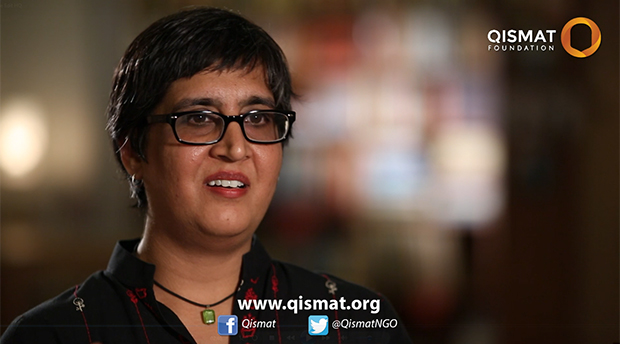
Sabeen Mahmud was killed on 24 April 2015. (Image courtesy Qismat Foundation)
Mahenaz Mahmud spoke of her daughter Sabeen’s dedication to Pakistan. (Click for video on Vimeo)
“Tonight, please don’t forget to laugh and dream out loud, that would be the best tribute you could pay to Sabeen”, said Mahenaz Mahmud via video at Unsilencing Pakistan, an event co-hosted by Index on Censorship at London’s Conway Hall on Thursday 23 July.
Three months earlier, Mahenaz’s daughter Sabeen Mahmud was killed by gunmen. On 24 April 2015, travelling home from hosting a panel discussion about the missing people of Balochistan two men on motorbikes surrounded the car and opened fire. Mother survived, daughter didn’t.
Sabeen Mahmud had been a prominent ‘social activist’ and human rights advocate including founding The Second Floor, a cafe dedicated to being a safe space for community discussion. Three months on from her murder, the London event was a tribute to a woman described by so many as an inspiration, a fantastic listener and a champion of free speech and freedom of expression.
Hosted by comedian Aatif Nawaz, the evening was a celebration of Mahmud’s life and Pakistani culture. Multiple speakers, many of whom knew Mahmud well, shared their thoughts on her work and the issues she confronted as she worked to encourage greater openness in Pakistan.
The event began with the trailer from forthcoming documentary Silencing Sabeen, a look back on the life and tragic death of a woman loved by so many. All of those who were close to Mahmud showered praise upon her and told anecdotes of a woman dedicated to the cause of free expression. BBC journalist Ziad Zafar, founder of Pakistan for All and a member of the newly launched Sabeen Mahmud Foundation’s board, said: “She was at the forefront of every progressive movement that has taken precedence in Pakistan in the last decade”. Dr Ayesha Siddiqa from the University of Oxford, who had met Sabeen on a number of occasions, said: “Conversation doesn’t weaken Pakistan. Sabeen knew that to free Pakistan, you need to unsilence it.”
Ali Dayan Hasan, a Pakistani human rights activist, knew Mahmud as a child and watched her grow into a beautiful woman. Of Karachi, her beloved birthplace, he said: “Her life, her achievement, her death is all quintessentially about the city that she came from”.
Childhood friend and Index on Censorship magazine contributor Kamila Shamsie described their blossoming friendship from the moment they met at Kindergarten. She had recently asked friends and colleagues of Sabeen to send her written praise of their late friend. One said: “Her passion was contagious,” while another said: “Sabeen would never have kept the spoils of victory, even if she had fought alone.”
The evening’s speakers also explored the state of Pakistan’s democracy and numerous attacks on free speech in recent times. Tehmina Kazi from British Muslims for Secular Democracy warned that “universal human rights have been tossed aside and been replaced by cultural relativism. The very people who need to have their eyes wide open have their eyes wide shut”.
Shaan Taseer of Pakistan For All, whose father Salmaan was murdered for his opposition to Pakistan’s blasphemy law, spoke forcefully about standing up to nationalist and religious figures like Abdul Aziz.
.@ShaanTaseer: If there’s one way to honour her memory: We must never stop providing the alternative narrative #UnsilencingPakistan
The New York Times Pakistan Bureau Chief Declan Walsh, who now operates from London after having his visa cancelled by Pakistani authorities, spoke of how, on first arriving in Pakistan in 2004, he was struck by the vibrancy and free speech of the press even though at the time it was under military rule. He called Mahmud’s murder a “very dark watershed in the decline of free speech in Pakistan in the last ten years.”
Jodie Ginsberg, CEO of Index on Censorship, said: “It takes bravery to be a dissenter at any time but it takes a special kind of courage to stick your head above the parapet in times of danger.”
Paying tribute to Mahmud’s passion for the Art, and T2F’s ongoing role as a gallery and performance space, Pakistani singers and dancers including Kali Chandrasegaram, Hyder Cheema and Ustad Roshan Abbas Khan were also on the programme. In a fitting nod to Mahmud’s well known support for young people and future generations, three students from City and Islington Sixth Form College were also invited, bringing diversity to the bill.
Co-organisers of the event, Yasmin Whittaker-Khan and Anneqa Malik thanked the audience and Index on Censorship, encouraging action to prevent more tragedies like Mahmud’s.
Malik, a personal friend of Mahmud’s, implored people to take personal responsibility for drawing people’s attention to the plights of those in Pakistan themselves rather than shouldering it on to others. She said: “Please don’t let them silence us. Please don’t let them silence Sabeen.”