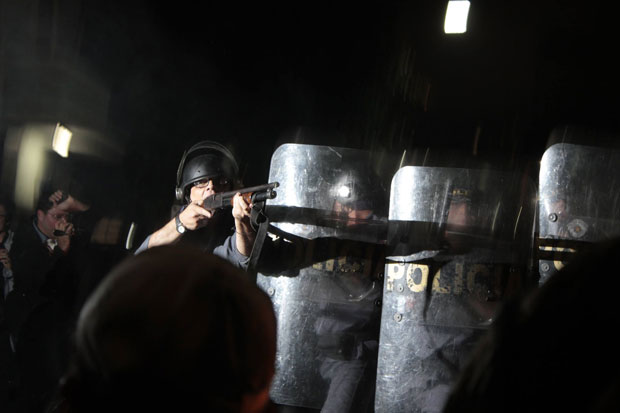
Police have used rubber bullets and pepper spray to disperse Brazilian protesters (Photo: Jimmy Trindade via Facebook)
Sparked by a series of transport fare hikes and official corruption, the ongoing mass protests in Brazil’s cities have been greeted by crackdowns by police. Rafael Spuldar reports on the journalists caught in the crossfire
While large protests are not common events in Brazil, some of the protesters say “the giant has awoken”, meaning that Brazil’s population of 190 million is mobilising to fight corruption and political misconduct.
As many as 15 journalists were injured by police and two were taken into custody during last Thursday’s demonstrations in São Paulo, according to Brazil’s Association of Investigative Journalism (Associação Brasileira de Jornalismo Investigativo, Abraji). The journalists were allegedly beaten, maced or hit by non-lethal rubber bullets covering the protests.
Reporter Giuliana Valloni from Folha de S.Paulo, Brazil’s biggest daily newspaper, was also hit in the eye by a rubber bullet. She says a policeman shot at her from a 20-meters.
“I wasn’t attacking anyone, I wasn’t cursing at anyone. I was doing my job”, Giuliana told Folhafrom her hospital bed.
“I saw him aiming at me, but I never thought he would fire, because I had (policemen) aiming at me before that night. You’ll never think that an armed guy in uniform will ever shoot you in the face”, she said.
Folha says that seven of its staff members – including Giuliana – were attacked by policemen at Thursday’s protests.
The harshest clashes between policemen and protesters occurred on Consolação Avenue, in downtown São Paulo. The crowd attempted to march up Consolação to reach Paulista Avenue – the financial center — but riot police blocked their way. More than 200 people were taken into custody.
Videos posted on social media and on YouTube allegedly show police abuse against demonstrators. Some people were targeted with tear gas in their own homes while recording videos of the protests. Other videos show protesters being shot even while they chanted sem violência, sem violência (“no violence, no violence”).
Organizations like Abraji and Brazil’s Press Association (Associação Brasileira de Imprensa, ABI) issued statements denouncing police excesses against media professionals and protesters, and urging the government to take action against them.
“The Union’s Public Ministry cannot be neither passive nor irresponsive before the soulless violence committed in São Paulo’s capital by the State’s security forces, which repeats without originality the repressive practices of the dictatorial regime”, said ABI in its statement, linking the recent events to the repression seen during Brazil’s military rule (1964-1985).
Abraji’s executive director Guilherme Alpendre says acts of violence against journalists during demonstrations are not a common thing, and he believes negative feedback will probably ease down police action and prevent new cases like the ones seen in São Paulo last Thursday.
However, Alpendre points out the fact that attacks by state agents against journalists have increased in the past three years. He cites reporters Mauri König and Rodrigo Neto as examples of that trend: the former wrote about police misconduct in the state of Paraná and had to move to Peru after receiving death threats, while the latter was shot down after denouncing involvement of police members with crime gangs in the state of Minas Gerais.
“I’m not saying all these cases are connected, or that the same method was employed in them, but what we see now is more violence perpetrated by the state against journalists. Those were media professionals identified as such, and they were attacked anyway”, Alpendre told Index on Censorship.
The demonstrations are taking place in many cities — São Paulo, Rio, Brasília, Belo Horizonte, Curitiba, Goiânia and Natal. It started as a national movement against the increase in bus fares, but now its members – mostly young people from leftist parties and students’ organizations – claim their demands are broader.
Protests could be seen during the weekend in federal capital Brasília, Belo Horizonte and Rio de Janeiro, coinciding with the start of the Confederations Cup, a warm-up event to next year’s World Cup, to be hosted in Brazil. Protesters demanded less money be spent on building stadiums and more be applied to education and other social works.
While protests in Belo Horizonte were peaceful, riot police used tear gas and stun grenades against the crowds in Rio and Brasília, where 29 people were arrested.
More demonstrations are scheduled for today. Protests are also being organised in 27 cities around the world in solidarity.
Some scholars have linked demonstrations in Brazil to those seen in Turkey, where mostly young, web-connected people have taken the streets – first to protest against the building of a shopping mall on a park, but later to fight the government.
Spanish sociologist Manuel Castells – one of the world’s most prominent cyberculture theorists – said last week that the demonstrations all over the world found a new way to gather and claim “the city back to the citizens”.
“Before, if people were discontented, the only thing they could do was to go to a mass demonstration organized by parties and unions, which would soon start to negotiate in the name of people. But now the capacity to self-organize is spontaneous. This is new, and this is social networking”, said Castells.
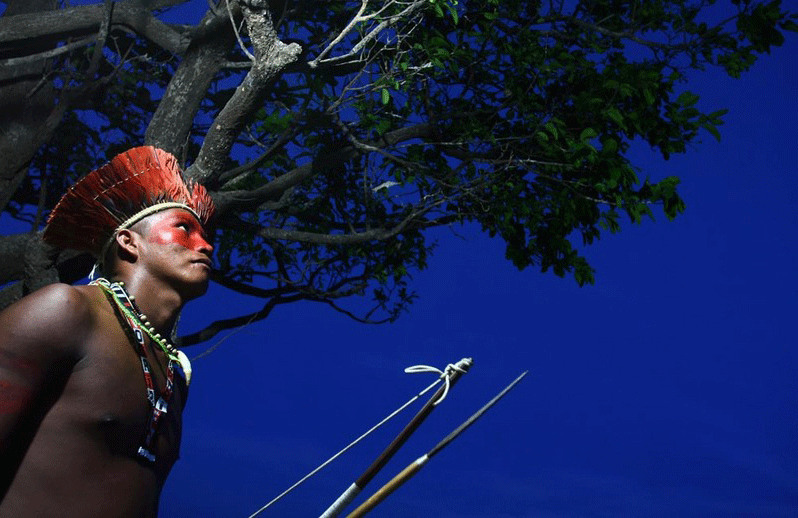
Brazil’s indigenous peoples are increasingly using the internet to fight for their rights, says Rafael Spuldar
Brazil’s indigenous population have gone online to campaign against social injustice in their community – Alberto Cesar Araujo/Demotix
Despite their poor economic and living conditions, Brazil’s indigenous peoples are increasingly using the internet to make their struggle for rights known to the world.
Historically, native Brazilians have been deprived of proper citizenship, first by slavery and the loss of their homeland in the 16th century and, after that, by prejudice, impoverishment, the loss of cultural traces and the disappearance of entire populations. But, the emergence of the internet has allowed Brazilian Indians access to a new era of free speech and civil activity.
One example of their fight to be heard is the campaign against the Draft Constitutional Amendment #215, currently being debated in the Chamber of Deputies. If the amendment passes, it would remove the Federal Government’s power to delimit indigenous lands and pass it to Congress.
Indigenous leaders fear this would strengthen landowners’ powers, who already have a strong lobbying position in Congress and would likely do their best to inhibit the creation of new reservations.
An online petition against the amendment has gathered more than 27,000 signatures.
Their cause also attracted huge support through social media late last year. Facebook users showed support to the Guarani and Kaiowá peoples by adding “Guarani-Kaiowá” to their profile name. The 45,000-strong group perpetually struggle to protect their ancestral province from land-grabbing farmers in the state of Mato Grosso do Sul.
In January 2013, however, Facebook ordered the additional names be removed, reminding users that they were forbidden from adopting fake names on their accounts.
Access to justice
Considered to be one of the main platforms for indigenous discussion, the Índios Online website is maintained by indian peoples from the states of Alagoas, Bahia, Roraima and Pernambuco.
Supported by the Ministry of Culture and Thydewá, an organisation protecting the rights of indigenous peoples, Índios Online allows “offline” Native Brazilians from all over the country to voice their needs and interact with other users.
According to the president of Thydewá, Sebastián Gerlic, those who feel their interests have been threatened by the website often approach the Justice system to censor its content — particularly regarding videos produced and uploaded by the indians.
Ingigenous Brazilian Potyra Tê Tupinambá ended up in court for her film documenting land reposession in an indigenous reservation in the northeastern state of Bahia. The ongoing lawsuit was taken out by a land owner interviewed on camera. It was a testimony, according to Gerlic, given spontaneously and with no animosity.
“The farmer accused Potyra of transmitting his image on the internet without his permission, and now he looks for reparation,” says the president of Thydewá, who took reponsibility for the director’s legal defence.
The internet was also a strong ally in the indigenous peoples’ struggle against the looting of the natural resources on their reservations. In mid-2011, the Ashaninka people used a solar-powered computer to denounce the invasion of their land by Peruvian woodcutters. This information was passed to authorities in federal capital Brasília, who sent a task force formed by the Federal Police and the Brazilian Army to arrest the invaders.
The Ashaninkas also addressed chief justice of the Supreme Court Joaquim Barbosa in an online petition, urging the Supreme Court to address the problem of tree cutting in their native territory. They demanded financial reparation for the lumbering activities that could reach 15,000,000 BRL (around 30,000,000 USD).
Limited access
Indians usually access the internet through centres maintained by Funai, Brazil’s National Indian Foundation or in LAN (local area network) houses, schools or in private homes. Funai does not have any digital inclusion programme specifically for the indigenous peoples – this responsibility goes to the Ministry of Culture. Through its programme called “Points of Culture”, the Ministry invested more than 1,300,000 BRL (about £447,000) on installing internet connections inside the Indian communities.
Despite public investments, online access has grown far less in indigenous communities than in poorer urban areas. According to a survey led by Rio de Janeiro State’s Secretary of Culture, in partnership with NGO Observatório das Favelas (“Slum Observatory”), 9 out of 10 people living in low-income areas in Rio have internet access.
Brazil has a population of 896,917 indigenous people divided in 230 different ethnic groups, according to the last Brazilian Census from 2010. This represents around 0.47 per cent of the country’s population.
Amongst this populus, access to employment is a problem. According to the last Census, 83 per cent of adult Brazilian indians earn no more than minimum wage (678 BRL a month, about £233) and 52.9 per cent of them don’t have any income at all.
According to the Indigenous Missionary Counsel, an organisation aiding native Brazilian peoples, at least 200 indians have been killed in Brazil in the last decade, mainly because of land disputes.
Cuban dissident and blogger Yoani Sánchez is having a hard time on her visit to Brazil, facing demonstrations by pro-Castro protesters.
One of the most prominent free-speech Cuban activists, Sánchez arrived in Brazil on Sunday (17 February) for a round of conferences and events in the northeastern state of Bahia and federal capital Brasília.
On Monday 18 February, Sánchez was at Feira de Santana (in Bahia) where she would attend a presentation of a documentary about the Cuban regime, but the violence ofthe protestors caused the event to be cancelled.
The demonstrators accused Sánchez’s blog Generación Y of spreading anti-Cuban propaganda. Some of the protesters went as far as denouncing her as a representative of imperialism and a CIA agent.
Senator Eduardo Suplicy from the ruling Workers’ Party had to intervene and ask for the protesters to ease down their attacks on the Cuban blogger. Security measures have been increased for Sánchez since then.
“I regret the situation got to this point, because I’m a person who uses words, I don’t use guns”, said Sánchez, who nevertheless praised the “freedom” and “plurality” she found in Brazil. In response to protests during her visit, the blogger also said that she was “happy to visit a country where people can speak their minds freely.”
Sánchez is on her first trip abroad after the Cuban government eased travel regulations for its citizens. Before that, she had being denied a travel permit for more than 20 times.
During her 80-day tour, the activist also plans to visit the Czech Republic, Spain, Mexico, United States, the Netherlands, Germany and Peru, amongst other countries.
A woman in Timbuktu says she was lashed by Islamist militants for talking to a man who wasn’t her husband. Salaka Djicke was caught talking to her lover on 31 December last year and was then sentenced to 95 lashings by a Islamic tribunal on 3 January. Djicke fell in love with the married man after he accidentally called when dialling a wrong number more than a year ago, and their relationship quickly blossomed. When Islamic extremists occupied Northern Mali in April 2012, Shariah law was quickly implemented, forbidding women from communicating with men. Her punishment was captured on film by local residents. The man — who Dijcke didn’t name in fear of rebel fighters returning — remains in Mali’s capital after fleeing the night they were discovered. Prior to France’s intervention in Northern Mali earlier this year, Islamist militants introduced strict Shariah law, issuing punishments such as flogging and stoning for perpetrators.
— Is this how you remember Michelangelo’s David? A town in Japan want to preserve the statue’s modesty
On 6 February, a radio station owner was murdered in Paraguay.Marcelino Vázquez was shot by unknown assailants as he left work at Sin Fronteras 98.5 FMin the city of Pedro Juan Caballero. He was on his way from the radio station to a local night club he also owned, but was stopped by two men on a motorcycle and shot several times. While Sin Fronteras is predominately music-focused, it features a regular news show covering a variety of issues. A parliamentary coup in June 2012 and the subsequent removal of President Fernando Lugo has had a negative impact on freedom of information and expression in Paraguay.
Lawyers for three members of Russian punk band Pussy Riot are appealing their convictions at the European Court of Human Rights. Representatives for Maria Alekhina, Yekaterina Samutsevich and Natalia Tolokonnikova are in Strasbourg today (7 February), after they filed a complaint on 6 February against their two year prison sentences. They said the convictions violated four articles of the European Convention on Human Rights: the right to free speech, fair trial, liberty and security and the prohibition of torture.The trio was first sentenced following their “punk-prayer” performed at Moscow’s main cathedral in February 2012 protesting Vladimir Putin’s return to power.
A radio journalist was shot on his way to work in Peru on 6 February. At the time of the attack, Juan Carlos Yaya Salcedo was driving to the Radio Max station where he worked, in the town of Imperial. He was shot in the leg by an unknown assailant and is expected to make a full recovery and return to work soon. Yaya, who hosts radio show Sin Escape (Without Escape), has never faced threats in the past but police said the attack was likely the result of his journalistic work, as the perpetrators didn’t attempt to steal anything. Yaya said the attack could have resulted from his reporting on the poor construction of a community building in the nearby town of Nuevo Imperial.
Residents of a townin Japan have complained about the erection of replica statues of Michelangelo’s David, requesting that he wear underpants. Okuizumo citizens told town officials that the 16-foot renaissance sculpture’s exposed penis could frighten their children, as some of the replicas, funded by a local business man, were installed in a local park where children often play. Most of the town’s 15,000 residents approved the Renaissance art tributes, and no plans have been made to clothe the statue. Japan has stringent laws regarding nudity. While watching and distributing porn is legal in the country, the country’s authorities request that genitalia be pixelated.