29 Nov 2022 | News, SLAPPS hero, Statements, United Kingdom
29 November 2022
To the Rt. Hon. Dominic Raab MP
Deputy Prime Minister and Lord Chancellor and Secretary of State for Justice
Copies sent to:
Rt. Hon. Dominic Raab, Deputy Prime Minister and Lord Chancellor and Secretary of State for Justice
Rt. Hon. Rishi Sunak MP, Prime Minister of the United Kingdom
Rt. Hon. Michelle Donelan MP, Secretary of State for Digital, Culture, Media and Sport
Rt. Hon. James Cleverly MP, Secretary of State for Foreign, Commonwealth and Development Affairs
Mr. Steve Reed MP, Shadow Labour Secretary of State for Justice
Rt. Hon. Alistair Carmichael MP, Liberal Democrat Spokesperson for Home Affairs, Justice and Northern Ireland
Ms. Anne McLaughlin MP, Shadow SNP Spokesperson (Justice)
Mr. John Penrose MP, UK Government Anti Corruption Champion
Mr. Paul Philip, Chief Executive, Solicitors Regulation Authority
Mr. Mark Neale, Director-General, The Bar Standards Board
Ms. Dunja Mijatović, Council of Europe Commissioner for Human Rights
Ms. Teresa Ribeiro, Organization for Security and Co-operation in Europe, Representative on Freedom of the Media
Ms. Irene Khan, United Nations Special Rapporteur on on the Promotion and Protection of the Right to Freedom of Opinion and Expression
Re: Adoption of a UK Anti-SLAPP Law
As a group of leading editors, journalists, publishers, lawyers and other experts, we are writing to express our support for the Model UK Anti-SLAPP Law launched this November by the UK Anti-SLAPP Coalition – and to urge you to move swiftly to enshrine these proposals in law.
Events over the past year have shone a light on the use of abusive lawsuits and legal threats to shut down public interest speech. This is a problem that has long been endemic in newsrooms, publishing houses, and civil society organisations. In an age of increasing financial vulnerability in the news industry, it is all too easy for such abusive legal tactics to shut down investigations and block accountability.
We welcome your commitment to bring in reforms to address Strategic Lawsuits Against Public Participation (SLAPPs), as you said on 20 July 2022, in order to “uphold freedom of speech, end the abuse of our justice system, and defend those who bravely shine a light on corruption.” High-profile cases – such as those targeting Catherine Belton, Tom Burgis, Elliot Higgins, and more recently openDemocracy and The Bureau of Investigative Journalism – are just the most visible manifestation of a much broader problem which has affected newspapers across Fleet Street and the wider UK media industry for many years.
The public interest reporting targeted by SLAPPs is vital for the health of democratic societies, including law enforcement’s ability to investigate wrongdoing promptly and effectively. This is of acute importance in the UK, which journalistic investigations have repeatedly shown to be a hub for illicit finance from kleptocratic elites. As of April 2022, the National Crime Agency (NCA) has estimated the scale of money laundering impacting the UK is in excess of £100bn a year.
Journalism has a huge role to play in tackling this problem. For example, investigations by the Organized Crime and Corruption Reporting Project (OCCRP) into the ‘Azerbaijani Laundromat’ scandal supported the NCA in seizing millions in corrupt funds from a number of individuals, including £5.6 million from members of one Azerbaijani MP’s family. Prior to the NCA’s seizure, the same MP had spent two years pursuing Paul Radu, co-founder of OCCRP through London’s libel courts. The inequality of arms in such cases is clear. As Radu notes: “The people suing journalists in the UK rely on these huge legal bills being so intimidating that the journalists won’t even try to defend themselves.”
In March 2022, at the launch of the Government consultation on SLAPPs, you stressed that “The Government will not tolerate Russian oligarchs and other corrupt elites abusing British courts to muzzle those who shine a light on their wrongdoing.” The findings of the consultation, published in July, clearly stated that “the type of activity identified as SLAPPs and the aim of preventing exposure of matters that are in the public interest go beyond the parameters of ordinary litigation and pose a threat to freedom of speech and the freedom of the press.”
Fortunately, there is an oven-ready solution to this problem. The Model Anti-SLAPP Law, drafted by the UK Anti-SLAPP Coalition in consultation with leading media lawyers and industry experts, would provide robust protection against SLAPPs, building on the framework proposed by the Ministry of Justice in July. Key features include:
- A filter mechanism that empowers courts to swiftly dispose of SLAPPs without the need for a subjective enquiry into the state of mind of the SLAPP filer. This mechanism should subject claims that exhibit features of abuse to a higher merits threshold.
- Penalties that are sufficient to deter the use of SLAPPs and provide full compensation to those targeted. Such penalties should take into account the harm caused to the defendant and the conduct of and the resources available to the claimant.
- Protective measures for SLAPP victims including cost protections, safeguards, and measures to reduce the ability of SLAPP claimants to weaponise the litigation process against public watchdogs.
The need could not be more urgent. Research by the Foreign Policy Centre and other members of the UK Anti-SLAPP Coalition has found that SLAPPs are on the rise and that the UK is the number one originator of abusive legal actions. In fact, the UK has been identified as the leading source of SLAPPs, almost as frequent a source as all European Union countries and the United States combined.
The EU has already taken steps, with a proposed Anti-SLAPP Directive announced in April. In the US, 34 US states already have anti-SLAPPs laws in place, and this year Congress has introduced the first federal SLAPP Protection Act. Moreover, the US has also launched the Defamation Defense Fund, recognising the impact SLAPP actions have on journalists, as they “are designed to deter them from doing their work.”
You have made clear your commitment to strengthening legal protections against these legal tactics. It is crucial momentum is not lost. We encourage you to put forward, in the earliest possible time frame, legislation in line with the model UK Anti-SLAPP Law, to ensure that the UK can keep pace and contribute to this global movement to protect against SLAPPs.
Yours,
John Witherow, Chairman, Times Media
Emma Tucker, Editor, The Sunday Times
Tony Gallagher, Editor, The Times
Victoria Newton, Editor-in-Chief, The Sun
Paul Dacre, Editor-in-Chief, DMG media
Ted Verity, Editor, The Daily Mail
Katharine Viner, Editor-in-Chief, The Guardian
Paul Webster, Editor, The Observer
Alison Phillips, Editor, The Mirror
Oliver Duff, Editor-in-Chief, i
Roula Khalaf, Editor, The Financial Times
Chris Evans, Editor, The Telegraph
Alan Rusbridger, Editor, Prospect Magazine
Ian Hislop, Editor, Private Eye
Zanny Minton Beddoes, Editor-in-Chief, The Economist
Alessandra Galloni, Editor-in-Chief, Reuters News Agency
John Micklethwait, Editor-in-Chief, Bloomberg
Drew Sullivan, Co-founder and Publisher, Organised Crime and Corruption Reporting Project (OCCRP)
Paul Radu, Co-founder and Chief of Innovation, OCCRP
Rozina Breen, CEO, The Bureau of Investigative Journalism (TBIJ)
Peter Geoghegan, Editor-in-Chief and CEO, openDemocracy
Nick Mathiason, Co-founder and Co-director, Finance Uncovered
Gerard Ryle, Director of the International Consortium of Investigative Journalists (ICIJ)
David Kaplan, Executive Director, Global Investigative Journalism Network (GIJN)
Michelle Stanistreet, General Secretary, National Union of Journalists (NUJ)
Dawn Alford, Executive Director, Society of Editors
Sayra Tekin, Director of Legal, News Media Association (NMA)
Sarah Baxter, Director, Marie Colvin Center for International Reporting
Paul Murphy, Head of Investigations, Financial Times
Rachel Oldroyd, Deputy Investigations Editor, The Guardian
Carole Cadwalladr, journalist, The Observer
Catherine Belton, journalist and author of the book, Putin’s People: How the KGB took back Russia and then took on the west
Tom Burgis, reporter and author of the book, Kleptopia: How dirty money is conquering the world
Oliver Bullough, Journalist and author
Clare Rewcastle Brown, investigative journalist and founder of The Sarawak Report
Richard Brooks, journalist, Private Eye
Matthew Caruana Galizia, Director of The Daphne Caruana Galizia Foundation
Mark Stephens CBE, Partner at Howard Kennedy LLP
Caroline Kean, Consultant Partner, Wiggin
Matthew Jury, Managing Partner, McCue Jury and Partners
David Price KC
Rupert Cowper-Coles, Partner at RPC
Conor McCarthy, Barrister, Monckton Chambers
Pia Sarma, Editorial Legal Director, Times Newspapers Ltd
Gill Phillips, Director of Editorial Legal Services, Guardian News & Media
Lisa Webb, Senior Lawyer, Which?
Juliette Garside, Deputy Business Editor, The Guardian and The Observer
Alexander Papachristou, Executive Director of the Cyrus R. Vance Center for International Justice
José Borghino, Secretary General, International Publishers Association
Dan Conway, CEO, Publishers Association
Arabella Pike, Publishing Director, HarperCollins Publishers
Joanna Prior, CEO of Macmillan Publishers International Limited
Meirion Jones, Editor, TBIJ
Emily Wilson, Bureau Local Editor, TBIJ
James Ball, Global Editor, TBIJ
Franz Wild, Enablers Editor, TBIJ
James Lee, Chair of the Board, TBIJ
Stewart Kirkpatrick, Head of Impact, openDemocracy
Moira Sleight, Editor, the Methodist Recorder
Paul Caruana Galizia, reporter, Tortoise
Tom Bergin, journalist and author
James Nixey, Director, Russia and Eurasia Programme, Chatham House
Edward Lucas, Author, European and transatlantic security consultant and fellow at the Center for European Policy Analysis (CEPA)
Sean O’Neill, Senior Writer, The Times
Dr Peter Coe, Associate Professor in Law, Birmingham Law School, University of Birmingham
Alex Wilson, Partner at RPC
George Greenwood, Investigations Reporter, The Times
Simon Bowers, Investigations Editor, Finance Uncovered
John Heathershaw, Professor of International Relations, University of Exeter
Tena Prelec, Research Fellow, DPIR, University of Oxford
Thomas Mayne, Research Fellow, DPIR, University of Oxford
Jodie Ginsberg, President, Committee to Protect Journalists
Dr Julie Macfarlane, Co-Founder, Can’t Buy My Silence campaign to ban the misuse of NDAs
Zelda Perkins, Co-Founder, Can’t Buy My Silence campaign to ban the misuse of NDAs
16 Nov 2022 | BannedByBeijing, China, News
Twenty-three years after writing his best known work, Red Star Over China, Edgar Snow returned to China in 1960 to investigate claims that a radical agrarian reform programme had resulted in devastating famine. “I diligently searched, without success, for starving people or beggars to photograph … I do not believe there is famine in China,” Snow wrote.
Snow was wrong. The famine in China was both real and devastating. It is estimated as many as 30 million died in it. Snow’s bias lens had ghostly echoes with Walter Duranty’s reporting from Ukraine, during the Holodomor, the mass famines engineered by Stalin. Only when faced with overwhelming evidence did he eventually concede that the genocide occurred, “to put it brutally – you can’t make an omelette without breaking a few eggs” he said.
In information vacuums, common during times of conflict such as the civil conflict in Syria, as well as in areas controlled by authoritarian regimes, reporting from independent journalists can quickly define or redefine the public’s perception of a regime or situation. While journalists can play a powerful role in challenging censorship and propaganda from the state, they can also act as the state’s servants. Such was the case for both Snow and Duranty, whose rose-tinted views of the countries impacted global perceptions. Herein lies the point – those who claim to be independent reporters can be incredibly useful to the state, sometimes more so than those working within state media, because the notion that they are independent carries with it a level of authority and weight.
The use of “junket journalism” to obscure reporting on crimes against humanity has only grown in prominence and sophistication. Nowhere has this been more evident than in China where the government has co-opted a range of journalists and social media influencers to help strengthen the CCP’s control over its narrative and obscure legitimate scrutiny of a number of important issues, most notably the genocide of the Uyghur population. Recent party documents and officials have emphasised the need to bolster the CCP political line, and inject positivity into the CCP and China’s image. Current President Xi Jinping said, “Wherever the readers are, wherever the viewers are, that is where propaganda reports must extend their new tentacles”.
A recent International Federation of Journalists (IFJ) survey confirmed that “China is conducting a media outreach campaign in almost every continent” with the 31 developed and 27 developing countries that participated in the survey similarly targeted. The researchers told the Guardian, “China is also wooing journalists from around the world with all-expenses-paid tours and, perhaps most ambitiously of all, free graduate degrees in communication, training scores of foreign reporters each year to ‘tell China’s story well’”.
While many other countries, including established democracies, have sought to influence and shape independent reporting through tours, capacity building opportunities and other tactics, the CCP’s overt prioritisation of journalism that “depends upon a narrative discipline that precludes all but the party-approved version of events” raises significant concerns as to its intentions.
In this effort to shape global news, the CCP is advantaged by its huge pockets. It has spent around $6.6 billion since 2009 on strengthening its global media presence, supposedly investing over $2.8 billion alone in media and adverts. Sarah Cook, NED reporter and researcher, emphasised that “no country is immune”.
This ambition is best summarised by the Belt and Road News Network (BRNN), which includes 182 media organisations from 86 countries as members, and a Council, which includes 26 countries, including Spain, France, Russia, Netherlands and the UK. The launch of the BRNN was announced in a paid advertorial in The Telegraph produced by People’s Daily. In September 2019, BRNN hosted a workshop for international journalists in Beijing as part of the 70th anniversary celebrations of the People’s Republic of China, which was organised in partnership with the State Council Information Office of China. It included a visit to the offices of People’s Daily, Xinhua News Agency and other “central media units”, as well as trips to “Shaanxi, Zhejiang, Guizhou and Guangdong provinces for interviews and researches in order to personally experience China’s unremitting efforts and fruitful results in poverty alleviation, ecological civilization, big data industry, urban planning, and independent intellectual property rights.”
While the workshop was attended by representatives from 46 mainstream media outlets from 26 Latin American and African countries, it would be overly simplistic to suggest that China is only focusing on countries from the global south. Since 2009, the China-United States Exchange Foundation (CUSEF) has taken 127 US journalists from 40 US outlets to China. This foundation has been identified as working with China’s United Front as highlighted by US Senator Ted Cruz, in a letter to the President of the University of Texas at Austin, who stated that “[t]oday, CUSEF and the united front are the external face of the CCP’s internal authoritarianism”.
The IFJ report notes that “the Chinese Embassy has sought out journalists working for Islamic media, organising special media trips to showcase Xinjiang as a travel destination and an economic success story.” Xinjiang and the treatment of Uyghur communities is a prominent area in which the CCP has focused its efforts. After a visit to Xinjiang, Harald Brüning, author and director of the Macau Post Daily, stated that “the anti-China forces’ allegations of genocide are preposterous judging by what the Macao journalists, most of whom had not visited the region before, saw and heard in Xinjiang.” In his piece, Brüning did not disguise the genesis of his trip, exclaiming in the third paragraph “[t]he extraordinarily well-organised tour took place at the invitation of the Office of the Commissioner of the Foreign Ministry of the People’s Republic of China in the Macao Special Administrative Region.” The piece is heavily framed around rebutting existing reporting – labelled in the piece as lies – including the use of forced labour in the cotton fields of Xinjiang, as well as decrying the “brutality the religious extremists and separatists [have] resorted to”.
However an all-expenses paid junket does not guarantee full control of a journalist’s coverage. Olsi Jazexhi (below), a Muslim Canadian-Albanian journalist and historian sought a way to travel to Xinjiang because he was sceptical of the dominant narrative in the West that Muslims were being oppressed in China. He approached the Chinese embassy in Albania who invited him on a trip to Xinjiang with other “China-friendly journalists”. Once in Xinjiang, Jazexhi was shocked by the detainees’ testimonies of having been jailed for simple expressions of their religious identity, such as reading the Quran or encouraging others to pray. In Urumqi, he was lectured by state officials who equated Islam with terrorism and was shocked by the number of empty mosques or those repurposed into stores.
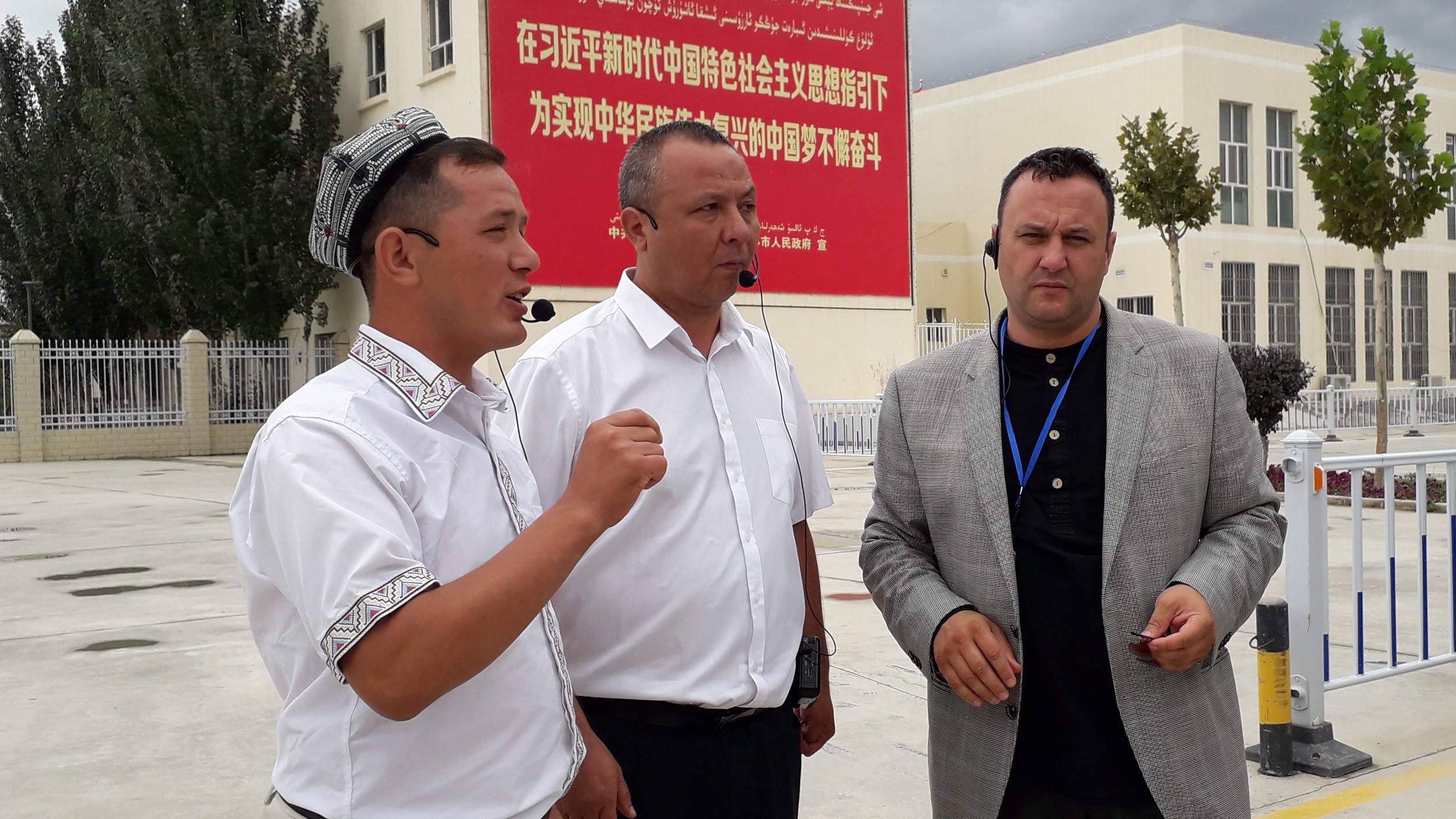
Olsi Jazexhi (right) listens to a handler during a tour of a mosque in Aksu city, Xinjiang in August 2019. Photo: Provided by Olsi Jazexhi
Other journalists who have tried to move away from the organised tours have faced a number of difficulties. When journalists have attempted to film camps that the government has not previously cleared for access, they have been turned away by local authorities. Road works or car crashes suddenly block their way and when the journalists attempt to return the next day, the roadworks suddenly reappear again. Members of a Reuters crew reported being tailed by a rotating cast of plain-clothed minders and “within an hour of the reporters leaving their hotel in the city of Kashgar through a back gate, barbed wire was erected across the exit and fire escapes on their floor were locked.”
While influencing journalists can sometimes be difficult, the expansion of blogging and social media influencing has opened up another avenue for state intervention. Travel vloggers who visit authoritarian countries say they just want to educate their viewers and avoid politics. Irish travel vlogger Janet Newenham told Al Jazeera after a controversial visit to Syria that “every country deserves to be shown in a different way and in a positive light even if most stuff about there has always been negative”. However, what can seem innocuous can take on more explicit political implications. “A lot of these vloggers are saying they’re apolitical in this and I’m sure that they are but the issue is, when you’re entering a conflict zone, your direct presence there becomes political,” researcher and adjunct professor, Sophie Kathyrn Fullerton told Al Jazeera.
A similar trend is increasingly evident in China. “I’m here because lots of people, right now, outside of China, want to know what Xinjiang is like,” says British vlogger, The China Traveller, at the start of a video, which focuses on him sampling a variety of local food while Uyghur women appeared to spontaneously dance behind him. Videos of this genre can be seen as part of what has been labelled the CCP’s project to “Disneyfy” Xinjiang. Uyghur culture has been co-opted by the state and amplified as a tourist attraction to change the narrative and drown out reports of genocide against the Uyghur community. In another video, The China Traveller praises the central government for rebuilding sections of the city, while failing to address the government’s other influence on the Xinjiang skyline: the mass demolition of religious institutions.
While Chinese culture is celebrated by The China Traveller and other vloggers in Xinjiang, French photographer Andrew Wack had a different experience when he returned to the region in 2019. Speaking to Wired a year after his trip, Wack commented on the stark absence of “men aged 20 to 60, many of whom had likely been rounded up and herded into indoctrination camps”. Throughout his visit, he was followed by plain-clothes police officers “and at checkpoints he was sometimes asked to show his photographs. On one occasion, he was asked to delete images”.
Many vloggers and journalists obscure any coordination or funding from Chinese bodies, or underplay how it may affect their coverage. Lee Barrett, a British vlogger, states in a video, “we go on some sponsored trips to places … our accommodation is paid for, our travel is paid for … nobody tells us what to say, nobody tells us what to film”. Due to the opaque nature of these relationships, it is impossible to interrogate the influence this type of support has on the vloggers’ reporting. However at times this veil is lifted. In a number of popular videos, minders sent by the Chinese state to monitor another vloggers’ trip can be clearly seen monitoring their behaviour.
When the BBC’s lead China reporter, John Sudworth, was invited into Xinjiang’s ‘re-education’ camps, he was presented with a highly choreographed and Disneyfied presentation of Xinjiang culture, which apparently even moved the Chinese officials accompanying the BBC crew to tears. However, Sudworth’s commitment to “peer beneath the official messaging and hold it up to as much scrutiny as we could” led him to scrutinise everything, including scraps of graffiti written in Uyghur and Chinese. This approach has had lasting consequences; he now reports on China from abroad, having had his visa revoked.
In modern day China, independent reporting from foreigners is one of the few avenues left in order to scrutinise power beyond the dominant state narrative. However, through the funding and coordination of junkets, training opportunities and other tactics, the Chinese state has followed in the footsteps of Assad’s Syria to try and control the message these foreigners send out into the world. This turns the principles of journalism against itself and manipulates the free expression environment in favour of the state.
Edgar Snow remains venerated in China. In 2021, the Foreign Ministry spokesperson Hua Chunying proclaimed on Twitter: “China hopes to see and welcome more Edgar Snows of this new era among foreign journalists”. John Sudworth provides a powerful counterweight, reminding us that we must “peer beneath the official messaging and hold it up to as much scrutiny as we could”.
- The authors approached The China Traveller and Lee Barrett for comment for this article. No response had been received by the time of going to press.

 “You can usually tell the quality of a tyrant’s credentials by the number of people he has thrown in jail on spurious grounds and Europe’s last dictator, Alyanksandr Lukashenka, is no exception,” says Index associate editor Mark Frary.