16 Sep 2022 | Belarus, Brazil, China, Iran, North Korea, Opinion, Russia, Ruth's blog, Saudi Arabia, Sri Lanka, Turkey, United Kingdom
The United Kingdom is in a period of national mourning, marking the passing of our head of state, Her Majesty Queen Elizabeth II. Global media has been transfixed, reporting on the minutiae of every aspect of the ascension of the new monarch and the commemoration of our former head of state. While the pageantry has been consuming, the constitutional process addictive (yes I am an addict) and the public grief tangible – the traditions and formalities have also highlighted challenges in British and global society – especially with regards to freedom of expression.
We have witnessed people being arrested for protesting against the monarchy. While the protests could be considered distasteful – I certainly think they are – that doesn’t mean that they are illegal and that the police should move against them. Public protest is a legitimate campaigning tool and is protected in British law. As ever, no one has the right not to be offended. And protest is, by its very nature, disruptive, challenging and typically at odds with the status quo. It is therefore all the more important that the right to peacefully protest is protected.
While I was appalled to see the arrests, I have been heartened in recent days at the almost universal condemnation of the actions of the police and the statements of support for freedom of expression and protest in the UK, from across the political system.
What this chapter has confirmed is that democracies, great and small, need to be constantly vigilant against threats to our core human rights which can so easily be undermined. This week our right to freedom of expression and the right to protest was threatened and the immediate response was a universal defence. Something we should cherish and celebrate because it won’t be long before we need to utilise our collective rights to free speech – again.
Which brings me onto the need to protest and what that can look like, even on the bleakest of days. On Monday, the largest state funeral of my lifetime is being held in London. Over 2,000 dignitaries are expected to attend the funeral of Her Majesty, Queen Elizabeth II, in Westminster Abbey. The heads of state of Russia, Belarus, Afghanistan, Syria, Venezuela and Myanmar were not invited given current diplomatic “tensions”. While I completely welcome their exclusion from the global club of acceptability, it does highlight who was deemed acceptable to invite.
Representatives from China, Brazil, Saudi Arabia, Turkey, Iran, North Korea and Sri Lanka will all be in attendance, all of whom have shown a complete disregard for some of the core human rights that so many of us hold dear. Can you imagine the conversation between Bolsonaro and Erdogan? Or the ambassador to Iran and the vice president of China?
While I truly believe that no one should picket a funeral – the very idea is abhorrent to me – that doesn’t mean that there are no other ways of protesting against the actions of repressive regimes and their leadership, who will be in the UK in the coming days. In fact the British Parliament has shown us the way – by banning representatives of the Chinese Communist Party from attending the lying in state of Her Majesty – as a protest at the sanctions currently imposed on British parliamentarians for their exposure of the acts of genocide happening against the Uyghur population in Xinjiang province. This was absolutely the right thing to do and I applaud the Speaker of the House of Commons, Rt Hon Lindsay Hoyle MP, for taking such a stance.
Effective protest needs to be imaginative, relevant and take people with you – highlighting the core values that we share and why others are a threat to them. It can be private or public. It can tell a story or mark a moment. But ultimately successful protests can lead to real change. Even if it takes decades. Which is why we will defend, cherish and promote the right to protest and the right to freedom of expression in every corner of the planet, as a real vehicle for delivering progressive change.
2 Sep 2022 | BannedByBeijing, China, News
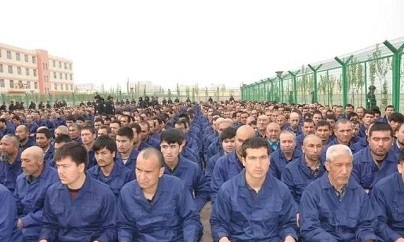
Detainees at a re-education camp in Xinjiang. Photo WeChat/Xinjiang Juridical Administration
“Serious human rights violations” have been committed in Xinjiang and the arbitrary and discriminatory detention of Uyghurs “may constitute…crimes against humanity” according to a controversial UN report that the Chinese government has been trying to quash.
The report also concludes that allegations of patterns of torture or ill-treatment, including forced medical treatment and adverse conditions of detention, as well as allegations of individual incidents of sexual and gender-based violence are “credible”.
What is also abundantly clear is that the report does not make mention of the word “genocide”, something that has left many campaigners unsatisfied.
The UN report goes so far as to push any mention of “suspicious deaths” occurring inside Xinjiang’s re-education centres into a footnote, saying that despite being presented with allegations on these by interviewees it had “not been possible to verify [them] to the requisite standard”. Restricting the ability of the UN to verify claims of human rights abuses is an effective method by which states, such as China, can effectively game the UN’s investigative process. By ensuring the body cannot access the evidence it needs, China can ostensibly shape what the UN can say without exerting any overt control or interference.
Last month it was revealed that the Chinese mission to the UN was lobbying to prevent the release of the report into human rights abuses in Xinjiang. The publication of the report, first commissioned in 2018, had been repeatedly delayed after having been completed in September 2021. Under tremendous pressure from other UN member states, the report was finally made available on 31 August in the last minutes of UN High Commissioner Michelle Bachelet’s term.
The release of the report has not been welcomed by the Chinese government. In its response to its publication, China’s mission to the UN said: “Based on the disinformation and lies fabricated by anti-China forces and out of presumption of guilt, the so-called ‘assessment’ distorts China’s laws and policies, wantonly smears and slanders China, and interferes in China’s internal affairs”.
The attempt to block the report’s publication may come as a shock to some but this incident is only the most recent attempt by the Chinese Communist Party (CCP) to silence Uyghurs both within and outside China and to discredit those who try to shine a light on their treatment. In the past, the UN has abdicated from its duty to challenge this global campaign against the Uyghurs. The publication of the report is a notable improvement on the UN’s poor track record. But the controversy surrounding the report’s release has left few critics of the UN optimistic about the ability of the organisation to defend Uyghurs in the future.
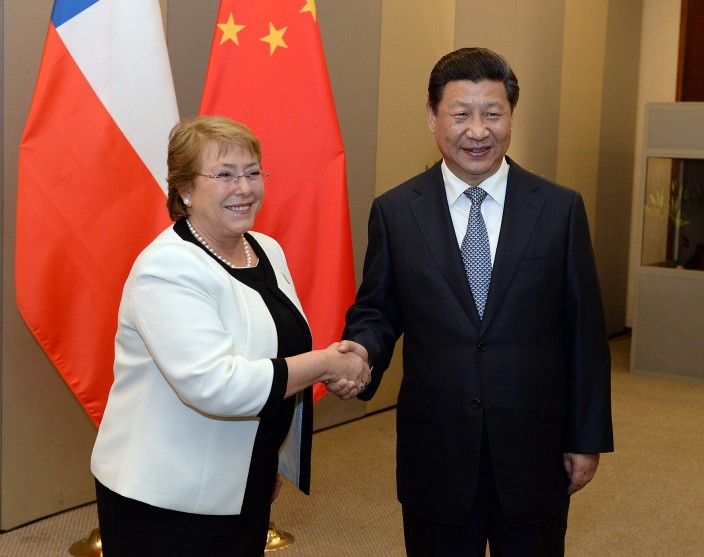
Michelle Bachelet meets Chinese president Xi Jinping in 2014, photo: Gobierno de Chile
The release of the Xinjiang report reflects a significant departure from the UN’s traditional soft-touch approach to managing its relationship with China. For example, earlier in 2022 Michelle Bachelet became the first UN High Commissioner to visit China in 17 years. While Bachelet praised China’s progress in labour standards and gender rights, she mentioned only in passing the treatment of Uyghurs, which according to credible reports, includes mass enslavement and systemic rape. Bachelet later admitted that her access to Uyghurs was severely restricted, ostensibly because of COVID-19 regulations, but to many her relative silence appeared to validate the Chinese government’s narrative surrounding events in Xinjiang. After her visit, The Global Times, a Chinese newspaper known for inevitably toeing the government line, ran an opinion piece praising Bachelet for changing her perspective on Xinjiang. The piece celebrated Bachelet’s adoption of CCP terminology – highlighting her use of “the term ‘Vocational Education and Training Centre’ instead of the so-called ‘re-education camp’” – and attributed her much-publicised decision not to run for a second term as High Commissioner to pressure she faced after speaking out in favour of China’s counter-terrorism measures.
Bachelet appeared to accept at face value claims that the re-education camps had “been dismantled” and appeared overly optimistic about “China’s stated aim of ensuring quality developed closely linked to developing the rule of law and respect for human rights”. While she expressed some half-hearted concern about the “lack of judicial oversight” in Xinjiang and mentioned Uyghurs she had met before her trip to China who had lost contact with their relatives, her condemnation of the treatment and mass detention of Uyghurs across the region was decidedly muted. Instead she praised China’s “tremendous achievements” in labour and gender rights, an insult to the victims of slave labour and sexual abuse in the camps. She concluded that “there is important work being done to advance gender equality, the rights of LGBTQI people or people with disabilities and all the people among other [groups]”.
China’s mission to the UN now says that the content of the report “is “entirely contradictory to the formal statement issued by [Bachelet]” following her visit. Just like the Global Times, China’s mission is falsely pointing to Bachelet’s Xinjiang trip as an exoneration of the CCP.
Bachelet herself emphasised that her visit “was not an investigation”, which begs the question why it happened in the first place. All her soft touch approach achieved was to grant the Chinese Communist Party (CCP) a significant PR win.

UN whistleblower Emma Reilly
To understand why UN officials like Bachelet have traditionally been so cautious about criticising China, Index spoke to Emma Reilly (left), an Irish former human rights officer at the United Nations Office of the High Commissioner for Human Rights (OHCHR). Reilly was fired in 2021 after blowing the whistle in 2017, revealing how the UN had for years been passing the names of Uyghurs set to testify before the UN to the Chinese government. Reilly explained to Index that Eric Tistounet from the OHCHR told concerned staff that “not giving them over would further Chinese distrust of the UN”.
One of the names on the list was Dolkun Isa who now resides in Germany. After the UN passed over his name to the Chinese authorities, his remaining family members who still resided in Xinjiang received a visit from the police. His parents later died in a re-education camp in circumstances that are still unclear. Reilly told Index that another person the UN exposed without their knowledge died upon their return to Xinjiang.
After the UN issued a medical report about Reilly, the Swiss police visited Reilly’s house and prevented her from attending a meeting about the issue she had exposed. In doing so, the UN effectively transformed the Swiss police into a tool of CCP censorship.
A tribunal was initiated to investigate Reilly’s case with the assistance of Rowan Downing QC, a former President of the UN Dispute Tribunal and an international war crimes judge. When it became clear that Downing’s ruling would not be favourable towards the UN, he was removed from his position. Downing compared this move to a coup.
Reilly told Index that the UN’s general reluctance to criticise the CCP is based on the misguided assumption that significant concessions need to be made to maintain a friendly relationship with the Chinese government. According to Reilly, it is commonly believed at the UN that increased engagement with the Chinese government will lead it to internalise global norms of human rights. But the opposite appears to be the case. In fact, the Chinese government has proven itself to be a powerful norm maker of its own as it becomes increasingly assertive in the UN.
Rosemary Foot’s book “China, the UN and Human Protection” seeks to explain the paradox of a China that is significantly more prominent in the UN system yet increasingly resistant to many of its central tenets. Most significantly, the Chinese government has sought to bolster the importance of sovereignty and undermine the universal nature of human rights.
For example, China had only used its security council veto power six times before the outbreak of the Syrian civil war. It then used it seven times to block resolutions condemning the Assad regime. The Chinese government believes that the treatment of Syrians, Uyghurs and other groups should be treated as “internal affairs” and economic growth should be seen as the principal means of improving human rights. As Kenneth Roth, the former executive director of Human Rights Watch, recently wrote, “if Beijing had its way, human rights would be reduced to a measurement of growth in gross domestic product”.
In her discussion with Index, Reilly expressed dismay that her case had received the most attention from right-leaning outlets sceptical of the UN project. Other outlets tended to focus on the treatment of whistleblowers rather than the behaviour she was uncovering and the necessity of systemic reform. Like many other UN whistleblowers, Reilly remains committed to the UN project and wants it changed, not abandoned.
Disempowering the UN (like the Trump administration tried to do by making significant cuts after its recognition of Jerusalem as the capital of Israel was rejected) will only empower the Chinese government to fill the vacuum. But the typical relationship the UN has had with the Chinese government swings the pendulum too far in the opposite direction. The UN must not allow itself to become a tool for China to censor its opponents but starving the UN of funds, undermining its mandate, and expecting it to reform is not a tenable solution that protects universal rights and targeted groups, including Uyghurs both in China and elsewhere.
Given the UN’s poor track record of endangering critics of the CCP, does the release of the Xinjiang report suggest the arrival of the kind of systemic reform that Reilly and others have called for?
Critics are sceptical that this recent development (while welcome) reflects a newly assertive United Nations. The next step would be for an independent investigation to be conducted into events in Xinjiang. Calls for such an investigation have also come from within the UN system after 50 UN human rights experts urged the Human Rights Council in 2020 to establish an independent UN mandate to monitor and report on human rights violations in China. According to the OHCHR’s own statement on this recommendation “unlike over 120 States, the Government of China has not issued a standing invitation to UN independent experts to conduct official visits.” However, two years later and progress has been glacial. Considering that the release of a report took almost three years once it was completed and was only possible after overwhelming pressure from other member states, any next step looks like an insurmountable challenge requiring consistent international solidarity and pressure at a time of growing international tension. The Chinese government cannot exert total influence over the UN to silence all of its critics but as demonstrated by the delays of the Xinjiang report, the UN process remains too easy for human rights abusers to impede.
Reilly remains critical of the UN. Now that the UN has officially recognised in its report that the CCP carries out “reprisals against Uyghur and other predominately Muslim minorities abroad in connection with their advocacy, and their family members in [Xinjiang]”, their continued smear campaign against her and refusal to condemn the policy she exposed is an increasingly untenable position.
There is also the question of how permanent the UN’s apparent change of strategy will be. It is notable that Bachelet only felt capable of releasing the report upon her departure from office when she would not have to face the consequences of her decision. Perhaps that now Bachelet is gone, her brief experiment with explicitly calling out the CCP’s human rights abuses will be replaced with business as usual.
Meanwhile, the global campaign to target Uyghurs both within and outside China continues
. Earlier this year, Index published a landmark report examining how the CCP has externalised its censorship and intimidation of Uyghurs even to those who have managed to escape to Europe in search of freedom and security. As highlighted by Reilly’s brave decision to blow the whistle, the CCP will use every mechanism and lever at its disposal to enforce its propaganda and target its perceived adversaries. Even though they now reside in Europe, Uyghurs continue to receive threats as do their families still living in Xinjiang. This report highlighted the lengths the CCP would go to strengthen its narrative and censor those brave enough to speak out, irrespective of where they are. It also revealed the inadequate response of European states to respond to this threat. Without a robust response, the CCP is emboldened to continue exporting its message to other countries and through international bodies like the UN. If the UN has only just reached the stage of officially recognising that this years long campaign is actually taking place, let alone taking active measures to stop it, who can Uyghurs rely on?
[Index made repeated requests to the United Nations for comment on this article but no replies were received at time of publication.]
To learn more about the censorship of Uyghurs in Europe, read Index’s Banned by Beijing report “China’s Long Arm”: https://www.indexoncensorship.org/2022/02/landmark-report-shines-light-on-chinese-long-arm-repression-of-ex-pat-uyghurs/
31 Aug 2022 | FEATURED: Martin Bright, News, Russia
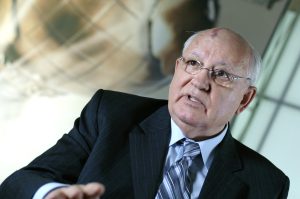
Mikhail Gorbachev in 2008. Photo: European Parliament, CC BY-NC-ND 2.0
In 2000 Mikhail Gorbachev wrote a short piece for Index on Censorship about the dangers to free expression in 21st century Russia. It followed raids carried out by masked, armed police on the offices of the Media-MOST consortium, then one of the most powerful media organisations in Russia. It was a show of force by the incoming president, Vladimir Putin, and a chilling sign of things to come.
The article, entitled Citizens’ Watch, expressed the best of the former President’s instincts in support of democracy and freedom: “Without a free press people don’t have a voice. They can be used as the authorities see fit; they can be manipulated”.
It was also prophetic in its concerns that the Russian people were sleepwalking into an authoritarian disaster: “I’m… worried and dispirited by the apathy of the public. The journalists are having to defend themselves on their own. It’s time we understood we shall never be a democratic state until we have learned to be citizens.”
He concluded: “It is not easy to live as a free man; without democratic institutions and rules, freedom often becomes its opposite.”
But the piece also demonstrates Gorbachev’s fatal weakness. As a good man with good intentions, he was too willing to give those with bad intentions (such as Vladimir Putin) the benefit of the doubt. Musing on who might be ultimately responsible for the crackdown, he wrote: “I find it hard to believe that raids like these can take place with the president’s knowledge. If, indeed, it is with his knowledge, I personally feel very disappointed.”
Disappointment defined Mikhail Gorbachev. As the last leader of the Soviet Union, he was quite possibly the most influential political figure of the post-war period, but from the moment the Berlin Wall fell, his life was marked with a series of disappointments. He had hoped the break-up of the Soviet Union would lead to democratic transformation and the introduction of a market economy with social safeguards. In many countries of the former Eastern bloc, this was indeed the case, but he also witnessed the rise of tyranny and corruption in many of the former Soviet republics. In his beloved Russia itself, he saw his liberal economic reforms hijacked first by the oligarchs and then by the state itself. This man of peace, whose childhood had driven him towards dialogue with the West, stood by as his country descended into an increasingly aggressive foreign policy with wars in Chechnya, Georgia, Syria and latterly in Ukraine. History will judge him harshly for his support of the Russian annexation of Crimea in 2014, although in his mind it was consistent with his lifelong support for national self-determination.
But possibly his greatest disappointment was what he saw as the catastrophic failure of world leaders to deal with the environmental crisis. In an interview with the Russian publication Dos’e na Tesnzuru reprinted in this magazine in 1998 he noted that “ecology” sprang to the top of the agenda in Russia thanks to his policy of glasnost (openness). As a result, 1,300 polluting enterprises were closed. It was his dream to establish a global environmental organisation to address the combined challenges of security poverty and environmental destruction and following the Rio Earth Summit in 1992 he established Green Cross International in Geneva.
His words in Index sounded an important warning: “Everyone can see that the forests are retreating, rivers becoming polluted. The reasons are obvious – people rule the earth, but they are not looking after it, only making demands: give me cotton, give me wood, give, give, give. We have to manage things differently.”
The end of the Cold War was Gorbachev’s greatest legacy and he knew that the freedoms he helped establish were built on the work done by the dissident intellectuals that came before him. He also knew that complacency was not an option.
A quarter of a century ago he told Dos’e na Tesnuru (which means Index on Censorship in Russian): “I am not a pessimist. All over the world the last dictators are leaving the political scene; attempts to impose dictatorship are ridiculous. Only one thing can protect us from such attempts – freedom of speech. That’s why any defence of freedom of speech is so important. Without it we could find ourselves once again caught in the trap.” His prediction of the demise of dictatorships was perhaps premature, but he was never wrong about the antidote.
