
Saudi Arabia: Kingdom must be held to account for suppression of dissent
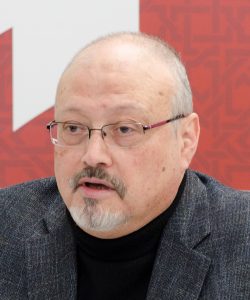
Saudi journalist, Global Opinions columnist for the Washington Post, and former editor-in-chief of Al-Arab News Channel Jamal Khashoggi offers remarks during POMED’s “Mohammed bin Salman’s Saudi Arabia: A Deeper Look”. March 21, 2018, Project on Middle East Democracy (POMED), Washington, DC.
Recognising the fundamental right to express our views, free from repression, we the undersigned civil society organisations call on the international community, including the United Nations, multilateral and regional institutions as well as democratic governments committed to the freedom of expression, to take immediate steps to hold Saudi Arabia accountable for grave human rights violations. The murder of Saudi journalist Jamal Ahmad Khashoggi in the Saudi Consulate in Istanbul on 2 October is only one of many gross and systematic violations committed by the Saudi authorities inside and outside the country. As the International Day to End Impunity for Crimes against Journalists approaches on 2 November, we strongly echo calls for an independent investigation into Khashoggi’s murder, in order to hold those responsible to account.
This case, coupled with the rampant arrests of human rights defenders, including journalists, scholars and women’s rights activists; internal repression; the potential imposition of the death penalty on demonstrators; and the findings of the UN Group of Eminent Experts report which concluded that the Coalition, led by Saudi Arabia, have committed acts that may amount to international crimes in Yemen, all demonstrate Saudi Arabia’s record of gross and systematic human rights violations. Therefore, our organisations further urge the UN General Assembly to suspend Saudi Arabia from the UN Human Rights Council (HRC), in accordance with operative paragraph 8 of the General Assembly resolution 60/251.
Saudi Arabia has never had a reputation for tolerance and respect for human rights, but there were hopes that as Crown Prince Mohammed Bin Salman rolled out his economic plan (Vision 2030), and finally allowed women to drive, there would be a loosening of restrictions on women’s rights, and freedom of expression and assembly. However, prior to the driving ban being lifted in June, women human rights defenders received phone calls warning them to remain silent. The Saudi authorities then arrested dozens of women’s rights defenders (both female and male) who had been campaigning against the driving ban. The Saudi authorities’ crackdown against all forms of dissent has continued to this day.
Khashoggi criticised the arrests of human rights defenders and the reform plans of the Crown Prince, and was living in self-imposed exile in the US. On 2 October 2018, Khashoggi went to the Consulate in Istanbul with his fiancée to complete some paperwork, but never came out. Turkish officials soon claimed there was evidence that he was murdered in the Consulate, but Saudi officials did not admit he had been murdered until more than two weeks later.
It was not until two days later, on 20 October, that the Saudi public prosecution’s investigation released findings confirming that Khashoggi was deceased. Their reports suggested that he died after a “fist fight” in the Consulate, and that 18 Saudi nationals have been detained. King Salman also issued royal decrees terminating the jobs of high-level officials, including Saud Al-Qahtani, an advisor to the royal court, and Ahmed Assiri, deputy head of the General Intelligence Presidency. The public prosecution continues its investigation, but the body has not been found.
Given the contradictory reports from Saudi authorities, it is essential that an independent international investigation is undertaken.
On 18 October, the Committee to Protect Journalists (CPJ), Human Rights Watch, Amnesty International, and Reporters Without Borders (RSF) called on Turkey to request that UN Secretary-General Antonio Guterres establish a UN investigation into the extrajudicial execution of Khashoggi.
On 15 October 2018, David Kaye, the UN Special Rapporteur on freedom of expression, and Dr. Agnès Callamard, the UN Special Rapporteur on summary executions, called for “an independent investigation that could produce credible findings and provide the basis for clear punitive actions, including the possible expulsion of diplomatic personnel, removal from UN bodies (such as the Human Rights Council), travel bans, economic consequences, reparations and the possibility of trials in third states.”
We note that on 27 September, Saudi Arabia joined consensus at the UN HRC as it adopted a new resolution on the safety of journalists (A/HRC/Res/39/6). We note the calls in this resolution for “impartial, thorough, independent and effective investigations into all alleged violence, threats and attacks against journalists and media workers falling within their jurisdiction, to bring perpetrators, including those who command, conspire to commit, aid and abet or cover up such crimes to justice.” It also “[u]rges the immediate and unconditional release of journalists and media workers who have been arbitrarily arrested or arbitrarily detained.”
Khashoggi had contributed to the Washington Post and Al-Watan newspaper, and was editor-in-chief of the short-lived Al-Arab News Channel in 2015. He left Saudi Arabia in 2017 as arrests of journalists, writers, human rights defenders and activists began to escalate. In his last column published in the Washington Post, he criticised the sentencing of journalist Saleh Al-Shehi to five years in prison in February 2018. Al-Shehi is one of more than 15 journalists and bloggers who have been arrested in Saudi Arabia since September 2017, bringing the total of those in prison to 29, according to RSF, while up to 100 human rights defenders and possibly thousands of activists are also in detention according to the Gulf Centre for Human Rights (GCHR) and Saudi partners including ALQST. Many of those detained in the past year had publicly criticised reform plans related to Vision 2030, noting that women would not achieve economic equality merely by driving.
Another recent target of the crackdown on dissent is prominent economist Essam Al-Zamel, an entrepreneur known for his writing about the need for economic reform. On 1 October 2018, the Specialised Criminal Court (SCC) held a secret session during which the Public Prosecution charged Al-Zamel with violating the Anti Cyber Crime Law by “mobilising his followers on social media.” Al-Zamel criticised Vision 2030 on social media, where he had one million followers. Al-Zamel was arrested on 12 September 2017 at the same time as many other rights defenders and reformists.
The current unprecedented targeting of women human rights defenders started in January 2018 with the arrest of Noha Al-Balawi due to her online activism in support of social media campaigns for women’s rights such as (#Right2Drive) or against the male guardianship system (#IAmMyOwnGuardian). Even before that, on 10 November 2017, the SCC in Riyadh sentenced Naimah Al-Matrod to six years in jail for her online activism.
The wave of arrests continued after the March session of the HRC and the UN Committee on the Elimination of Discrimination against Women (CEDAW) published its recommendations on Saudi Arabia. Loujain Al-Hathloul, was abducted in the Emirates and brought to Saudi Arabia against her will on 15 May 2018; followed by the arrest of Dr. Eman Al-Nafjan, founder and author of the Saudiwoman’s Weblog, who had previously protested the driving ban; and Aziza Al-Yousef, a prominent campaigner for women’s rights.
Four other women’s human rights defenders who were arrested in May 2018 include Dr. Aisha Al-Manae, Dr. Hessa Al-Sheikh and Dr. Madeha Al-Ajroush, who took part in the first women’s protest movement demanding the right to drive in 1990; and Walaa Al-Shubbar, a young activist well-known for her campaigning against the male guardianship system. They are all academics and professionals who supported women’s rights and provided assistance to survivors of gender-based violence. While they have since been released, all four women are believed to be still facing charges.
On 6 June 2018, journalist, editor, TV producer and woman human rights defender Nouf Abdulaziz was arrested after a raid on her home. Following her arrest, Mayya Al-Zahrani published a letter from Abdulaziz, and was then arrested herself on 9 June 2018, for publishing the letter.
On 27 June 2018, Hatoon Al-Fassi, a renowned scholar, and associate professor of women’s history at King Saud University, was arrested. She has long been advocating for the right of women to participate in municipal elections and to drive, and was one of the first women to drive the day the ban was lifted on 24 June 2018.
Twice in June, UN special procedures called for the release of women’s rights defenders. On 27 June 2018, nine independent UN experts stated, “In stark contrast with this celebrated moment of liberation for Saudi women, women’s human rights defenders have been arrested and detained on a wide scale across the country, which is truly worrying and perhaps a better indication of the Government’s approach to women’s human rights.” They emphasised that women human rights defenders “face compounded stigma, not only because of their work as human rights defenders, but also because of discrimination on gender grounds.”
Nevertheless, the arrests of women human rights defenders continued with Samar Badawi and Nassima Al-Sadah on 30 July 2018. They are being held in solitary confinement in a prison that is controlled by the Presidency of State Security, an apparatus established by order of King Salman on 20 July 2017. Badawi’s brother Raif Badawi is currently serving a 10-year prison sentence for his online advocacy, and her former husband Waleed Abu Al-Khair, is serving a 15-year sentence. Abu Al-Khair, Abdullah Al-Hamid, and Mohammad Fahad Al-Qahtani (the latter two are founding members of the Saudi Civil and Political Rights Association – ACPRA) were jointly awarded the Right Livelihood Award in September 2018. Yet all of them remain behind bars.
Relatives of other human rights defenders have also been arrested. Amal Al-Harbi, the wife of prominent activist Fowzan Al-Harbi, was arrested by State Security on 30 July 2018 while on the seaside with her children in Jeddah. Her husband is another jailed member of ACPRA. Alarmingly, in October 2018, travel bans were imposed against the families of several women’s rights defenders, such as Aziza Al-Yousef, Loujain Al-Hathloul and Eman Al-Nafjan.
In another alarming development, at a trial before the SCC on 6 August 2018, the Public Prosecutor called for the death penalty for Israa Al-Ghomgam who was arrested with her husband Mousa Al-Hashim on 6 December 2015 after they participated in peaceful protests in Al-Qatif. Al-Ghomgam was charged under Article 6 of the Cybercrime Act of 2007 in connection with social media activity, as well as other charges related to the protests. If sentenced to death, she would be the first woman facing the death penalty on charges related to her activism. The next hearing is scheduled for 28 October 2018.
The SCC, which was set up to try terrorism cases in 2008, has mostly been used to prosecute human rights defenders and critics of the government in order to keep a tight rein on civil society.
On 12 October 2018, UN experts again called for the release of all detained women human rights defenders in Saudi Arabia. They expressed particular concern about Al-Ghomgam’s trial before the SCC, saying, “Measures aimed at countering terrorism should never be used to suppress or curtail human rights work.” It is clear that the Saudi authorities have not acted on the concerns raised by the special procedures – this non-cooperation further brings their membership on the HRC into disrepute.
Many of the human rights defenders arrested this year have been held in incommunicado detention with no access to families or lawyers. Some of them have been labelled traitors and subjected to smear campaigns in the state media, escalating the possibility they will be sentenced to lengthy prison terms. Rather than guaranteeing a safe and enabling environment for human rights defenders at a time of planned economic reform, the Saudi authorities have chosen to escalate their repression against any dissenting voices.
Our organisations reiterate our calls to the international community to hold Saudi Arabia accountable and not allow impunity for human rights violations to prevail.
We call on the international community, and in particular the UN, to:
- Take action to ensure there is an international, impartial, prompt, thorough, independent and effective investigation into the murder of journalist Jamal Ahmad Khashoggi;
- Ensure Saudi Arabia be held accountable for the murder of Khashoggi and for its systematic violations of human rights;
- Call a Special Session of the Human Rights Council on the recent wave of arrests and attacks against journalists, human rights defenders and other dissenting voices in Saudi Arabia;
- Take action at the UN General Assembly to suspend Saudi Arabia’s membership of the Human Rights Council; and
- Urge the government of Saudi Arabia to implement the below recommendations.
We call on the authorities in Saudi Arabia to:
- Produce the body of Jamal Ahmad Khashoggi and invite independent international experts to oversee investigations into his murder; cooperate with all UN mechanisms; and ensure that those responsible for his death, including those who hold command responsibility, are brought to justice;
- Immediately quash the convictions of all human rights defenders, including women and men advocating for gender equality, and drop all charges against them;
- Immediately and unconditionally release all human rights defenders, writers, journalists and prisoners of conscience in Saudi Arabia whose detention is a result of their peaceful and legitimate work in the promotion and protection of human rights including women’s rights;
- Institute a moratorium on the death penalty; including as punishment for crimes related to the exercise of rights to freedom of opinion and expression, and peaceful assembly;
- Guarantee in all circumstances that all human rights defenders and journalists in Saudi Arabia are able to carry out their legitimate human rights activities and public interest reporting without fear of reprisal;
- Immediately implement the recommendations made by the UN Group of Eminent Experts on Yemen; and
- Ratify the International Covenant on Civil and Political Rights, and bring all national laws limiting the rights to freedom of expression, peaceful assembly and association into compliance with international human rights standards.
Signed,
Access Now
Action by Christians for the Abolition of Torture (ACAT) – France
Action by Christians for the Abolition of Torture (ACAT) – Germany
Al-Marsad – Syria
ALQST for Human Rights
ALTSEAN-Burma
Americans for Democracy & Human Rights in Bahrain (ADHRB)
Amman Center for Human Rights Studies (ACHRS) – Jordan
Amman Forum for Human Rights
Arabic Network for Human Rights Information (ANHRI)
Armanshahr/OPEN ASIA
ARTICLE 19
Asian Forum for Human Rights and Development (FORUM-ASIA)
Asian Human Rights Commission (AHRC)
Asociación Libre de Abogadas y Abogados (ALA)
Association for Freedom of Thought and Expression (AFTE)
Association for Human Rights in Ethiopia (AHRE)
Association malienne des droits de l’Homme (AMDH)
Association mauritanienne des droits de l’Homme (AMDH)
Association nigérienne pour la défense des droits de l’Homme (ANDDH)
Association of Tunisian Women for Research on Development
Association for Women’s Rights in Development (AWID)
Awan Awareness and Capacity Development Organization
Bahrain Institute for Rights and Democracy (BIRD)
Bureau for Human Rights and the Rule of Law – Tajikistan
Cairo Institute for Human Rights Studies (CIHRS)
Cambodian League for the Promotion and Defense of Human Rights (LICADHO)
Canadian Center for International Justice
Caucasus Civil Initiatives Center (CCIC)
Center for Civil Liberties – Ukraine
Center for Prisoners’ Rights
Center for the Protection of Human Rights “Kylym Shamy” – Kazakhstan
Centre oecuménique des droits de l’Homme (CEDH) – Haïti
Centro de Políticas Públicas y Derechos Humanos (EQUIDAD) – Perú
Centro para la Acción Legal en Derechos Humanos (CALDH) – Guatemala
Citizen Center for Press Freedom
Citizens’ Watch – Russia
CIVICUS
Civil Society Institute (CSI) – Armenia
Code Pink
Columbia Law School Human Rights Clinic
Comité de acción jurídica (CAJ) – Argentina
Comisión Ecuménica de Derechos Humanos (CEDHU) – Ecuador
Comisión Nacional de los Derechos Humanos – Dominican Republic
Committee on the Administration of Justice (CAJ) -Northern Ireland
Committee to Protect Journalists
Committee for Respect of Liberties and Human Rights in Tunisia
Damascus Center for Human Rights in Syria
Danish PEN
DITSHWANELO – The Botswana Center for Human Rights
Dutch League for Human Rights (LvRM)
Election Monitoring and Democracy Studies Center – Azerbaijan
English PEN
European Centre for Democracy and Human Rights (ECDHR)
European Saudi Organisation for Human Rights (ESOHR)
FIDH within the framework of the Observatory for the protection of human rights defenders
Finnish League for Human Rights
Freedom Now
Front Line Defenders
Fundación regional de asesoría en derechos humanos (INREDH) – Ecuador
Foundation for Human Rights Initiative (FHRI) – Uganda
Global Voices Advox
Groupe LOTUS (RDC)
Gulf Centre for Human Rights (GCHR)
Hellenic League for Human Rights (HLHR)
Human Rights Association (IHD) – Turkey
Human Rights Center (HRCIDC) – Georgia
Human Rights Center “Viasna” – Belarus
Human Rights Commission of Pakistan
Human Rights Concern (HRCE) – Eritrea
Human Rights in China
Human Rights Center Memorial
Human Rights Movement “Bir Duino Kyrgyzstan”
Human Rights Sentinel
IFEX
Index on Censorship
Initiative for Freedom of Expression (IFoX) – Turkey
Institut Alternatives et Initiatives citoyennes pour la Gouvernance démocratique (I-AICGD) – DR Congo
International Center for Supporting Rights and Freedoms (ICSRF) – Switzerland
Internationale Liga für Menscherechte
International Human Rights Organisation “Fiery Hearts Club” – Uzbekistan
International Legal Initiative (ILI) – Kazakhstan
International Media Support (IMS)
International Partnership for Human Rights (IPHR)
International Press Institute
International Service for Human Rights (ISHR)
Internet Law Reform and Dialogue (iLaw)
Iraqi Association for the Defense of Journalists’ Rights
Iraqi Hope Association
Italian Federation for Human Rights (FIDH)
Justice for Iran
Karapatan – Philippines
Kazakhstan International Bureau for Human Rights and the Rule of Law
Khiam Rehabilitation Center for Victims of Torture
KontraS
Latvian Human Rights Committee
Lao Movement for Human Rights
Lawyers’ Rights Watch Canada
League for the Defense of Human Rights in Iran (LDDHI)
Legal Clinic “Adilet” – Kyrgyzstan
Ligue algérienne de défense des droits de l’Homme (LADDH)
Ligue centrafricaine des droits de l’Homme
Ligue des droits de l’Homme (LDH) Belgium
Ligue des Electeurs (LE) – DRC
Ligue ivoirienne des droits de l’Homme (LIDHO)
Ligue sénégalaise des droits humains (LSDH)
Ligue tchadienne des droits de l’Homme (LTDH)
Maison des droits de l’Homme (MDHC) – Cameroon
Maharat Foundation
MARUAH – Singapore
Middle East and North Africa Media Monitoring Observatory
Monitoring Committee on Attacks on Lawyers, International Association of People’s Lawyers (IAPL)
Movimento Nacional de Direitos Humanos (MNDH) – Brasil
Muslims for Progressive Values
Mwatana Organization for Human Rights
National Syndicate of Tunisian Journalists
No Peace Without Justice
Norwegian PEN
Odhikar
Open Azerbaijan Initiative
Organisation marocaine des droits humains (OMDH)
People’s Solidarity for Participatory Democracy (PSPD)
People’s Watch
PEN America
PEN Canada
PEN International
PEN Lebanon
PEN Québec
Promo-LEX – Moldova
Public Foundation – Human Rights Center “Kylym Shamy” – Kyrgyzstan
Rafto Foundation for Human Rights
RAW in WAR (Reach All Women in War)
Reporters Without Borders (RSF)
Right Livelihood Award Foundation
Robert F. Kennedy Human Rights
Sahrawi Media Observatory to document human rights violations
SALAM for Democracy and Human Rights (SALAM DHR)
Scholars at Risk (SAR)
Sham Center for Democratic Studies and Human Rights in Syria
Sisters’ Arab Forum for Human Rights (SAF) – Yemen
Solicitors International Human Rights Group
Syrian Center for Legal Studies and Research
Syrian Center for Media and Freedom of Expression (SCM)
Tanmiea – Iraq
Tunisian Association to Defend Academic Values
Tunisian Association to Defend Individual Rights
Tunisian Association of Democratic Women
Tunis Center for Press Freedom
Tunisian Forum for Economic and Social Rights
Tunisian League to Defend Human Rights
Tunisian Organization against Torture
Urgent Action Fund for Women’s Human Rights (UAF)
Urnammu
Vietnam Committee on Human Rights
Vigdis Freedom Foundation
Vigilance for Democracy and the Civic State
Women Human Rights Defenders International Coalition
Women’s Center for Culture & Art – United Kingdom
World Association of Newspapers and News Publishers (WAN-IFRA)
World Organisation Against Torture (OMCT) within the framework of the Observatory for the protection of human rights defenders
Yemen Center for Human Rights
Zimbabwe Human Rights Association (ZimRights)
17Shubat For Human Rights
