28 Feb 2017 | Index Reports, Mapping Media Freedom, Press Releases
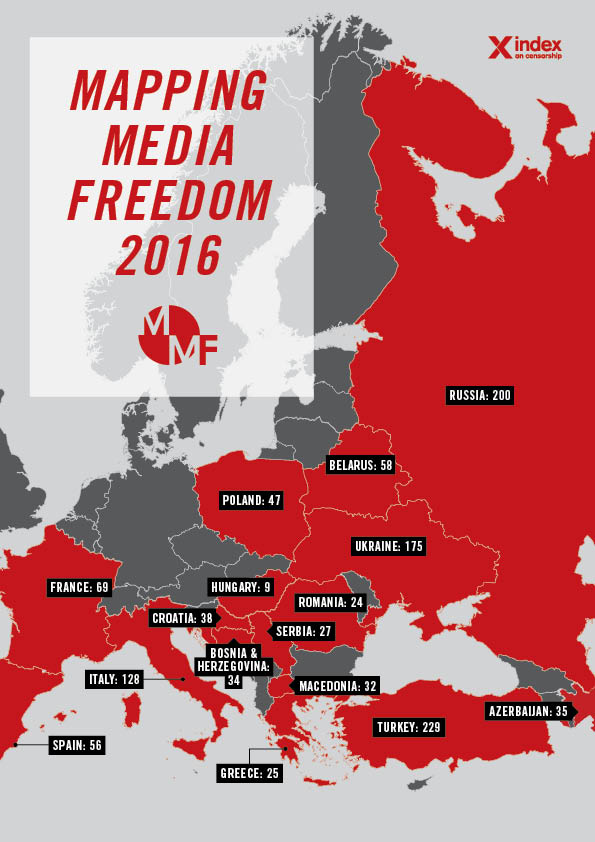 Freedom of expression campaign group Index on Censorship launches Media Freedom Month in March with the release of its annual report into media freedom in Europe. The report shows journalists face regular harassment, legal sanctions and even jail for doing their job – even in supposed democracies. Index’s Media Freedom Month aims to raise awareness of and funding for its work campaigning on press freedom.
“Right now, journalists and journalism are threatened from all directions: UK journalists who travel to the US are being told they need to hand over their mobile phone contacts and Facebook passwords. US journalists are being labelled as peddlers of ‘fake news’ over any articles the President dislikes and reporters across Europe face a host of laws that hamper their ability to work,” said Index chief executive Jodie Ginsberg.
Media Freedom Month will begin with the launch on Tuesday of the latest Mapping Media Freedom report on Europe and will end with an exclusive study of media freedom in the United States that goes well beyond the current focus on Donald Trump and his relationship with the press.
“A country without a free media is not a free country: Journalism provides a vital check on corruption and abuse of power and we must fight to protect it,” said Ginsberg.
Between 1 January and 31 December 2016, Mapping Media Freedom’s network of correspondents, partners and other journalists submitted a total of 1,387 verified threats to press freedom in 42 European countries.
“The precarious state of press freedom across the globe is underlined by the volume of verified incidents added to Mapping Media Freedom in 2016. The spectrum of threats is growing, the pressure on journalists increasing and the public right to transparent information is under assault. People who are simply trying to do their job are being targeted like never before. These trends do not bode well for 2017,” Hannah Machlin, Mapping Media Freedom project officer, said.
Some of the major themes in the data – and which journalists should be wary of in 2017 – include:
- Violence from right-wing groups
- Dangers faced when reporting on protests and demonstrations organised across the political spectrum
- Impunity: Physical attacks on journalists not properly investigated; government officials intimidating reporters without fear of punishment
- Difficulties reporting on refugees, including being denied access and violence
- Silencing journalists by arresting them on ties to terrorist or extremist groups
- Criminalised libel laws subjecting media outlets to high fines
- Economic difficulties leading to the closure or restructuring media outlets and buyouts by wealthy businesspeople, often leading to job cuts and dismissals
- State of emergency laws being used to detain journalists without charge
- Death threats and smear campaigns disseminated online
The 2016 report is available in web and pdf format at https://mappingmediafreedom.org/plus/
For more information, please contact Hannah Machlin, Mapping Media Freedom project officer at [email protected]
About Mapping Media Freedom
Mapping Media Freedom – a major Index on Censorship project and a joint undertaking with the European Federation of Journalists and Reporters Without Borders, partially funded by the European Commission – covers 42 countries, including all EU member states, plus Bosnia, Iceland, Kosovo, Macedonia, Montenegro, Norway, Serbia, Turkey, Albania along with Ukraine, Belarus and Russia in (added in April 2015), and Azerbaijan (added in February 2016). The platform was launched in May 2014 and has recorded over 2,700 incidents threatening media freedom.
About Index on Censorship
Index on Censorship is a freedom of expression charity that campaigns against censorship and promotes free expression worldwide. Founded in 1972, Index has published some of the world’s leading writers and artists in its award-winning quarterly magazine, including Nadine Gordimer, Mario Vargas Llosa, Samuel Beckett and Kurt Vonnegut. It also has published some of the greatest campaigning writers from Vaclav Havel to Elif Shafak.
27 Feb 2017 | Mapping Media Freedom, News
[vc_row][vc_column][vc_column_text]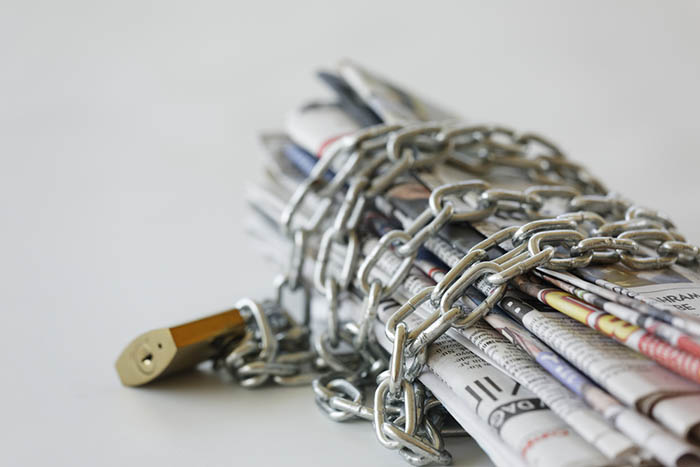
Each week, Index on Censorship’s Mapping Media Freedom project verifies threats, violations and limitations faced by the media throughout the European Union and neighbouring countries. Here are recent reports that give us cause for concern.
Independent journalist Elchin Ismayilli, who used to contribute to Cumhuriyet newspaper and Azerbaijani Saadi, was detained on 17 February on charges of extortion through intimidation and abuse of power, reported Azadliq Radio.
According to the journalist’s lawyer, Ismayilli is being charged for threatening an employee of the local culture and tourism department.
The journalist says the allegations are not true.
A month before, Ismayilli asked to borrow 1000AZN from the person who is allegedly accusing him of extortion. He was detained when picking up the money.
During a meeting with his lawyer, he explained he had known this individual since 2003 and that they had good relations.
In September he received a warning from the police on was called into questioning for allegedly assaulting an officer.
The journalist ties both incidents to his work.
The French police prevented freelance journalist Alexis Kraland from accessing a demonstration in Place de la République, in Paris, on 18 February, the journalist reported on Twitter and confirmed to Mapping Media Freedom.
Kraland was intending to cover a protest in solidarity with a young man called Theo, who was allegedly raped during a violent police arrest.
The police asked the journalist for his press card which is not necessary to cover a demonstration as a journalist, Kraland told Mapping Media Freedom.
The Federal Migration Service won its case against Demyan Kudryavtsev, owner of Independent Media, on 21 February, Vedomosti reported.
“It has been established that false data was deliberately submitted in this citizenship application. The Supreme Court acknowledged this”, the court’s press service stated.
FMS did not receive all the necessary data in the application submitted in 2009, Kudryavtsev told Novaya Gazeta.
The President or FMS is now able to deprive him of his citizenship based on the court decision.
New amendments to a 2014 law by the State Duma prohibit foreigners from establishing and owning more than 20 per cent of any Russian media outlet. If Kudryavtsev is deprived of his Russian citizenship, he will not be able to continue owning Vedomosti and other outlets under the Independent Media umbrella.
Hannah Machlin, project officer of the Mapping Media Freedom project, said: “The decision to take away Kudrayastev’s passport will affect the legality of his ownership of media outlets Vedmosti and the Moscow Times, making it a clear violation to press freedom”.
Özgür Gelecek daily’s Newsroom Editor Aslı Ceren Aslan was arrested on 21 February in Şanlıurfa province, Cumhuriyet newspaper reported.
Aslan, who was detained on 18 February, was allegedly subjected to physical violence and strip searched twice during her detention and arrest. Özgür Gelecek reported that Aslan was in Şanlıurfa to report on the recent developments in Syria at the time of her detention.
According to reports, the journalist was arrested on charges of “belonging to a terrorist organisation” and “violating Turkish borders.”
Her arrest brings the number of journalists in Turkish prisons to 154.
Boris Pejovic, a photographer for daily newspaper Vijesti, was insulted and pushed during a brawl on 15 February between MPs from the ruling Democratic Party of Socialists and the opposition Democratic Front in the Parliament of Montenegro, daily newspaper Vijesti reported.
As Vijesti reported, MPs and Parliament security pushed and insulted Pejovic.
Opposition leaders and supporters protested in front of Montenegro’s parliament after the ruling majority stripped two MPs of their immunity from prosecution over their alleged involvement in a coup attempt, Balkan Insight reported.
The incident was strongly condemned by the Trade Union of Media of Montenegro (SMCG).[/vc_column_text][/vc_column][/vc_row][vc_row][vc_column][vc_column_text]
Click on the bubbles to view reports or double-click to zoom in on specific regions. The full site can be accessed at https://mappingmediafreedom.org/
[/vc_column_text][/vc_column][/vc_row]
20 Feb 2017 | News, Youth Board
[vc_row][vc_column][vc_column_text]Index on Censorship has recruited a new youth board to sit until June 2017. The group is made up of young students, journalists and legal professionals from countries including India, Hungary and the Republic of Ireland.
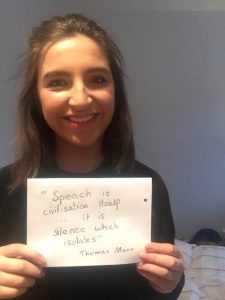
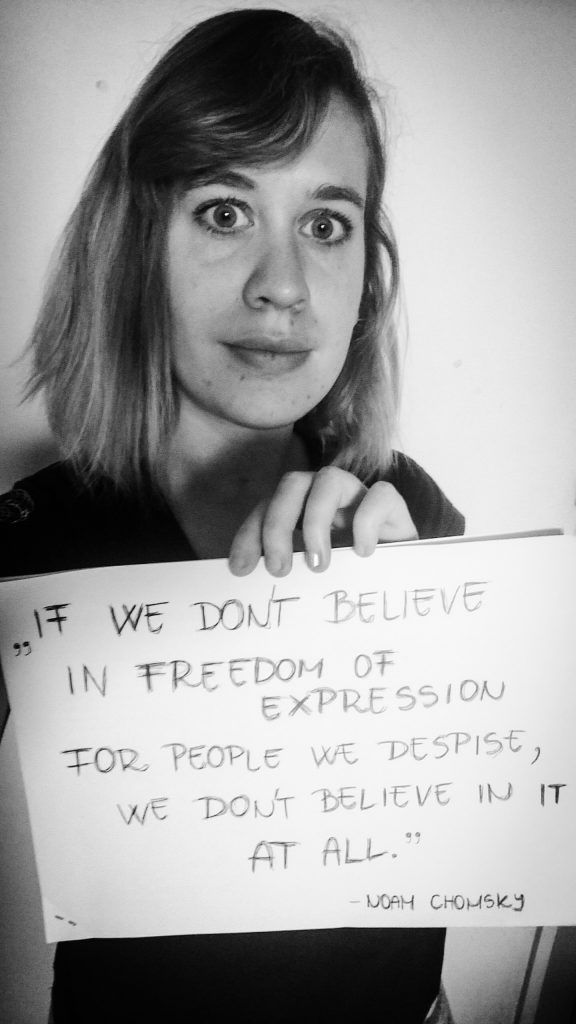
Each month, board members meet online to discuss freedom of expression issues around the world and complete an assignment that grows from that discussion. For their first task the board were asked to write a short bio and take a photo of themselves holding a quote that reflects their belief in free speech.
 Fionnuala McRedmond – Dublin
I graduated last June from the University of Cambridge with a degree in classics. I am now studying for a MSc in political theory at the London School of Economics. I was an active student journalist during my time at Cambridge, and it was there that I first developed an interest in the struggles of censorship and speech across the globe. The propensity for governments to censor speech and ideas is not a modern phenomenon. In ancient Rome book burning was not unheard of, and Cicero once expressed the all too familiar idea: “it is not permitted to say what one thinks… it is obviously permitted to keep silent.” Then, as much as now, free speech was the cornerstone of a healthy society. And then, as much as now, speech was censored by tyrannical power. I am particularly interested in the relationship between censorship and identity. In the past, and even more so now, people have been denied the right to share their words and ideas on the basis of ethnic, religious and political identity. Work by groups like Index on Censorship is crucial in protecting people’s right to speak, no matter who they are. I hope to better understand and develop these ideas with the Index on Censorship youth board.
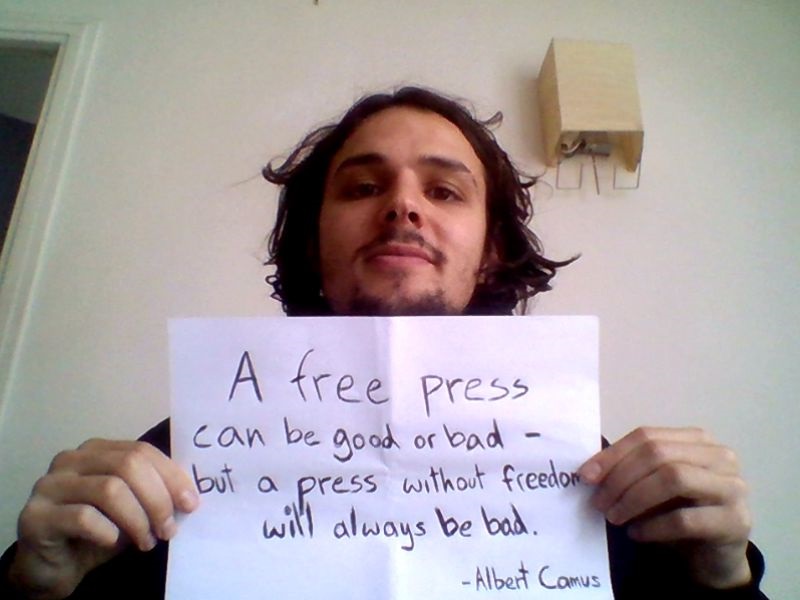
 Júlia Bakó – Budapest
I am a Hungarian journalist, student and activist currently living in Budapest. After finishing my first degree in journalism, I have started studying international relations.
As a journalist and as someone who is deeply committed to human rights I am naturally drawn to freedom of expression and freedom of press issues. During the last couple of years I have worked with several NGOs and other organisations like Transparency International, Amnesty International, OSCE and Atlatszo.hu. I have dealt with corruption cases as an investigative journalist, I have studied human rights monitoring and – partly because of my studies, but mostly because of my personal interest and commitment – I have tried to explore freedom of expression and other issues not just in my own country, but all over the world, to find patterns, similarities and possible measures that could be taken either on a national or international level.
The quote I chose about freedom of expression says something what we sometimes tend to forget about. Being able to express our own opinions, however right they may seem to us, should never stop us from fighting for the rights of others to be able to act the same way, even though their opinions seem fundamentally different sometimes. Granting the chance to express opinions we do not agree with is what is able to create the diversity of thought, the debate about social issues and with that democracy itself.
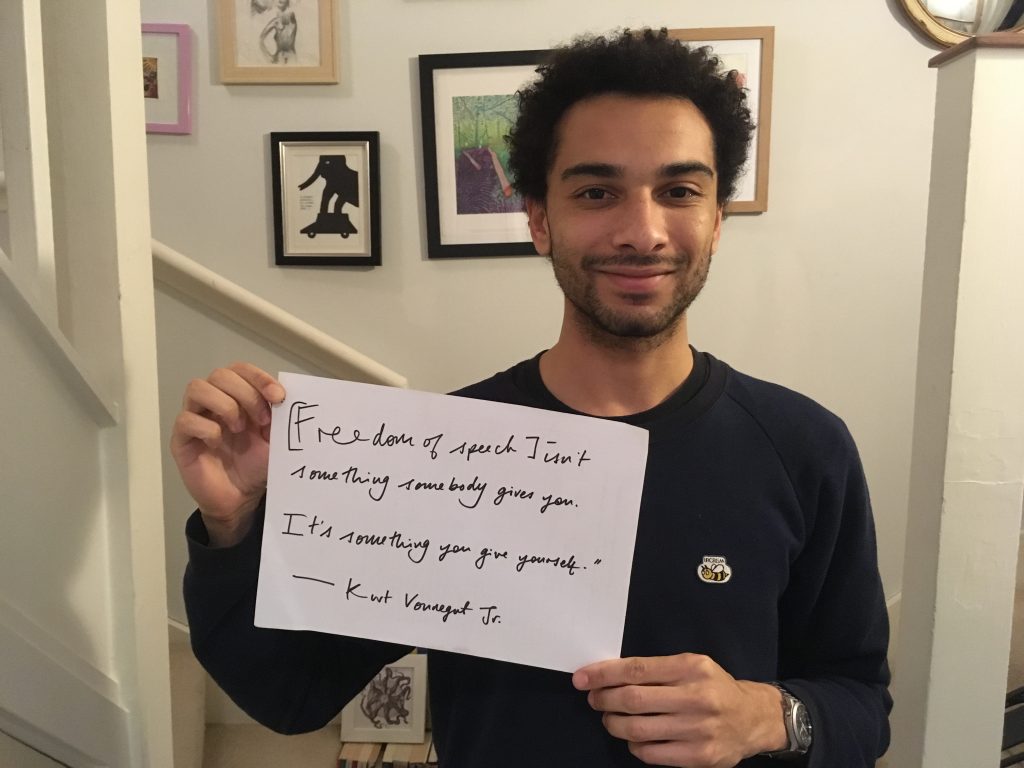
 Samuel Earle – Paris
I currently live in Paris, where I am a freelance writer and English teacher.
I became interested in freedom of expression while studying politics at university – first at undergraduate and then at MSc level – and that continues today through my interest in journalism. What’s clear to me is that although freedom of expression is always valuable, the challenges it faces globally are never the same.
In the west, I think there is a complacency concerning freedom of expression: that stopping censorship is assumed to be enough. But I believe that in societies as unequal as our own, and where market forces reign, the value of freedom of expression can be diminished – as shown, for example, by the fake-news phenomenon.
 Samuel Rowe – London
I am currently a postgraduate law student, having studied literature as an undergraduate in the UK and the USA. I hope to become a public law barrister, specialising in media and information law and human rights. Like the character in Kurt Vonnegut’s Hocus Pocus, I believe that the right to freedom of speech is innate. It is not a commodity; it is not something to be bargained with. My interest in issues surrounding freedom of speech directed my undergraduate dissertation, which focused on the western surveillance state. This sort of covert action can have the effect of creating an environment of self-censorship, and often has a disproportionate impact on marginalised communities. I looked at methods of resistance (of which there are many) to see how groups maintained freedom of speech under the gaze of the state. The suppression of freedom of speech is hardly a novel phenomenon and mass surveillance is just one way in which it is currently under threat. From White House officials calling disagreeable information “fake news” to irresponsible no platforming in universities, this is an era in which the limits and value of freedom of speech are being questioned. I believe that without freedom of speech, there can be no full interrogation of the evils which face us. And without interrogation, we risk losing sight of the full scope those evils might pose.
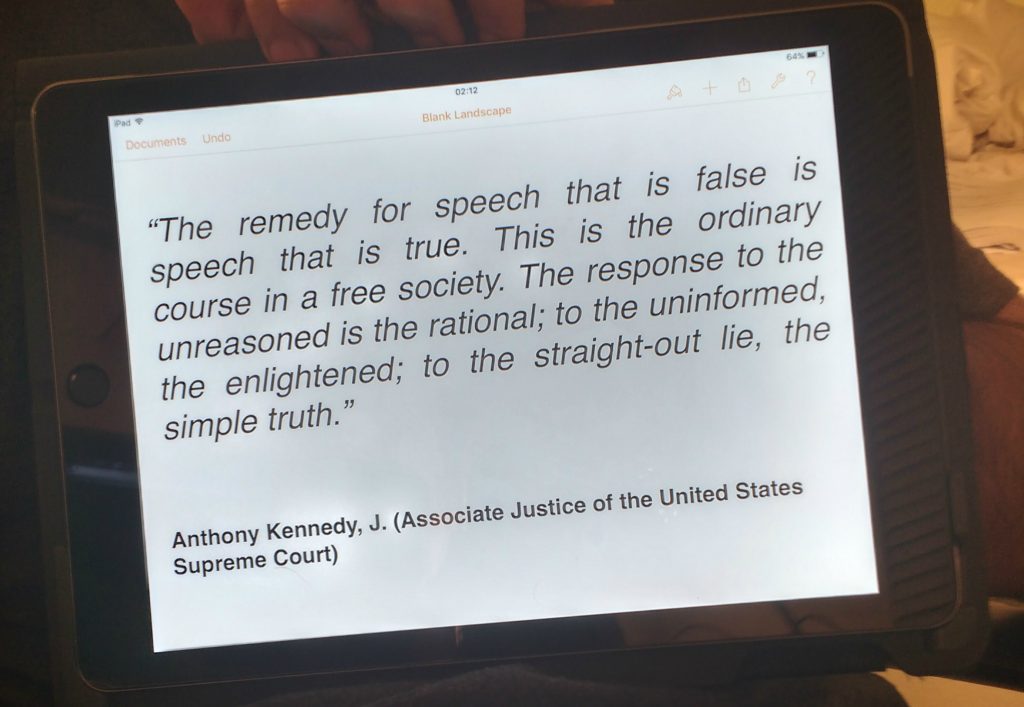 Tarun Krishnakumar – New Delhi
In recent times, there has been much concern expressed about the proliferation of “fake” news online and the impact it can have on democratic processes, politics and the public at large. These concerns have stirred various stakeholders – including governments, news media and internet intermediaries – into action. For instance, the German government recently declared fake news from Russia to be a significant threat to its upcoming elections. In a similar vein, internet giants like Google and Facebook – likely in the wake of unfavourable political outcomes – have been clamouring to show that they are willing to clamp down on content that is false or misleading.
In response to these developments, the quote I’ve selected manifests what, I feel, should be the appropriate response to fake speech: more “non-fake” speech – and not more regulation. While many justifications to clamp down on fake news may be well-intentioned, the history of regulating speech has shown us that inserting an intermediary into a conversation creates unintended and harmful consequences for free speech. Often this manifests as overt censorship while, in other cases, it is the creation of private arbiters of what may or may not be said on a platform – a more covert and creeping harm. Given the subjectivity in judging what news is “fake”, the debate also presents an excuse for regimes to tighten existing censorship controls or establish new ones.
The internet has given everyone an opportunity to have an equal say. This must be preserved at all costs. Fake news must be countered not through bans, blocking or regulation but by targeting the societal information asymmetries that allow it to flourish and creating conditions that facilitate society to produce more speech that is not “fake”. Policy efforts should focus on educating readers and providing them the tools to judge content for themselves – thereby minimising the effect of false or misleading content. For this, what is necessary is a culture of being exposed to a balanced diet of diverse content. When governments peddle nationalistic, religious, or political rhetoric in educational curricula and skew facts, little do they realise that they are creating the very conditions that allow “fake” news to flourish and have the harmful impacts that they complain of.
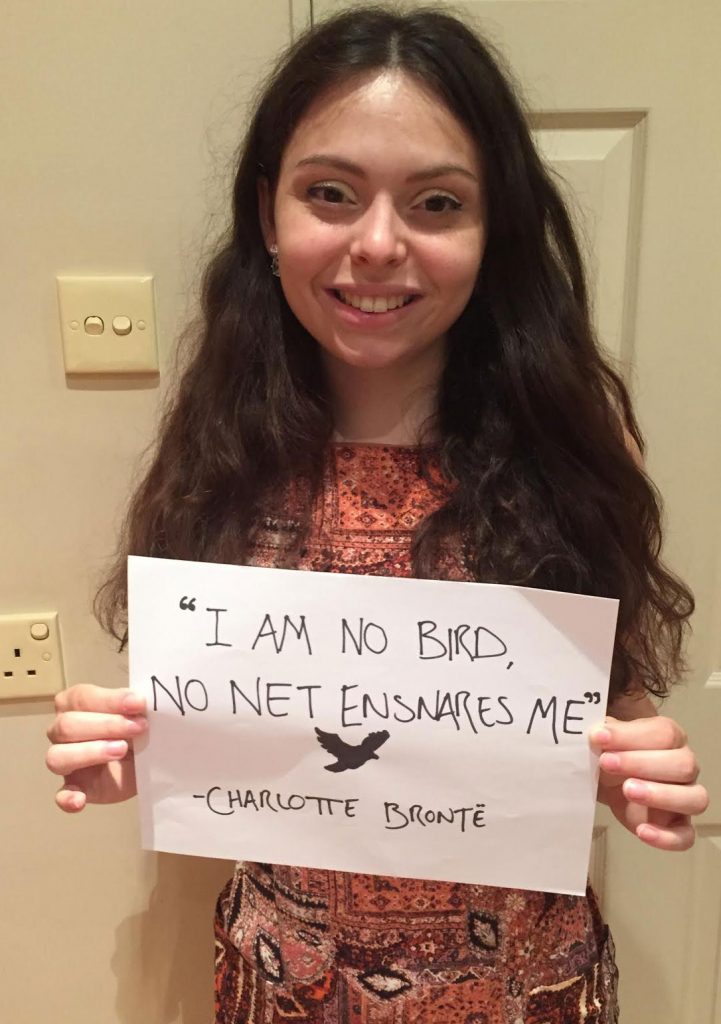 Sophia Smith-Galer – London
I’m a MA student studying broadcast journalism at City University in London. I studied Spanish and Arabic previously at Durham University and I’m particularly interested in how artists and writers overcome challenges to their freedom of expression in Latin America and the Middle East. As a singer I have always been intrigued by the imagery of a caged bird that sings despite its entrapment; Charlotte Bronte instead uses this metaphor to show how independent Jane Eyre has become by the end of the eponymous novel. Humans have always connected birds with freedom, or lack of – just look at Twitter’s logo – and so the quote really resonated with me.
Freedom of expression is particularly important to me as several countries that speak both of the languages I have dedicated years of study to continue to be plagued by tyrants and censors. I’m particularly interested addressing censorship in Latin America and the Middle East, especially with regard to the arts, as I’m also a classical singer and keen art historian.
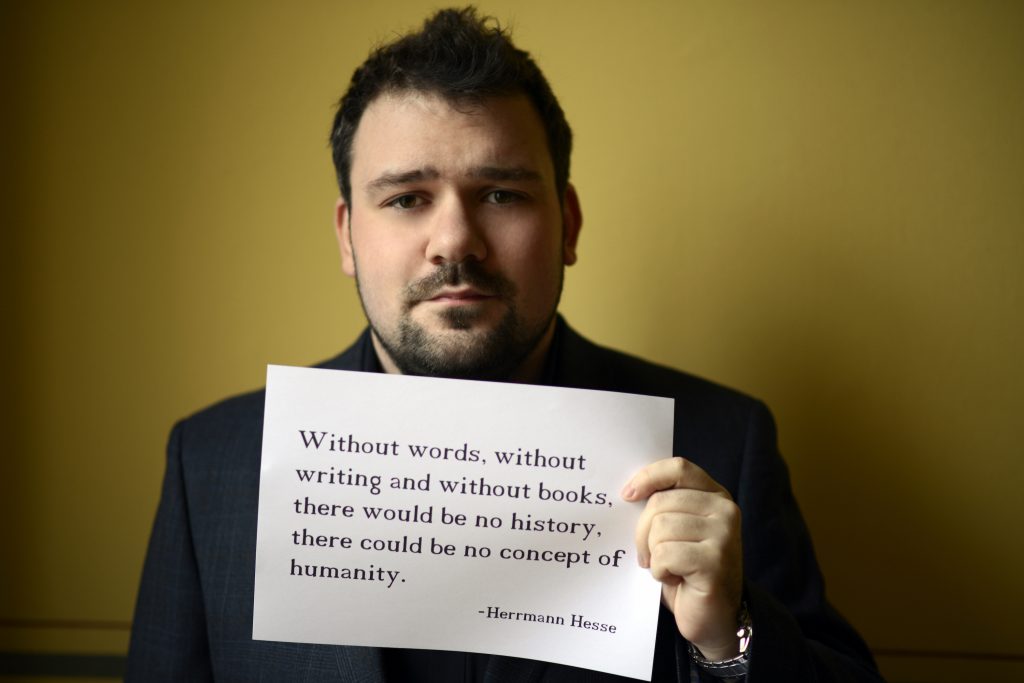 Constantin Eckner – St Andrews
I am originally from Germany. I graduated from University of St Andrews with an MA degree in modern history. Currently, I am a PhD candidate specialising in human rights, asylum policy and the history of migration. Moreover, I have worked as a writer and journalist since I was 17 years old, covering a variety of topics over the years. Longer stays in cities like Budapest and Istanbul have raised my awareness for pressures exerted upon freedom of expression.
I chose this particular quote, because Hermann Hesse emphasised the importance of the written word and how it had an impact on the concept of humanity. In his time, Hesse was conscious that without writing it was not possible to express thoughts and spread ideas. Therefore, all those who fought the existence of the written word threatened humanity which was a frightening thought for a humanist like Hesse.
In a perfect world, every human being would live without fear of state censorship and potentially facing repercussions for the words they write—or for the pictures they draw, for the photos they shoot, for music they play.
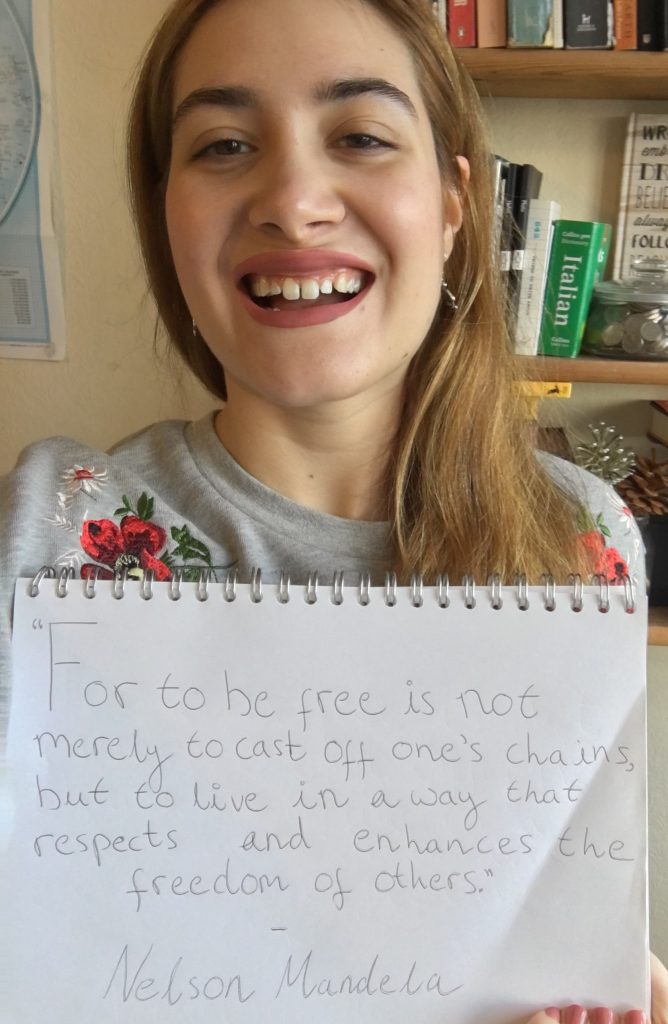 Isabela Vrba Neves – Stockholm
I’m half Brazilian and half Czech, raised in Sweden, but currently living in London where I work in communications for a mental health charity. I‘m also a Latin America correspondent for the International Press Foundation (IPF), a platform where young journalists get to write about stories that matter the most to them. It was during my time at Kingston University, studying journalism and French, when my interest in censorship and freedom of expression first emerged.
During my undergraduate studies I learned how important a free press is for a working democracy. It is a platform bringing together multiple voices, by sharing news, ideas and holding those in power to account. However, many journalists around the world suffer repression for simply doing their job and for using their right to free speech.
For me, Nelson Mandela‘s quote represents the importance of respecting and listening to each other, even with different views, but also highlighting the voices of those who are forced into silence.
Interviewing journalists from Venezuela and Pakistan, who face these types of constraints, has made me more engaged in sharing stories concerning freedom of expression, not only by journalists, but also by artists and activists. In the future, as a journalist, I want to focus on freedom of expression and by being part of the youth advisory board, I will be able to expand my knowledge and have great conversations with other young people who are passionate for justice and social change.[/vc_column_text][/vc_column][/vc_row][vc_row full_width=”stretch_row_content”][vc_column][three_column_post title=”More from the youth advisory board” category_id=”6514″][/vc_column][/vc_row]
17 Feb 2017 | Awards, China, Digital rights, Fellowship, Fellowship 2016, News
GreatFire are the 2016 Digital Activism Fellow
The 2016 Digital Activism Fellow GreatFire is a collective of anonymous individuals using technology to combat China’s draconian internet censorship regime. Charlie Smith answers questions about recent developments of China’s Great Firewall.
Index: The Chinese government warned in December that its controls on the internet are necessary to prevent foreign powers from “destabilising the state”. Would Great Fire be considered to be associated with such powers? What would be the consequences of this?
Smith: I don’t think the Chinese authorities fully understand how the internet works. They have this great image in their mind of creating “cyber sovereignty” but this is an impossible task. The internet by nature is international. Information is exchanged across borders. So, yes, foreign powers are destabilising China’s internet every minute. In the opinion of the Chinese authorities, I guess this happens every time somebody says “Xi Jinping is a totalitarian despot” or shares a photo of the great leader with his pants too high.
But even if the authorities were able to establish what they think is “cyber sovereignty”, they would quickly find that many Chinese also like saying nasty things about Xi Dada.
Index: Why do you think the latest crackdown on VPNs, requiring government registration for all VPNs based in China, is not as serious as it has been made out to be? Do you think it will make any difference to the way circumvention tools operate?
Smith: It is normal that the authorities ask that telecoms companies check to see who is using their services. There are a lot of cheap domestic VPN providers – some of whom probably do not have the interests of Chinese consumers at heart. It’s a good thing if they go out of business. Consumers will choose other solutions – other circumvention tools, foreign VPNs – and in the process learn more about how circumvention works in China. Educating the market at this stage will be very very valuable.
I think this is also one of the first times that the authorities have said that VPNs serve a purpose. If they continue with this line of messaging, they are actually saying that using a VPN is legal, not illegal. Companies are the main drivers here. If companies have problems accessing the resources that they need to run their businesses, the government will hear about it.
Index: You wrote pessimistically on your blog of Google’s attempts to end censorship, and mentioned that yourselves and other companies could have far more success with access to Google’s resources. How optimistic do you feel about reaching those goals if Google continues to drag its feet?
Smith: If Google continues to sit back and do nothing except take credit for working hard to “end online censorship everywhere” we will still reach our goals. We could get there faster if we worked with Google, but they are not essential to the solution. The only explanation for Google’s inaction in fighting censorship is that they want to “re-enter” the China market by self-censoring Google Play. This would not affect our day-to-day operations too much, but it would really signal the beginning of the end in terms of working in partnership with the Chinese authorities on censorship. Google would join Apple, LinkedIn, Microsoft and many others as a bad actor, leaving only one path forward for new entrants to the China market – self-censorship.
Index: There has been talk of Chinese tech companies poaching talent from the US en masse amid President Trump’s crackdown on foreign labour and uncertainty around his stance towards Silicon Valley. Do you think this would give extra momentum to the anti-censorship movement in China?
Smith: Good question – never thought of that before.
Yes, I think this would greatly help the anti-censorship movement. There is a lot of Chinese talent overseas. It will be hard for them to come back to China and suddenly have to do without the social media and networks that they have established overseas. That shared frustration will lead them to find a better solution than just a VPN.
Index: How has your VPN monitoring service been progressing? Have numbers/uptake improved?
Smith: I think Circumvention Central has shown that VPNs are quite volatile in China. What works today may not work as well tomorrow, which you can see in our data. I think we’ve seen Chinese internet users gravitate to made-in-China solutions, like Shadowsocks.
Index: Should we be worried about China launching international state-run media through CCTV? How would it be comparable to the impact of Russia Today, for example?
Smith: China has deep pockets and is really only getting started in terms of establishing their media footprint overseas. They can afford to lose as much money as is needed to get these operations up and running and then to keep them running. But at the moment, the actual content is so poor, it’s laughable. RT seems to at least have professionals working both in front and behind the cameras. I don’t think CCTV quite has the human resources aspect of this down pat yet, but in time, they will compete for talent. However, by the time they are really ready to challenge other media outlets, I believe that foreign governments will likely place obstacles in CCTV’s path if China has not reciprocated by loosening her own media restrictions.
