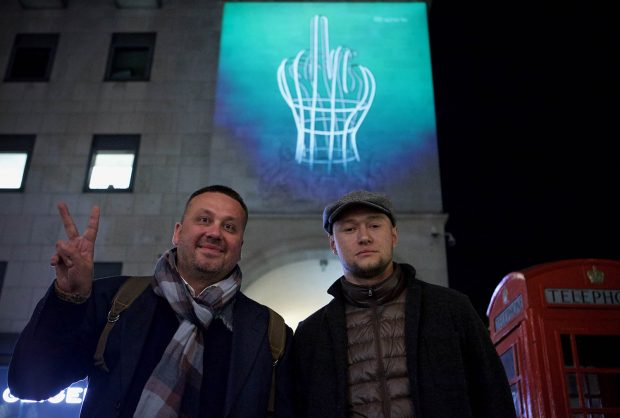
Andriy Klyvynyuk (right) and fellow activist Eugene Stepanenko in front of a projection of Ai Weiwei’s freedom of expression symbol in London. Photo: Nicolai Khalezin
Ukrainian rock musician and activist Andriy Klyvynyuk spoke to Index on Censorship about his support for popular film director and pro-Ukrainian activist Oleg Sentsov and the other Ukrainian political prisoners held by Russia.
Klyvynyuk, the frontman of the pop group Boombox, was a speaker at Belarus Free Theatre’s Freedom of Expression in Ukraine event at the House of Commons in London, where he called on the British government to demand Sentsov’s release. Sentsov is serving a 20-year prison sentence on charges of being part of a terrorist conspiracy. He has stated that he was tortured by investigators and that a key witness recanted in the courtroom on the grounds that evidence had been extorted under torture. His lawyers describe the case against him as “absurd and fictitious”.
Sentsov faces another 18 years in jail but Klyvynyuk, who drove an ambulance during the pro-EU Euromaidan protests in 2014, is determined that Ukraine will continue to work towards a future free of Russian interference.
“We used to cry but now we are laughing because we are not afraid,” he told Index. “We are only 25 years old as a country, and we are at the very beginning of a road. We want to be open and don’t want to see a great wall. I don’t want to be a big star somewhere, having everything but not being able to travel, speak with you, and that was the point of Euromaidan. We are not for the money, the wealth, houses and cars – it’s not what we want, it’s not the point of life at all.”
According to Klyvynyuk, it is Russia that is afraid. “They are very frightened to lose their dominance, to lose their money, to lose their superpower, in such a way as our mafia lost their power,” he said. “The officials are so much afraid that they invaded an independent state.”
Other speakers at the House of Commons event included journalist and author Peter Pomerantsev, and film and theatre director turned soldier Eugene Stepanenko. A video was shown including messages of solidarity from artists including fashion designer Vivienne Westwood and actor Will Attenborough.
Klyvynyuk welcomed these contributions. Although he does not mix his art with his activism, he feels strongly that those with a public position have a responsibility to speak out on human rights abuses. Those who shut their eyes to it, he says, are “clowns dancing on the tables of dictators”.
“I’m a patriot of course but I don’t think Ukraine is bigger or better than any other country in the world,” he said, calling on the world’s media to refocus on Russia’s behaviour towards its neighbour. “This is why we talk about political prisoners all over the world and wars all over the world. But to forget about situations like that, then everybody says ‘Oh, how are you? Are you okay?’ three years later. I say ‘Hey, stop, you know nothing’, and if you are a media person, if you’ve got followers on your social media, if thousands of people are waiting to hear from you, you should find some time to tell these important things.”
As for Oleg Sentsov, Klyvynyuk’s message was one of hope. “I hope that he won’t be broken inside, I hope that he, all of them, will find strength to live through, and then after we win, go out and not just sit and do nothing but continue their work, what they are here for.”
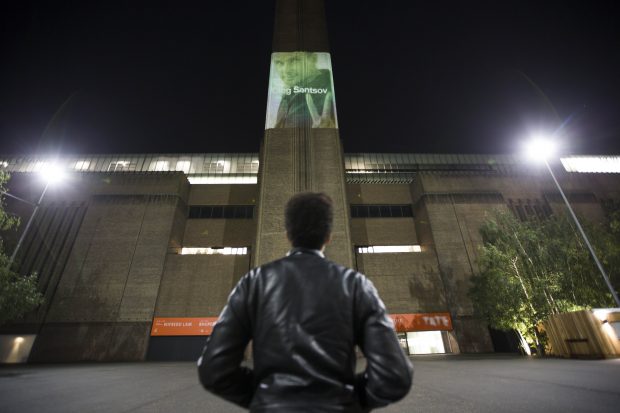
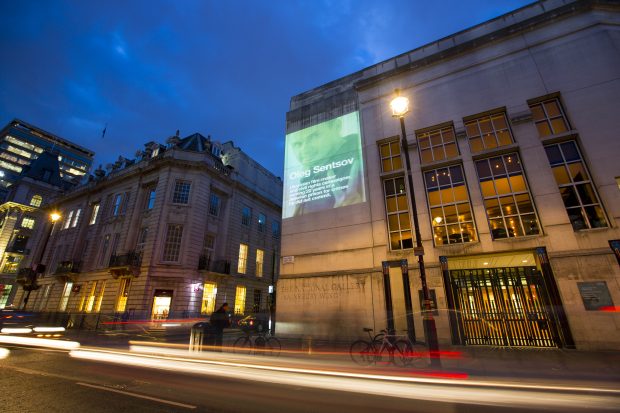
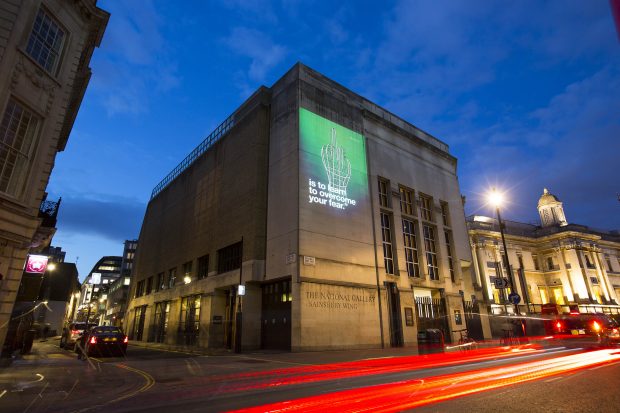
10 October 2016: Belarus Free Theatre project Ai Weiwei’s symbol of freedom of expression onto five iconic buildings across London to highlight the case of Oleg Sentsov. Credit: Graeme Robertson
“We urgently call upon British politicians to put justice, human rights and international law ahead of business interests and to look afresh at the cases of the Kremlin hostages, [and] all political prisoners held by Russia, including our friend Oleg Sentsov,” co-founding artistic director of Belarus Free Theatre, Natalia Kaliada said.
On Monday 10 October, the theatre company hosted Freedom of Expression in Ukraine, an event at the House of Commons, in solidarity with Oleg Sentsov, a popular film director and pro-Ukrainian activist serving a 20-year prison sentence as well as all other Ukrainian political prisoners currently detained in Russian jails.
Sentsov is currently imprisoned in Siberia and is facing 18 more years in jail on charges of being part of a terrorist conspiracy. Sentsov has stated that he was tortured by investigators, and that a key witness recanted in the courtroom on the grounds that evidence had been extorted under torture. His lawyers describe the case against him as “absurd and fictitious”.
The night included a film calling for Sentsov’s release featuring actor Simon Callow, Belarusian Nobel Laureate for Literature Svetlana Alexievich, Polish film director and chair of European Film Academy Agnieszka Holland, actor Will Attenborough, film director Yuri Khaschevatsky and fashion designer and activist, Vivienne Westwood.
Natalia Kaplan, a cousin of Sentsov, could not be in London for the event but recorded a special video appeal for his release.
Pussy Riot’s Maria Alyokhina and members of Belarus Free Theatre read extracts of letters from Sentsov and short scenes from Belarus Free Theatre’s latest production, Burning Doors. Other speakers included Andrei Khliyvynuk, activist and frontman of Ukrainian supergroup Boombox, and film and theatre-director-turned-soldier Eugene Stepanenko.
Nobel Laureate for Literature Svetlana Alexievich and British filmmaker Lord Puttnam both recorded a special message for the event.
Sentsov first came to the attention of the international film world with Gamer, a debut feature inspired by the computer and video-gaming club for young people that he had founded. It opened to great acclaim at the Rotterdam International Film Festival in 2012.
The European Film Academy together with leading international film directors, including Pedro Almodóvar, Wim Wenders, Stephen Daldry, Mike Leigh and Ken Loach, have campaigned for Sentsov’s release, echoing the grave concerns of Amnesty International that his trial was a “total fiasco” and that the “entire case for the prosecution is built on a house of cards”.
Fernando Bovaira named Sentsov an honorary member of the 62nd San Sebastian Film Festival’s main competition jury, and a chair was reserved for him in solidarity.
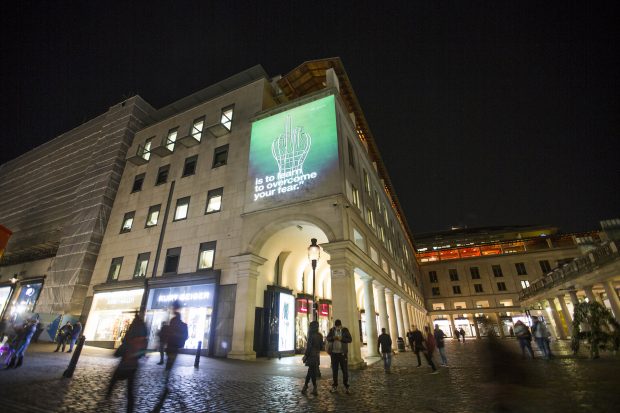
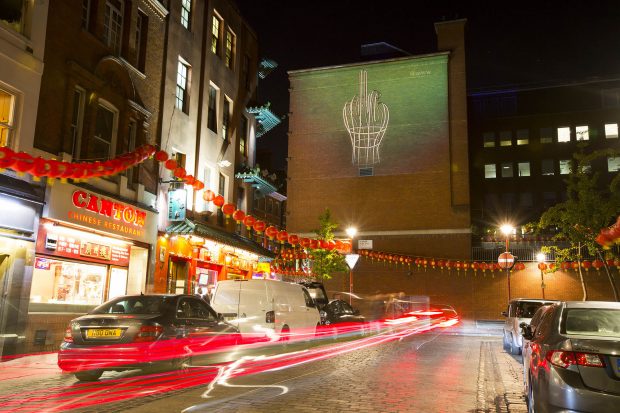
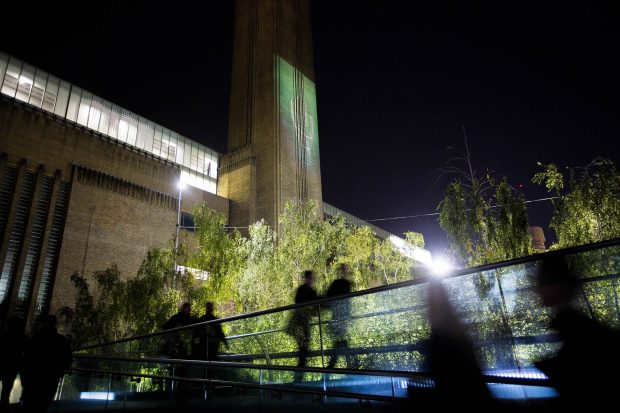
During the evening, an image of Ai Weiwei’s middle finger was projected onto five iconic buildings in London: The National Gallery’s Sainsbury Wing, The Forth Plinth in Trafalgar Square, Royal Opera House, Soho’s Gerrard Street and Tate Modern, together with a short film of Sentsov’s “sham trial” to garner UK public support and attention to his plight.
Ai’s finger, is used as a symbol of freedom “a powerful reminder of the need to strive for justice and freedom of expression,” explained Kaliada.
Credit: Graeme Robertson.
Credit: Graeme Robertson
Credit: Graeme Robertson
Credit: Graeme Robertson
Credit: Graeme Robertson
The demonstration was part of Belarus Free Theatre’s I’m with the Banned campaign which is an artist-led effort to bring together those who live in political freedom in solidarity with artists and activists who are censored or imprisoned in Belarus, Russia, Ukraine and anywhere else in the world where justice and freedom are denied.
Kaliada said: “In recent months, Ukraine has disappeared off the public radar even though the war rages on and Russia continues to drag the world into a new Cold War at a highly sophisticated level that endangers people living in the geopolitical knot known as Ukraine, Belarus and Russia, as well as threatening the global security of people further across the world.”
She said that London is where the founding members of Belarus Free Theatre sought shelter five years ago when they arrived in the UK as political refugees from Belarus.”For one night, the walls of the city will speak on behalf of those who are silenced, and one of the greatest capitals of the world will stand with us in solidarity with Oleg Sentsov,” she said. “As contemporary artists and human beings we have only one tool: creativity.”
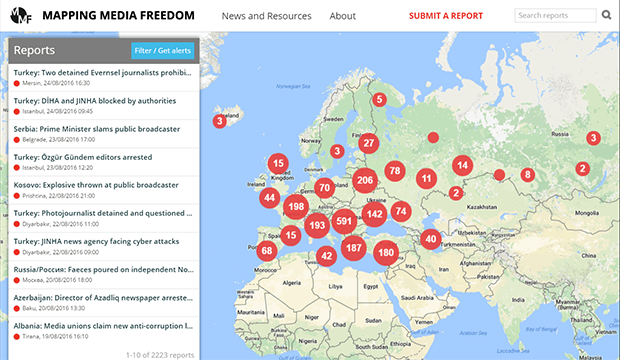
The armed conflict between the Russian Federation and Ukraine, the occupation of Crimea and Russian support for separatists in Donbas have lead to a large-scale media war, Mapping Media Freedom correspondent Tetiana Pechonchyk writes.
Faced with Russian propaganda, which attempts to stir up hatred, Ukraine imposed a number of restrictions in the media to protect its national security and territorial integrity against its aggressive neighbor. Those restrictions have manifested themselves at different levels and in different ways and touched not only on the Russian media and journalists but also Ukrainian media workers and bloggers who have been accused of being too sympathetic to Russia. In some cases the restrictions have been disproportionate, they have narrowed the space for criticism in Ukraine amid an armed conflict that began in 2014.
The most well-known example is the case of Ruslan Kotsaba, a Ukrainian journalist and blogger, who was arrested in February 2015 for posting a video criticising the country’s military recruitment campaign and called on Ukrainians to boycott it. A month later, on 31 March, Kotsaba was accused of “treason” and obstructing “the legitimate activities of the armed forces of Ukraine”.
After nearly a year and a half in detention — during which Amnesty International named him a “prisoner of conscience” — Kotsaba was acquitted of the charges by the Ivano-Frankivsk court of appeal.
In a second case, Olena Drubych a journalist working for municipally owned Kharkovskie Izvestiya, was fired in March 2016 for republishing material from the Russian website Expert Online, which reported “the Russians celebrated the second anniversary of Crimea returning to the Russian Federation”.
Two reports to MMF involved Russian TV news crews, who tried to work in Ukraine covering events.
In September 2015, Katerina Voronina, a journalist for Russian TV channel NTV was detained along with her driver by representatives of the Right Sector, a far-right Ukrainian nationalist political party, near the administrative border between occupied Crimea. NTV said that the journalist was reporting about a blockade on goods going into Crimea, and was on Ukrainian territory legally. According to the Right Sector website, Voronina, who was questioned for three hours, was filming Ukrainian soldiers. Voronina was then transferred to the Ukrainian State Security Service where she was interrogated for six more hours before being released the following morning.
In April 2016 a film crew from Russian TV channel Mir-24 was denied entry to Ukraine at the Belarusian border by Vystupovychi crossing point border guards. The journalists were planning to visit the abandoned city of Pripyat to report on the anniversary of the Chernobyl nuclear disaster. According to border guards, the four correspondents, who were Belarusian citizens, did not have any permits or other documents confirming the objective of their visit.
As Index on Censorship reported in May, the Ukrainian website Myrotvorets, which publishes the personal data of those it believes to support separatism in eastern Ukraine, posted the identities of over 4,000 journalists accredited by the self-proclaimed Donetsk People’s Republic. Among those named were correspondents working for the BBC, Reuters, AFP, The Independent, Ceska televize, CNN, Al Jazeera, Liberation, ITAR-Tass and RT. Following the release, the site was criticised and announced it was shutting down, but was back online by 19 May.
Ukrainian authorities launched a criminal investigation but observers have little hope of an objective investigation. The website is openly supported by Ukraine’s interior minister, Arsen Avakov and his advisor MP Anton Herashchenko.
Following the initial post on 7 May, Myrotvorets released a second, larger list on 20 May, which contained 5,412 names including 2,082 Russian and 1,816 international journalists. The site has subsequently registered with Ukrainian authorities as a media outlet.
In 2016, Ukraine’s ranking in Reporters Without Borders press freedom index climbed 22 places to 107th out of 180 countries. According to Freedom House’s world press freedom index, Ukraine is a partially free country, up 11 places over 2015.
This article was updated on 2 September 2016 to provide context and clarification to the nature of the media environment between Russia and Ukraine.
The conflict over Crimea and the fighting in eastern Ukraine has resulted in a media war, which has left both Russian and Ukrainian journalists struggling to report accurately on the situation, writes Mapping Media Freedom correspondent Andrey Kalikh.
In Russia, the partisan media environment has been driven by state-backed broadcasters. Federally financed TV channels — Russia 1 and RT — toe the government line on events in eastern Ukraine and Crimea. In 2015, the government boosted its funding of media to 72 billion rubles ($1.2 billion).
Mapping Media Freedom is monitoring the situation with Ukrainian media and journalists working in Russia. These are some of the cases filed by MMF Russian correspondents.
Reporting teams working for Ukrainian television outlets were barred from attending the March 2016 trial of Nadezhda Savchenko, a pilot captured by pro-Russian separatists in eastern Ukraine and handed over to Russian military forces. Savchenko was accused of having directed artillery fire that killed two Russian journalists.
Former Los Angeles Times correspondent Sergei Loiko, a Russian, has been repeatedly harassed in Moscow, where he is based, following the publication of articles on the conflict and his book The Airport, a novel set amid the battle for Donetsk airport in eastern Ukraine. In October 2015 he received a threatening phone call, followed in April 2016 by an incident during which four unknown perpetrators approached him as he was entering independent TV Dozhd’s studio to participate in a live programme.
Some journalists have been barred from entering Russia altogether. In one case, Sergei Supinsky, an AFP photographer based in Ukraine, was stopped from traveling to Moscow from Minsk. Supinsky was told he could not board his flight. No reason was given for the ban.
Russian journalists and activists have also become targets for pressure if they are perceived as supporting Ukraine or objecting to Russian involvement in the conflict.
In April 2016, Mikhail Afanasyev, an independent Novaya Gazeta correspondent based in the Republic of Khakassia posted a photo on Facebook of Kiev’s Maidan Square, where he had recently visited. He was immediately targeted with threats and insults by people referring to themselves as “patriots”.
In December 2015, a blogger from the Siberian city of Tomsk received a five-year sentence for “extremist” videos published on his YouTube page. In one of his videos, later removed, Vadim Tyumentsev referred to refugees from eastern Ukraine “who come and stay in Tomsk, although there are enough other problems in the city”. He accused officials of providing more help to the newcomers than the local population.
This article was updated on 6 September 2016 to provide more context and clarification.