12 Jun 2014 | Events
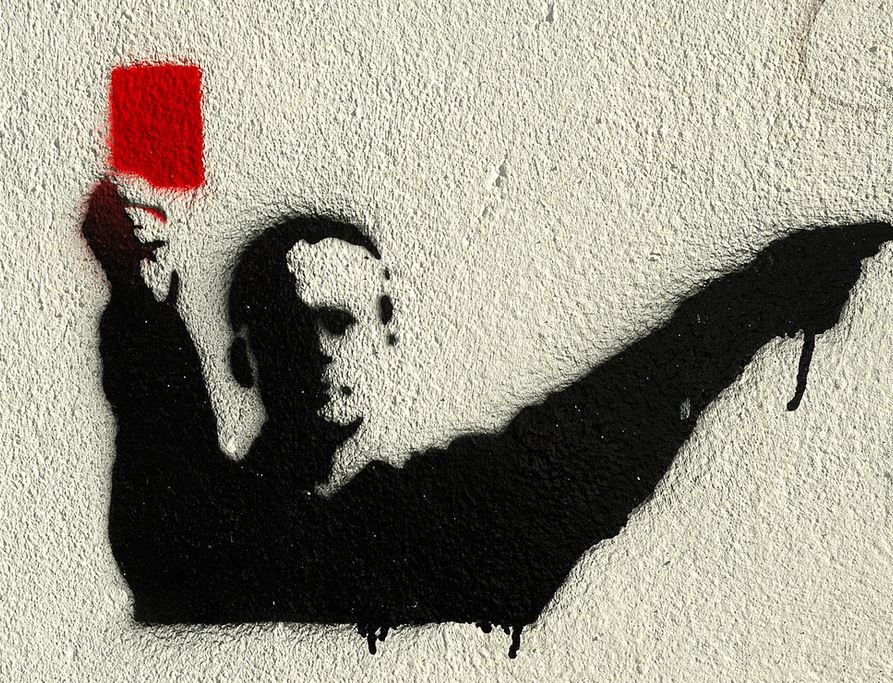
‘Football can inspire communities and break down barriers. Football is for all…everybody has the right to play football free from discrimination or prejudice’ – FIFA
You won’t often see Belgium playing ball with Russia, or Iran standing shoulder to shoulder with Argentina. But events like the World Cup offer a rare chance for politically opposed countries to interact in a way that governments don’t allow.
In a sporting tournament, should we ignore a country’s track record of suppressing journalists, censoring campaigners or blocking the internet? Or should we blow the whistle on free speech abusers and show the worst free-speech abusers a red card?
For our first #IndexDrawTheLine event, we are opening up our offices to anyone under the age of 25 to come and debate this thorny question. Join us to find out who the worst offenders at Rio 2014? And have your say on what referees should do: let countries play on or give them a red card?
WHEN: Monday 30th June, 5.30-7pm
WHERE: Index on Censorship, 92-94 Tooley Street, London, SE1 2TH
TICKETS: This event is FREE for under 25’s, please RSVP here.
DRAW THE LINE is a new project for tomorrow’s leaders, artists, journalists and campaigners to get involved in fighting censorship: share your thoughts in the #IndexDrawtheLine discussion forum, take on the debate at our monthly events or contribute to our Young Writers / Artists programme. Tell us – where do you draw the line?
12 Jun 2014 | Europe and Central Asia, Magazine
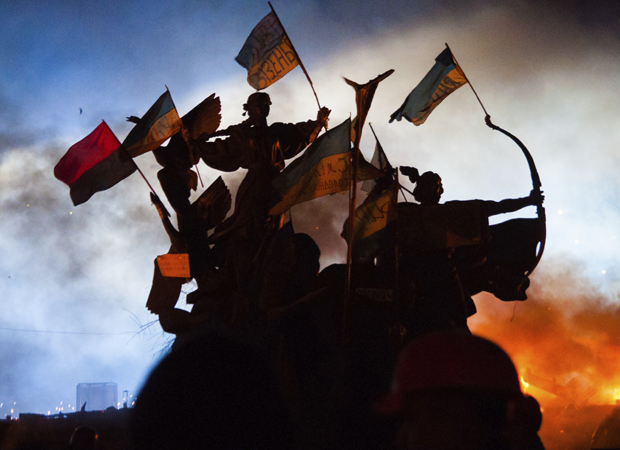
Twenty five years ago this autumn the Berlin Wall was pulled down and a wave of euphoria swept not just across that city, but across Europe, and then the world. When, also in 1989, Francis Fukuyama wrote we were seeing the “end of history” it seemed to make sense. His essay suggested not that history was over, but a new era was coming, one in which liberal democracy had defeated authoritarianism and the world would now inevitably become more free.
In the wake of the fall, eastern European nations swapped authoritarian regimes for democratic governments. And people who lived behind that wall were now able to travel more easily, read news that had previously been censored, and listen to music that had been forbidden. Many got the chance to vote in their first free election, with a choice of parties, and even had the option not to vote at all.
Bricks were falling and barriers were coming down as that long line of wire and sentry posts that had divided a continent was dismantled.
A quarter of a century on and the bubble of optimism is deflating. The two world superpowers of the 1980s, the US and Russia, are squaring up again, with presidents Putin and Obama exchanging threats and counter threats. In parts of the former Soviet Union little appears to have changed for the better with attacks on gay people, anti-gay legislation and the introduction of blasphemy and anti-swearing laws. In Belarus and Azerbaijan the hope for freedom still exists, but an atmosphere of fear prevails. Journalists there still live in fear of being beaten up, imprisoned or put under house arrest for writing articles that report problems that dictators would rather not have reported. Internet restrictions stop news being distributed, and samizdat, the opposition’s underground newspapers of the Soviet era, continues to exist in Belarus. Further west of Moscow things are better than they were. Freedom to travel, write and read what you want came with the new era. But there are ominous signs. In Hungary there has been a rise in discrimination against minority groups such as the Roma, swastikas painted on Jewish gravestones, and a rise in support for fascist groups. In Poland there are similar reports of upsurges in extremism and homophobia. That initial post-wall swell of enthusiasm for change has been replaced by cynicism and anxiety.
Across Europe a strand of nasty nationalism is striding into the political arena. And weeks after Russia occupied Crimea, and continues to stand at the redrawn borders of Ukraine, the European landscape looks almost as anxious and divided as it did in the days of presidents Reagan and Brezhnev. Fears about a new Cold War feel well founded. If history teaches us anything, it should teach us to expect situations to repeat themselves, and to learn from the past.
History is certainly playing a part in these cycles. The narratives of hate often use a rewriting of history to make their case. “Those people hated us, so now we can hate them,” argues one set. “They supported the Nazis in the war,” argues one more. “The Jews might have had it bad, but it was just as bad for the non-Jewish Poles,” argues another.
A new memorial to a pro-Nazi leader in Hungary has been erected, and writers with far-right connections are now on the country’s school curriculum. Austerity has given the nasty nationalists an opportunity to tell a new story about Europe. It’s too open; it’s too competitive for jobs; our young people don’t have enough opportunities; it’s all the fault of (a group can be named here). And all this creates distant echoes of German voices in the 1930s. Austerity and high levels of unemployment open up an angry fear of a troubled future where people will have less than they have now, often an excuse for popular support for repressive legislation. Politicians and wannabe politicians are drawing out emotional memories of Russia’s fight against the Nazis; WWII victories; and myths of Russia resplendent in centuries past or Hungary split and defeated, then mixing with nostalgia, a cupful of anger and a return to religiosity, in some cases, to present the case for tighter drawn laws that ban free speech or allow states to clampdown on groups they don’t like.
The past is being rewritten.
So, have the expected gains been as nought? In her article for this issue, Irena Maryniak argues that the dividing line in Europe still exists, but it has now shifted further east, along the eastern border of the Baltic states and down the western border of Belarus. To the east there is a greater expectation of conformity and that the group is greater than the individual. There are fault lines where tensions explode and where the push and pull from decades and where arguments about national identity and geo-political pressures result in sudden uprisings and anger. Meanwhile, Konstanty Gebert, who was a leading Solidarity journalist and continues to work as a writer, charts the public’s disillusionment with the “free” press in Poland. He explores why the newly independent media was not as willing to investigate stories as objectively as it should have done, and how people’s trust in the media has dissolved.
Our three German writers on the post-wall era explore different themes. Crime writer Regula Venske looks at the expectation that Germany would have a cohesive national identity by now, but her exploration through crime novels of the country’s image of itself shows a nation more comfortable with itself as regional rather than national. Matthias Biskupek looks back at theatre and literature censored in the former East Germany; while academic and writer Thomas Rothschild has felt his optimism ebb away. Meanwhile Generation Wall, our panel of under 25-year-olds from eastern Europe, speak to their parents’ generation about the past and talk about their present.
Clearly it’s not all bad news. Those members of Generation Wall are mentally and physically well travelled in a way that the older generation was not able to enjoy. They have experienced a life mostly uncensored. Freedom House’s influential Freedom in the World report shows that the number of countries rated as “free” has swept from 61 to 88, and four more than 1989 are rated “partly free”.
And as this year’s Eurovision Song Contest showed there are protests across Europe at the heavy handed tactics of Russian authorities, and at their attitudes to minorities. While a Eurovision audience booing at the Russian contestants or Russia’s neighbours reducing their traditional 12 votes won’t have a long-term effect, it is a sign of an airing of opinions from traditional Russian allies. Bloc voting, so long a tradition in Eurovision, appeared to be breaking down. The end of history has not happened, but learning from the past should never go away.
This article was published in the Summer 2014 issue of Index on Censorship magazine.
12 Jun 2014 | Cameroon, Iran, News, Nigeria, Russia
The 2014 World Cup in Brazil starts today, 32 nations preparing to battle it out across eight groups in the first stage of the tournament.
This year’s competition, like so many before it, comes with its designated group of death. For those not familiar with the lingo, it means the group containing the highest amount of strong teams. Or even more simply put, the group most difficult to progress from. (You can’t accuse the beautiful game of holding back on the melodrama).
Index has looked at the countries taking part in arguably the biggest show on earth, and put together our own group of death — the freedom of expression edition.
Cameroon
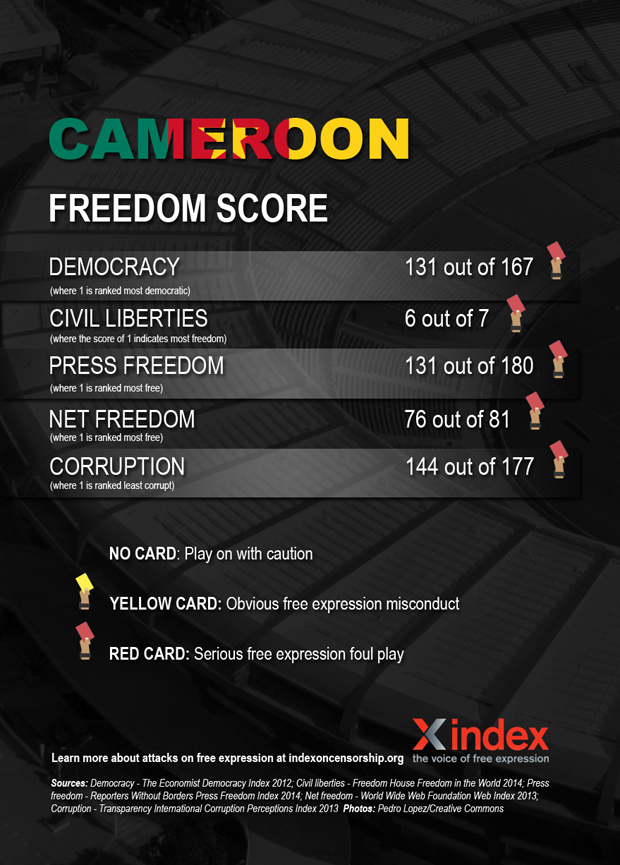
Cameroon — or the Indomitable Lions — have a solid track record in qualifying for the World Cup, having taken part seven time, more than any other African side. There were also the first African team to make it to the quarter final and are responsible for one of the most iconic moments in the tournament’s history. Their track record on free speech, however, is less impressive.
Freedom of expression is guaranteed in Cameroon’s constitution. Despite this, the government of Paul Biya — the country’s leader since 1982 — has been been accused numerous violations of free expression.
Large parts of the press are biased towards the ruling elite, while critical journalists face detainment, harassment and demands to reveal sources, among other things. Self censorship is widespread. In September 2013, 11 press outlets, including newspapers, radio stations and a TV station, were shut down for disrespecting “ethics and professional norms”. In 2010, former newspaper editor Germain Ngota, who had been investigating corruption allegations involving the state-run oil company, died in jail.
Freedom of assembly is often cracked down on. In 2012, former opposition presidential candidate Vincent-Sosthène Fouda and others were charged with “holding an unlawful demonstration”. The same year, security forces used tear against a crowd gathered to protest against Biya. In 2008, around 100 people were killed in clashes with police in anti-government riots.
Arts are not spared either. In 2013, Jean-Pierre Bekolo’s film Le President was banned in Cameroon because it discussed the end of Biya’s reign . In 2008, Lapiro de Mbanga, who criticised the constitutional change in term times that would allow Biya to stay in powers through song, was arrested.
Homosexuality is outlawed, and punishable by up to 14 years in prison. Human rights violations against LGBTI people, or those perceived to be, are “commonplace”. In July 2013, Eric Ohena Lembembe, director of the Cameroonian Foundation for AIDS (CAMFAIDS) was brutally murdered, in what friends suspect was an attack based on his pro-LGBTI advocacy.
Iran
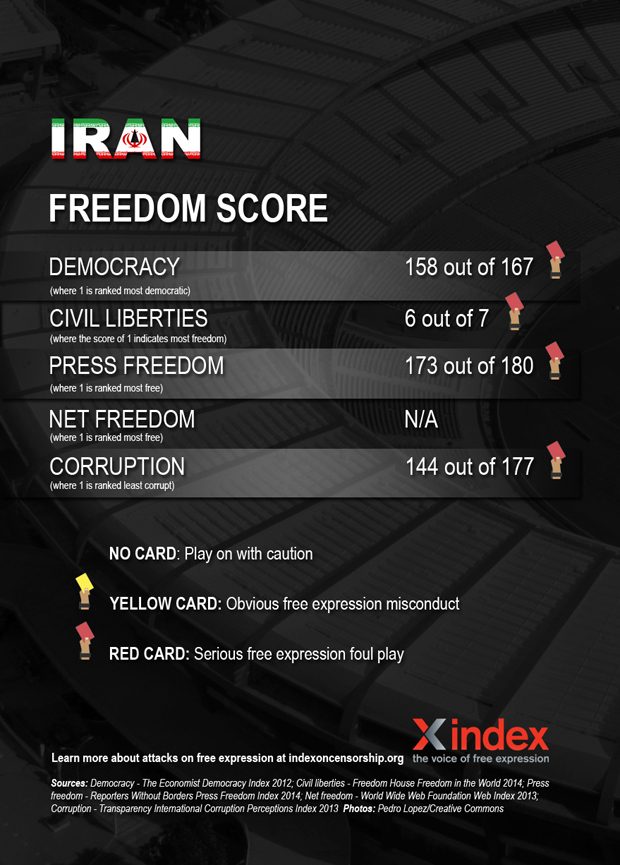
Team Melli will hope that their fourth appearance at the World Cup will see them progress from the group stages for the first time. When he was elected almost a year ago, there was hope that President Hassan Rouhani would be a progressive force within Iran. The results so far have been mixed.
Since coming into power, Rouhani has taken some steps to improve press freedom, such as withdrawing 50 motions against journalists, and lifting some restrictions on previously banned topics. However, the government still controls all TV and radio, and censorship and self-censorship is widespread. The latest figures put the number of jailed journalists in Iran at 35. In January 2013, a group of journalists were arrested for allegedly cooperating with “anti revolutionary” news outlets abroad. Journalists’ associations and civil society organisations that support freedom of expression have also been targeted.
The internet and social media played a significant part in publicising and documenting the protests that followed the 2009 election, which many Iranians believed was fraudulent. The regime has banned Facebook, YouTube, Twitter and, recently, Instagram. The lead-up to the 2013 elections saw Iranian leaders tightening access to the web, and silencing “negative” news. While Rouhani — seemingly an avid Twitter user — has indicated plans to relax web censorship, the country’s plans to launch a “national internet” are said to be going ahead.
In May, eight people were jailed on charges including blasphemy, propaganda against the ruling system, spreading lies insulting the country’s supreme leader Ayatollah Ali Khamenei on Facebook. Recently, a group of young people were arrested over a video posted of them singing and dancing along to the song “Happy”, which police called was a “vulgar clip” that had “hurt public chastity”. Some commentators believe the move was meant to intimidate Iranians and discourage online criticism.
Nigeria
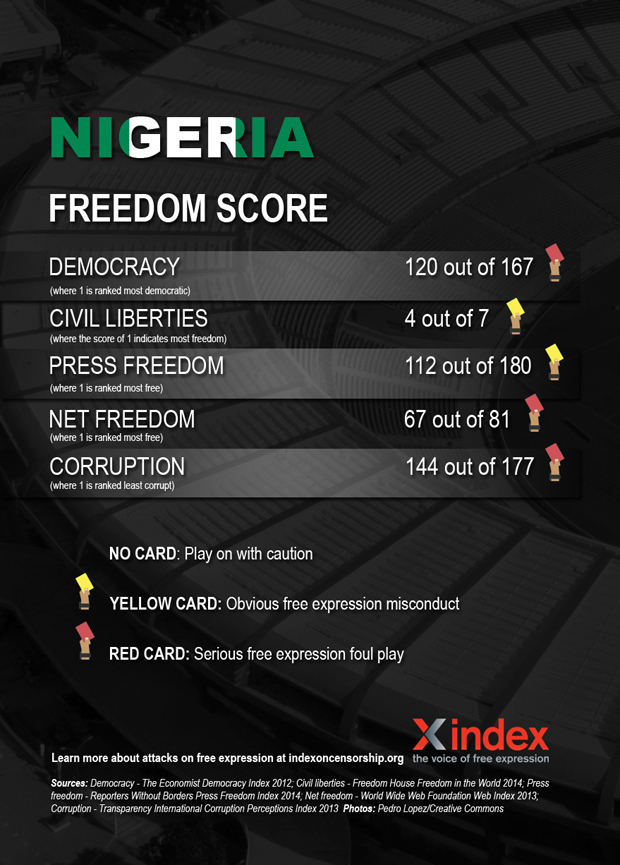
Brazil 2014 marks 20 years since Nigeria’s first outing at the World Cup, and the Super Eagles arrive at the tournament as reigning Africa Cup of Nations champions. The country’s leadership, however, is not a champion of free expression.
While parts of Nigerian media is controlled by people directly involved in politics, the country can also boast a lively independent media sector. However, journalists, especially those covering sensitive topics such as corruption or separatist and communal violence still face threats. Journalists have been arrested by security forces, and media outlets have been attacked by terrorists. Legal provisions such as sedition and criminal defamation also challenge press freedom. In 2011, a journalist was arrested over stories detailing alleged corruption in the Nigerian Football Federation.
The country’s freedom of information act was put in place in 2011. However, when human rights lawyer Rommy Mom tried to use the legislation to trace some 500 million of missing aid money allocated to his flood ravaged home state of Benue, he was met with threats from people connected to the state governor, and was forced to flee.
The Same Sex Marriage Prohibition Act 2013 outlawing gay marriage and relationships, was signed into law by President Goodluck Jonathan in January. The unpublished law makes it illegal for gay people to hold meetings, and outlaws the registration of homosexual clubs, organisations and associations. Those found to be participating in such acts face up to 14 years in jail.
Nigeria has come under international attention in recent months for abduction of the Chibok school girls by terrorist group Boko Haram. Among other things, Nigerians responded with the powerful #BringBackOurGirls campaign. In June however, authorities seemed to ban an offline protest against the kidnappings, before quickly backtracking. It is also worth noting that the Nigerian government has targeted journalists in their “war on terror”.
Russia
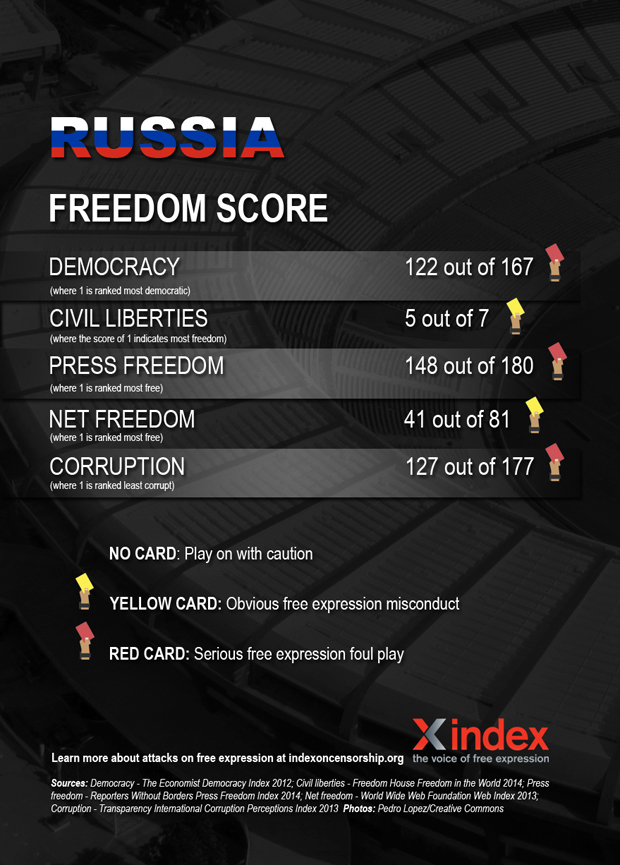
Team Sbornaya travel to Brazil in the knowledge that next time in the World Cup rolls around, they will be playing on home soil. Russia of course, recently hosted another international sporting event — the 2014 Winter Olympics. However, global attention did not improve the country’s poor record on freedom of expression. In fact, experts predicted a rise in censorship ahead of the Olympics.
Press freedom has long been under attack by Russian authorities, with TV news currently providing little beyond the official government line. In the last few months, the relatively well-respected TV channel RIA Novosti was liquidated following a decree by President Vladimir Putin, and replaced by a new press agency headed by a Kremlin-loyalist. In January, Dozhd, a popular independent TV channel was dropped by satellite and cable operators over a controversial survey. For the remaining critical journalists, Russia — one of the countries with the highest number of unpunished journalist murders — is a dangerous place to work.
The crackdown on the internet is widely believed to have started with the protests surrounding the elections securing Putin’s third term in power, organised partly through social media, but it has recently intensified. The Duma has adopted controversial amendments to an information law, targeting bloggers with blocking and fines for anything from failing to verify information posted, to using curse words. Also recently, the founder of “Russian Facebook” VKontakte says he was forced out, with the son of the head of Russia’s largest state-run media corporation predicted to take over as CEO. In 2013, the Duma approved legislation allowing immediate blocking of websites featuring content deemed “extremist”.
Public protests are discouraged through forceful responses by police, arrests, harsh fines and prison sentences. The country’s recent anti-gay legislation also pose a big threat to free expression and assembly. The ban on “promotion” of gay relationships, means that any form of expression deemed to be “gay propaganda” can be shut down. The law has also lead to physical attacks on Russia’s LGBT population.
An earlier version of this article stated that Brazil 2014 marks ten years since Nigeria’s first outing at the World Cup. This has been corrected.
This article was published on June 12, 2014 at indexoncensorship.org
12 Jun 2014 | Azerbaijan, Azerbaijan News, Bahrain, Brazil, China, Draw the Line, Russia
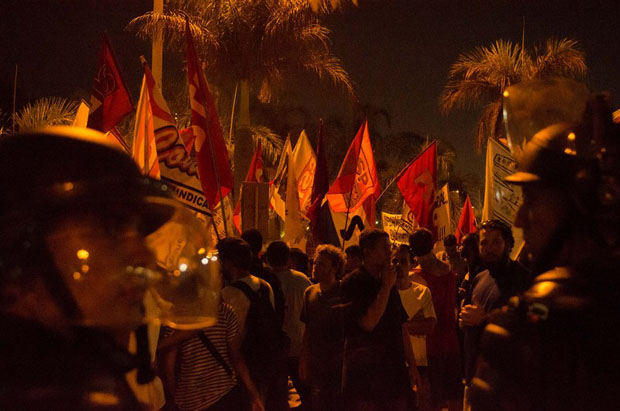
Protests against increase in public transportation costs in Rio de Janeiro on 13 February (Image: Mauricio Fidalgo/Demotix)
The World Cup — arguably the biggest international event on the planet — is upon us once more. But in the past year, Brazilians have been using their rights to free expression to organise large-scale protests to show their dissatisfaction with hosting the tournament. Meanwhile, revelations of serious human rights violations and corruption related to 2022 host Qatar have emerged. This year, human rights are sharing the spotlight with the beautiful game and its stars.
This isn’t the first time politics and sports have mixed. Just think of the Formula 1 Grand Prix races hosted in Gulf kingdom Bahrain, where authorities have cracked down on pro-democracy protesters; or the 2008 Olympics organised by the Chinese communist regime, which employs two million people to help monitor web activity; or the 1978 World Cup held in then-military dictatorship Argentina. More recently, Vladimir Putin’s Russia hosted the Winter Olympics (and will host the 2018 World Cup) not long after implementing homophobic legislation targeting so-called “gay propaganda”, while Belarus, which has been ruled by dictator Alexander Lukashenko since 1994, organised the 2014 Ice Hockey World Championship. Azerbaijan, with its, according to the latest figures, 142 political prisoners, is playing host to the inaugural European Games in 2015.
That’s without even considering the many human rights abuses perpetrated by authorities in participating countries.
The question that often comes up when these huge, prestigious events roll around, is how do we respond to the countries that repress their citizen’s free expression? Should we boycott? Should we use the attention to raise our voice on human rights abuses? Should we engage or ignore? Get involved the discussion using the hashtag #IndexDrawtheLine and tell us — where do you draw the line?
This article was published on June 12, 2014 at indexoncensorship.org
