24 May 2013 | In the News
BRAZIL
Brazil’s Federal Police seize journalist’s equipment
Brazil’s Federal Police seized a journalist’s equipment – including his computer – during an operation to remove indians from a farm in the state of Mato Grosso do Sul. The seizure was decried as illegal by the reporter’s employer, one of the country’s most prominent aid agencies aimed at indigenous peoples, Rafael Spuldar reports. (Index on Censorship)
ISRAEL
Bill protecting IDF from slander passes first Knesset reading
New law will allow for defamation lawsuits to be filed against people or groups who slander the IDF, without having to go through the attorney-general, as is the case today. The bill aims to protect the IDF from libel by Israel detractors. (Israel Hayom)
PHILIPPINES
DOJ deletes libel from new anti-cybercrime bill
THE Department of Justice (DOJ) has removed libel from the provisions of Republic Act (RA) 10175 or the Cybercrime Prevention Act of 2012, pruning away one of the questioned sections of the law. (Business Mirror)
RUSSIA
Putin’s war on dissent in Russia
A year after the mass protests marking Vladimir Putin’s controversial presidential win, Elena Vlasenko reports from Moscow on the heavy-handed repression confronting the Russian opposition. (Index on Censorship)
SYRIA
Birthday wishes for Bassel Khartabil
Software engineer and open-source advocate Bassel Khartabil spent his second birthday in prison yesterday. Index calls on the Syrian government to release Khartabil. (Index on Censorship)
THAILAND
Critic’s Facebook page suspended; cartoonist ‘ignores’ summonses
Thammasat University academic Somsak Jeamteerasakul’s Facebook account has been suspended for 30 days, leading to widespread criticism on social media. (The Nation)
TUNISIA
Crackdown on radical Islamists tests Tunisia’s stability
For the first time since the Arab Spring uprisings of 2011, relations between mainstream Islamists in government and radical Salafist Muslim activists have reached breaking point, sparking deadly clashes in two Tunisian cities. (Reuters)
TURKEY
Turkey presents Prophet’s sayings for the 21st Century
cholars around the Muslim world were alarmed five years ago by news reports that Turkey planned a new, possibly heretical, compilation of the Prophet Mohammad’s sayings that might scrap those it thought were no longer applicable. (Al Arabyia)
UKRAINE
Journalists defend colleagues in Ukraine’s ‘new war with press’
Two journalists were attacked while covering a street rally in Kiev, and nine more Ukrainian reporters were in danger of losing government accreditation following a protest to support their colleagues, Andrei Alaiksandrau reports. (Index on Censorship)
UNITED KINGDOM
A responsible internet
Internet companies and service providers need to do much more to keep pornography away from children. (The Telegraph)
Woolwich attack: two arrested over Twitter comments
Two men are arrested for making alleged offensive comments on Twitter about the murder of British soldier Lee Rigby in Woolwich. (Channel 4)
UNITED STATES
Associated Press Scandal: Does the Media Only Care About Free Speech When It Comes to Their Own?
It is no surprise that the media has been quick to voice its support for Fox News reporter James Rosen and the Associated Press , following revelations of invasive government investigations into their respective sources. (PolicyMic)
Obama to Gitmo Speech Heckler: ‘Part Of Free Speech Is…You Listening’
President Barack Obama had a hard time getting through parts of his foreign policy speech at the National Defense University Thursday, thanks to Medea Benjamin, co-founder of left-leaning, female anti-militarism group Code Pink. (Personal Liberty Digest)
Sexual harassment rules on college campuses trickle down to freedom of speech
The places where you might find some of the freest thinkers and those that want to protect their right to free speech are now also the target of new policies that will limit that same speech. (MyNorthwest.com)
PostScript: McConnell and free speech
Senate Minority Leader Mitch McConnell appears with an opinion piece on our page today. He argues that the IRS and AP scandals are part of a pattern with the Obama administration’s push for the disclosure of political donors. (Washington Post)
LePage tells legislative leaders he’s moving out of State House because of ‘censorship’
Democratic legislative leaders said Thursday that Republican Gov. Paul LePage told them he would move his office from the State House in a protest over not being able to have a television display outside his office. But LePage said his staff would remain there “until partisan leaders of the Legislature choose to evict them.” (Bangor Daily News)
Student Blog Competition
Think you have what it takes to be published by Index on Censorship? Here’s your chance to find out. More >>>
Index on Censorship Events
Caught in the web: how free are we online? June 10, 2013
The internet: free open space, wild wild west, or totalitarian state? However you view the web, in today’s world it is bringing both opportunities and threats for free expression. More >>>
20 May 2013 | In the News
GLOBAL
Social media isn’t a free-for-all space
It is often thought that social media breaks down barriers and allows the oppressed an avenue for free speech. Social media can also allow easy sharing of information with a wider audience, all with just a click of a button. (Asia One)
Cannes 2013:Iran’s Farhadi and China’s Jia talk cinema & censorship
Two directors from countries with tough film censorship brought bold and probing movies to the Cannes Film Festival on Friday — one exploring China’s social problems, the other delving into the mysteries of the human heart. (India Live)
ALGERIA
Algerian newspaper editor accuses government of censorship
An editor has accused Algeria’s government of censorship after it blocked the publication of his two newspapers. (Washington Post)
Bouteflika’s ‘coma’ leads to censorship of two Algerian dailies
Algeria censored two dailies over reports that President Abdelaziz Bouteflika, hospitalised in Paris since April 27, will return home in a coma after his health took a turn for the worse, their chief said on Sunday. (Middle East Online)
BAHRAIN
Letter: Bahrain citizens denied basic rights
In the U.S., many citizens exercise their right to peaceful assembly. However, in Bahrain this basic human right is being denied. Citizens are subject to ridiculous punishments for peaceful expression and assembly. Bloomington Pantagraph
Video: Surveillance for Sale: ‘UK exports spyware to Bahrain to track activists’
The Bahraini government is accused of using surveillance software from a UK-based company, to spy on a leading rights activist. That’s according to documents filed at the High Court in London, by one of the founders of the rights group, Bahrain Watch. The programme works by infecting your computer, and then recording your Skype conversations and social media activity. It can also take screenshots without your knowledge, and access information on your hard disk. Alaa Shehabi, who filed the court documents – told RT that digital surveillance has been spreading in Bahrain, since former high ranking UK police officer John Yates became security advisor there. (RT)
INDIA
Send Section 66A bullies home
We’re all familiar with the use of IT Act Section 66A to stifle dissent. Even the apex court has admitted that the law cannot be entrusted to ordinary policemen. But now big organisations are figuring out how to take advantage of this censorship tool too. (India Today
ITALY
Amanda Knox claims she is penniless after facing libel lawsuits over her memoir
Amanda Knox has revealed that she is almost broke because of her huge legal bills – despite a $1.5million book advance. (Daily Mail
RUSSIA
EU ‘worried’ about Russia’s human rights record
The European Union criticised Russia’s human rights record, saying it was increasingly concerned at a wave of restrictive legislation and prosecutions against activists. (TV New Zealand)
UNITED STATES
What We Said 150 Years Ago: How free speech is abridged
The New York copperheads (who were Democrats living in northern states opposed to the Civil War) had a meeting the other afternoon to denounce the (Lincoln) administration for suppressing the liberty of “free speech.” (Wisonsin State Journal)
Ashley: Chilling effect on free expression worth worrying about
What’s going on here? By coincidence or terrible karma, the unsettling developments on the free expression of ideas, open government and our ability to monitor that government are reason for concern and anger. (The Herald-Sun)
‘IRS suppressed advocates of free speech’
The Internal Revenue Service has sought to “suppress” advocates of free speech by targeting conservative groups based on their ideology, says Jim W. Dean, managing editor and columnist at Veterans Today. (Press TV)
17 May 2013 | Azerbaijan News, Europe and Central Asia, News
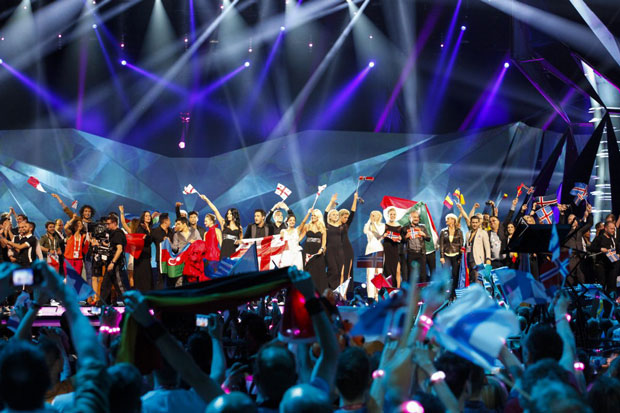
The Eurovision Song Contest gives a platform to some of Europe’s outliers on free expression. Photo: Sander Hesterman (EBU) / Eurovision 2013
Europe will once again be swept away by a sparkly hurricane of techno beats and pompous ballads, kitschy and/or traditional costumes, wind machines, pyrotechnics, heavily accented English, awkward host banter and nul points. Yes, Eurovision takes our breath away in more ways than one.
While first and foremost a showbiz spectacle, if you look beneath the layer of sequins you’ll soon discover the political tinge to the continent’s premier singing competition. From the start in 1956, it was designed as fun way of testing out new broadcasting technology. Those partial to the occasional conspiracy theory would have you believe this was also a convenient cover for pan-European satellite testing during the Cold War, which is why NATO members Turkey and Israel were invited to the party.
With the lifting of the Iron Curtain and the inclusion of the Eastern Bloc in 1990, much was said about the healing, unifying power of the contest. Since then, even more has been said about the tendency of the late arrivals to share their points amongst themselves. The UK, for instance, have been vocal about political, neighbourhood voting being the cause of their recent Eurovision failings, rather than, say, sending entries like this. And while Eurovision, somewhat censoriously, prohibits political songs that has not stopped artists from trying to get their meaningful messages across.
The most famous recent example is perhaps Georgia’s pun-tastic 2009 offering “We Don’t Want To Put In’‘, to be performed at final in — you guessed it — Moscow. They were told to change the song or drop out, and ultimately chose the latter. Krista Siegfrids, Finland’s entrant this year, has warned she might be planting a kiss on one of her female dancers in protest at her country’s failure to adopt equal marriage legislation.
Most significantly, Eurovision gives its entrants prime time access to some 800 million viewers around the world – an unparalleled platform on which to promote their nation should they choose to. Many have jumped at the opportunity, chief among them the land of fire; Azerbaijan. As 2012 hosts, the Aliyev regime poured millions of their significant oil wealth into reforming their international reputation as a repressive hereditary dictatorship. The only problem with this otherwise foolproof plan was that they forcefully evicted people to make room for an ambitious Eurovision-inspired urban renewal project in Baku, attacked journalists covering and speaking up about it, and generally conducted their notoriously human rights abusing business as usual. Not much has changed since the party left town a year ago — only this week, the regime announced they have extended libel laws to online speech ahead of October’s presidential election.
Before that, 2009 hosts Russia attempted to dazzle Europe and the world, with a spectacular stage show in the 25,000 capacity Indoor Olympic Arena in Moscow. However, LGBT activists seized the opportunity to shine the spotlight on the country’s poor record on gay rights, attempting to stage a Slavic-wide Pride parade on the day of the final. In a clear violation of the right to freedom of expression and assembly, the parade was banned. Many of the protesters who showed up anyway, were attacked and arrested. LGBT rights remain poor in Russia, with a 100-year ban on pride parades in Moscow announced only last year. The charm offensive of last year’s singing, dancing, baking grandma entry has this year been followed by the John-and-Yoko-esque ‘What If?‘, which among other gems, contains the lyrics “Together we can make a better place/ On this little island out in space”. Meanwhile, in Russia, internationally funded NGOs have to register as ‘foreign agents’, or risk fines and prison time.
You don’t have to host to be able to host to take full advantage of the promotional platform Eurovision. Like Belarus, you can condense your message to fit the 3-minute performance slot. In 2011, the country known as Europe’s last dictatorship sent Anastasiya Vinnikova to perform the subtly named “I Love Belarus“. Somehow, it didn’t progress to the final. Maybe the rest of Europe had some trouble reconciling the country described in the song, with its “fields full of gold” and “free, friendly and young people”, with the country where you’re put in prison for pointing out that your repressive dictator is, well, a dictator.
Also in the running this year is Hungary, the country with some of the most draconian press regulation on the continent. There’s Ukraine, where the former prime minister is serving a seven-year jail sentence for what is widely recognised as politically motivated charges. In Italy, the final will be broadcast on public broadcaster RAI, one half of the TV duopoly that poses a big threat to the country’s media plurality. In Greece, financial woes have also had a pretty detrimental effect on freedom of expression. Bulgaria’s web of cosy relationships between authorities and media leaves the country without an accurate picture of itself.
Yes, Eurovision is first and foremost one of the biggest parties in the world. However, as you’re watching the spectacle unfold on Saturday, spare a thought for the Europeans who are not as free to express themselves as their fellow countrymen on stage in Malmo.
16 May 2013 | In the News
AUSTRALIA
ASIC request sparks internet censorship
The Australian Securities and Investments Commission’s use of internet censorship powers caused the accidental blocking of more than 1000 websites in April.(The Australian)
AZERBAIJAN
Azerbaijan extends libel law to web speech
Index on Censorship and partner organizations have strongly condemned moves by Azerbaijan’s government on Tuesday to criminalise online slander and abuse in the run-up to the country’s October Presidential election. (Index on Censorship)
BAHRAIN
Bahrain blogger given asylum in UK
A Bahraini blogger and human rights activist said he had been granted asylum in Britain after being in hiding for two years. (Gulf News)
Bahrain court jails six for insulting king on Twitter
A Bahraini court jailed six people for a year on Wednesday for insulting King Hamad bin Issa al Khalifa in messages on the microblogging site Twitter, the official news agency said. (Reuters)
BRUNEI
Brunei: ‘Slow Internet is Almost Like Censorship’
Brunei internet users are complaining against the slow and unreliable internet connection in their country. (Global Voices)
CANADA
U.S. man’s “supportive” web chat with suicidal Canadian teen “free speech”: lawyer
An American man convicted in 2011 of posing as a young, depressed woman in an online “suicide chat room” and helping a Canadian teenager kill herself in 2008 has appealed the verdict to Minnesota’s top court, arguing this week that the free-speech provisions of the U.S. First Amendment should have protected his “supportive” conversations with the distraught Carleton University student. (Canada.com)
CHINA
As China’s social media takes off, Beijing’s censorship campaign heats up
A few well-regarded intellectuals known to be critical of the Communist Party have drawn millions of followers on China’s Twitter. (Christian Science Monitor)
Blog of Critic of Chinese Censorship Deleted
It will hardly come as a surprise to anyone to learn that a popular writer and well-known critic of China’s pervasive censorship system has run into trouble for his views. (Reason)
EGYPT
Bassem Youssef’s fight for free speech wins cheers at AMF
Egypt’s Bassem Youssef, the TV host called to court for poking fun at President Mursi, was applauded at this week’s Arab Media Forum (AMF) after making a rousing argument for free speech. (AlArabiya)
Egyptian artists declare war on sexual harassment
Since the fall of President Hosni Mubarak two years ago, artists have been active in breaking Egypt’s age-old taboos around sexual violence, especially since sexual harassment has been on the rise. In the period after the revolution, artists — including women — have covered the country’s walls with murals and slogans, using them to amplify calls for change. Melody Patry reports. (Index on Censorship)
IRELAND
Irish mobile phone shutdown may be allowed during G8
The Irish government will allow the mobile phone network to be shut down in border areas during the G8 summit. (BBC)
KUWAIT
Kuwait: Draft Law Threatens Free Speech, Says HRW
Kuwaiti authorities should amend a proposed new press law that would increase state control of the news media and further curtail the right to free speech. The draft should be revised to protect free speech, consistent with requirements under international law, not curtail it, Human Rights Watch said. (Eurasia Review)
LIBYA
Young Libyans Find Escape in ‘Secret’ Cinema
In the basement of a villa in central Tripoli, young Libyans seeking an escape from violence and disorder watch an American movie classic screened using a simple projector and laptop. (Reuters via Voice of America)
RUSSIA
Russian bird lovers targeted as ‘foreign agents’
An organisation behind a nature reserve dedicated to the protection of Russia’s cranes has been ordered to register as “a foreign agent” under the country’s non-governmental organisation law. The case highlights how arbitrary implementation is chilling free expression in the country, Andrei Aliaksandrau reports. (Index on Censorship)
UNITED KINGDOM
Letter: Free speech, extremism and a university’s duty
Institutions have a legal obligation to promote free speech, and that may involve allowing controversial, indeed sometimes offensive, opinions to be expressed. (The Times)
UNITED STATES
The DOJ’s Freedom of Speech Breach
The seizure of AP’s phone records is legal, but that doesn’t make it an acceptable course of action for the Justice Department to take. (The American Prospect)
Lawmakers accuse Obama administration of abusing free speech rights
U.S. lawmakers accused the Obama administration on Wednesday of trampling on free speech rights and evading questions about the Justice Department’s secret seizure of Associated Press telephone records. (Reuters via The Chicago Tribune)
IRS targeting not only chills speech, it attacks 1st Amendment freedoms
The news that an office of the Internal Revenue Service targeted for review a number of groups with names that included “patriot” or “tea party” is chilling enough to hear – but there’s more reason to be concerned from a First Amendment perspective. (TriCities.com)
