1 Jul 2016 | Mapping Media Freedom, mobile, News, Serbia, Spain, Turkey, United Kingdom
Click on the dots for more information on the incidents.
Each week, Index on Censorship’s Mapping Media Freedom project verifies threats, violations and limitations faced by the media throughout the European Union and neighbouring countries. Here are five recent reports that give us cause for concern.
June 28: Shortly after an attack that saw three suicide bombers target Istanbul airport, killing 41 people and injuring more than 200, the government imposed a gag order to Turkish media outlets. This was followed by social media users reporteing problems with access and switching to VPN services.
Gag orders are frequently used by the Turkish authorities. But this time, shortly after the attack, RTUK, Turkey’s Radio and Television Supreme Council, expanded the ban to include all media.
According to Vocativ, the office of the Turkish Prime Minister instituted the ban on any photos or videos of the explosion for national security reasons.
According to Mashable, the media ban has been an issue as Turkey has been the victim of a spate of terror attacks in the last year, including a suicide bombing in Suruc in July 2015, a double suicide bombing in Ankara in October 2015, a suicide bombing in Istanbul in January and a deadly bombing in Ankara in February.
25 June: A Guardian reporter was denied access to a golf course resort in Aberdeen owned by Donald Trump, where US presidential candidate was on the second day of a two-day UK visit.
Two Guardian journalists were denied entry to the golf club by staff who said they weren’t on the list and did not have credentials.
At a press conference on Friday at his Turnberry golf course in Ayrshire, Trump took offence when a Guardian journalist asked him why UK and Scottish senior politicians had not come to meet him, suggesting it might be because he was toxic.
He replied by saying the questioner was a “nasty guy”.
Trump has banned several newspapers and media organisations from campaign events, including Buzzfeed in 2015 and The Washington Post in June 2016.
24 June: Two days before the general elections, two police officers entered the newsroom of website Público in Madrid asking for the recording of a conversation between the Spanish interior minister and a regional anti-fraud office chief, the newspaper reported.
Público executives refused to hand over the material because the agents didn’t have a court order, according to Público.
On Tuesday 21 June, left-leaning Público website published the secret conversation between centre-right interior minister Jorge Fernández Díaz and Daniel de Alfonso, director of Catalan anti-corruption office.
The conversation took place in October 2014, when the officials discussed the investigation directed at members of the two regional political parties which had been organizing a referendum on independence. They were planning to fabricate scandals related to separatists, informed Público, calling it a “conspiracy”.
In November 2012, the local centre-right Democratic Convergence of Catalonia party and left-wing party Republican Left of Catalonia organised a non-official referendum in Catalonia, north-eastern region, where a majority of citizens voted in favour of independence from Spain.
The Spanish Constitutional Court prohibited the referendum, claiming it was not legal according to the constitution.
Center-right Partido Popular has been in power since 2011 and both interior minister Fernández Díaz and prime minister Mariano Rajoy said the case, [in the run-up to the general elections], is a “campaign maneuver” produced by their political rivals.
24 June: Turkish businessman Mehmet Cengiz threatened newspaper Cumhuriyet with death threats over the phone, Turkish Minute reported.
Cengiz whose name was mentioned during the corruption scandal in December of 2013, called the newspaper headquarters telling them “I will fight you. Don’t make this man a killer”, reported Ozgur Dusunce news website.
The threat came shortly after Cumhuriyet newspaper announced it was set to publish a series of documents leaked through the Panama Papers, which would include Mehmet Cengiz, and other well-known businessmen with ties to the ruling government of Justice and Development Party.
24 June: A local politician for the Democratic Party of Sandzak, Behri Beganovi, menaced and tried to stop Alem Rovcanin, a cameraperson for TV Novi Pazar, from filming during a session of the local parliament in Prijepolje, news agency Tanjug reported.
According to Rovcanin, Beganovic cursed at him multiple times, and then reached for his camera, telling him he should not film him.
Due to the interference of other parliament members, the camera remained untouched.
Beganovic, the founder of the party DPS, was reportedly unhappy that cameraperson Alem Rovcanin was filming him during a parliamentary session.
Regional TV Novi Pazar has condemned the incident and asked journalist associations to react.
10 Jun 2016 | Greece, Mapping Media Freedom, mobile, News, Serbia, Spain, Turkey, Ukraine
Click on the dots for more information on the incidents.
Each week, Index on Censorship’s Mapping Media Freedom project verifies threats, violations and limitations faced by the media throughout the European Union and neighbouring countries. Here are five recent reports that give us cause for concern.
On 1 June David Jiménez, who was fired as El Mundo’s director on 25 May, filed a complaint against the paper.
Jiménez alleges that Antonio Fernández-Galiano Campos, president of El Mundo’s owner Unidad Editorial, pressured him to edit the paper to conform with the publisher’s corporate strategy.
Jiménez, who was hired as director in May 2015, claimed his right to direct editorial coverage independently was suppressed. His firing came just four days after the paper laid off 168 staffers including 38 journalists due to financial pressures.
Riot police overseeing an operation to move refugees from a camp in Idomeni, on the border near Macedonia (FYROM), only allowed public broadcaster ERT and the national Athens News Agency to cover the events.
The Greek Union of Photojournalists denounced the “flagrant violation of the freedom and pluralism of press”, during an operation to evacuate the country’s largest informal refugee camp of Idomeni. The statement stressed that journalists and photojournalists were not in danger, at least “not more than the ERT and ANA journalists”.
“If the trapped people use violence it won’t be against journalists and photojournalists, but against the police,” the organisation said in its statement.
In an interview with Greek TV, Mega Channel, a representative of the government commented that “there are always restrictions to the press during such operations”.
Journalists for the provincial radio and TV station RTV Vojvodina claim they will be replaced by new journalists who have been chosen by the Serbian Progressive Party, which has been the ruling party in the autonomous region Vojvodina since the elections in April 2016.
The entire editorial staff was told on Wednesday 18 May 2016 that they no longer need to come to work, and that other journalists would take over their jobs. They have not been fired.
Editor-in-chief of TV channel 1, Mirjana Jovic, and general director Srdjan Mihajlovic had earlier resigned. Both are believed to have left the station under “political pressure”. Programme director Slobodan Arezina has also been dismissed, B92 reported.
In response, around forty journalists and editors have sent an open letter in which they express their worries about “sudden personnel changes that have not been clearly explained”. They are demanding a public explanation from the management “about why there has been such a sudden shift without explanation and whether this is a political decision”.
A court in the city of Mersin sentenced journalist Arzu Yildiz to 20 months in jail and deprived of legal guardianship over her children for footage she published in May 2015.
The footage was from a court hearing where four prosecutors were on trial for ordering a search of trucks belonging to Turkey’s MIT intelligence agency as they traveled to Syria in 2014, Reuters reported. President Erdogan accused those who covered the story as plotting against his government along with enemies to undermine Turkey and to embarrass the country.
The lawyer said the decision to strip parental rights was an act of revenge. “There are many cases in which the court does not execute this article of the penal code. They didn’t have to do it”.
Ukrainian president Petro Poroshenko signed a decree to impose personal sanctions against 17 Russian media executives for broadcasting propaganda, the Unian information agency reported.
According to Human Rights Watch, among the 17 are Konstantin Ernst, general director of Channel One, Russia’s main state-owned television channel, and Margarita Simonyan, chief editor of Russia’s international television network RT (formerly Russia Today) and the Rossiya Segodnya news agency. Journalists on the list also include Vladislav Fronin, chief editor of the official government newspaper Rossiyskaya Gazeta, and Vitali Leibin, editor at Russkiy Reporter magazine. Russia either owns — at least partially — or exerts significant control over the media outlets listed in the presidential decree, HRW said.
According to the decree the 17 individuals “create real and potential threat to national interests, national security, sovereignty, and territorial integrity of Ukraine; facilitate terrorist activity and violate citizens’ rights and freedoms; contribute to the occupation of territories, and obstruct full realization of rights and freedoms by Ukrainian citizens.”
The decree bars the 17 from entering Ukraine through December 31 2017.
6 Jun 2016 | Croatia, Europe and Central Asia, European Union, Hungary, News
Since the 1920s, generations of western Europeans got used to the monopoly of public radio and later public television. These broadcasters developed strategies to better serve audiences and distance themselves from governments. The arrival of private broadcasters, in many cases taking place only in the 1970’s, was generally viewed as a complimentary service aimed at entertaining the public. Although public service broadcasting lost market share, it remained a respected institution in society; necessary to bring up youth, to get an objective picture of the world and cater to the interests of minorities.
Eastern Europeans also got used to the monopoly of state radio and television. Those broadcasters served the communist parties and were administered and financed by governments. Their political bankruptcy came with the collapse of communist ideology, underlined in particular by the plurality of private broadcasters that came on to the scene in the early 1990s.
These private media – with plentiful Western programming – was indeed television, for so long hidden from the viewers by totalitarian regimes. Politicians flocked to their studios to take part in talk shows, abandoning once-mighty state television. Thus, in the east, the public perception of public broadcasting was predominantly sceptical, if not negative. A discussion on its development was of tangential interest, at least during the saturation process of the new private media.
Abandoned by politicians and the public, the slow and clumsy transformation of the state broadcasters into public ones was guided by the bureaucrats, almost by themselves. The driving force behind the transformation was almost exclusively the activity of Strasbourg and Brussels. We all know that in the words of European institutions “public service broadcasting is a vital element of democracy in Europe.” Transformation of state television into a public one was a condition precedent of new democracies becoming member states of the Council of Europe in some cases. The authenticity of the transformation has been important to become a candidate for entry into the European Union and even sometimes to NATO.
Developments in younger EU member states show the importance of public service broadcasters for the development of democracy – and how they can be misused.
In December 2015, Poland‘s parliament adopted a law giving the treasury minister the mandate to appoint and dismiss members of management and supervisory boards. Since the law came into effect in January, reportedly more than 100 journalists in public media have lost their jobs, allegedly for not being government-friendly.
In March, the Croatian parliament dismissed the director general of Croatian Radio-Television. A week later, the government also proposed that parliament reject a regular report from the independent media regulator, both events raising serious concerns about the overall media freedom situation in the country.
Hungary was probably the first example in the EU where public service broadcasting was practically turned back into state broadcasting, going against international standards calling for independence. New media laws in 2010 and the restructuring of the media landscape led, within a matter of one year, to all public service media being subordinated to political decisions. The new system introduced and cemented the political dependence of public service media; the governing party had nominated all new heads of public service media and the Media Authority now controls the budget of all public service media. The law vested unusually broad powers in the politically homogeneous Media Authority and Media Council, enabling them to control content of all media.
The battle to establish credible public service broadcasters in transitional democracies has been even more difficult to wage.
The latest example is the steering board of Bosnian Radio and Television which last month decided to suspend operation of all programming at the end of this month. This decision, a wrong one for several reasons, follows years of political and financial wrangling over control of the operation.
Throughout the western Balkans, significant issues are pending affecting the independence and financial stability of public broadcasting.
A bureaucratic response to the need to establish public service broadcasters has brought predictable results. The newly established broadcasters were visibly underfunded, with formal and informal administrative links – if not strings – to governments and no clear commitments to the public. Once established, it was unclear what to do with them. Most governments viewed them as an element of bureaucracy itself, a burden to carry on the road to a united Europe. If possible and convenient, they tried to make use of them through a carrot-and-stick policy.
As such, the new public service broadcasters immediately became subject to criticism by almost anyone who wanted to speak about them. Left to survive in the monstrous buildings of brutal architecture that once belonged to powerful state television, they had to sell airtime to advertisers, beg for Western donations and save on everything.
The advance of the internet and other new technologies almost killed the whole idea of television and radio, including public service broadcasting. It was saved by the transformation process – from public service broadcasting to public service media. In the West, the BBC and other companies have struggled to make use of the changing trends in media consumption. They went online, launched smartphone applications, became interactive, archived in order to engage fragmented audiences where and when required by the viewers.
Unfortunately this is not the case in the East. Public service broadcasters at best try to appeal to the older and well-educated audiences, traditional in their use of public service media. For our children, today’s debate is not only irrelevant, it is beyond their understanding.
Is there a future?
In my view we are losing the battle and might soon lose the war. To reverse the trend, we should do the following:
Give public service broadcasters a clear-cut mandate and obligation to program for the public which, in turn, should have effective feedback and control over content. There should be programmes that cater to minorities; there should be objective news, calm and matter-of-fact debates, educational and children’s programmes.
Public service broadcasters should function independently of the government. Buffer boards, meaning councils should be established to guarantee that only an abuse of a clear-cut mandate may serve to reprimand or dismiss an editor; only mismanagement and corruption may lead to firing executive directors.
And, finally, licence fees should be introduced or increased to heighten a feeling of public ownership. We can talk about other methods of independent funding, but none of them may bring this feeling of owning an institution that serves you.
Recent columns:
Dunja Mijatović: Chronicling infringements on internet freedom is a necessary task
Dunja Mijatović: Propaganda is ugly scar on face of modern journalism
Dunja Mijatović: There is hope that justice can be served in Serbia
24 May 2016 | Azerbaijan, Azerbaijan News, Belarus, Belgium, Bosnia, Croatia, Europe and Central Asia, France, Germany, Greece, Index Reports, Macedonia, Mapping Media Freedom, mobile, News, Poland, Serbia, Spain, Turkey, Ukraine
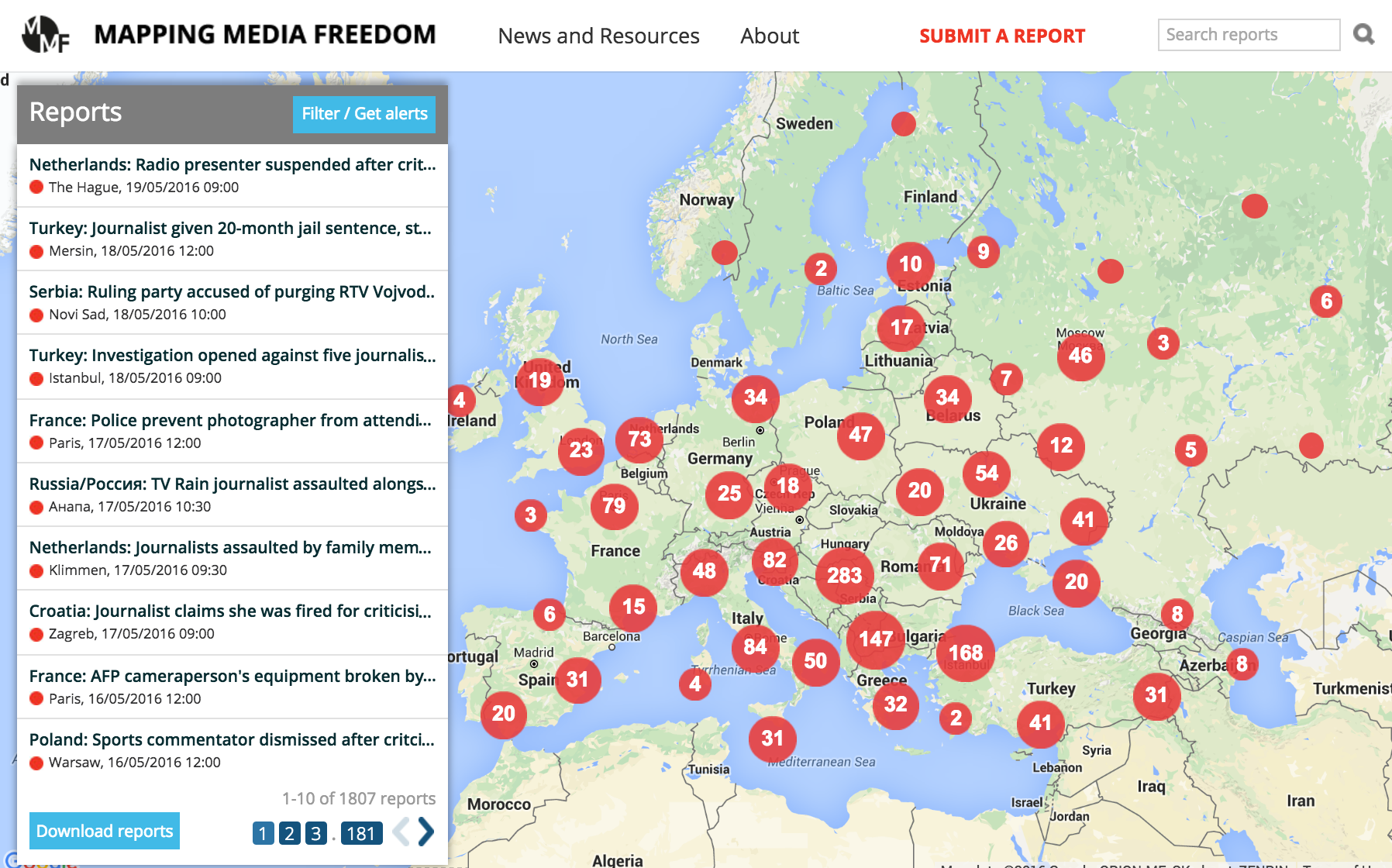
Mapping Media Freedom launched to the public on 24 May 2014 to monitor media censorship and press freedom violations throughout Europe. Two years on, the platform has verified over 1,800 media violations.
“The data the platform has collected over the last two years confirms that the state of press freedom across Europe is deplorable,” said Hannah Machlin, project officer for Mapping Media Freedom. “Media violations are occurring regularly in countries with strong democratic institutions and protective laws for journalists. Legislation limiting the press, violence across the continent and authoritarian governments are also fuelling this rapid and worrying decline. We hope that institutions and leaders take note of this information and take action swiftly.”
To mark the anniversary, we asked our correspondents to pick a key violation that stood out to them as an example of the wider picture in their region.
Russia / 113 verified reports
Several journalists and human rights activists attacked in Ingushetia
“The brutal attack on a minibus carrying six journalists and several human rights activists near the border between Ingushetia and Chechnya on the 9 March 2016 demonstrates the dangers faced by media professionals working in Russia’s North Caucasus. No suspects have been established so far. This case stands out due to its extreme violence but also supports a common trend: the reluctance of the local authorities to ensure that the journalists’ rights are respected.” – Ekaterina Buchneva
Italy / 190 verified reports
97 journalists accused of breaking the law in mafia investigation
“This was a very relevant investigation, with no precedent, that took place in October, a few weeks away from the start of the trial known as Mafia Capitale, which concerns the scandal that involved the government of the city of Rome. It is a collective intimidation because it involved 97 journalists, who were denounced for violating the secret on the ongoing investigations. It is a really serious form of intimidation because it was activated within the field of law and thus is not punishable.” – Rossella Ricchiuti
Turkey / 57 verified reports
Zaman newspaper seized by authorities
“These attacks and actions taken by the government against independent media in Turkey attest to the shrinking space of independent media overall. In addition, it illustrates the shifting power dynamic within the ruling government in Turkey where once upon a time friends, are turned into enemies by the regime. As the paper wrote itself, Turkey is headed through its ‘darkest and gloomiest days in terms of freedom of the press.'” – MMF’s Turkey correspondent
Azerbaijan/ 5 verified reports
Writer banned from leaving country
“Aylisl’s 12-hour interrogation at the airport and later charges of hooliganism were just as absurd as the claim that a 79-year-old man, suffering from a heart condition and other health issues would attack an airport employee to such an extent that it would cause hemorrhage. I chose this example to illustrate the absurdity of charges brought against individuals in Azerbaijan but also the extent to which the regime is ready to go in order to muzzle those voices who different.” – MMF’s Azerbaijan correspondent
Macedonia / 59 verified reports
Deputy Prime Minister attacks journalist
“This incident best demonstrates the division in society as a whole and among journalists as a professional guild. This is a clear example of how politicians and elites look upon and treat the journalist that are critical towards their policies and question their authority.” – Ilcho Cvetanoski
Bosnia / 56 verified reports
Police raid Klix.ba offices
“This was the most serious incident over the last two years in Bosnia regarding the state’s misuse of institutions to gag free media and suppress investigative journalism. In this specific incident, the state used its mechanisms to breach media freedoms and send a chilling message to all other media.” – Ilcho Cvetanoski
Croatia / 64 verified reports
Journalist threatened by disbanded far-right military group
“After the centre-right government in Croatia came to power in late 2015, media freedom in the country rapidly deteriorated. Since then around 70 media workers in the public broadcaster were replaced or removed from their posts. This particular case of the prominent editor-in-chief of the weekly newspaper Novosti receiving a threatening letter from anonymous disbanded military organisation demonstrates the polarisation in the society and its affect on media freedom.” – Ilcho Cvetanoski
Greece / 34 verified reports
Golden Dawn members assault journalists covering demonstration
“This was the second attack against journalists by Golden Dawn members within one month. With more than 50,000 asylum seekers and migrants trapped in Greece, the tension between members of the far-right group and anti-fascist organisations is rising.” – Christina Vasilaki
Poland / 35 verified reports
Over 100 journalists lose jobs at public broadcasters
“This report highlights the extent of the ongoing political cleansing of the public media since the new media law was passed in early January.” – Martha Otwinowski
Germany / 74 verified reports
Journalist stops blogging after threats from right-wing extremists
“The MMF platform lists numerous incidents where German journalists have been threatened or physically assaulted by right-wing extremists over the last two years. This incident stands out as a case of severe intimidation that resulted in silencing the journalist altogether.” – Martha Otwinowski
Belgium / 19 verified reports
Press asked to respect lockdown during anti-terrorism raids
“On 22 November 2015, the Belgian authorities asked the press to refrain from reporting while a big anti-terrorist raid was taking place in Brussels. While understandable, this media lock-down raised questions for press freedom and underlined the difficulties of reporting on terror attacks and anti-terror operations.” – Valeria Costa-Kostritsky
Luxembourg / 2 verified reports
Investigative journalist on trial for revealing Luxleaks scandal
“This Luxleaks-related case is the only violation we have become aware in Luxembourg over the period (which is not to say that no other cases occurred). Along with two whistleblowers, a journalist was prosecuted by PricewaterhouseCoopers and accused of manipulating a whistleblower into leaking documents. This is a good example of the threat the notion of trade secrets can represent to journalism.” – Valeria Costa-Kostritsky
Ukraine / 127 verified reports
Website leaks personal information of more than 4,000 journalists
“This incident shows how fragile the media freedom and personal data of journalists are in armed conflict. Even after a great international scandal, the site continues to break the legislation and publishes new lists. It has been operating for two years already and those involved in its activities go unpunished. It seems that the post-Maidan Ukraine has simply ‘no political will’ for this.” – Tetiana Pechonchyk
Crimea / 18 verified reports
Journalists’ homes searched, criminal case filed
“This report shows the everyday life of independent journalists working on the peninsula. Only a few critical voices are still remaining in Crimea while the majority of independent journalists were forced to leave the profession or to leave Crimea and continue their work on the mainland Ukraine.” – Tetiana Pechonchyk
Spain / 49 verified reports
Journalist fined for publishing photos of arrest
“The latest issue for the Spanish media is the Public Security Law, introduced in June 2015, which among other things limits space for reporters. The law prohibits the publication of photo and video material where police officers may be identified, unless official state permission is obtained. This was the first case of a journalist being fined by the new law.” – Miho Dobrasin
Belarus / 47 verified reports
Journalist beaten by police, detained and fined for filming police attacks
“The story has ended in impunity: a criminal case was not even filed against the police officers who had beaten the journalist.” – Volha Siakhovich
Latvia / 12 verified reports
Latvia and Lithuania ban Russian-language TV channels
“This was the beginning of a disturbing tendency to react with rather futile gestures against Russian television channels. The bans are not so much against the media, as telling the audience that the authorities, not the public, will decide what Latvian viewers may or may not see or hear.” – Juris Kaža
Serbia / 110 verified reports
Investigative journalists victim of smear campaign
“You have to be very brave to launch a new investigative journalism portal in Serbia and expose corruption and organised crime involving government officials. That is why the launch of KRIK in early 2015 has been so important for media freedom, but at the same time so dangerous for its journalists. Smear campaigns like this by pro-government tabloid Informer are a relatively new but common method in the Balkans to scare journalists off.” – Mitra Nazar
