11 Sep 2019 | Belarus, Belarus Incident Reports
[vc_row][vc_column][vc_column_text]
Index on Censorship’s Monitoring and Advocating for Media Freedom project tracks press freedom violations in five countries: Azerbaijan, Belarus, Russia, Turkey and Ukraine. Learn more.
[/vc_column_text][/vc_column][/vc_row][vc_row][vc_column][vc_row_inner][vc_column_inner][vc_custom_heading text=”4 Incidents” use_theme_fonts=”yes”][vc_column_text]
Journalist covering protests in Brest receives messages with threats
21 August 2019 – Journalist Nasta Zakharevich, who has been reporting on the construction of a controversial battery factory located in Brest, received insulting messages and a veiled threat from an account on VKontakte social network.
The VKontakte account is known for often leaving harsh and rude comments under posts authored by opponents of the plant. Earlier an individual with the same name and surname as the VKontakte profile that made the comments had filed a complaint with the police against ecological activist Dzmitry Bekalyuk, who is an opponent of the plant. The compliant accused accused Bekalyuk of “discrediting the Republic of Belarus.”
Link: https://charter97.link/en/news/2019/8/21/345601/
http://greenbelarus.info/articles/21-08-2019/zhurnalistka-kotoraya-pishet-pro-zavod-akb-v-breste-poluchila-soobshcheniya-s
Categories: Online Defamation/Discredit/Harassment/Verbal Abuse, Intimidation
Source(s) of violation: Known private individual(s)
State-run newspaper concealed opposition symbol on photo
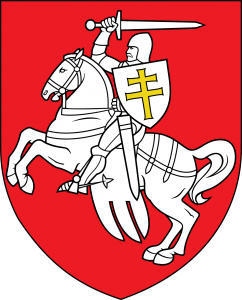
Coat of arms associated with Belarusian opposition. It was previously the country’s coat of arms in 1918 and from 1991-1995. (Photo: Wikipedia)
15 August 2019 – Adzinstva, the local state-owned newspaper in Barysau, altered a photo published on its website of sports coach Viktar Zakharjeu to hide the previous state emblem of Belarus Pahonia, which is regarded by the authorities as an opposition symbol.
Pahonia was the official emblem of the Belarusian Democratic Republic in 1918 and of the Republic of Belarus from 1991 to 1995. It was abolished after Alexander Lukashenko became the country’s president, though it is not officially prohibited and is included on the Republic of Belarus’ cultural heritage list.
Links: https://baj.by/be/content/barysauskaya-rayonka-adzinstva-zamazala-pagonyu-na-svitshoce-geroya-intervyu
http://www.edinstvo.by/ru/news/obshchestvo/item/9153-borisovchanin-stal-pervym-trenerom-v-belarusi-po-krossfitu-v-invalidnoj-kolyaske?fbclid=IwAR3Z1yq6x92K-ZtxfF2DdNn1CY33vQVCCzVTwTZ95e6npWOzB2XDVsbCPh0
Category: Censorship
Source(s) of violation: Employer/Publisher/Colleague(s)
Regional government official refused to provide information on communicable disease
14 August 2019 – An official for the Brest regional government refused to provide information on a case of anthrax in the Stolin district to Aksana Brovach, a journalist working for the newspaper Komsomolskaya Pravda v Belarusi.
The official said that all the information was available from on the state-run news agency BelTA: “Can you read? How is it written there?”
The press-service of the Ministry of Agriculture and Food only published an official announcement about the anthrax case on the BelTA news agency.
Link: https://baj.by/be/content/usya-infarmacyya-na-belta-u-bresckim-ablvykankame-admovilisya-davac-kamentar-nakont-vypadku
Category: Blocked Access
Source(s) of violation: Government/State Agency/Public official(s)/Political party
After accusations, local independent news outlets investigated by police
13 August 2019 – Ivan Sukharevich, a resident of the town of Drahichyn in the Brest region, sent letters to the National Assembly of Belarus and to the news website Piershy Rehijon editor-in-chief Piotr Huzajeuski. In the letters, Sukharevich expressed his negative attitude to this online media outlet and particularly to its Drahichyn correspondent Siarhei Hardzijevich.
The writer warned of the serious consequences for the Piershy Rehijon if its journalists try “to shake up the community of our town and region” on the eve of the parliamentary elections and demanded to bring Hardzijevich to responsibility.
Accusations of lying are mentioned many times in the letter, but no evidence was provided for the accusations.
Sukharevich’s complaint was sent to the Drahichyn district police department to be investigated. Hardzijevich got a written response from the police that no evidence of illegal activity had been found.
Link: https://1reg.by/2019/08/13/drogichinskiy-pravdorub-pozhalovalsya-v-parlament-na-korrespondenta-pershaga-reg-yonu/
Categories: Offline Defamation/Discredit/Harassment/Verbal Abuse
Source(s) of violation: Known private individual(s)[/vc_column_text][/vc_column_inner][/vc_row_inner][/vc_column][/vc_row][vc_row][vc_column][vc_basic_grid post_type=”post” max_items=”4″ element_width=”6″ grid_id=”vc_gid:1567416168666-b6a972c4-0bc2-10″ taxonomies=”8996″][/vc_column][/vc_row]
11 Sep 2019 | Azerbaijan, Azerbaijan Incident Reports
[vc_row][vc_column][vc_column_text]
Index on Censorship’s Monitoring and Advocating for Media Freedom project tracks press freedom violations in five countries: Azerbaijan, Belarus, Russia, Turkey and Ukraine. Learn more.
[/vc_column_text][/vc_column][/vc_row][vc_row][vc_column][vc_row_inner][vc_column_inner][vc_custom_heading text=”2 Incidents” use_theme_fonts=”yes”][/vc_column_inner][/vc_row_inner][vc_column_text]
Court upholds Khadija Ismayilova’s probation period
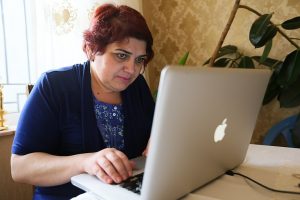
Journalist Khadija Ismayilova was the subject of both violations this month.
12 August 2019 – Investigative reporter, Khadija Ismayilova’s request for an early end to her probation period was rejected, according to the Turan news agency.
The Binagadi district court refused to satisfy journalist’s request on the grounds the journalist was not fully recovered.
Ismayilova was released on probation in 2016 after having served a year and a half of her seven and a half year sentence. Her probationary sentence forbids Ismayilova from leaving the country or working.
Links: https://ifex.org/azerbaijan-khadija-ismayilovas-request-for-early-end-to-her-probation-rejected/
https://www.contact.az/ext/news/2019/8/free/Social/en/83009.htm
https://www.azadliq.org/a/x%C9%99dic%C9%99-ismay%C4%B1l-m%C9%99hkumlu%C4%9Fun-l%C9%99%C4%9Fvini-ist%C9%99yir/30083659.html
Categories: criminal charges/fines/sentences; subpoena/court order/lawsuit;
Sources of violation: court/judicial
Court upholds charges of tax evasion against Khadija Ismayilova
7 August 2019 – The Supreme Court of Azerbaijan upheld charges of tax evasion against investigative reporter Khadija Ismayilova, the independent Turan News Agency reported.
The journalist has been ordered to pay 45,145 Azerbaijani manats to tax authorities, who claim Ismayilova intentionally avoided paying taxes during her time as Bureau chief of Azadliq Radio.
Ismayilova said she considers the decision unlawful and that now she has exhausted all domestic legal remedies, she will take the case to the European Court of Human Rights.
Links: https://www.azadliq.org/a/x%C9%99dic%C9%99-ismay%C4%B1l%C4%B1n-m%C9%99hk%C9%99m%C9%99si/30098186.html
https://www.contact.az/ext/news/2019/8/free/Social/en/82962.htm
Categories: criminal charges/fines/sentences; subpoena/court order/lawsuit;
Sources of violation: court/judicial[/vc_column_text][/vc_column][/vc_row][vc_row][vc_column][vc_basic_grid post_type=”post” max_items=”4″ element_width=”6″ grid_id=”vc_gid:1575028108260-b66cab02-1f6d-6″ taxonomies=”8996″][/vc_column][/vc_row]
6 Sep 2019 | Campaigns -- Featured, Statements
[vc_row][vc_column][vc_column_text]Building trust in the media, achieving media sustainability, and ending impunity for murdered journalists are all issues that will be covered during the upcoming International Parliamentary Seminar on Media Freedom, which takes place in London on 9 – 11 September. The Council of Europe’s Platform for the Protection of Journalism and Safety of Journalists is relevant in this regard, as it seeks to gather and disseminate information on serious media freedom issues.
The platform was launched in 2014 in response to growing hostility toward journalists and media freedom in Europe, so as to swiftly and systematically notify the Council of Europe of pertinent issues and to empower it to take timely and coordinated action when necessary. Index on Censorship is proud to be one of the platform partners. Since 2015 we have submitted and co-sponsored nearly 300 alerts (notifications) to the platform about threats to media freedom and the safety of journalists.
Index on Censorship contributes to the platform, including by drawing on its Monitoring and Advocating for Media Freedom project, which monitors threats, limitations and violations related to media freedom in Azerbaijan, Belarus, Russia, Turkey and Ukraine. In 2018, 17 alerts were submitted to the platform relating to impunity for murdered journalists. Of these, 15 occurred in the countries covered by Index’s media freedom project: Turkey (2), Azerbaijan (2), Ukraine (5), and Russia (6).
In advance of the International Parliamentary Seminar on Media Freedom session on regional initiatives, which takes place on 10 September, Index on Censorship expresses the belief that the platform provides a model that could be replicated by other regions. Such a mechanism has the capacity to quickly draw on the knowledge and expertise of media freedom organisations and journalists’ networks, in order to promote media freedom and enhance the safety of journalists.
Index has noted with extreme concern that the number of alerts about serious threats to journalists’ lives has almost doubled on an annual basis since the launch of the Platform in 2015. We believe that stronger political commitment and practical engagement from politicians and governments is needed to support media freedom around the world. In Council of Europe states, this means that parliamentarians must fully engaging with the platform by ensuring that each alert receives a swift and comprehensive response. This is essential in order for the platform to fulfil its potential.
While Index on Censorship commends the UK’s commitment to press freedom, we note that since the beginning of 2018 seven Council of Europe alerts have concerned the UK: new counter-terrorism legislation; proposed internet regulation; the arrest of two journalists in September 2018; the killing of a journalist in April 2019; the continued impunity for the killing of a journalist who was murdered in 2001; an attack on a journalist in August 2019; and a government-backed arms fair’s (DSEI) refusal to grant two journalists accreditation. Four of these alerts have yet to receive a response.
Noting the UK’s role as one of the Council of Europe’s founding members, Index urges the UK to continue engaging with the platform and ensure it takes practical and concrete steps to promote the protection of media freedom in the UK. The UK should aim to set an example for other countries by providing prompt and detailed state replies to alerts.
Contact: Jessica Ní Mhainín, [email protected] [/vc_column_text][vc_basic_grid post_type=”post” max_items=”4″ element_width=”6″ grid_id=”vc_gid:1567768197646-934f3ae2-fe70-1″][/vc_column][/vc_row]
22 Aug 2019 | Campaigns -- Featured, Media Freedom, media freedom featured, Monitoring and Advocating Coverage, Russia, Statements
Since the electoral authorities rejected several opposition candidates for September’s city council elections, protesters have taken to the streets of Moscow on four consecutive Saturdays. Russian authorities have responded with threats, violence, and detentions.
Journalists who have been reporting on the protests have consistently been targeted. On 27 July 2019, two journalists suffered broken noses after being struck by police, one received injuries to his hands and head after being hit with a police baton, a fourth was beaten in a police van after his arrest, and a fifth received injuries from a police assault.
Police have detained dozens of reporting journalists in the last few weeks, even after they had shown their accreditation. On 3 August 2019, police detained at least fourteen journalists. One journalist was arrested even after police found his accreditation and editorial assignment when they searched him. He was released shortly afterwards, but subsequently re-arrested and taken to a police station. All eight journalists were released the same day without charge.
Several YouTube channels have been broadcasting the protests live, but on 11 August the Russian communications regulator Roskomnadzor published a statement calling on YouTube to stop “advertising” the demonstrations. The regulator said that a failure to respond would be considered “interference in its sovereign affairs” and that Russia would have the right to retaliate.
Several media freedom and journalists’ organisations have filed two alerts with the Council of Europe’s Platform to Promote the Protection of Journalism and Safety of Journalists in relation to Russia’s response to the protests. No reply has so far been received from the Russian Federation.
Jessica Ní Mhainín, Policy Research and Advocacy Officer at Index on Censorship said “Russian authorities seem to be indifferent to the fact that, by targeting protesters and journalists with violence and detentions, they are in flagrant violation of their obligations under international human rights law. But they should bear in mind that their response will only fan the flames of these pro-democracy protests. Journalists are the defenders of our democracy – without journalists and media freedom, there is no democracy”.
Nora Wehofsits, Advocacy Officer at the European Centre for Press and Media Freedom said “The violent crackdown on journalists in Russia is a violation of the freedom of the press and freedom of information. Repressing coverage on protests in favour of fair elections and against police violence – and on the oppression of those – re-affirms the need of journalists as watchdogs. It must stop”.
Ravi R. Prasad, Director of Advocacy at the International Press Institute said “Attack on journalists covering democratic protests is against the principles of democracy. The government should allow journalists to do their job without any fear of reprisal and attacks. By attacking journalists Russia is attempting to stifle press freedom and the right of its people to be informed”.
Russia is not the only country where journalists are under threat in connection with protests. Index on Censorship’s 2018 report Targeting the messenger: Journalists on the frontline of protests highlighted the challenges in European countries.
Index on Censorship
European Centre for Press and Media Freedom (ECPMF)
International Press Institute (IPI)
European Federation of Journalists (EFJ)
South East Europe Media Organisation (SEEMO)
Reporters Without Borders (RSF)
Russian Journalists’ and Media Workers’ Union (JMWU)
Committee to Protect Journalists (CPJ)
Index on Censorship’s Monitoring and Advocating for Media Freedom project monitors threats, limitations and violations related to media freedom in five countries: Azerbaijan, Belarus, Russia, Turkey and Ukraine for the purpose of identifying and analysing issues, trends and drivers and exploring possible response options and opportunities for advocating media freedom. The project collects and analyses limitations, threats and violations that affect a journalist as they do their job.
- Independent media sources have been hamstrung by restrictive legislation and police, governmental, and private interference.
- Physical assaults, detentions, lawsuits, fines, and blocked access are common. Many outlets have chosen to practice self-censorship to protect themselves.
- Strict new laws limiting press freedom have been introduced, despite having progressive press laws from the 1990s still on the books and a constitutional article guaranteeing freedom of the press.
Out of 175 violations recorded in Russia by the Monitoring and Advocating for Media Freedom project between February and June 2019, 20 were physical assaults that came from political figures, police structures, known private individuals and unknown perpetrators. Several of the cases are egregious examples of how physical violence is used to target journalists in Russia.
Read the full report
Previous report: Legislative restrictions, bomb threats and vandalism are just some of the issues Russian journalists have faced this year
