Hungarian journalist Tamás Bodoky founded the investigative news website Atlatszo.hu to promote a free press in Hungary, a country where journalists and news organisations face recently introduced media taxes, a proposed internet tax for citizens, smear campaigns and police-run office raids. Bodoky has brought together a range of crowd-sourced approaches to empower citizens in the face of this deteriorating situation for human rights, including tools to allow for anonymous reporting of corruption, to help investigate freedom of information requests (and refusals), and MagyarLeaks, a Tor-based whistleblowing service. Last year Atlatszo.hu was put on the government’s NGO blacklist, but Bodoky continues to run the site, as well as workshops to help keep investigative journalism in Hungary alive. He is the recipient of the 2015 Index on Censorship Freedom of Expression Award for Digital Activism.
Atlatszo.hu is calling on all those who believe that the independence of journalism in Hungary is under threat. All those who agree that politics and business interests have sunk their claws into everyday life. All those who know that taxpayer money is vanishing. We are calling on you to help us let the world know the truth.
Almost four years ago Atlatszo.hu pledged to tackle the uphill battle represented by these challenges.
As a watchdog NGO for investigative journalism, we set out to promote transparency and freedom of information in Hungary.
Atlatszo.hu – “atlatszo” means transparent in Hungarian – produces investigative reports, accepts information from whistleblowers, files freedom of information requests, and commences freedom of information lawsuits in cases where those requests are refused.
We are only a small group of journalists, lawyers and IT-specialists. But since the beginnings we have won more than 60 percent of FOI lawsuits we initiated. In fact we have been so successful in the courtrooms that in 2013 the governing majority introduced a bill to curtail FOI legislation which was dubbed “Lex Átlátszó” by the Hungarian press.
Looking back to 2011, when Atlatszo.hu was founded, I remember that many journalists dismissed the effort and were quite sure it wouldn’t last. We ignored these critics. We were confident that this was the way to go; to position ourselves outside the mainstream media, and to seek out alternative communication channels — because all of the main journalistic platforms were and still are severely constrained.
In Hungary, domestic journalism has come to represent the interests of local oligarchs. Multinational media firms are busy appeasing the political and economic powers that be. The advertising sector is a powerful censorship instrument – too often used to exert pressure. And every year since we started, the situation has become dramatically worse.
Now, the ruling political elite is pushing out its full arsenal. From business regulation to media control. From forcing personnel changes to diverting media outlets by prescribing countless directions. State funded public media has been reduced to a propaganda tool.
Most recently, the Hungarian government sparked a row over the foreign funding of local NGOs. The row has escalated to the extent that even groups advocating simple environmental concerns, or campaigning against corruption, are now being targeted. The only tangible reason to be found is that the government doesn’t appreciate funding going to any organization it doesn’t fully approve of.
I look at all of this, I look at my country, and I say one simple thing. I say Atlatszo will not be defeated. Hungary can have a fair and just democracy. Yes, it still can be done.
Thank you.
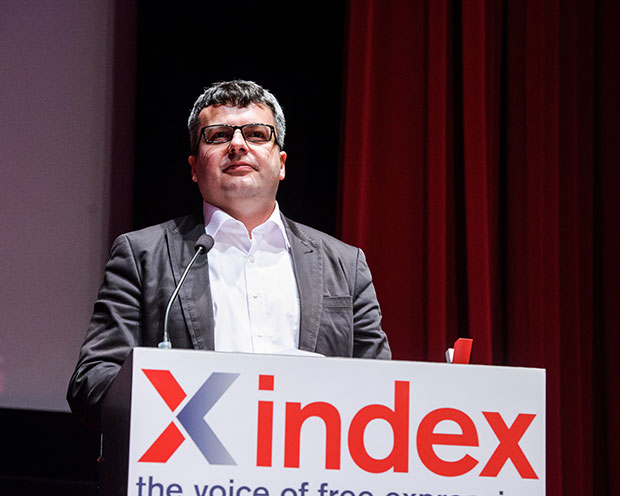
Journalist Tamas Bodoky (Photo: Alex Brenner for Index on Censorship)
A Kenyan woman speaking out for women in one of the world’s most dangerous regions and a female journalist who exposed an unreported uprising in Saudi Arabia are among the winners of this year’s Index on Censorship Freedom of Expression Awards.
“Our shortlisted nominees are all tackling direct and serious threats to stifle free speech,” said Index on Censorship CEO Jodie Ginsberg. “We were humbled and inspired by their stories, and their dedication to ensuring we can all speak freely.”
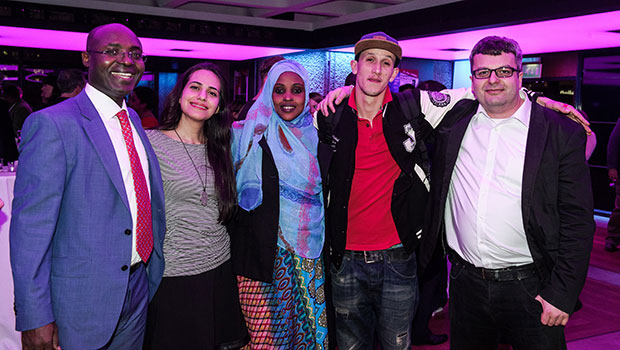
Index on Censorship 2015 Freedom of Expression award winners: Rafael Marques de Morais (journalism), Safa Al Ahmad (journalism), Amran Abdundi (campaigning), Mouad “El Haqed” Belghouat (arts) and Tamas Bodoky (digital activism) (Photo: Alex Brenner for Index on Censorship)
Awards are presented in four categories: journalism, arts, campaigning and digital activism. The winners were Saudi journalist Safa Al Ahmad and Angolan reporter Rafael Marques de Morais (journalism – jointly awarded); Moroccan rapper “El Haqed” (arts); Kenyan women’s rights campaigner Amran Abdundi (campaigning); and Hungarian freedom of information website Atlatszo (digital activism).
The crime of free expression
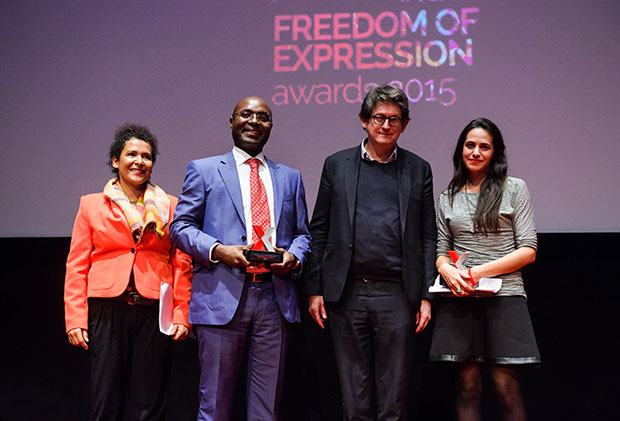
Journalist and campaigner Mariane Pearl, journalism award recipient Rafael Marques de Morais, Guardian editor Alan Rusbridger and journalism award recipient Safa Al Ahmad (Photo: Alex Brenner for Index on Censorship)
Al Ahmad was recognised for her documentary Saudi’s Secret Uprising, which exposed details of an unreported mass demonstration in Saudi Arabia. “Safa Al Ahmad dared to go into places that are difficult for women and for reporters, to bring that information back and share it with the world,” said Turkish author Elif Shafak, one of the five judges. Saudi Arabia is a mystery, even to its own people, said Al Ahmad in her acceptance speech: “Parts of our history is deliberately concealed, the present is muddled with rumours and half-truths. The government-owned and controlled media play a major role in the dissemination of those false realities of ourselves and others. This makes facts a precious commodity in Saudi Arabia.”
Angolan investigative reporter Marques de Morais has been repeatedly prosecuted for his work exposing government and industry corruption and will go on trial on 24 March charged with defamation. “Rafael is a very important individual doing very important work in a very, very difficult environment,” said judge Sir Keir Starmer QC. Marques de Morais dedicated his speech to the Zone 9 group of Ethiopian bloggers currently in jail “for the crime of exercising their right to freedom of expression”.
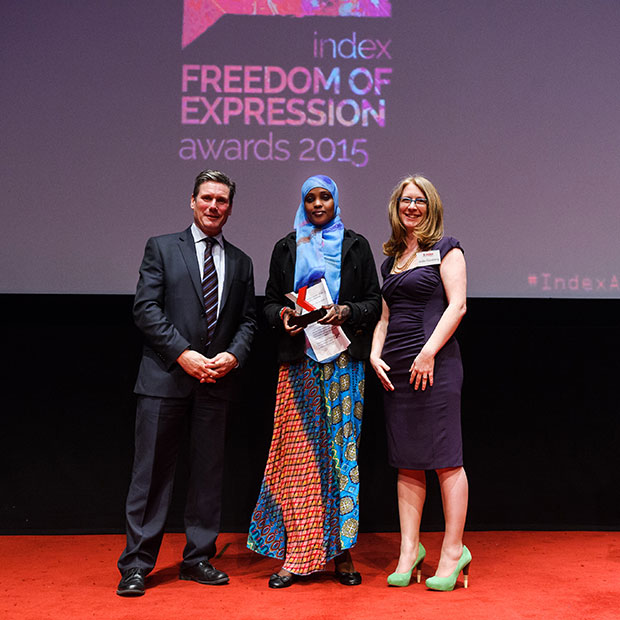
Doughty Street barrister Keir Starmer, campaigning award recipient Amran Abdundi and Index on Censorship CEO Jodie Ginsberg (Photo: Alex Brenner for Index on Censorship)
The winner in the campaigning category, Amran Abdundi, is a women’s rights activist based in north-eastern Kenya and runs a group helping women along the dangerous border with Somalia, where terrorism and extremist violence dominate. Judge Martha Lane Fox said: “Amran Abdundi was a standout candidate for me. She is doing something incredibly powerful in an unbelievably complicated and dangerous situation.” Abdundi dedicated her award to the “marginalised women of northern Kenya… who will now know that their struggles and their efforts to fight for their rights are being recognised internationally”.
Help us let the world know the truth
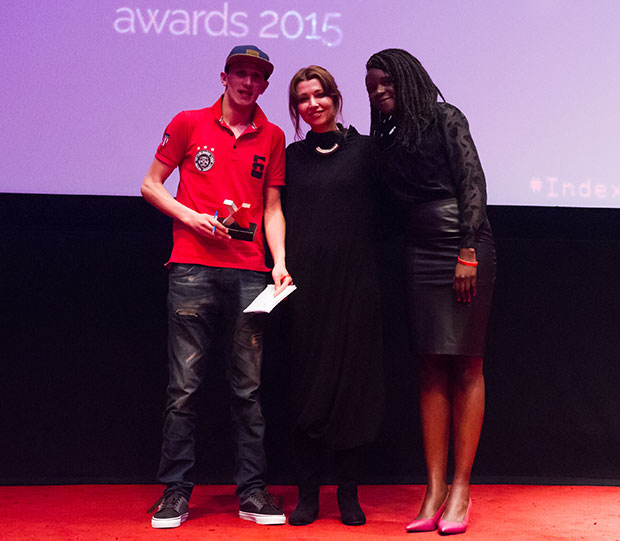
Arts category winner Mouad “El Haqed” Belghouat, novelist Elif Shafak and actor Stella Odunlami (Photo: Alex Brenner for Index on Censorship)
Arts category winner Mouad “El Haqed” Belghouat is a Moroccan rapper and human rights activist whose music highlights widespread poverty and endemic government corruption in Morocco. He has been imprisoned on spurious charges three times in as many years, most recently in 2014. Belghouat said in his acceptance speech: “I have been through difficult times: I was jailed, fired from my work, rejected by many friends. I am still forbidden to sing in my own country. But after all that I am still determined that I will never change my position. I will fight for freedom, equality and human rights for ever.” Lane Fox said Belghouat had taken his music and “translated it into a kind of online activism, but then, crucially, mobilised people in the street”.
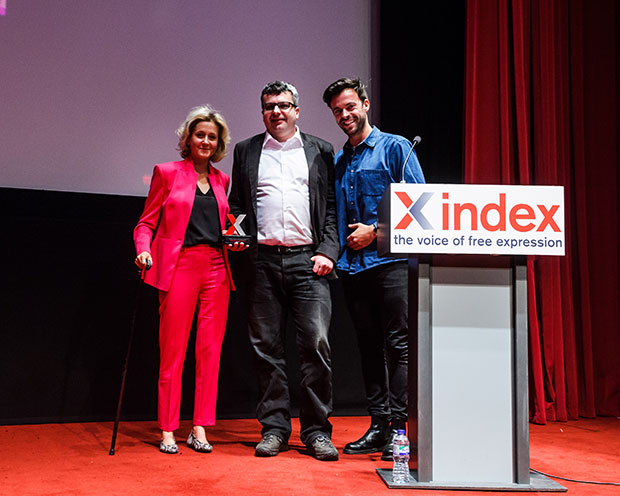
The digital award, decided by public vote, went to Hungarian investigative news outlet Atlatszo.hu managed by Tamás Bodoky. The website acts as watchdog to a Hungarian government which has increasingly tightened its grip on press freedom in the country. Editor-in-chief Bodoky said Atlatszo.hu called on all those who believe that independent journalism in Hungary is under threat. “All those who agree that politics and business interests have sunk their claws into everyday life. All those who know that taxpayer money is vanishing. We are calling on you to help us let the world know the truth.”
Entrepreneur Martha Lane Fox, digital activism award recipient Tamas Bodoky and actor Jolyon Rubinstein (Photo: Alex Brenner for Index on Censorship)
The awards were presented by the judges along with special guests including Guardian editor Alan Rusbridger.
A special award was also given on the evening to honour the many Azerbaijani journalists and activists jailed or forced into exile or hiding following a recent crackdown by the government. Former award winner and journalist Idrak Abbasov, who was forced to flee Azerbaijan last year, accepted the award on behalf of all those facing persecution in the country. “I call upon the world community to help Azerbaijan… so that our colleagues might be released and that our country might become a normal state in which we and others might live freely,” Abbasov told the audience in a video speech.
The evening featured an exhibition of specially commissioned cartoons by international cartoonists, reflecting on the past 12 months for free expression. Most of the artists had direct experience of persecution over their work, including Syrian political cartoonist Ali Ferzat – a former Index award winner – and Malaysia’s Zunar. “In the wake of the attacks on Charlie Hebdo, we wanted to pay homage to the work of cartoonists who are so often the first to face censorship in any move to stifle free expression,” said Index’s Jodie Ginsberg.
Amran Abdundi is an activist who, through various channels, has worked to make life safer in northeastern Kenya – supporting women who are vulnerable to rape, female circumcision and murder. Despite death threats, Abdundi’s Frontier Indigenous Network (FIN) has set up shelters along the dangerous border between Kenya and Somalia, an area where militant terrorist groups pose a threat to many. Alongside these shelters, FIN also maps out conflict areas, targets the illegal arms trade which fuels local conflict and has set up radio listening groups. As a way of reaching women in remote areas, these circles help to dispel myths about tuberculosis treatment and female property ownership, and to tackle doctrines spread by the area’s terror organisations. She is the recipient of the 2015 Index on Censorship Freedom of Expression Award for Campaigning.
I want to thank the judges who selected me for this award after going through so many worthwhile and wonderful nominations that were submitted from around the world. Equally I want to thank Index on Censorship’s staff. I will be eternally indebted to you all.
This award goes to marginalised women of northern Kenya whom I have worked with closely for the last ten years and who have joined hands with me in fighting outdated cultural practices that deny them the right to own property, expose them to dangerous practices like FGM, and threaten them with sexual exploitation.
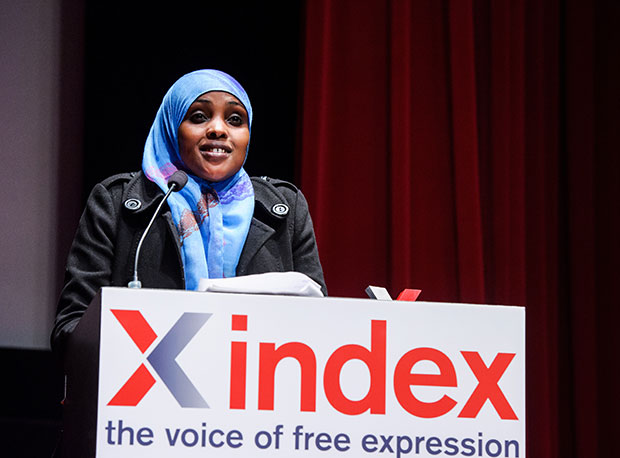
Women’s rights activist Amran Abdundi (Photo: Alex Brenner for Index on Censorship)
The award also goes to conflict concubines who were abducted by armed youths in the height of armed violence in northern Kenya and acted as comfort women for armed militias. When these women came back from conflict zones with children born out of wedlock, they were rejected by their families. This award is for them.
Society rejected them and they live in separate makeshift areas outside normal settlement areas in northern Kenya. Working together with the conflict concubines we engaged various stakeholders — women leaders, elders, local government officials, cultural leaders and youths in order to open a dialogue. This led to partial acceptance by the community in accommodating them. I am still working in engaging the stakeholders to fully accept them and still hope to integrate the conflict concubines in mainstream society.
This award also goes to women who through my organizational campaign are today enjoying their constitutional right to own property, land and livestock. This is contrary to past practice when all lands, livestocks and properties acquired by women was registered in name of their husbands. Or if the woman was single or widowed, her brother or father’s name. Our campaign and advocacy managed to break that outdated cultural practice.
The award also goes to women victims of armed violence perpetrated by terrorist groups, community militias and gangs along the Kenya/Somalia border. Thugs who have used their armed power to attack, rape, gang rape and block women fleeing droughts from reaching Dadaab refugee camp in northern Kenya. We used our loud speakers to confront the attackers and we documented the abuses along the border.
I have done all these things not to win any award or recognition but because of a grave reality on the ground. A horror which moved me to join hands with other women and form a woman-led organisation called FRONTIER INDIGENOUS NETWORK.
As a founder member I started as community mobiliser and now I am Executive Director. Because of my work and campaigns I have been called many names by those people who are opposed to change. I cannot mention those names here — they are unprintable or not worth mentioning. But this award also goes to them too.
Thank you Index on Censorship for selecting my work in northern Kenya for this award. The women of northern Kenya will now know that their struggles and their efforts to fight for their rights are being recognised internationally.
Today is my birthday and it will be a birthday that I will never forget. It will be in my mind for the rest of my life. You are a true partner of the women of northern Kenya. Thank you.
Moroccan rapper and human rights activist Mouad “El Haqed” Belghouat (roughly translated as “the enraged”) has not only seen his songs censored and his album banned but has also been imprisoned three times since 2011 – including a one-year jail term for lyrics critical of the police in his song Dogs of the State. Imprisoned for four months in 2014, after seeing witnesses at his trial stopped from testifying and key pieces of evidence barred, El Haqed continues to make music about endemic corruption in the Moroccan state and widespread poverty in his country. He is the recipient of the 2015 Index on Censorship Freedom of Expression Award for Arts.
I take this opportunity to thank you for this honour, especially Helen and David for everything they did for me to obtain my visa to be here today among you. And I can’t forget the many people who believe in my case and helped me through since I was jailed for the first time in 2011. I’m sorry that I can’t reveal more names but I will remember you forever.
While I was writing this speech, I didn’t know yet if I would be able to join you or not — because so often my visa applications have been refused. I hope future generations will have more freedom to travel without obstacles — because the earth belongs to us and we belong to it.
I’m very honoured by this nomination and I dedicate it to the soul of my mother and to all people who were prisoners, or are right now still incarcerated, or will be prisoners in the future because of their mere thoughts or opinions.
I was jailed three times because of my opinions. It would take a long time to speak about each arrest, so to make a long story short, just a few words on why they arrested me each time:
The first time: because of my activities in 20 February movement. We were asking for freedom, equality and democracy.
The second time: because of a song that someone else uploaded to YouTube three years earlier. It doesn’t make sense at first, but it does when you realise that it didn’t allow me to finish the album I was working on.
The third time: the same old story. I was going to a stadium and they arrested me because I continue to refuse to change my positions.
I have been through difficult times: I was jailed, fired from my work, rejected by many friends. I am still forbidden to sing in my own country. But after all that I am still determined that I will never change my position. I will fight for freedom, equality and human rights for ever.
I am very happy to have the chance to speak freely in front of you today. I hope I will one day be able to speak freely and sing in my own country in front of my fans.
Right now, as we celebrate, there are a lot of people behind bars because of their opinions. I hope for freedom for them really soon.
Freedom of expression is your arm. Lift it to fight for dignity and equality. Even if they kill us or jail us they cannot do the same with our thoughts or opinions. You cannot kill an idea or opinion. You cannot put it behind bars.
Thank you again everyone and have a great evening.
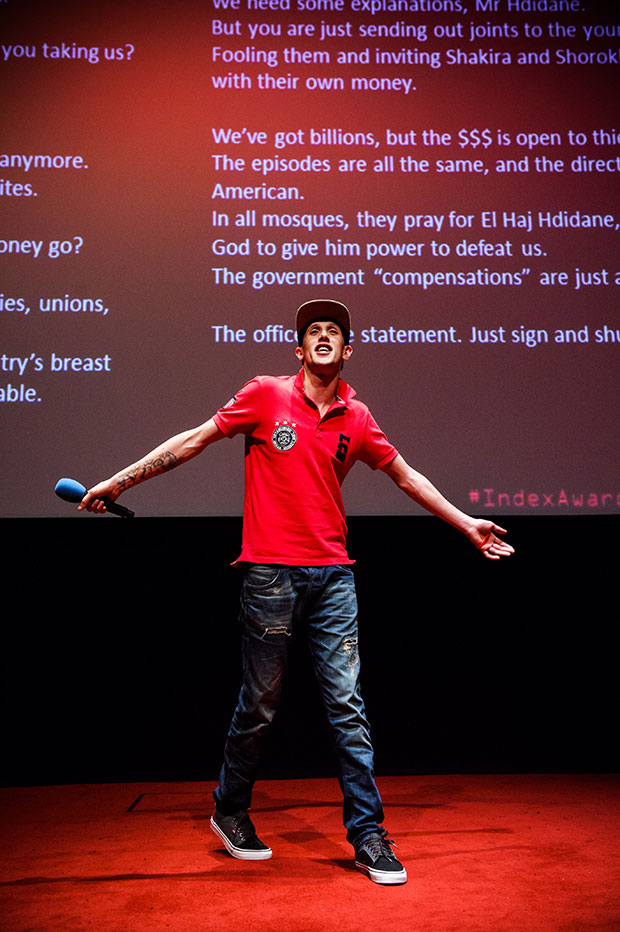
Banned from performing at home in Morocco, Arts category winner Mouad “El Haqed” Belghouat sang at the Index awards (Photo: Alex Brenner for Index on Censorship)