19 Jun 2014 | Azerbaijan Statements, Campaigns, Digital Freedom, Digital Freedom Statements
The following is a transcript of a joint oral statement, led by ARTICLE 19 and supported by several IFEX members, that was read aloud today, 19 June 2014, at the 26th UN Human Rights Council session in Geneva:
Thank you Mr. President,
Two years ago this Council affirmed by consensus that “the same rights that people have offline must also be protected online, in particular freedom of expression”.
In 2014, the outcome document of Net-Mundial in Brazil recognised the vital role of the internet to achieve the full realisation of sustainable development goals. 31 UN Special Rapporteurs recently affirmed that guaranteeing the free-flow of information online ensures transparency and participation in decision-making, enhancing accountability and the effectiveness of development outcomes.
Development and social inclusion relies on the internet remaining a global resource, managed in the public interest as a democratic, free and pluralistic platform. States must promote and facilitate universal, equitable, affordable and high-quality Internet access for all people on the basis of human rights and net-neutrality, including during times of unrest.
The blocking of communications, such as the shutdown of social media in Malaysia, Turkey, and Venezuela is a violation of freedom of expression and must be condemned. Dissent online must be protected. We deplore the detention of Sombat Boonngamanong in Thailand, who faces up to 14 years imprisonment for using social media to urge peaceful resistance to the recent military coup in the form of a three-finger salute.
One year after the Snowden revelations, this Council must recognise that trust in the internet is conditional on respect for the rights to freedom of expression and privacy online, regardless of users’ nationality or location. Any mass (or dragnet) surveillance, which comprises collection, processing and interception of all forms of communication, is inherently disproportionate and a violation of fundamental human rights.
The targeted interception and collection of personal data must be conducted in accordance with international human rights law, as set out in the necessary and proportionate principles. Critical and intermediate infrastructure must not be tampered with for this end, nor should any system, protocol or standard be weakened to facilitate interception or decryption of data.
ARTICLE 19 urges the Human Rights Council to take action to comprehensively address these challenges.
Thank you.
Signed,
ActiveWatch – Media Monitoring Agency
Africa Freedom of Information Centre
Albanian Media Institute
Arabic Network for Human Rights Information
ARTICLE 19
Association of Caribbean Media Workers
Bahrain Center for Human Rights
Cairo Institute for Human Rights Studies
Cambodian Center for Human Rights
Canadian Journalists for Free Expression
Center for Independent Journalism – Romania
Center for Media Freedom and Responsibility
Egyptian Organization for Human Rights
Foro de Periodismo Argentino
Foundation for Press Freedom – FLIP
Freedom Forum
Human Rights Watch
Index on Censorship
Institute for the Studies on Free Flow of Information
International Press Institute
Maharat Foundation
Media, Entertainment and Arts Alliance
Media Institute of Southern Africa
Media Rights Agenda
National Union of Somali Journalists
Norwegian PEN
Pacific Islands News Association
Pakistan Press Foundation
PEN Canada
Privacy International
Reporters Without Borders
Southeast Asian Press Alliance
South East European Network for Professionalization of Media
West African Journalists Association
World Association of Community Radio Broadcasters – AMARC
Access
Alternative Informatics
Asian Forum for Human Rights and Development (FORUM-ASIA)
Association for Progressive Communications (APC)
Bangladesh Internet Governance Forum
Bangladesh NGOs Network for Radio and Communications (BNNRC)
Barys Zvozskau Belarusian Human Rights House
Big Brother Watch
Bir Duino (Kyrgyzstan)
Bits of Freedom
Bolo Bhi Pakistan
Bytes For All
Center for e-parliament Research
Centre for Internet & Society
Center for National and International Studies, Azerbaijan
Center for the Development of Democracy and Human Rights, Russia
Chaos Computer Club
CIVICUS: World Alliance for Citizen Participation
Digital Rights Foundation, Pakistan
Electronic Privacy Information Center
English Pen
European Centre for Not-for-Profit Law (ECNL)
Helsinki Citizens’ Assembly – Vanadzor
Human Rights Monitoring Institute, Lithuania
International Centre for Not-for-Profit Law (ICNL)
International Federation for Human Rights (FIDH)
Kazakhstan International Bureau for Human Rights and Rule of Law
Kenya Human Rights Commission
Liberty
OpenMedia.org
Open Net Korea
Open Rights Group
Panos Institute West Africa
Samuelson-Glushko Canadian Internet Policy & Public Interest Clinic (CIPPIC)
Simon Davies, publisher of “Privacy Surgeon”
Thai Netizen Network
Zimbabwe Human Rights Forum
12 Jun 2014 | Europe and Central Asia, Magazine
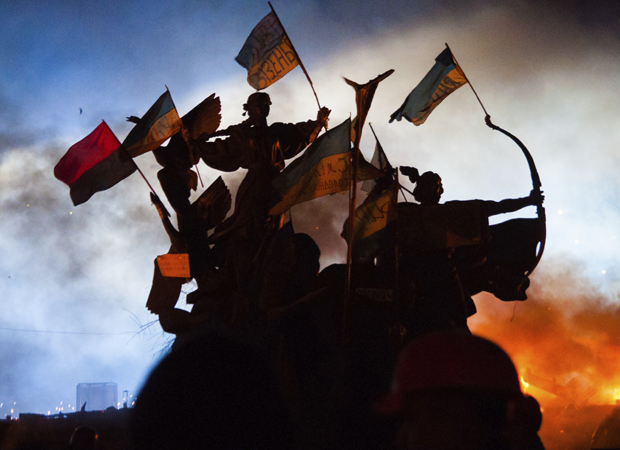
Twenty five years ago this autumn the Berlin Wall was pulled down and a wave of euphoria swept not just across that city, but across Europe, and then the world. When, also in 1989, Francis Fukuyama wrote we were seeing the “end of history” it seemed to make sense. His essay suggested not that history was over, but a new era was coming, one in which liberal democracy had defeated authoritarianism and the world would now inevitably become more free.
In the wake of the fall, eastern European nations swapped authoritarian regimes for democratic governments. And people who lived behind that wall were now able to travel more easily, read news that had previously been censored, and listen to music that had been forbidden. Many got the chance to vote in their first free election, with a choice of parties, and even had the option not to vote at all.
Bricks were falling and barriers were coming down as that long line of wire and sentry posts that had divided a continent was dismantled.
A quarter of a century on and the bubble of optimism is deflating. The two world superpowers of the 1980s, the US and Russia, are squaring up again, with presidents Putin and Obama exchanging threats and counter threats. In parts of the former Soviet Union little appears to have changed for the better with attacks on gay people, anti-gay legislation and the introduction of blasphemy and anti-swearing laws. In Belarus and Azerbaijan the hope for freedom still exists, but an atmosphere of fear prevails. Journalists there still live in fear of being beaten up, imprisoned or put under house arrest for writing articles that report problems that dictators would rather not have reported. Internet restrictions stop news being distributed, and samizdat, the opposition’s underground newspapers of the Soviet era, continues to exist in Belarus. Further west of Moscow things are better than they were. Freedom to travel, write and read what you want came with the new era. But there are ominous signs. In Hungary there has been a rise in discrimination against minority groups such as the Roma, swastikas painted on Jewish gravestones, and a rise in support for fascist groups. In Poland there are similar reports of upsurges in extremism and homophobia. That initial post-wall swell of enthusiasm for change has been replaced by cynicism and anxiety.
Across Europe a strand of nasty nationalism is striding into the political arena. And weeks after Russia occupied Crimea, and continues to stand at the redrawn borders of Ukraine, the European landscape looks almost as anxious and divided as it did in the days of presidents Reagan and Brezhnev. Fears about a new Cold War feel well founded. If history teaches us anything, it should teach us to expect situations to repeat themselves, and to learn from the past.
History is certainly playing a part in these cycles. The narratives of hate often use a rewriting of history to make their case. “Those people hated us, so now we can hate them,” argues one set. “They supported the Nazis in the war,” argues one more. “The Jews might have had it bad, but it was just as bad for the non-Jewish Poles,” argues another.
A new memorial to a pro-Nazi leader in Hungary has been erected, and writers with far-right connections are now on the country’s school curriculum. Austerity has given the nasty nationalists an opportunity to tell a new story about Europe. It’s too open; it’s too competitive for jobs; our young people don’t have enough opportunities; it’s all the fault of (a group can be named here). And all this creates distant echoes of German voices in the 1930s. Austerity and high levels of unemployment open up an angry fear of a troubled future where people will have less than they have now, often an excuse for popular support for repressive legislation. Politicians and wannabe politicians are drawing out emotional memories of Russia’s fight against the Nazis; WWII victories; and myths of Russia resplendent in centuries past or Hungary split and defeated, then mixing with nostalgia, a cupful of anger and a return to religiosity, in some cases, to present the case for tighter drawn laws that ban free speech or allow states to clampdown on groups they don’t like.
The past is being rewritten.
So, have the expected gains been as nought? In her article for this issue, Irena Maryniak argues that the dividing line in Europe still exists, but it has now shifted further east, along the eastern border of the Baltic states and down the western border of Belarus. To the east there is a greater expectation of conformity and that the group is greater than the individual. There are fault lines where tensions explode and where the push and pull from decades and where arguments about national identity and geo-political pressures result in sudden uprisings and anger. Meanwhile, Konstanty Gebert, who was a leading Solidarity journalist and continues to work as a writer, charts the public’s disillusionment with the “free” press in Poland. He explores why the newly independent media was not as willing to investigate stories as objectively as it should have done, and how people’s trust in the media has dissolved.
Our three German writers on the post-wall era explore different themes. Crime writer Regula Venske looks at the expectation that Germany would have a cohesive national identity by now, but her exploration through crime novels of the country’s image of itself shows a nation more comfortable with itself as regional rather than national. Matthias Biskupek looks back at theatre and literature censored in the former East Germany; while academic and writer Thomas Rothschild has felt his optimism ebb away. Meanwhile Generation Wall, our panel of under 25-year-olds from eastern Europe, speak to their parents’ generation about the past and talk about their present.
Clearly it’s not all bad news. Those members of Generation Wall are mentally and physically well travelled in a way that the older generation was not able to enjoy. They have experienced a life mostly uncensored. Freedom House’s influential Freedom in the World report shows that the number of countries rated as “free” has swept from 61 to 88, and four more than 1989 are rated “partly free”.
And as this year’s Eurovision Song Contest showed there are protests across Europe at the heavy handed tactics of Russian authorities, and at their attitudes to minorities. While a Eurovision audience booing at the Russian contestants or Russia’s neighbours reducing their traditional 12 votes won’t have a long-term effect, it is a sign of an airing of opinions from traditional Russian allies. Bloc voting, so long a tradition in Eurovision, appeared to be breaking down. The end of history has not happened, but learning from the past should never go away.
This article was published in the Summer 2014 issue of Index on Censorship magazine.
12 Jun 2014 | Azerbaijan, Azerbaijan News, Bahrain, Brazil, China, Draw the Line, Russia
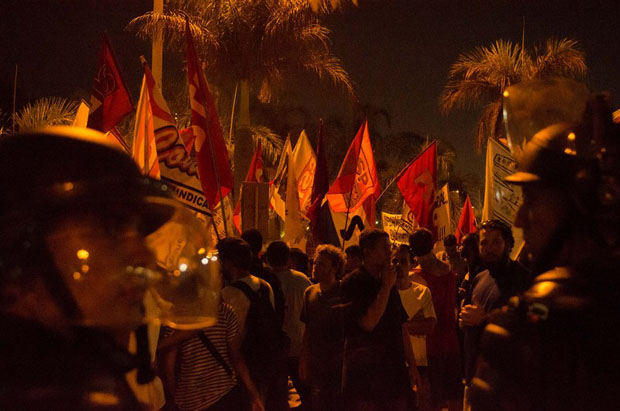
Protests against increase in public transportation costs in Rio de Janeiro on 13 February (Image: Mauricio Fidalgo/Demotix)
The World Cup — arguably the biggest international event on the planet — is upon us once more. But in the past year, Brazilians have been using their rights to free expression to organise large-scale protests to show their dissatisfaction with hosting the tournament. Meanwhile, revelations of serious human rights violations and corruption related to 2022 host Qatar have emerged. This year, human rights are sharing the spotlight with the beautiful game and its stars.
This isn’t the first time politics and sports have mixed. Just think of the Formula 1 Grand Prix races hosted in Gulf kingdom Bahrain, where authorities have cracked down on pro-democracy protesters; or the 2008 Olympics organised by the Chinese communist regime, which employs two million people to help monitor web activity; or the 1978 World Cup held in then-military dictatorship Argentina. More recently, Vladimir Putin’s Russia hosted the Winter Olympics (and will host the 2018 World Cup) not long after implementing homophobic legislation targeting so-called “gay propaganda”, while Belarus, which has been ruled by dictator Alexander Lukashenko since 1994, organised the 2014 Ice Hockey World Championship. Azerbaijan, with its, according to the latest figures, 142 political prisoners, is playing host to the inaugural European Games in 2015.
That’s without even considering the many human rights abuses perpetrated by authorities in participating countries.
The question that often comes up when these huge, prestigious events roll around, is how do we respond to the countries that repress their citizen’s free expression? Should we boycott? Should we use the attention to raise our voice on human rights abuses? Should we engage or ignore? Get involved the discussion using the hashtag #IndexDrawtheLine and tell us — where do you draw the line?
This article was published on June 12, 2014 at indexoncensorship.org
6 Jun 2014 | Azerbaijan News, Digital Freedom, News

(Image: Bplanet/Shutterstock)
Croatia’s new criminal code has introduced “humiliation” as an offence — and it is already being put to use. Slavica Lukić, a journalist with newspaper Jutarnji list is likely to end up in court for writing that the Dean of the Faculty of Law in Osijek accepted a bribe. As Index reported earlier this week, via its censorship mapping tool mediafreedom.ushahidi.com: “For the court, it is of little importance that the information is correct – it is enough for the principal to state that he felt humbled by the publication of the news.”
These kinds of laws exist across the world, especially under the guise of protecting against insult. The problem, however, is that such laws often exist for the benefit of leaders and politicians. And even when they are more general, they can be very easily manipulated by those in positions of power to shut down and punish criticism. Below are some recent cases where just this has happened.
Tajikistan
On 4 June this year, security forces in Tajikistan detained a 30-year-old man on charges of “insulting” the country’s president. According to local press, he was arrested after posting “slanderous” images and texts on Facebook.
Iran
Eight people were jailed in Iran in May, on charges including blasphemy and insulting the country’s supreme leader Ayatollah Ali Khamenei on Facebook. They also were variously found guilty of propaganda against the ruling system and spreading lies.
India
Also in May this year, Goa man Devu Chodankar was investigated by police for posting criticism of new Indian Prime Minister Narendra Modi on Facebook. The incident was reported the police someone close to Modi’s Bharatiya Janata Party (BJP), under several different pieces of legislation. One makes it s “a punishable offence to send messages that are offensive, false or created for the purpose of causing annoyance or inconvenience”.
Swaziland
Human rights lawyer Thulani Maseko and journalist and editor Bheki Makhubu were arrested in March this year, and face charges of “scandalising the judiciary” and “contempt of court”. The charges are based on two articles, written by Maseko and Makhubu and published in the independent magazine the Nation, which strongly criticised Swaziland’s Chief Justice Michael Ramodibedi, levels of corruption and the lack of impartiality in the country’s judicial system.
Venezuela
In February this year, Venezuelan opposition leader Leopoldo Lopez was arrested on charges of inciting violence in the country’s ongoing anti-government protests. Human Rights Watch Americas Director Jose Miguel Vivanco said at the time that the government of President Nicholas Maduro had made no valid case against Lopez and merely justified his imprisonment through “insults and conspiracy theories.”
Zimbabwe
Student Honest Makasi was in November 2013 charged with insulting President Robert Mugabe. He allegedly called the president “a dog” and accused him of “failing to do what he promised during campaigns” and lying to the people. He appeared in court around the same time the country’s constitutional court criticised continued use of insult laws. And Makasi is not the only one to find himself in this position — since 2010, over 70 Zimbabweans have been charged for “undermining” the authority of the president.
Egypt
In March 2013, Egypt’s public prosecutor, appointed by former President Mohamed Morsi, issued an arrest warrant for famous TV host and comedian Bassem Youssef, among others. The charges included “insulting Islam” and “belittling” the later ousted Morsi. The country’s regime might have changed since this incident, but Egyptian authorities’ chilling effect on free expression remains — Youssef recently announced the end of his wildly popular satire show.
Azerbaijan
A recent defamation law imposes hefty fines and prison sentences for anyone convicted of online slander or insults in Azerbaijan. In August 2013, a court prosecuted a former bank employee who had criticised the bank on Facebook. He was found guilty of libel and sentenced to 1-year public work, with 20% of his monthly salary also withheld.
Malawi
In July 2013, a man was convicted and ordered to pay a fine or face nine month in prison, for calling Malawi’s President Joyce Banda “stupid” and a “failure”. Angry that his request for a new passport was denied by the department of immigration, Japhet Chirwa “blamed the government’s bureaucratic red tape on the ‘stupidity and failure’ of President Banda”. He was arrested shortly after.
Poland
While the penalties were softened somewhat in a 2009 amendment to the criminal code, libel remains a criminal offence in Poland. In September 2012, the creator of Antykomor.pl, a website satirising President Bronisław Komorowski, was “sentenced to 15 months of restricted liberty and 600 hours of community service for defaming the president”.
This article was published on June 6, 2014 at indexoncensorship.org
