4 Feb 2014 | Digital Freedom, News
[vc_row][vc_column][vc_column_text]
Today Facebook celebrates its 10th anniversary. The social networking giant now has over 1.23 billion users, but there are still political leaders around the world who don’t want their country to have access to the site, or those who have banned it in the past amid fears it could be used to organise political rallies.
North Korea
Perhaps the most secretive country in the world little is known about internet access in Kim Jong-un’s nation. Although a new 3G network is available to foreign visitors, for the majority of the population the internet is off limits. But this doesn’t seem to bother many who, not knowing any different, enjoy the limited freedoms offered to them by the country’s intranet, Kwangmyong, which appears to be mostly used to post birthday messages.
A limited number of graduate students and professors at Pyongyang University of Science and Technology do have access to the internet (from a specialist lab) but in fear of the outside world many chose not to use it. Don’t expect to see Kim Jong-un’s personal Facebook page any time soon.
Iran
In Iran, however, political leaders have taken to social media- despite both Facebook and Twitter officially being extraordinarily difficult to access in the country. Even President Hassan Rouhani has his own Twitter account, although apparently he doesn’t write his own tweets, but access to these accounts can only be gained via a proxy server.
Facebook was initially banned in the country after the 2009 election amid fears that opposition movements were being organised via the website.
But things may be beginning to looking up as Iran’s Culture Minister, Ali Jannati, recently remarked that social networks should be made accessible to ordinary Iranians.
China
The Great Firewall of China, a censorship and surveillance project run by the Chinese government, is a force to be reckoned with. And behind this wall sits the likes of Facebook.
The social media site was first blocked following the July 2009 Ürümqi riots after it was perceived that Xinjiang activists were using Facebook to communicate, plot and plan. Since then, China’s ruling Communist Party has aggressively controlled the internet, regularly deleting posts and blocking access to websites it simply does not like the look of.
Technically, the ban on Facebook was lifted in September 2013. But only within a 17-square-mile free-trade zone in Shanghai and only to make foreign investors feel more at home. For the rest of China it is a waiting game to see if the ban lifts elsewhere.
Cuba
Facebook isn’t officially banned in Cuba but it sure is difficult to access it.
Only politicians, some journalists and medical students can legally access the web from their homes. For everyone else the only way to connect to the online world legally is via internet cafes. This may not seem much to ask but when rates for an hour of unlimited access to the web cost between $6 and $10 and the average salary is around $20 getting online becomes ridiculously expensive. High costs also don’t equal fast internet as web pages can take several minutes to load: definitely not value for money for the Caribbean country.
Bangladesh
The posting of a cartoon to Facebook saw the networking site shut down across Bangladesh in 2010. Satirical images of the prophet Muhammad, along with some of the country’s leaders, saw one man arrested and charged with “spreading malice and insulting the country’s leaders”. The ban lasted for an entire week while the images were removed.
Since then the Awami-League led government has directed a surveillance campaign at Facebook, and other social networking sites, looking for blasphemous posts.
Article continues below[/vc_column_text][/vc_column][/vc_row][vc_row][vc_column][vc_custom_heading text=”Stay up to date on freedom of expression” font_container=”tag:p|font_size:28|text_align:left” use_theme_fonts=”yes”][vc_separator color=”black”][/vc_column][/vc_row][vc_row][vc_column width=”1/2″][vc_column_text]
Index on Censorship is a nonprofit that defends people’s freedom to express themselves without fear of harm or persecution. We fight censorship around the world.
To find out more about Index on Censorship and our work protecting free expression, join our mailing list to receive our weekly newsletter, monthly events email and periodic updates about our projects and campaigns. See a sample of what you can expect here.
Index on Censorship will not share, sell or transfer your personal information with third parties. You may may unsubscribe at any time. To learn more about how we process your personal information, read our privacy policy.
You will receive an email asking you to confirm your subscription to the weekly newsletter, monthly events roundup and periodic updates about our projects and campaigns.
[/vc_column_text][/vc_column][vc_column width=”1/2″][gravityform id=”20″ title=”false” description=”false” ajax=”false”][/vc_column][/vc_row][vc_row][vc_column][vc_separator color=”black”][/vc_column][/vc_row][vc_row][vc_column][vc_column_text]Egypt
As Egyptians took to the streets in 2011 in an attempt to overthrow the regime of Egyptian President Hosni Mubarak the government cut off access to a range of social media sites. As well as preventing protestors from using the likes of Facebook to foment unrest, many websites registered in Egypt could no longer be accessed by the outside world. Twitter, YouTube, Hotmail, Google, and a “proxy service” – which would have allowed Egyptians to get around the enforced restrictions- seemed to be blocked from inside the country.
The ban lasted for several days.
Syria
Syria, however, dealt with the Arab Spring in a different manner. Facebook had been blocked in the country since 2007 as part of a crackdown on political activism, as the government feared Israeli infiltration of Syrian social networking sites. In an unprecedented move in 2011 President Bashar al-Assad lifted the five year ban in an apparent attempt to prevent unrest on his own soil following the discontent in Egypt and Tunisia.
During the ban Syrians were still able to easily access Facebook and other social networking sites using proxy servers.
Mauritius
Producing fake online profiles of celebrities is something of a hobby to some people. However, when a Facebook page proclaiming to be that of Mauritius Prime Minister Navin Ramgoolam was discovered by the government in 2007 the entire Mauritius Facebook community was plunged into darkness. But the ban didn’t last for long as full access to the site was restored the following day.
These days it would seem Dr Ramgoolam has his own (real) Facebook account.
Pakistan
Another case of posting cartoons online, another case of a government banning Facebook. This time Pakistan blocked access to the website in 2010 after a Facebook page, created to promote a global online competition to submit drawings of the prophet Muhammad, was brought to their attention. Any depiction of the prophet is proscribed under certain interpretations of Islam.
The ban was lifted two weeks later but Pakistan vowed to continue blocking individual pages that seemed to contain blasphemous content.
Vietnam
During a week in November 2009, Vietnamese Facebook users reported an inability to access the website following weeks of intermittent access. Reports suggested technicians had been ordered by the government to block the social networking site, with a supposedly official decree leaked on the internet (although is authenticity was never confirmed). The government denied deliberately blocking Facebook although access to the site today is still hit-and-miss in the country.
Alongside this, what can be said on social networking sites like Facebook has also become limited. Decree 72, which came into place in September 2013, prohibits users from posting links to news stories or other news related websites on the social media site.
This article was published on 4 February 2014 at indexoncensorship.org[/vc_column_text][/vc_column][/vc_row][vc_row][vc_column][vc_basic_grid post_type=”post” max_items=”12″ style=”load-more” items_per_page=”4″ element_width=”6″ grid_id=”vc_gid:1538131415482-d092e45b-9f66-5″ taxonomies=”136″][/vc_column][/vc_row]
27 Jan 2014 | Libya, News, Politics and Society
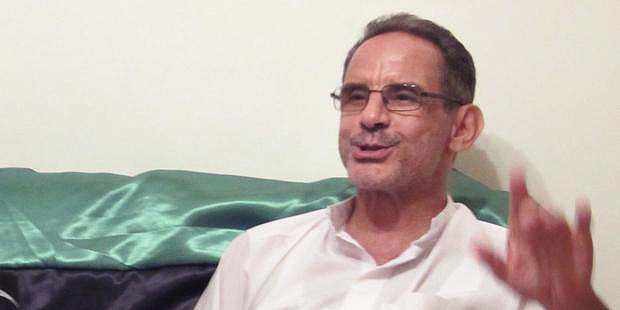
Jamal al-Hajji was convicted of defamation on 31 December 2013. (© Amnesty International)
After 42 years of political oppression in Libya, it was hoped that the apparatus of Gaddafi’s regime would be dismantled after he was swept from power. Vestiges of the despot’s suffocating grip on free speech still remain, and are still being used to suppress political expression.
Jamal al-Hajji, a writer and commentator from Tripoli, faces jail and a large fine after comments he made in a television interview in February 2013 sparked a defamation case by government figures. During an interview on al-Wataniya, a Libyan television channel, al-Hajji accused the Minister of Foreign Affairs, Mohamed Abulaziz and five other politicians and public figures of conspiring against Libya and the “17 February Revolution”.
Four of them lodged a complaint against al-Hajji, resulting in a court sentencing him to eight months in prison and a 400,000 Libyan dinar fine (around £200,000). His case is being supported by Amnesty International, who say relics from Gaddafi’s punitive legal system are being used to obstruct free speech.
“No one should be sent to prison for expressing their views. Free expression is one of the rights Libyans took to the streets to reclaim during the 2011 uprising against Muammar al-Gaddafi,” said Hassiba Hadj Sahraoui, Deputy Director of the Middle East and North Africa Programme at Amnesty International, in a statement issued on Amnesty’s website.
The charity’s Libya researcher, Magdalena Mughrabi, told Index on Censorship: “The Penal Code which is currently in use is the same as under al-Gaddafi. The Libyan authorities should immediately amend or repeal all laws and articles of the Penal Code which impose arbitrary restrictions on freedom of expression.”
Al-Hajji, now aged 58, was arrested a number of times by the Gaddafi regime — the first time in 2007 for organizing a peaceful gathering to commemorate the deaths of 12 protesters at a 2005 demonstration in Tripoli.
He spent a year in jail without charge, and was then sentenced, by the State Security Court, to twelve years imprisonment. Luckily, he was released a year later and submitted a formal complaint to the authorities, criticising the justice system, maltreatment of prisoners, and the torture and arbitrary detention of Libyan citizens.
The authorities summoned him for questioning over the document and threw him in prison for a further four months.
In 2011, he was arrested once more by police officers, who accused him of hitting a man in his car. At the time he was advocating online for peaceful protests mirroring those which had been happening in Tunisia, Egypt and other states across the Middle East.
And now, even with a new transitional regime in place, al-Hajji has found himself in prison again.
When asked if he thought the revolution had been successful, al-Hajji told Index on Censorship: “It is still going on and will continue, it will not stop until we have freedom. The military are not ready to lead this country so we will fight to remove them until we get a proper, working democracy.”
“I wouldn’t call this a new regime, these people aren’t responsible enough to run a country and in any case, many are from the old Gaddafi regime. They don’t want the laws changed because they know any new laws could be used against them.”
The law used to convict al-Hajj was Article 439 of the Libyan Penal Code, which carries a punishment of up to two years in prison as well as a fine. Several other articles of this Code prescribe prison terms for activities that would commonly be understood as freedom of expression and freedom of association. In cases where someone criticises public officials or state institutions, the recommended punishment can be the death penalty.
The same laws were used in September 2013 to charge Moad al-Hnesh, a Libyan engineer aged 34, who had campaigned against Western intervention into Libya in 2011. While living in the UK, he participated in a Stop the War Coalition demonstration outside the House of Commons in London, during which he was photographed holding a photo of a purported victim of a NATO bombing.
Following his return to Libya, he was arrested on 3rd April 2012 by a militia from Zawiya, after a group of Libyan students who had met him at Coventry University lodged a complaint against him with the Zawiya Military Council. He now faces a life sentence for criticising Libya while abroad, or a reduced sentence of fifteen years for “publically insulting the Libyan people.”
Amara Abdalla al-Khattabi, a journalist aged 67, was arrested in December 2012, a month after his newspaper had published the names of 84 allegedly corrupt judges. He was charged with “insulting constitutional or popular authorities” and also faces up to 15 years in prison. Article 195 of the Penal code was frequently used in the al-Gaddafi era to repress freedom of expression.
Al-Hajji is currently on bail and has an appeal hearing scheduled for 13th February.
This article was posted on 27 January 2014 at indexoncensorship.org
21 Jan 2014 | Middle East and North Africa, News
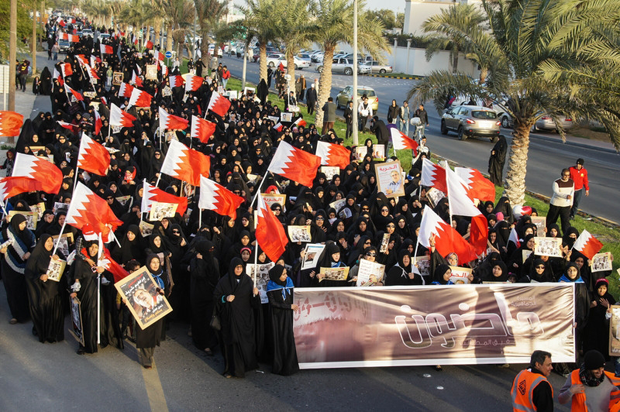
A pro-democracy protest in Bahrain, where activists have been jailed for inciting protests through their online activities (Photo: Moh’d Saeed / Demotix)
One hundred and forty characters are all it takes.
Twitter users from Marrakech to Manama know—call for political reforms, joke about a sensitive topic, or expose government abuse and you could end up in jail. Following the overthrow of Muammar Qaddafi and Zine el-Abidine Ben Ali, authorities in Libya and Tunisia unblocked hundreds of websites and dismantled the state surveillance apparatus. But overall, internet freedom in the region has only declined in the three years since the Arab Spring as authoritarian leaders continue to crack down on any and all threats to their ever-tenuous legitimacy.
As the online world has become a fundamental part of Arab and Iranian societies, leaders are waking up to the “dangers” of social media and placing new restrictions on what can be read or posted online. This shift has been most marked in Bahrain, one of the most digitally-connected countries in the world. After a grassroots opposition group took to the streets to demand democratic reforms, authorities detained dozens of users for Twitter and Facebook posts deemed sympathetic to the cause. Similarly, several prominent activists were jailed on charges of inciting protests, belonging to a terrorist organization, or plotting to overthrow the government through their online activities.
Conditions in Egypt—where social media played a fundamental role in mobilising protesters and documenting police brutality—continued to decline over the past year. In only the first six months of Mohammad Morsi’s term, more citizens were prosecuted for “insulting the office of the president” than under Hosni Mubarak’s entire 30-year reign. Cases have now been brought against the same bloggers and activists that were instrumental in rallying the masses to protest against Mubarak (and later Morsi) in Tahrir Square, while countless others were tortured by Muslim Brotherhood thugs or state security forces.
Even in the moderate kingdoms of Morocco and Jordan, state officials are looking to extend their existing controls over newspapers and TV channels to the sphere of online media. Ali Anouzla, a website editor in Morocco, faces terrorism charges in the latest attempt by the state to silence him and his popular online newspaper, Lakome. Access to independent journalism is even worse in Jordan, where over 200 news sites have been blocked for failing to obtain a press license. The government instituted burdensome requirements in a bid to deter any views that counter the state-sponsored narrative.
If governments are beginning to pay attention, it is because online tools for social mobilisation and individual expression are having a profound impact. Social media accounts were set up for every candidate in Iran’s 2013 presidential elections, despite the fact that Twitter, Facebook, and YouTube are all blocked within the country. In Saudi Arabia – which now boasts the highest Twitter and YouTube usage per capita of any country in the world – social media has been used to promote campaigns for women’s right to drive, to highlight the mistreatment of migrant workers, and to debate sensitive subjects such as child molestation. Citizen journalism was vital in documenting chemical weapons use in Syria, and a new online platform alerts local residents of incoming scud missiles. Nonetheless, Iran, Saudi Arabia, and Syria rank as some of the least free countries in the world in terms of internet freedom according to Freedom House’s Freedom on the Net study.
Remarkably, the country that has made the most positive strides over the past three years, was once among the most repressive online environments in the region – Tunisia. Protest videos from the town of Sidi Bouzid led to an intense crackdown on online dissidents by the Ben Ali regime. Digital activists even enlisted the help of Anonymous, the hacktivist group, to rally international media attention, provide digital security tools, and bring down government websites. Since then, Tunisian authorities have ceased internet censorship, reformed the regulatory environment, and ceded control of the state-owned internet backbone. Tunisia is now the only country in the region to have joined intergovernmental group the Freedom Online Coalition.
So while the snowball effect of social media contributed to the overthrow of several despots, many of the region’s internet users conversely find themselves in more restrictive online environments than in January 2011. Authoritarian governments now know exactly what the face of revolution looks like and, over the past three years, have shown their commitment to counter the internet’s potential to empower citizens and mobilise opposition. Users in liberal democracies may joke about the insignificance of “liking” a post on Facebook or uploading a video to YouTube, but in a region where your social media activity can make you an enemy of the state, 140 characters can lead to serious repercussions.
This article was posted on 21 January 2014 at indexoncensorship.org
17 Jan 2014 | Middle East and North Africa, News, Palestine
 A leading Palestinian human rights activist has claimed that freedom of speech is far greater under the Hamas regime in Gaza than in the Fatah-controlled West Bank.
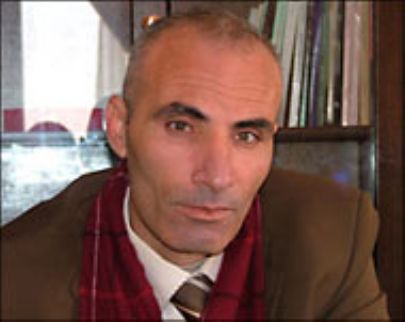
Khalil Abu Shamala, director of the al-Dameer Centre For Human Rights – which works in both Gaza and the West Bank – said that although there were still occasional arrests of Fatah members, “nowadays we don’t document many violations”.
He noted that this was partly down to Hamas’s weakness in the face of international pressures, particularly the breakdown of relations with the Egyptian regime.
In the past, Hamas has made large-scale arrests of journalists and called many others in for questioning, with opposition activists and bloggers facing harassment.
But although abuses still occurred in Gaza, Abu Shamala said that government forces in the Palestinian Authority–controlled West Bank took much harsher action against critics.
“Freedom of expression in Gaza is better than in the West Bank,” he told Index on Censorship. “We have many cases where the PA arrest and attack people because they criticize them on Facebook, and many Facebookers in the West Bank use alternative names, not their real names. But here, they speak without any harassment by Hamas.”
A rift between Hamas and Fatah, which culminated in the Islamist group seizing power in the Strip in 2007, has led to the creation of two near-separate entities in Gaza and the West Bank. Hamas refuses to recognise the Jewish state and is under an embargo by Israel and the international community.
“I don’t know why, but in the West Bank, Palestinian Authority security systems have cooperation and coordination with Israel – and they don’t want to give the opportunity for a third intifada, and they don’t want to allow Hamas or those who are against the Palestinian Authority [to speak out] because they know many of the Palestinians in the West Bank hate the Palestinian Authority,” Abu Shammala continued.
Hamas has previously issued proceedings against Abu Shamala for his outspoken criticism of the Islamist group.
“After they took over Gaza, they wanted from the beginning to impose their Islamic agenda on the society,” he said, adding that his organisations and others had tried to combat these efforts.
The Hamas deputy foreign minister, Ghazi Hamed, denies that his government took any action to silence their critics.
“We are not oppressing people and people can speak loudly, can criticise the government, can criticise Hamas,” said Hamed. “We never put anyone in jail who criticizes Hamas or write something against Hamas. We have different organisations, political parties, even writers, they have full freedom to write what they want.”
