15 Jan 2014 | Europe and Central Asia, European Union, Index Reports, News, Politics and Society
This article is part of a series based on our report, Time to Step Up: The EU and freedom of expression
Beyond its near neighbourhood, the EU works to promote freedom of expression in the wider world. To promote freedom of expression and other human rights, the EU has 30 ongoing human rights dialogues with supranational bodies, but also large economic powers such as China.
The EU and freedom of expression in China
The focus of the EU’s relationship with China has been primarily on economic development and trade cooperation. Within China some commentators believe that the tough public noises made by the institutions of the EU to the Chinese government raising concerns over human rights violations are a cynical ploy so that EU nations can continue to put financial interests first as they invest and develop trade with the country. It is certainly the case that the member states place different levels of importance on human rights in their bilateral relationships with China than they do in their relations with Italy, Portugal, Romania and Latvia. With China, member states are often slow to push the importance of human rights in their dialogue with the country. The institutions of the European Union, on the other hand, have formalised a human rights dialogue with China, albeit with little in the way of tangible results.
The EU has a Strategic Partnership with China. This partnership includes a political dialogue on human rights and freedom of the media on a reciprocal basis.[1] It is difficult to see how effective this dialogue is and whether in its present form it should continue. The EU-China human rights dialogue, now 14 years old, has delivered no tangible results.The EU-China Country Strategic Paper (CSP) 2007-2013 on the European Commission’s strategy, budget and priorities for spending aid in China only refers broadly to “human rights”. Neither human rights nor access to freedom of expression are EU priorities in the latest Multiannual Indicative Programme and no money is allocated to programmes to promote freedom of expression in China. The CSP also contains concerning statements such as the following:
“Despite these restrictions [to human rights], most people in China now enjoy greater freedom than at any other time in the past century, and their opportunities in society have increased in many ways.”[2]
Even though the dialogues have not been effective, the institutions of the EU have become more vocal on human rights violations in China in recent years. For instance, it included human rights defenders, including Ai Weiwei, at the EU Nobel Prize event in Beijing. The Chinese foreign ministry responded by throwing an early New Year’s banquet the same evening to reduce the number of attendees to the EU event. When Ai Weiwei was arrested in 2011, the High Representative for Foreign Affairs Catherine Ashton issued a statement in which she expressed her concerns at the deterioration of the human rights situation in China and called for the unconditional release of all political prisoners detained for exercising their right to freedom of expression.[3] The European Parliament has also recently been vocal in supporting human rights in China. In December 2012, it adopted a resolution in which MEPs denounced the repression of “the exercise of the rights to freedom of expression, association and assembly, press freedom and the right to join a trade union” in China. They criticised new laws that facilitate “the control and censorship of the internet by Chinese authorities”, concluding that “there is therefore no longer any real limit on censorship or persecution”. Broadly, within human rights groups there are concerns that the situation regarding human rights in China is less on the agenda at international bodies such as the Human Rights Council[4] than it should be for a country with nearly 20% of the world’s population, feeding a perception that China seems “untouchable”. In a report on China and the International Human Rights System, Chatham House quotes a senior European diplomat in Geneva, who argues “no one would dare” table a resolution on China at the HRC with another diplomat, adding the Chinese government has “managed to dissuade states from action – now people don’t even raise it”. A small number of diplomats have expressed the view that more should be done to increase the focus on China in the Council, especially given the perceived ineffectiveness of the bilateral human rights dialogues. While EU member states have shied away from direct condemnation of China, they have raised freedom of expression abuses during HRC General Debates.
The Common Foreign and Security Policy and human rights dialogues
The EU’s Common Foreign and Security Policy (CFSP) is the agreed foreign policy of the European Union. The Maastricht Treaty of 1993 allowed the EU to develop this policy, which is mandated through Article 21 of the Treaty of the European Union to protect the security of the EU, promote peace, international security and co-operation and to consolidate democracy, the rule of law and respect for human rights and fundamental freedom. Unlike most EU policies, the CFSP is subject to unanimous consensus, with majority voting only applying to the implementation of policies already agreed by all member states. As member states still value their own independent foreign policies, the CFSP remains relatively weak, and so a policy that effectively and unanimously protects and promotes rights is at best still a work in progress. The policies that are agreed as part of the Common Foreign and Security Policy therefore be useful in protecting and defending human rights if implemented with support. There are two key parts of the CFSP strategy to promote freedom of expression, the External Action Service guidelines on freedom of expression and the human rights dialogues. The latter has been of variable effectiveness, and so civil society has higher hopes for the effectiveness of the former.
The External Action Service freedom of expression guidelines
As part of its 2012 Action Plan on Human Rights and Democracy, the EU is working on new guidelines for online and offline freedom of expression, due by the end of 2013. These guidelines could provide the basis for more active external policies and perhaps encourage a more strategic approach to the promotion of human rights in light of the criticism made of the human rights dialogues.
The guidelines will be of particular use when the EU makes human rights impact assessments of third countries and in determining conditionality on trade and aid with non-EU states. A draft of the guidelines has been published, but as these guidelines will be a Common Foreign and Security Policy document, there will be no full and open consultation for civil society to comment on the draft. This is unfortunate and somewhat ironic given the guidelines’ focus on free expression. The Council should open this process to wider debate and discussion.
The draft guidelines place too much emphasis on the rights of the media and not enough emphasis on the role of ordinary citizens and their ability to exercise the right to free speech. It is important the guidelines deal with a number of pressing international threats to freedom of expression, including state surveillance, the impact of criminal defamation, restrictions on the registration of associations and public protest and impunity against human right defenders. Although externally facing, the freedom of expression guidelines may also be useful in indirectly establishing benchmarks for internal EU policies. It would clearly undermine the impact of the guidelines on third parties if the domestic policies of EU member states contradict the EU’s external guidelines.
Human rights dialogues
Another one of the key processes for the EU to raise concerns over states’ infringement of the right to freedom of expression as part of the CFSP are the human rights dialogues. The guidelines on the dialogues make explicit reference to the promotion of freedom of expression. The EU runs 30 human rights dialogues across the globe, with the key dialogues taking place in China (as above), Kazakhstan, Kyrgyzstan, Tajikistan, Turkmenistan, Uzbekistan, Georgia and Belarus. It also has a dialogues with the African Union, all enlargement candidate countries (Croatia, the former Yugoslav republic of Macedonia and Turkey), as well as consultations with Canada, Japan, New Zealand, the United States and Russia. The dialogue with Iran was suspended in 2006. Beyond this, there are also “local dialogues” at a lower level, with the Heads of EU missions, with Cambodia, Bangladesh, Egypt, India, Israel, Jordan, Laos, Lebanon, Morocco, Pakistan, the Palestinian Authority, Sri Lanka, Tunisia and Vietnam. In November 2008, the Council decided to initiate and enhance the EU human rights dialogues with a number of Latin American countries.
It is argued that because too many of the dialogues are held behind closed doors, with little civil society participation with only low-level EU officials, it has allowed the dialogues to lose their importance as a tool. Others contend that the dialogues allow the leaders of EU member states and Commissioners to silo human rights solely into the dialogues, giving them the opportunity to engage with authoritarian regimes on trade without raising specific human rights objections.
While in China and Central Asia the EU’s human rights dialogues have had little impact, elsewhere the dialogues are more welcome. The EU and Brazil established a Strategic Partnership in 2007. Within this framework, a Joint Action Plan (JAP) covering the period 2012-2014 was endorsed by the EU and Brazil, in which they both committed to “promoting human rights and democracy and upholding international justice”. To this end, Brazil and the EU hold regular human rights consultations that assess the main challenges concerning respect for human rights, democratic principles and the rule of law; advance human rights and democracy policy priorities and identify and coordinate policy positions on relevant issues in international fora. While at present, freedom of expression has not been prioritised as a key human rights challenge in this dialogue, the dialogues are seen by both partners as of mutual benefit. It is notable that in the EU-Brazil dialogue both partners come to the dialogues with different human rights concerns, but as democracies. With criticism of the effectiveness and openness of the dialogues, the EU should look again at how the dialogues fit into the overall strategy of the Union and its member states in the promotion of human rights with third countries and assess whether the dialogues can be improved.
[1] It covers both press freedom for the Chinese media in Europe and also press freedom for European media in China.
[2] China Strategy Paper 2007-2013, Annexes, ‘the political situation’, p. 11
[3] “I urge China to release all of those who have been detained for exercising their universally recognised right to freedom of expression.”
[4] Interview with European diplomat, February 2013.
24 Dec 2013 | News, Religion and Culture
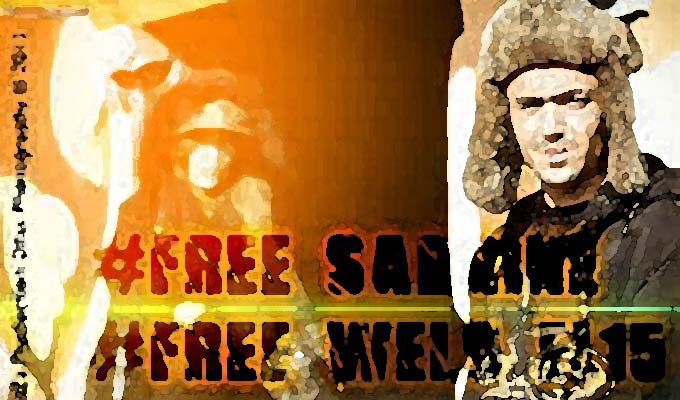
Art is one of the most prominent forms of freedom of expression, allowing people to express their thoughts through song, dance, prose and theatre. It is not uncommon across the world for performers to be attacked as a form of censorship, ultimately silencing what they are trying to say.
Ala Yaacoub- Tunisian rapper, two years imprisonment
Tunisian rapper Weld El 15, real name Ala Yaacoub, was sentenced to two years in prison after posting a song online in which he insulted and threatened police.
Yaacoub, 25, told AFP that in the rap, entitled The Police are Dogs, he used the same terms that the police use to speak about the youth: “The police have to respect citizens if they want to be respected. I am afraid because in a country like Tunisia the law is not applied; you can expect anything.”
Some of those involved in the production of the music video for the rap, including director Mohamed Hedi Belgueyed and actress Sabrine Klibi, were handed suspended sentences of six months. Yaacoub was freed a month after his trial and given a suspended six-month term.
Tunisia was the first country to be hit by the ‘Arab Spring’ after which a moderate Islamist-led government was elected after the overthrow of Zine al-Abidine Ben Ali. Since then there has been an increase in ultra-conservative Islamists, Salafists, who have been campaigning for greater public piety in Tunisia.
Aron Atabek – Kazakh poet, 18 years imprisonment
In 2007 Aron Atabek was sentenced to 18 years imprisonment following his involvement in a 2006 protest against an attempt by Kazakh authorities to flatten a shanty town; the protest ended in violent clashes and the death of a police officer.
Whilst in jail Atabek wrote poetry and prose relating to the clash which was later smuggled out of his prison and posted online. The authorities, not happy with this, sentenced Atabek to two years in solitary confinement, serving one year until November 2013. This type of punishment, in which he was watched under 24 hour video surveillance, was nothing new to the poet having spent two years in solitary confinement previously for refusing to wear a prison uniform.
Since leaving solitary confinement and returning to his previous prison Atabek’s family are still yet to have any contact with him.
Malian musicians- 12,000 singers and musicians banned from working
Islamic militants first announced a ban on music in the north of Mail in 2012; since then the ban has spread to nearly two-thirds of the country, a country from which artists such as Ali Farka Touré, Rokia Traoré and Salif Keita have witnessed global success.
After armed militants sent out death threats nearly 12,000 musicians found themselves out of work, with some facing exile, as instruments were destroyed and live venues shut down. The 2013 Festival in the Desert, a world famous Malian music event, was moved to neighbouring Burkina Faso and then later postponed due to security risks.
Fadimata “Disco” Walet Oumar was forced to flee as the conflict in Mali developed: “Life without music is not possible … I would rather die than never be able to perform, create or listen to music again in my life.”
The state of emergency has been lifted in the country and the Islamists driven out of the north of the country by the help of the French. But refugees returning to the country don’t yet believe that Mali’s problems are over.
Tunisian actors
Nineteen actors in the Tunisian city of El Kef were attacked by Salafist Muslims only to be arrested themselves by police under claims of ‘indecency’.
Whilst performing at a small theatre, to help raise funds for another venue that had been burnt down in an arson attack, the group of actors were attacked by the militant group. The performance, entitled “Guetlouh” (They Killed Him), was a tribute to opposition politician Chokri Belaid, who was assassinated in February by suspected Salafists.
The charge for indecent behaviour carries a sentence of up to six months imprisonment in Tunisia.
Lena Hendry
‘No Fire Zone: The Killing Fields of Sri Lanka’ was shown on Channel 4 in 2012, drawing in more than double the viewers of a 11pm broadcast despite the graphic content it showed. The ITN team behind the documentary went on to be nominated for a Nobel Peace Prize.
Lena Hendry, on the other hand faces jail for organising a private screening of the documentary during a human rights event in Kuala Lumpur, Malaysia.
Hendry was charged on 19 September for her involvement in the screening of the documentary on 9 July 2013 under the Film Censorship Act 2002, in connection with the screening of a video which was not vetted and approved by the Film Censorship Board of Malaysia. If convicted she faces a fine of between $1,576 and $9,455, up to three years in jail or both.
The Magistrates’ Court scheduled a final procedural hearing for 17 March 2014, and set the trial dates for 31 March to 4 April 2014. Lena Hendry is bringing a High Court appeal challenging the charges.
20 Dec 2013 | Azerbaijan, Azerbaijan News, Europe and Central Asia, News
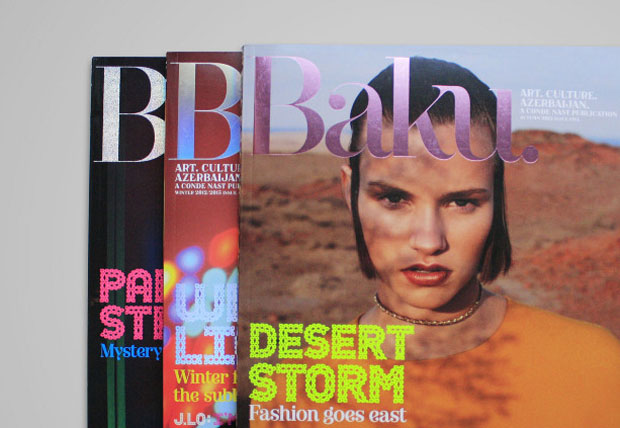
Earlier editions of Baku magazine
The contrast is stark. On one hand, you’ve got Azadliq — Azerbaijan’s leading independent newspaper — balancing on the brink of bankruptcy. Known for its critical coverage of the country’s repressive regime, led by President Ilham Aliyev (in a role he essentially inherited from his father Heydar), the paper has been under continuous economic attacks by the government. Defamation cases and payments being held back, among others things, have left the paper in serious danger of folding.
On the other hand, there’s Baku — the art and culture magazine with an Azerbaijani twist, brainchild of Aliyev’s daughter Leyla and co-published by Conde Nast — which recently celebrated its second birthday. A magazine so expensively produced it has its own special font probably doesn’t need to concern itself too much with sales figures and turnover.
The birthday bash was held at “vibrant Baku night spot Pacifico”, where “the champagne flowed and the band played into the night” and guests “toasted the title’s success”. I know this because I recently got my hands on issue 10 of the magazine, which hit the newsstands last week. The party was heavily featured in the society section, which also included appearances by Leyla herself, her sister Arzu and mother and First Lady Mehriban.
Somewhat ironically, I found a stack at an Index event exhibiting the work of Azerbaijani photographers capturing some of the country’s many protests. They were probably kindly donated by the representatives from the Azerbaijani embassy, who popped along to the event.
At first glance, Baku magazine seems like your typical glossy, upmarket mag, promoting the sort of grossly decadent lifestyle most of us would never come within a gold cobbled country mile of. However, it doesn’t take many page turns to sense that something is a bit off.
One of the first things that hits you is the near-obsession between creating links between Azerbaijan and the most glamorous, posh and high-culture aspects of western countries. “Walking along the Boulevard, the wide, tree-lined esplanade that sweeps the length of Baku’s Caspian seafront, is probably quite similar to walking along the Promenade des Anglais in Nice, during the cooler months,” coos Leyla Aliyeva, who also holds the role of Editor-in-Chief, in her Editor’s letter. There is also the feature on the country’s new ski resort, Shahdag. “Sure, it’s not Les Trois Vallees”, the article says. But you can still tuck into Tskian, “the Azerbaijani equivalent of a French alpine tartiflette”. While it is far from the only country to indulge in a bit of self-promotion, the idea of selling Azerbaijan as a modern, glamorous it-spot, seems to permeate the whole publication to a slightly comical extent. But considering they have in the past hired western PR companies to help polish the country’s international image, I guess this is to be expected.
It is further reflected in the editorial staff, filled with Darrens, Marias, Carolines and Simons. For a magazine about Azerbaijan, it doesn’t seem to have many actual Azerbaijanis working for it. Granted, supply might be a bit sparse, as there are a number of journalists among the country’s (at least) 142 political prisoners. Perhaps potential employees are afraid of being blackmailed, like investigative journalist Khadija Ismayilova? Or brutally attacked, like reporter Idrak Abbasov? Or maybe it’s because most of Azerbaijan’s media is otherwise engaged in state-controlled media?
Anyway, it is not surprising that a magazine called Baku, whose USP is Azerbaijan, focuses on all things, well, Azerbaijan. Some tenuous links are drawn, like the article suggesting that jewellery designer to the stars Loree Rodkin’s new collection will be inspired by Azerbaijan, essentially based on nice things she said at an exhibition in Baku. The interview with musical prodigy Nazrin Rashidova, who was born in the country, is only really jarring if you know that musicians, like Jamal Ali, who have dared criticise President Aliyev have allegedly been tortured by the police.
However, there are sections that seem to leave all pretence at the door, and go full on into that strange subtle-yet-obvious mode of PR-managed propaganda. The eight-page ode to Baku’s controversial beautification and modernisation project, under the guise of an interview with designer behind much of it, is issue 10’s most striking example. In fawning terms, it discusses the type of urban renewal that saw houses demolished and families evicted in the lead-up to the Eurovision Song Contest, hosted in the capital in 2012. We also get previews of yet-to-be unveiled treats. The Port Baku development, opening this spring, “is set to become the city’s premier luxury address” with “flagship stores from the world’s leading fashion brands” and exclusive apartments with “access to a 3000sq m leisure club and spa”. There are also plans to transform “a former power station complex into three destination restaurants and a nightclub.” And it goes on and on. A separate article announces the opening of the Fairmont hotel in one of the city’s Flame Towers. The 36-floor hotel will boast “Baku’s first French Bistro”.
It’s a dedicated effort to shift international attention away from corruption, poverty and the continuing attacks on human rights. But while this attempt to paint Azerbaijan as a harmonious and modern hot-spot might work for some, juxtaposed against the actual goings-on in the country, Baku magazine also manages to highlight the vast gulf between the life the regime and its elite circles lead, and the struggle of those fighting for democracy. In some ways, it is a very tangible symbol of the two Azerbaijans.
To buy a copy of the autumn issue of Index on Censorship, featuring work by some of Azerbaijan’s most brave photojournalists, click here.
This article was published on 20 Dec, 2013 at indexoncensorship.org
12 Dec 2013 | Digital Freedom Reports, Europe and Central Asia, European Union, Index Reports, News, Politics and Society
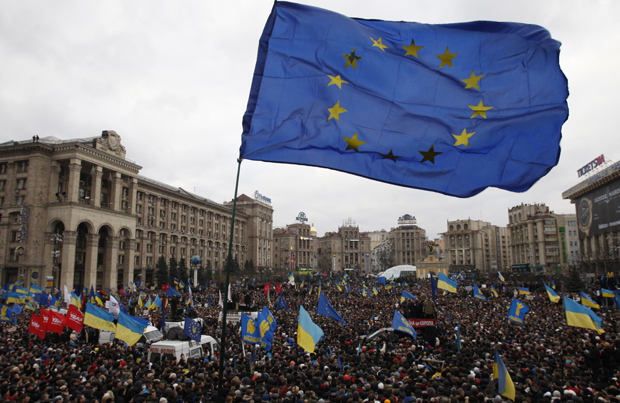
As Ukraine experiences ongoing protests over lack of European integration, Index’ new report looks at the EU’s relationship with freedom of expression (Photo: Anatolii Stepanov / Demotix)
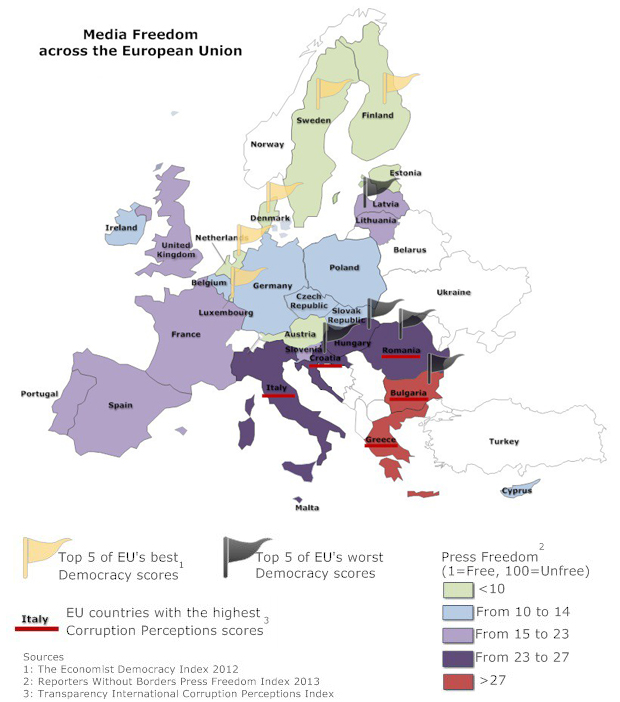
Index on Censorship’s policy paper, Time to Step Up: The EU and freedom of expression, looks at freedom of expression both within the European Union’s 28 member states, which with over 500 million people account for about a quarter of total global economic output, but also how this union defends freedom of expression in the wider world. States that are members of the European Union are supposed to share “European values”, which include a commitment to freedom of expression. However, the way these common values are put into practice vary: some of the world’s best places for free expression are within the European Union – Finland, Netherlands, Denmark and Sweden – while other countries such as Italy, Hungary, Greece and Romania lag behind new and emerging global democracies.
This paper explores freedom of expression, both at the EU level on how the Commission and institutions of the EU protect this important right, but also across the member states. Firstly, the paper will explore where the EU and its member states protect freedom of expression internally and where more needs to be done. The second section will look at how the EU projects and defends freedom of expression to partner countries and institutions. The paper will explore the institutions and instruments used by the EU and its member states to protect this fundamental right and how they have developed in recent years, as well as the impact of these institutions and instruments.
Outwardly, a commitment to freedom of expression is one of the principle characteristics of the European Union. Every European Union member state has ratified the European Convention on Human Rights (ECHR); the International Covenant on Civil and Political Rights (ICCPR) and has committed to the Universal Declaration of Human Rights. To complement this, the Treaty of Lisbon has made the EU Charter of Fundamental Rights legally binding which means that the EU institutions and member states (if they act within the scope of the EU law) must act in compliance with the rights and principles of the Charter. The EU has also said it will accede to the ECHR. Yet, even with these commitments and this powerful framework for defending freedom of expression, has the EU in practice upheld freedom of expression evenly across the European Union and outside with third parties, and is it doing enough to protect this universal right?
Within the European Commission, there has been considerable analysis about what should be done when member states fail to abide by “European values”, Commission President Barroso raised this in his State of the Union address in September 2012, explicitly calling for “a better developed set of instruments” to deal with threats to these perceived values and the rights that accompany them. With threats to freedom of expression increasing, it is essential that this is taken up by the Commission sooner rather than later.
To date, most EU member states have failed to repeal criminal sanctions for defamation, with only Croatia, Cyprus, Ireland and the UK having done so. The parliamentary assembly of the Council of Europe called on states to repeal criminal sanctions for libel in 2007, since then little action has been taken by EU member states. There also remain significant issues in the field of privacy law and freedom of information across the EU.
While the European Commission has in the past tended to view its competencies in the field of media regulation as limited, due to the introduction of the Charter of Fundamental Rights into EU primary law, the Commission is looking at a possible enhancement of its role in this area.
With media plurality limited across Europe and in fact potentially threatened by the convergence of media across media both online and off (and the internet being the most concentrated media market), the Commission must take an early view on whether it wishes to intervene more fully in this field to uphold the values the EU has outlined. Political threats against media workers are too commonplace and risks to whistleblowers have increased as demonstrated by the lack of support given by EU member states to whistleblower Edward Snowden. That the EU and its member states have so clearly failed one of the most significant whistleblowers of our era is indicative of the scale of the challenge to freedom of expression within the European Union.
The EU and its member states have made a number of positive commitments to protect online freedom, including the EU’s positioning at WCIT, the freedom of expression guidelines and the No-Disconnect strategy helping the EU to strengthen its external polices around promoting digital freedom. These commitments have challenged top-down internet governance models, supported the multistakeholder approach, protected human rights defenders who use the internet and social media in their work, limited takedown requests, filters and others forms of censorship. But for the EU to have a strong and coherent impact at the global level, it now needs to develop a clear and comprehensive digital freedom strategy. For too long, the EU has been slow to prioritise digital rights, placing the emphasis on digital competitiveness instead. It has also been the case that positive external initiatives have been undermined by contradictory internal policies, or a contradiction of fundamental values, at the EU and member state level. The revelations made by Edward Snowden show that EU member states are violating universal human rights through mass surveillance.
The Union must ensure that member states are called upon to address their adherence to fundamental principles at the next European Council meeting. The European Council should also address concerns that external government surveillance efforts like the US National Security Agency’s Prism programme are undermining EU citizens’ rights to privacy and free expression. A comprehensive overarching digital freedom strategy would help ensure coherent EU policies and priorities on freedom of expression and further strengthen the EU’s influence on crucial debates around global internet governance and digital freedom. With the next two years of ITU negotiations crucial, it’s important the EU takes this strategy forward urgently.
While the European Commission has in the past tended to view its competencies in the field of media regulation as limited, due to the introduction of the Charter of Fundamental Rights into EU primary law, the Commission is looking at a possible enhancement of its role in this area.
With media plurality limited across Europe and in fact potentially threatened by the convergence of media across media both online and off (and the internet being the most concentrated media market), the Commission must take an early view on whether it wishes to intervene more fully in this field to uphold the values the EU has outlined.
Political threats against media workers are too commonplace and risks to whistleblowers have increased as demonstrated by the lack of support given by EU member states to whistleblower Edward Snowden. That the EU and its member states have so clearly failed one of the most significant whistleblowers of our era is indicative of the scale of the challenge to freedom of expression within the European Union.
Where the EU acts with a common approach among the member states, it has significant leverage to help promote and defend freedom of expression globally. To develop a more common approach, since the Lisbon Treaty, the EU has enhanced its set of policies, instruments and institutions to promote human rights externally, with new resources to do so. Enlargement has proved the most effective tool to promote freedom of expression with, on the whole, significant improvements in the adherence to the principles of freedom of expression in countries that have joined the EU or where enlargement is a real prospect. That this respect for human rights is a condition of accession to the EU shows that conditionality can be effective. Whereas the eastern neighbourhood has benefitted from the real prospect of accession (for some countries), in its southern neighbourhood, the EU has failed to promote freedom of expression by placing security interests first and also by failing to react quickly enough to the transitions in its southern neighbourhood following the events of the Arab Spring. The new strategy for this region is welcome and may better protect freedom of expression, but with Egypt in crisis, the EU may have acted too late. The EU must assess the effectiveness of some of its foreign policy instruments, in particular the dialogues for particular countries such as China.
The freedom of expression guidelines provide an excellent opportunity to reassess the criteria for how the EU engages with third party countries. Strong freedom of expression guidelines will allow the EU to better benchmark the effectiveness of its human rights dialogues. The guidelines will also reemphasise the importance of the EU, ensuring that the right to freedom of expression is protected within the EU and its member states. Otherwise, the ability of the EU to influence external partners will be limited.
Headline recommendations
• After recent revelations about mass state surveillance the EU must develop a roadmap that puts in place strong safeguards to ensure narrow targeted surveillance with oversight not mass population surveillance and must also recommit to protect whistle-blowers
• The European Commission needs to put in place controls so that EU directives cannot be used for the retention of data that makes mass population surveillance feasible
• The EU has expanded its powers to deal with human rights violations, but is reluctant to use these powers even during a crisis within a member state. The EU must establish clear red lines where it will act collectively to protect freedom of expression in a member state
• Defamation should be decriminalised across the EU
• The EU must not act to encourage the statutory regulation of the print media but instead promote tough independent regulation
• Politicians from across the EU must stop directly interfering in the workings of the independent media
• The EU suffers from a serious credibility gap in its near neighbourhood – the realpolitik of the past that neglected human rights must be replaced with a coherent, unified Union position on how to promote human rights
Recommendations
- The EU has expanded its powers to deal with human rights violations, but is reluctant to use these powers even during a crisis within a member state. The EU must establish clear red lines where it will act collectively to protect freedom of expression in a member state
- The EU should cut funding for member states that cross the red lines and breach their human rights commitments
Libel, privacy and insult
- Defamation should be decriminalised in line with the recommendations of the Council of Europe parliamentary assembly, and the UN and OSCE’s special rapporteurs on freedom of expression.
- Insult laws that criminalise insult to national symbols should be repealed
Freedom of information
- To better protect freedom of information, all EU member states should sign up to the Council of Europe Convention on Access to Official Documents
- Not all EU institutions, offices, bodies and agencies are acting on their freedom of information commitments. More must be done by the Commission to protect freedom of information
Media freedom & plurality
- The EU must revisit its competencies in the area of media regulation in order to prevent the most egregious breaches of the right to freedom of expression in particular the situations that arose in Italy and Hungary
- The EU must argue against statutory regulation of the print media and argue for independent self-regulation where media bandwidth is no longer limited by spectrum and other considerations
- Member states must not allow political interference or considerations of “political balance” into the workings of the media, where this happens the EU should be considered competent to act to protect media freedom and pluralism at a state level
- The EU is not doing enough to protect whistleblowers. National states must do more to protect journalists from threats of violence and intimidation
Digital
- The Commission must prepare a roadmap for collective action against mass state surveillance
- The EU is right to argue against top-down state control over internet governance it must find more natural allies for this position globally
- The Commission should proceed with a Directive that sets out the criteria takedown requests must meet and outline a process that protects anonymous whistle-blowers and intermediaries from vexatious claims
The EU and freedom of expression in the world
- The EU suffers from a credibility issue in its southern neighbourhood. To repair its standing in the wider world, the EU and its member states must not downgrade the importance of human rights in any bilateral or multilateral relationship
- The EU’s EEAS Freedom of Expression guidelines are welcome. To be effective, they need to focus on the right to freedom of expression for ordinary citizens and not just media actors
- The guidelines need to become the focus for negotiations with external countries, rather than the under-achieving human rights dialogues
- With criticism of the effectiveness of the human rights dialogues, the EU should look again at how the dialogues fit into the overall strategy of the Union and its member states
The European Union contains some of the world’s strongest defenders of freedom of expression, but also a significant number of member states who fail to meet their European and international commitments. To deal with this, in recent years, the European Union’s member states have made new commitments to better protect freedom of expression. The new competency of the European Court of Justice to uphold the values enshrined in the European Convention of Human Rights will provide a welcome alternative forum to the increasingly deluged European Court of Human Rights. This could have significant implications for freedom of expression within the EU. Internally within the EU there is still much that could be done to improve freedom of expression. It is welcome that that the EU and its member states have made a number of positive commitments to protect online freedom, with new action on vexatious takedown notices and coordinated action to protect the multistakeholder model of internet governance. Increasing Commission concern over media plurality may also be positive in the future.
Yet there are a number of areas where the EU must do more. The decriminalisation of defamation across Europe should be a focal point for European action in line with the Council of Europe’s recommendations. National insult laws should be repealed. The Commission should not intervene to increase its powers over national media regulators, but should act where it has clear competencies, in particular to prevent media monopolies and to help deal with conflict of interests between politicians and state broadcasters. Most importantly, discussions of mass population surveillance at the European Council in October must be followed by a roadmap outlining how the EU will collectively take action on this issue. Without internal reform to strengthen protections for freedom of expression, the EU will not enjoy the leverage it should to promote freedom of expression externally to partner countries. While the External Action Service freedom of expression guidelines are welcome, they must be impressed upon member countries as a benchmark for reform.
Externally, the EU has failed to deliver on the significant leverage it could have as the world’s largest trading block. Where the EU has acted in concert, with clear aims and objectives for partner countries, such as during the process of enlargement, it has had a big impact on improving and protecting freedom of expression. Elsewhere, the EU has fallen short, particularly in its southern neighbourhood and in its relationship with China, where the EU has continued human rights dialogues that have failed to be effective.
New commitments and new instruments post-Lisbon may better protect freedom of expression in the EU and externally. Yet, as the Snowden revelations show, the EU and its member states must do significantly more to deliver upon the commitments that have been agreed.
Full report PDF: Time to Step Up: The EU and freedom of expression
This article was posted on 12 Dec 2013 at indexoncensorship.org
