17 May 2020 | Statements
Index calls for the immediate release of Lina Attalah, the editor and co-founder of the Egyptian news website Mada Masr, one of the few independent news outlets in the country to offer an alternative narrative to government-controlled media.
Attalah was arrested outside Tora prison while attempting to interview the mother of Egyptian blogger and political activist Alaa Abd El Fattah, who had been arrested in September 2019 after writing a critical column in Mada Masr. He is currently on hunger strike protesting his pretrial detention conditions.
Rachael Jolley, editor-in-chief of Index on Censorship, said: “Lina was doing her job and reporting on a climate of crackdown and fear in Egypt right now, where news coverage happens under extreme pressure. We call on the international community not to ignore what is going on in Egypt.”
Mada Masr, which was shortlisted in the journalism category in Index’s 2016 Freedom of Expression Awards, was one of 21 websites blocked by the Egyptian authorities in 2017 for “supporting terrorism and extremism and spreading lies” in violation of the International Covenant on Civil and Political Rights.
Freedom of expression is coming under increasing attack in Egypt and media critical of the government of president Abdel Fattah el-Sisi face huge challenges in doing their important work.
14 May 2020 | Covid 19 and freedom of expression, News
[vc_row][vc_column][vc_column_text]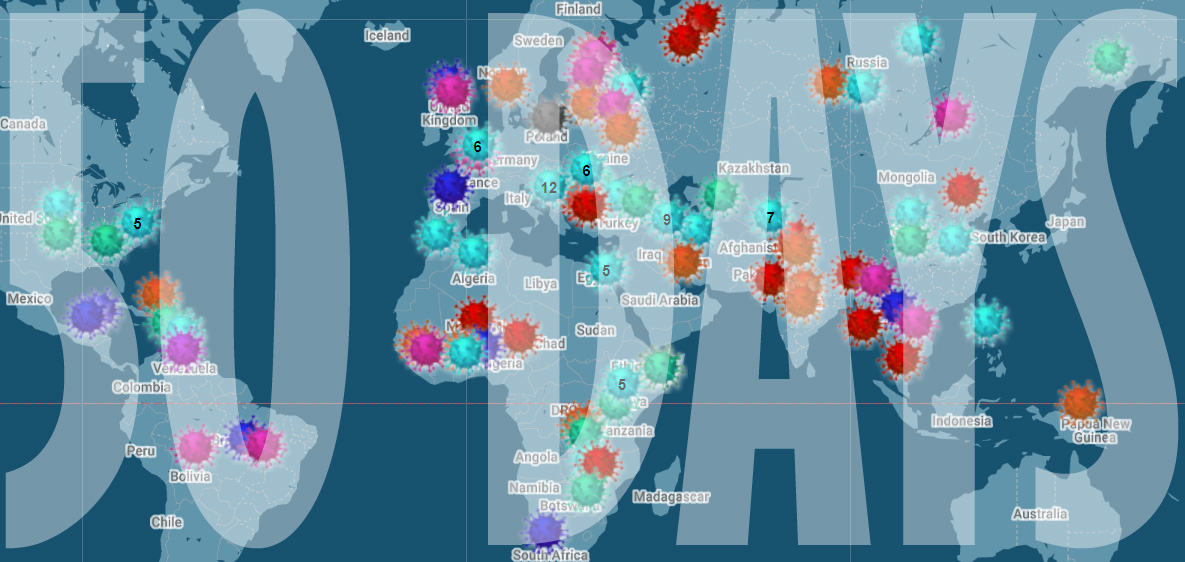
As we mark 50 days since we first started collating attacks on media freedom related to the coronavirus crisis, we’re horrified by the number of attacks we have mapped – over 150 in what is ultimately a short period of time.
We know that in times of crisis media attacks often increase – just look at what happened to journalists after the military coup in Egypt in 2013 and the failed coup against Recep Tayyip Erdogan in Turkey in 2016. The extent of the current attacks, in democratic as well as authoritarian countries, has been a shock.
Our network of readers, correspondents, Index staff and our partners at the Justice for Journalists Foundation have helped collect the more than 150 reports media attacks.
But these incidents are likely to be the very tip of the iceberg. When the world is in lockdown, finding out about abuses of power is harder than ever. Journalists are struggling to do their job even before harassment. How many more attacks are happening that we don’t yet know about? It’s a scary thought.
Rachael Jolley, editor-in-chief of Index on Censorship, said: “We are alarmed at the ferocity of some of the attacks on media freedom we are seeing being unveiled. In some states journalists are threatened with prison sentences for reporting on shortages of vital hospital equipment. The public need to know this kind of life-saving information, not have it kept from them. Our reporting is highlighting that governments around the world are tempted to use different tactics to stop the public knowing what they need to know.”
Index is alarmed that the attacks are not coming from the usual suspects. Yes, there have been plenty of incidents reported in Russia and the former Soviet Union, Turkey, Hungary and Brazil. At the same time there have been many incidents in countries you would not expect to see – Spain, New Zealand, Germany and the UK.
The most common incident we have recorded on the map are attacks on journalists – whether physical or verbal – and cases where reporters have been detained or arrested. There have been more than 30 attacks on journalists, with the source of many of these being the US President Donald Trump. He has a history of being combative with the press and decrying fake news even where the opposite is the case and the crisis has seen a ramped up attempt at excluding the media. During the crisis, he has refused to answer journalists’ questions, attacked the credentials of reporters and walked out from press conferences when he doesn’t like the direction they are taking.
We have also seen reporters and broadcasters detained and charged just for trying to tell the story of the crisis, including Dhaval Patel, editor of the online news portal Face of Nation in Gujarat, Mushtaq Ahmed in Bangladesh and award-winning investigative journalist Wan Noor Hayati Wan Alias in Malaysia.
Since we started the mapping project, we have highlighted other specific trends. Orna Herr has written about how coronavirus is providing pretext for Indian prime minister Narendra Modi to increase attacks on the press and Muslims. Jemimah Steinfeld wrote about how certain leaders are dodging questions while we have also looked at how freedom of information laws are being suspended or deadlines for information extended.
Although the map does not tell the whole story it does act as a record of these attacks. When this crisis is finally all over, it will allow us to ask questions about why these attacks happened and to make sure that any restrictions that have been introduced are reversed, giving us back our freedom.[/vc_column_text][/vc_column][/vc_row][vc_row][vc_column][vc_btn title=”Report an incident” shape=”round” color=”danger” link=”url:https%3A%2F%2Fforms.gle%2Fhptj5F6ZvxjcaGLa7|||” css=”.vc_custom_1589455005016{border-radius: 5px !important;}”][/vc_column][/vc_row]
27 Mar 2020 | News
[vc_row][vc_column][vc_single_image image=”112806″ img_size=”full” add_caption=”yes” alignment=”center”][vc_column_text]Journalists beaten by batons in India; Brazil’s president lashing out at the media; a reporter arrested in Niger, all three stories tied together by a common thread – they dared to report on the coronavirus crisis.
As the world’s attention turns to fighting the pandemic, many of the world’s leaders want to fight the media at the same time. If anything, they’re taking this opportunity with the world being distracted to ramp up efforts to silence journalists.
This is why Index has launched a map in which we document what is going on around the world. The map is a partnership with Justice for Journalists Foundation who, together with our expertise running other mapping projects, will contribute by expanding cooperation with their existing regional partners in central Asia.
While we are aware some restrictions to movement and assembly are necessary at present and that these will invariably effect how journalists to do their jobs, we expect all restrictions to be lifted once the epidemic is under control, and are tracking those restrictions and attacks to media that go far beyond what could be considered reasonable and justified.
Already the response has been incredible, though deeply unsettling too. We’ve had alerts from across the globe, from the USA through to Brazil, from countries with poor records on freedom of expression to ones with higher standards. In one day alone we mapped nine new incidents. Nine. A sad reality of the world we live in today is that media violations are far from rare, but nine in a day is pretty astonishing.
At present China leads in terms of media attacks, which isn’t surprising given the duel facts of it being the country of coronavirus origin and one of the most censored media environments in the world. China’s bid to control news of the outbreak has seen a ramping up of media censorship, as Index reported at the time. Perhaps the most troubling of all stories to emerge was last month when three Wall Street Journal reporters were kicked out of the country following the newspaper publishing an opinion piece in which China was referred to as the sick man of Asia. Foreign media presence has been drained further since then. Last week China expelled more than 13 journalists from the Wall Street Journal, the Washington Post and the New York Times and banned them from working in Hong Kong and Macau too.
If that wasn’t bad enough the Chinese government is expecting other countries to sing to their tune. When Dutch cartoonist Maarten Wolterink posted a cartoon showing a Chinese plane with a coronavirus clinging to its tailplane on 24 January, the Chinese ambassador in The Netherlands voiced his disapproval and an expectation that Dutch cartoonists would be censured if they “insulted” China. Similarly, in Denmark on 27 January a cartoon by Niels Bo Bojesen appeared in Jyllands-Posten that portrayed coronavirus particles taking the place of the stars on China’s national flag. The Chinese embassy in Copenhagen demanded a public apology. Fortunately, Danish politicians didn’t capitulate. They were vocal in their defence of the paper and the general principle of free expression.
But it’s not just China that is censoring information on the outbreak and kicking journalists out. Just yesterday news emerged that Egyptian authorities have forced Guardian journalist and former Index employee Ruth Michaelson to leave the country after she reported on a scientific study saying Egypt likely has more coronavirus cases than the official numbers. Michaelson, who has lived in and reported from Egypt since 2014, has now come to the end of the road for reporting in the country, all because of something she wrote about coronavirus.
Perhaps most alarming are the violations happening in countries that until now we have regarded as relatively free. In South Africa, for example, the government has stopped epidemiologists, virologists, infectious disease specialists and other experts from commenting on Covid-19. All requests for comment must be directed to the National Institute for Communicable Diseases. At a time when knowledge is crucial, when the internet is being flooded with disinformation, blocking access to those who are experts in the field is dangerous to say the least.
Similarly, in Slovenia the investigative journalist Blaž Zgaga has been subject to death threats and a smear campaign since submitting a request for information to the government about its management of the coronavirus crisis. Zgaga is now living in a state of fear. This in a country that ranked 34 out of 180 countries in the RSF world press freedom index 2019. Is Slovenia about to turn its back on media freedom?
All of these examples show why the map is critical. We need to let it be known to people and politicians that we are watching and that we are documenting. We need to increase awareness around the world about the current state of press freedom during the coronavirus crisis, as well as to raise awareness more broadly about the importance of media freedom and the challenges that journalists face. We need to rally behind and help journalists as much as we can during this incredibly difficult period. And, moving forward, we need to improve media freedom globally. After all, the tools used against journalists right now didn’t just emerge overnight – they’ve been finessed, tailored and expanded over the years.
These are unprecedented times and in moments of crisis our freedoms have a tendency to slide away from us. But these are also times when good, honest, trusty-worthy journalism is more important than ever. We intend to hold those in power to account and to aid those at the forefront of reporting on the coronavirus crisis.
For more information on the map and/or to report an attack, please click here.[/vc_column_text][/vc_column][/vc_row][vc_row][vc_column][/vc_column][/vc_row]
16 Mar 2020 | Awards, Fellowship 2020, News
[vc_row][vc_column][vc_single_image image=”112645″ img_size=”full”][/vc_column][/vc_row][vc_row][vc_column][vc_column_text]This year’s three nominees in the digital activism category of Index on Censorship’s Freedom of Expression awards work in different areas of the online landscape but all are doing important work.
First up we have the Arab Center for the Advancement of Social Media, or 7amleh, a non-profit organisation focused on protecting the human rights of Palestinians in the online space.
The organisation’s research has shown that two thirds of Palestinian youth are afraid to voice their political opinions online.
Israel routinely uses Palestinians’ private information from social media in its surveillance, leading many young Palestinians to self-censor after seeing family, friends and journalists arrested.
7amleh’s work protecting online safety and digital rights, advocacy and research has been crucial. It has campaigned with NGOs for amendments to the Palestinian Authority’s Cybercrimes Law, the development of the first Arabic Digital Security Manual and digital training being implemented into the Palestinian education system.
Our second nominee is eQualitie, an international group of digital activists whose mission is to promote and defend fundamental freedoms and human rights, including the free flow of information online.
Based in Montreal, eQualitie develop technologies to prevent cyber attacks, work to circumvent internet censorship and secure online communication. Additionally, they launch critical investigations to find the source of attacks and expose them.
As well as advocating free expression online, eQualitie have also delivered security training to over 3,000 journalists, activists and members of the public in over 40 countries. They have defended over 400 organisations from cyber attacks, including Black Lives Matter, and more than a million people use their protected websites every day.
Founded in 2010, our third nominee – HarassMap – allows victims and witnesses of sexual harassment in Egypt to pinpoint on a map exactly where their harassment occurred and also gives them access to a community of people who can help them.
The organisation has collected reports of more than 1,500 incidents of harassment and these are used to put an end to stereotypes that blame the harassed, make people understand that sexual harassment is a crime that has serious consequences, build campaigns to change perceptions and equip volunteers and partners with information that they use to create zero-tolerance attitudes and behaviour in schools, universities, workplaces, and on the streets.
It is based on the idea that if more people start taking action when sexual harassment happens in their presence, they can end what they call “an epidemic”.
HarassMap’s work saw Cairo University become the first in the Middle East to implement an anti-sexual harassment strategy. HarassMap has also partnered with Uber on sexual harassment policy and training.
The winner of the digital activism category will be announced at our awards event at the May Fair Hotel in London on 30 April. Digital activism is one of the four categories that will be recognised at the awards, alongside campaigning, journalism and the arts.
Our 2019 winner in this category was Fundación Karisma.
The winner of the 2020 journalism award will be chosen by a panel of judges which includes Ruth Ibegbuna, founder of multi award-winning youth leadership charity Reclaim and now director of Roots — an initiative aimed at bringing together people from different walks of life.[/vc_column_text][/vc_column][/vc_row]
