19 Jun 2019 | Magazine, Magazine Contents, Volume 48.02 Summer 2019
[vc_row][vc_column][vc_custom_heading text=”With contributions from Xinran, Ahmet Altan, Stephen Woodman, Karoline Kan, Conor Foley, Robert Harris, Stefano Pozzebon and Melanio Escobar”][/vc_column][/vc_row][vc_row][vc_column][vc_column_text]
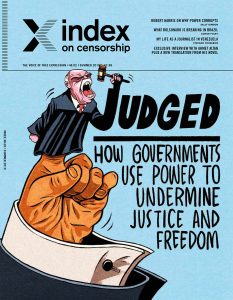
Judged: How governments use power to undermine justice and freedom. The summer 2019 edition of Index on Censorship magazine
The summer 2019 Index on Censorship magazine looks at the narrowing gap between a nation’s leader and its judges and lawyers. What happens when the independence of the justice system is gone and lawyers are no longer willing to stand up with journalists and activists to fight for freedom of expression?
In this issue Stephen Woodman reports from Mexico about its new government’s promise to start rebuilding the pillars of democracy; Sally Gimson speaks to best-selling novelist Robert Harris to discuss why democracy and freedom of expression must continue to prevail; Conor Foley investigates the macho politics of President Jair Bolsonaro and how he’s using the judicial system for political ends; Jan Fox examines the impact of President Trump on US institutions; and Viktória Serdült digs into why the media and justice system in Hungary are facing increasing pressure from the government. In the rest of the magazine a short story from award-winning author Claudia Pineiro; Xinran reflects on China’s controversial social credit rating system; actor Neil Pearson speaks out against theatre censorship; and an interview with the imprisoned best-selling Turkish author Ahmet Altan.
[/vc_column_text][/vc_column][/vc_row][vc_row][vc_column][vc_custom_heading text=”Special Report: Judged: How governments use power to undermine justice and freedom”][/vc_column][/vc_row][vc_row][vc_column][vc_column_text]Law and the new world order by Rachael Jolley on why the independence of the justice system is in play globally, and why it must be protected
Turkey’s rule of one by Kaya Genc President Erdogan’s government is challenging the result of Istanbul’s mayoral elections. This could test further whether separation of powers exists
England, my England (and the Romans) by Sally Gimson Best-selling novelist Robert Harris on how democracy and freedom of expression are about a lot more than one person, one vote
“It’s not me, it’s the people” by Stephen Woodman Mexico’s new government promised to start rebuilding the pillars of democracy, but old habits die hard. Has anything changed?
When political debate becomes nasty, brutish and short by Jan Fox President Donald Trump has been trampling over democratic norms in the USA. How are US institutions holding up?
The party is the law by Karoline Kan In China, hundreds of human rights lawyers have been detained over the past years, leaving government critics exposed
Balls in the air by Conor Foley The macho politics of Brazil’s new president plus ex-president Dilma Rousseff’s thoughts on constitutional problems
Power and Glory by Silvia Nortes The Catholic church still wields enormous power in Spain despite the population becoming more secular
Stripsearch by Martin Rowson In Freedonia
What next for Viktor Orbán’s Hungary? Viktoria Serdult looks at what happens now that Hungary’s prime minister is pressurising the judiciary, press, parliament and electoral system
When justice goes rogue by Melanio Escobar and Stefano Pozzebon Venezuela is the worst country in the world for abuse of judicial power. With the economy in freefall, journalists struggle to bear witness
“If you can keep your head, when all about you are losing theirs…” by Caroline Muscat It’s lonely and dangerous running an independent news website in Malta, but some lawyers are still willing to stand up to help
Failing to face up to the past by Ryan McChrystal argues that belief in Northern Ireland’s institutions is low, in part because details of its history are still secret
[/vc_column_text][/vc_column][/vc_row][vc_row][vc_column][vc_custom_heading text=”Global View”][vc_column_text]Small victories do count by Jodie Ginsberg The kind of individual support Index gives people living under oppressive regimes is a vital step towards wider change[/vc_column_text][/vc_column][/vc_row][vc_row][vc_column][vc_custom_heading text=”In Focus”][vc_column_text]Sending out a message in a bottle by Rachael Jolley Actor Neil Pearson, who shot to international fame as the sexist boss in the Bridget Jones’ films, talks about book banning and how the fight against theatre censorship still goes on
Remnants of war by Zehra Dogan Photographs from the 2019 Freedom of Expression Arts Award fellow Zehra Doğan’s installation at Tate Modern in London
Six ways to remember Weimar by Regula Venske The name of this small town has mythic resonances for Germans. It was the home of many of the country’s greatest classical writers and gave its name to the Weimar Republic, which was founded 100 years ago
“Media attacks are highest since 1989” by Natasha Joseph Politicians in South Africa were issuing threats to journalists in the run-up to the recent elections. Now editors have built a tracking tool to fight back
Big Brother’s regional ripple effect by Kirsten Han Singapore’s recent “fake news” law which gives ministers the right to ban content they do not like, may encourage other regimes in south-east Asia to follow suit
Who guards the writers? Irene Caselli reports on journalists who write about the Mafia and extremist movements in Italy need round-the-clock protection. They are worried Italy’s deputy prime minister Matteo Salvini will take their protection away
China in their hands by Xinran The social credit system in China risks creating an all-controlling society where young people will, like generations before them, live in fear
Playing out injustice by Lewis Jennings Ugandan songwriter and politician Bobi Wine talks about how his lyrics have inspired young people to stand up against injustice and how the government has tried to silence him[/vc_column_text][/vc_column][/vc_row][vc_row][vc_column][vc_custom_heading text=”Culture”][vc_column_text]“Watch out we’re going to disappear you” by Claudia Pineiro The horrors of DIY abortion in a country where it is still not legal are laid bare in this story from Argentina, translated into English for the first time
“Knowing that they are there, helps me keep smiling in my cell” by Ahmet Altan The best-selling Turkish author and journalist gives us a poignant interview from prison and we publish an extract from his 2005 novel The Longest Night
A rebel writer by Eman Abdelrahim An exclusive extract from a short story by a new Egyptian writer. The story deals with difficult themes of mental illness set against the violence taking place during the uprising in Cairo’s Tahrir Square[/vc_column_text][/vc_column][/vc_row][vc_row][vc_column][vc_custom_heading text=”Column”][vc_column_text]Index around the world – Speak out, shut out by Lewis Jennings Index welcomed four new fellows to our 2019 programme. We were also out and about advocating for free expression around the world[/vc_column_text][/vc_column][/vc_row][vc_row][vc_column][vc_custom_heading text=”Endnote”][vc_column_text]
[/vc_column_text][/vc_column][/vc_row][vc_row][vc_column width=”1/3″][vc_custom_heading text=”Subscribe”][vc_column_text]In print, online, in your mailbox, on your iPad.
Subscription options from £18 or just £1.49 in the App Store for a digital issue.
Every subscriber helps support Index on Censorship’s projects around the world.
 SUBSCRIBE NOW[/vc_column_text][/vc_column][vc_column width=”1/3″][vc_custom_heading text=”Listen”][vc_column_text]Music has long been a form of popular rebellion, especially in the 21st century. These songs, provide a theme tune to the new magazine and give insight into everything from the nationalism in Viktor Orban’s Hungary to the role of government-controlled social media in China to poverty in Venezuela
LISTEN HERE[/vc_column_text][/vc_column][vc_column width=”1/3″][vc_custom_heading text=”Listen”][vc_column_text]The summer 2019 magazine podcast, featuring interviews with best-selling author Xinran; Italian journalist and contributor to the latest issue, Stefano Pozzebon; and Steve Levitsky, the author of the New York Times best-seller How Democracies Die.
LISTEN HERE[/vc_column_text][/vc_column][/vc_row]
12 Jun 2019 | Events
[vc_row][vc_column][vc_column_text]Social media platforms wield immense control over the information we see online. With rising pressure from governments; and increasing reliance on algorithms, social media platforms are in danger of silencing millions of activists and marginalised groups across the world with content takedowns and blocked accounts.
You are invited to hear the views from our panellists and take part in a discussion that will shape ARTICLE19 campaign.
Our vision for the campaign is to safeguard freedom of expression online. This cannot be achieved without better accountability and transparency. We will be calling on social media platforms to respect due process guarantees and create clear and transparent mechanisms to enforce such guarantees. Some questions we will be discussing include:
● How content takedown and account deactivation is affecting activism?
● What is the scale of the problem and its impact on free speech?
● What is the role of authorities for content takedown on social media platforms?
● What can be done to improve accountability and transparency online?
● What can the campaign do to amplify voices of those seeking change?[/vc_column_text][vc_custom_heading text=”Panelists” font_container=”tag:h3|text_align:left” use_theme_fonts=”yes”][vc_row_inner][vc_column_inner width=”1/2″][vc_single_image image=”107205″ img_size=”full”][vc_column_text]Thomas Hughes has been executive director of ARTICLE 19 since 2013. For the past two decades, Hughes has worked on human rights and media development issues, including as deputy director of International Media Support (IMS) between 2005 and 2010, as well as previously for the United Nations, European Commission and Organisation for Security and Cooperation in Europe (OSCE).[/vc_column_text][/vc_column_inner][vc_column_inner width=”1/2″][vc_single_image image=”107204″ img_size=”full”][vc_column_text]Jennifer Robinson is a barrister in London. Her practice focuses on international law, free speech and civil liberties. She advises media organisations, journalists and whistle-blowers on all aspects of media law. Robinson serves as a trustee for the Bureau for Investigative Journalism, and sits on the advisory board of the European Center for Constitutional and Human Rights and the Bonavero Human Rights Institute at the University of Oxford.[/vc_column_text][/vc_column_inner][/vc_row_inner][vc_row_inner][vc_column_inner width=”1/2″][vc_single_image image=”107206″ img_size=”full”][vc_column_text]Pavel Marozau is a civic and internet activist. He was under politically motivated persecution by the Belarusian authorities for producing satirical animated films casting president Lukashenko, being accused of slandering the Belarusian president. During the Geneva Summit, Marozau founded a network of activists from Iran, Burma, Venezuela, Cuba, Zimbabwe, and Egypt, as well as a founder of counter-propaganda web-television ARU TV.[/vc_column_text][/vc_column_inner][vc_column_inner width=”1/2″][vc_single_image image=”107207″ img_size=”full”][vc_column_text]Paulina Gutiérrez is an international human rights lawyer and internet freedom advocate in Latin America. She holds a degree in law and another one in international relations. During the last four years, Gutiérrez designed and developed the digital rights agenda for ARTICLE19 Mexico and Central America Regional Office. She’s also a member of INDELA’s Advisory Board and BENETECH’s Human Rights Program Advisory Board.[/vc_column_text][/vc_column_inner][/vc_row_inner][vc_column_text]
When: Thursday 20 June 5:30-10pm
Where: The Law Society’s Hall, 113 Chancery Lane, London WC2A 1PL
Tickets: Free. Registration required via Eventbrite
[/vc_column_text][vc_column_text]Presented in partnership with[/vc_column_text][vc_row_inner][vc_column_inner width=”1/4″][vc_single_image image=”60288″ img_size=”full”][/vc_column_inner][vc_column_inner width=”1/4″][/vc_column_inner][vc_column_inner width=”1/4″][/vc_column_inner][vc_column_inner width=”1/4″][/vc_column_inner][/vc_row_inner][/vc_column][/vc_row]
9 May 2019 | Awards, Fellowship, Fellowship 2018, News
[vc_row][vc_column][vc_column_text]
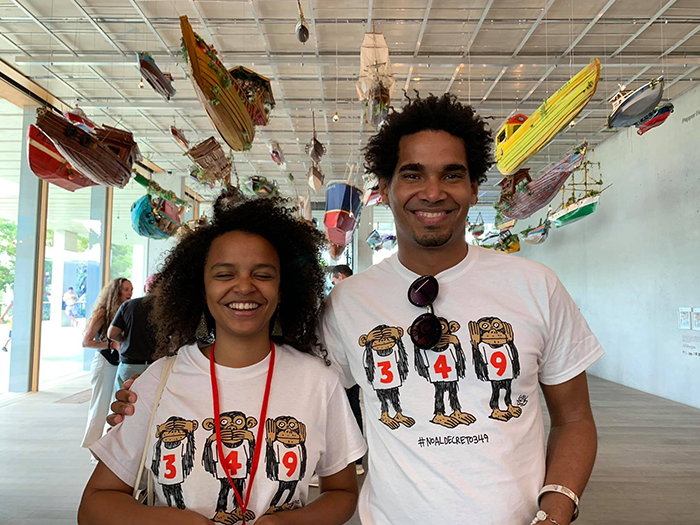
Cuban artists Luis Manuel Otero Alcantara and Yanelys Nuñez Leyva, members of the Index-award winning Museum of Dissidence
Yanelys Nuñez Leyva and Luis Manuel Otero Alcántara, members of the 2018 Index on Censorship Freedom of Expression Award-winning Cuban artist collective the Museum of Dissidence, have been putting themselves on the line in the fight for free expression in Cuba, from being harassed by the authorities to their numerous arrests for protesting Decree 349, a vague law intended to severely limit artistic freedom in the country.
Cubans voted overwhelmingly for a new constitution that upholds the one-party state while claiming to bring about some economic and social reform, but the Museum of Dissidence took a more critical stance to the referendum. Index caught up with Nuñez Leyva and Otero Alcántara to talk about the current situation in Cuba and what they’ve been up to recently.
Index on Censorship: Why did the Museum of Dissidence and its members come out so strongly against the new Cuban constitution?
Luis Manuel Otero Alcántara: The constitution imposed by the regime is an aberration that goes against the freedom of the Cuban and does not represent us as Cubans, intellectuals or humans. The Magna Carta should not be written to control and cut my freedom, it must represent a balance of citizen welfare especially for the immediate future.
Index: Decree 349 will see all artists prohibited from operating in public places without prior approval from the Ministry of Culture. How does this impact the work you do?
Otero Alcántara: The campaign against the 349 was a great victory, the regime had to admit that it was wrong. The country’s leaders had to face and make political moves to placate countless artists, intellectuals and ordinary people concerned about Cuban culture and who joined in the demands to the regime.
Given this, the 349 helped to make visible all the repression and censorship that the government has been carrying out against culture and art for 60 years. As a legacy, we left the movement of San Isidro, a group of artists and intellectuals that has the mission to overcome all the inhumane repression of the regime, to be vigilant and proactive over freedom of Cuban art and culture. The most important project of the post-campaign movement 349 will be the Observatory of Cultural Rights in Cuba.
Index: What sort of training did Yanelys Nuñez Leyva receive while in Prague as part of the Freedom of Expression Awards Fellowship and how will it be useful in Museum of Dissidence?
Yanelys Nuñez Leyva: The training covered tools I can use for work, such as video editing. It also offered insight into new topics such as feminism, a social movement that is not yet as strong in Cuba but should be.
Index: What did Museum of Dissidence do while in Mexico at the Oslo Freedom Forum and how will this help further your cause?
Otero Alcántara: The MDC joined several independent institutions in Cuba such as the Matraca Project, or the Endless Poetry Festival, so that each one, from his or her experience, would demand freedom of expression for all Cubans in a forum.
In all the presentations, we emphasised the unjust detention of two Cuban musicians, Maikel Castillo and Pupito, who are imprisoned for opposing Decree 349.
Index: How did attending Libertycon in Washington DC reinforce or re-inspire your fight for artistic freedom in Cuba?
Luis Manuel: All these events we have been a part of, such as Forum 2000, or the Index award, or the residency in Metal, have helped to create a platform where contemporary art ceases to be an ornament in a house but an exercise of pressure and a true link of change within Cuba.
Index: Although nearly 87% of voters in the referendum voted yes to the new constitution, there was an unprecedented display of ballot-box dissent, with more than 700,000 people voting no. What do you think this is a result of and do you think this signifies changing times for the Cuban population and government?
Otero Alcántara: In a totalitarian regime like the one in Cuba, where it controls all the information, international observers and legal transparency systems are not allowed, those percentages are strategies of the regime to simulate a less critical state than the one that exists. Those numbers are a joke but the interesting thing is to see how the political opposition handles that ‘no.’ Making ordinary people see that they are not alone, that other thousands of people feel and voted just like them, is something that contributes to encouraging dissent.
Index: What makes you remain so steadfast in your fight for artistic expression in Cuba when the oppression of artists continues, including the recent arrest of members of the Museum of Dissidence?
Otero Alcántara: Love binds me, wherever I want to escape, from the shelter of the pillow in the darkness of my room; going through a luxurious hotel in Miami or in a bucolic countryside in the UK, the suffering of Cuba and the human is shaking my head and the only way I can free myself from that ghost is to fight and know that I am doing something.
Last December when the government promised to implement the 349, I felt that my spirit was imprisoned in the body of a regime, so I took responsibility for the life of my body through a hunger strike to the regime. It would be they who would decide if I was still breathing my body or not but my spirit would be free.
Luckily, we got a reaction from the government. They appeared on Cuban television, and that was because of the union that was achieved among all the artists.
Index: What are the main goals that you’ll be working toward throughout 2019?
Otero Alcántara: 2019 is the year of the official state-sponsored Havana biennial and a year of preparation for the #00 Biennial of 2020, which are two interesting scenarios for the future of Cuban culture right now. The other thing is to continue working for overall freedom in Cuba.
Index: How has the Museum of Dissidence benefitted from its time on the Index on Censorship Freedom of Expression Awards Fellowship?
Otero Alcántaral: Being Index Fellows was one of the best things that has happened to the museum in its history as a work of art and an institution. It was a prize that gave visibility to the Musem of Dissidence and gave us thousands of contacts. It gave us protection against the repression of the regime and its discredit toward political art in Cuba. But above all we met people like Perla Hinojosa and the rest of the Index team, also Mohamed Sameh from ECRF, Julie Tribault, the promoters of the Metal artistic residency and another large number of projects and platforms that, with their example, have encouraged us to continue the struggle, especially in the moments of greatest loneliness.[/vc_column_text][/vc_column][/vc_row][vc_row][vc_column][vc_basic_grid post_type=”post” max_items=”4″ element_width=”6″ grid_id=”vc_gid:1583501159250-00b68107-bcde-1″ taxonomies=”7874″][/vc_column][/vc_row]
26 Apr 2019 | Digital Freedom, Media Freedom, media freedom featured, News, Russia, Singapore, United Kingdom
[vc_row][vc_column][vc_single_image image=”97329″ img_size=”full” add_caption=”yes” alignment=”right”][vc_column_text]“Fake news”. The phrase emerged only a matter of years ago to become familiar to everybody. The moral panic around fake news has grown so rapidly that it became a common talking point. In its short life it has been dubbed the Collins Dictionary’s word of 2017 and the Bulletin of Atomic Scientists say it was one of the driving factors that made them set their symbolic Doomsday Clock to two minutes from midnight in 2019. It is a talking point on the lips of academics, media pundits and politicians.
For many, it is feared that “fake news” could lead to the end of democratic society, clouding our ability to think critically about important issues. Yet the febrile atmosphere surrounding it has led to legislation around the world which could potentially harm free expression far more than the conspiracy theories being peddled.
In Russia and Singapore politicians have taken steps to legislate against the risk of “fake news” online. A report published in April 2019 by the Department of Digital, Culture, Media and Sport could lead to stronger restrictions on free expression on the internet in the UK.
The Online Harms White Paper proposes ways in which the government can combat what are deemed to be harmful online activities. However, while some the harmful activities specified — such as terrorism and child abuse — fall within the government’s scope, the paper also declares various unclearly defined practices such as “disinformation” as under scrutiny.
Internet regulation would be enforced by a new independent regulatory body, similar to Ofcom, which currently regulates broadcasts on UK television and radio. Websites would be expected to conform to the regulations set by the body.
According to Jeremy Wright, the UK’s Secretary of State for Digital, Culture, Media and Sport, the intention is that this body will have “sufficient teeth to hold companies to account when they are judged to have breached their statutory duty of care”.
“This will include the power to issue remedial notices and substantial fines,” he says, “and we will consult on even more stringent sanctions, including senior management liability and the blocking of websites.”
According to Sharon White, the chief executive of the UK’s media regulatory body Ofcom, the term “fake news” is problematic because it “is bandied around with no clear idea of what it means, or agreed definition. The term has taken on a variety of meanings, including a description of any statement that is not liked or agreed with by the reader.” The UK government prefers to use the term “disinformation”, which it defines as “information which is created or disseminated with the deliberate intent to mislead; this could be to cause harm, or for personal, political or financial gain”.
However, the difficulty of proving that false information was published with an intention to cause harm could potentially affect websites which publish honestly held opinions or satirical content.
As a concept, “fake news” is frequently prone to bleeding beyond the boundaries of any attempt to define it. Indeed, for many politicians, that is not only the nature of the phrase but the entire point of it.
“Fake news” has become a tool for politicians to discredit voices which oppose them. Although the phrase may have been popularised by US President Donald Trump to attack his critics, the idea of “fake news” has since become adopted by authoritarian regimes worldwide as a justification to deliberately silence opposition.
As late US Senator John McCain wrote in a piece for The Washington Post: “the phrase ‘fake news’ — granted legitimacy by an American president — is being used by autocrats to silence reporters, undermine political opponents, stave off media scrutiny and mislead citizens.
“This assault on journalism and free speech proceeds apace in places such as Russia, Turkey, China, Egypt, Venezuela and many others. Yet even more troubling is the growing number of attacks on press freedom in traditionally free and open societies, where censorship in the name of national security is becoming more common.”
In Singapore — a country ranked by Reporters Without Borders as 151 out of 180 nations for press freedom in 2019 — a bill was introduced to parliament ostensibly intended to combat fake news.
Singapore’s Protection from Online Falsehoods and Manipulation Bill would permit government ministers to order the correction or removal of online content which is deemed to be false. It is justified under very broad, tautological definitions which state amongst other things that “a falsehood is a statement of fact that is false or misleading”. On this basis, members of the Singaporean government could easily use this law to censor any articles, memes, videos, photographs or advertising that offends them personally, or is seen to impair the government’s authority.
In addition to more conventional definitions of public interest, the term is defined in the bill as including anything which “could be prejudicial to the friendly relations of Singapore with other countries.” The end result is that Singaporeans could potentially be charged not only for criticising their own government, but Singapore’s allies as well.
Marte Hellema, communications and media programme manager for the human rights organisation FORUM-ASIA explains her organisation’s concerns: “We are seriously concerned that the bill is primarily intended to repress freedom of expression and silence dissent in Singapore.”
Hellema pointed out that the law would be in clear violation of international human rights standards and criticised its use of vague terms and lack of definitions.
“Combined with intrusive measures such as the power to impose heavy penalties for violations and order internet services to disable content, authorities will have the ability to curtail the human rights and fundamental freedoms of anyone who criticises the government, particularly human rights defenders and media,” Hellema says.
In Russia, some of the most repressive legislation to come out of the wave of talk about “fake news” was signed into law earlier this year.
In March 2019, the Russian parliament passed two amendments to existing data legislation to combat fake news on the internet.
The laws censor online content which is deemed to be “fake news” according to the government, or which “exhibits blatant disrespect for the society, government, official government symbols, constitution or governmental bodies of the Russian Federation”.
Online news outlets and users which repeatedly run afoul of the laws will face fines of up to 1.5 million roubles (£17,803) for being seen to have published “unreliable” information.
Additionally, individuals who have been accused of specifically criticising the state, the law or the symbols which represent them risk further fines of 300,000 roubles (£3,560) or even prison sentences.
The move has been criticised by public figures and activists, who see the new laws as an attempt to stifle public criticism of the government and increase control over the internet. The policy is regarded as a continuation of previous legislation in Russia designed to suppress online anonymity and blacklist undesirable websites.[/vc_column_text][/vc_column][/vc_row]
