Music has long been used as a form of resistance, from civil rights movements to the fall of the Berlin Wall. The latest issue of Index on Censorship magazine, focusing on taboos and the breaking down of social barriers, features an exclusive new short story by Ariel Dorfman about a military trumpeter who plays a defiant, rebellious song on his instrument.
In honour of the story, we have compiled a playlist of music that has been used as protest and resistance from all over the world. The influence of these songs show just how powerful music can be as a form of rebellion.
Many artists on the list have been forced into exile or censored. Index on Censorship has teamed up with the award-winning makers of the documentary They Will Have To Kill Us First to launch the Music in Exile Fund, which will help support musicians in similar situations.
Beethoven’s Ninth Symphony – Ode to Joy
Ode to Joy has been adopted by many protest movements around the world. Most notably the song was played on the streets of Chile in resistance to the Pinochet dictatorship. Demonstrators gathered outside prisons singing Ode to Joy, giving strength to the prisoners who suffered torture there at the hands of the regime.
Joan Baez – We Shall Overcome
We Shall Overcome is a key protest song of the civil rights movement. The song, which has been covered by various artists, was first used in 1945 by tobacco workers fighting for better pay in Charleston, South Carolina. The song, with its message of solidarity and hope, has been used in many protests around the world, not least in the 1950s and 1960s by activists in the American civil rights movement.
Vuyisile Mini – Ndodemnyama we Verwoerd
Ndodemnyama we Verwoerd (Watch Out, Verwoerd) is one of the most well-known songs in South Africa due to its association with the campaign against apartheid. Hendrik Verwoerd, who served as prime minister of South Africa until his assassination in 1966, became known as the “architect of apartheid” for his role in implementing the system of racial segregation. Unsurprisingly, he became the subject of many protest songs, including Ndodemnyama we Verwoerd by Vuyisile Mini. Mini became one of the most powerful organisers of the resistance, earning himself the moniker the “organiser of unorganised”. He was sentenced to death in 1964 on charges of sabotage and political crimes and is said to have sung the song while being led to the gallows.
November 2015 marked the 25th anniversary of the fall of the Berlin wall. Many songs have been associated with the demise of the wall, which divided Berlin for nearly three decades, particularly Wind of Change by German heavy metal band The Scorpions. The song, one of peace and hope, was released a few months after the wall was torn down and became one of the top-selling singles of 1991. The music video to Wind of Change shows footage of the wall being removed.
Songhoy Blues – Al Hassidi Terei
The four members of Songhoy Blues met as refugees after being forced into exile by Muslim extremists who banned all music in Mali in 2012. In defiance of the extremists, they formed the desert blues band, refusing to have music taken away from them. They have since gone on to work with Damon Albarn of Blur and Nick Zimmer of the Yeah Yeah Yeahs, been on an international tour and were nominees for the arts category of the Index on Censorship Freedom of Expression Awards 2014.
Ramy Essam – Irhal
Irhal became known as the anthem of Egypt’s uprising against President Mubarak’s after singer Ramy Essam performed the song during the 2011 protests in Tahrir Square. Irhal, which urges the president to resign, became internationally known after Essam’s performance was posted on YouTube during the protests. After the revolution, Essam returned to Tahrir Square where he was arrested and tortured by the military council. He was offered safe city residence in Sweden following his arrest and has been living there since 2014.
Tropicália/Gilberto Gil – Miserere Nóbis
The Tropicália movement is a brief artistic movement that took place in Brazil in the 1960s. During the movement, which was co-founded by Gilberto Gil and Caetano Veloso, musicians expressed their resistance to the country’s military dictatorship through their music and their socially and politically charged lyrics. The movement only lasted around a year before being suppressed by the military regime. Gil and Veloso were arrested in 1969 and forced to live in exile in London for the political content of their work but returned to Brazil in 1972.
Billie Holiday – Strange Fruit
Strange Fruit, most famously performed by Billie Holiday, protests American racism and the lynching of African Americans. The song began as a poem written by teacher Abel Meeropol published in 1937; Who then set it to music and performed it as a protest song at various venues in New York in the late 1930s along with his wife and the singer Laura Duncan.
Chieftains and Sinead O’Connor – Foggy Dew
Foggy Dew is the name of several old Irish ballad. This version of the song chronicles the Easter Rising of 1916 in Dublin when Irishmen fought for the cause of Irish independence. During World War I, thousands of Irishmen served in the British forces. Many Irish nationalists felt they should have stayed in Ireland and fought for Irish independence, which is reflected in the song.
Killing in the Name – Rage Against The Machine
American rap-metal band Rage Against the Machine released Killing in the Name in 1992, six months after the Los Angeles riots, which were triggered after four white police officers were acquitted of beating black motorist Rodney King. The song is institutional racism and police brutality. Known for its excessive use of expletives, Killing in the Name originally received little air time.
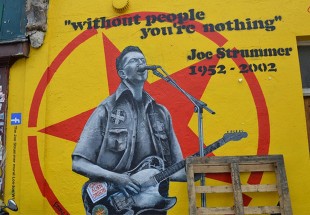
Joe Strummer (The Clash) mural, London. Credit: Flickr / Matt Brown
The Clash – White Riot
When The Clash released White Riot, many people thought it was a song advocating some kind of race war. This couldn’t be further from the truth. With the lyrics, Joe Strummer was appealing to white youths to find a worthy cause to fight (or riot) for, just as many black youths had in the UK at the time. At its heart, it is a song about class and race.
Bob Marley – Get Up, Stand Up
Bob Marley is renowned for his songs about peace, love and resistance. With Get Up, Stand Up being one of his most well-known protest songs. Marley wrote the song with fellow Jamaican musician Peter Tosh as a challenge to oppression. The song is famed for the lyrics: “You can fool some people sometimes but you can’t fool all the people all the time.”
Pete Seeger – Joe Hill
Joe Hill was a miner, songwriter and union organiser for the Industrial Workers of the World (IWW). Hill was executed in America in 1915 following a controversial trial in which he was found guilty of the murders of John G Morrison and his son Arling. Hill refused to testify at his trial believing he would be worth more to the labour movement as a dead martyr than alive. After his death, Hill was the subject of songs by various artists, including Paul Robeson, Joan Baez and Pete Seeger.
Sam Cooke – A Change Is Gonna Come
A Change Is Gonna Come has been covered by various artist but was originally written by Sam Cooke. The song is another civil rights anthem concerning the struggles of African Americans during the 1960s. Cooke was said to have been inspired to write to song by various events in his life, predominantly being turned away from a “whites only” hotel. The singer was shot and killed just before the song was due to be released as a single in 1964.
Tinariwen – Lulla
Tinariwen are made up of musicians from the Tuareg community, whose music reflects the issues faced by the Tuareg people. The musicians received military training when they were living in exile in Libya in the 1980s, and many of the members of Tinariwen were rebel fighters in the 1990 revolt against the Malian government. In 1991, the collective, who’s name translates to “the people of the desert”, left the military to focus on music on a full-time basis.
Eagles of Death Metal – People Have the Power
On 8 December, Eagles of Death Metal joined U2 on stage in Paris, just three weeks after Muslim extremists launched an attack at their concert at the Bataclan Theatre, killing 89 people, plus 41 in two other attacks. Together the bands performed a cover of Patti Smith’s People Have the Power, showing bravery and resistance against the terrorists who left the city in fear.
You can read the Ariel Dorfman’s new short story, All I Ever Have, about music as a form of resistance in the latest Index on Censorship magazine. Each magazine sale helps Index on Censorship fight for free expression worldwide. Order your copy here, or take out a digital subscription via Exact Editions (just £18 for the year).
[vc_row][vc_column][vc_custom_heading text=”What can’t people talk about? The latest magazine looks at taboos around the world”][vc_row_inner][vc_column_inner width=”1/2″][vc_column_text]
What’s taboo today? It might depend where you live, your culture, your religion, or who you’re talking to. The latest issue of Index on Censorship magazine explores worldwide taboos in all their guises, and why they matter. Comedians Shazia Mirza and David Baddiel look at tackling tricky subjects for laughs; Alastair Campbell explains why we can’t be silent on mental health; and Saudi Arabia’s first female feature-film director Haifaa Al Mansour speaks out on breaking boundaries with conservative audiences.
Plus a crackdown on porn and showing your cleavage in China; growing up in Germany with the ghosts of WW2; what you can and can’t say in Israel and Palestine; and the argument for not editing racism out of old films. As the anniversary of Charlie Hebdo murders approaches, we also have a special section of cartoonists from around the world who have drawn taboos from their homelands – from nudity, atheism and death to domestic violence and necrophilia.
Also in this issue, Mark Frary explores the secret algorithms controlling the news we see, Natasha Joseph interviews the Swaziland editor who took on the king and ended up in prison, and Duncan Tucker speaks to radio journalists who lost their jobs after investigating presidential property deals in Mexico.
And in our culture section, Chilean author Ariel Dorfman looks at the power of music as resistance in an exclusive short story, which is finally seeing the light after 50 years in the pipeline. We have fiction from young writers in Burma tackling changing rules in times of transition, and there’s newly translated poetry written from behind bars in Egypt, amid the continuing crackdown on peaceful protest.
Each magazine sale helps Index on Censorship fight for free expression worldwide. Order your copy here, or take out a digital subscription via Exact Editions (just £18 for the year).
The history man – Professor Mohammed Dajani Daoudi explains how he has no regrets, despite causing outrage after taking Palestinian students to Auschwitz
Provoking Putin – Oleg Kashin on how new laws are silencing Russians
Quiet zone: a global cartoon special – Featuring taboo-busting illustrations from Bonil, Dave Brown, Osama Eid Hajjaj, Fiestoforo, Ben Jennings, Khalil Rhaman, Martin Rowson, Brian John Spencer, Padrag Srbljanin, Toad and Vilma Vargas
[/vc_column_text][/vc_column][/vc_row][vc_row][vc_column][vc_custom_heading text=”SUBSCRIBE” css=”.vc_custom_1481736449684{margin-right: 0px !important;margin-left: 0px !important;border-bottom-width: 1px !important;padding-bottom: 15px !important;border-bottom-color: #455560 !important;border-bottom-style: solid !important;}”][vc_column_text]Index on Censorship magazine was started in 1972 and remains the only global magazine dedicated to free expression. Past contributors include Samuel Beckett, Gabriel García Marquéz, Nadine Gordimer, Arthur Miller, Salman Rushdie, Margaret Atwood, and many more.[/vc_column_text][vc_row_inner][vc_column_inner width=”1/2″][vc_single_image image=”76572″ img_size=”full”][/vc_column_inner][vc_column_inner width=”1/2″][vc_column_text]In print or online. Order a print edition here or take out a digital subscription via Exact Editions.
Copies are also available at the BFI, the Serpentine Gallery, MagCulture, (London), News from Nowhere (Liverpool), Home (Manchester), Calton Books (Glasgow) and on Amazon. Each magazine sale helps Index on Censorship continue its fight for free expression worldwide.
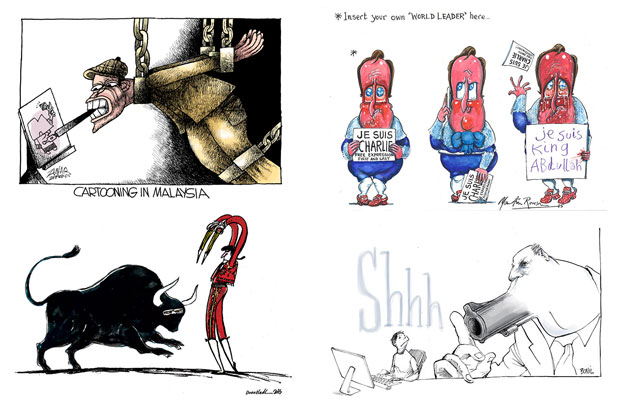
Among the cartoons available in the auction are original artworks by Zulkiflee Anwar Haque (Zunar); Martin Rowson; Xavier Bonilla (Bonil); and Doaa El Adl (clockwise from top left).
Index on Censorship is delighted to announce the auction of an incredible collection of cartoons that celebrate the power of art to challenge suppression. The auction will help fund our work supporting persecuted writers and artists worldwide.
Make a new donation to Index before the end of December to receive a limited-edition postcard set of 10 cartoons created by some of the world’s top political cartoonists
Earlier this year, Index commissioned 10 of the world’s leading cartoonists to pen a work on the theme of free expression. The cartoons are powerful tributes to the role of art, drawn by world-renowned artists from every continent: from a US Pulitzer Prize winner to a Syrian cartoonist beaten in retaliation for his work.
Beginning Tuesday, 24 November 2015, bidders will be able to enter bids for hand-drawn artwork by:
Xavier Bonilla (Bonil) – Ecuador
Regularly denounced, threatened and fined, Ecuador’s Bonil has earned the title “the pursued cartoonist” for his work. For 30 years he has critiqued, lampooned and ruffled the feathers of Ecuador’s political leaders, in the process earning a reputation as one of the wittiest and most fearless cartoonists in South America.
Kevin Kallaugher (Kal) – United States
US artist Kal is the editorial cartoonist for The Economist and The Baltimore Sun and his work has appeared in more than 100 publications worldwide including Le Monde, Der Spiegel, The International Herald Tribune, The New York Times, Time, Newsweek, and The Washington Post. He has won numerous awards, including the 2014 Grand Prix for Cartoon of the Year.
Signe Wilkinson (Signe) – United States
The first woman to win the Pulitzer Prize for Editorial Cartooning, Signe has won several other awards for her work. She comments on topical political issues and is best known for her daily cartoons in The Philadelphia Daily News.
Jean Plantureux (Plantu) – France
Plantu is the chief cartoonist for France’s Le Monde and founder of Cartooning for Peace, a global network of cartoonists. This drawing is a rare, signed copy of the world-famous cartoon Plantu drew for Le Monde the day after the attack on Charlie Hebdo.
Martin Rowson – UK
A former Cartoonist Laureate, political satirist Martin Rowson contributes cartoons to The Guardian and the Daily Mirror as well as Index on Censorship magazine. His work has earned him several awards, including the prize for the Best Humour and Satire Book of the Year at this year’s Political Book Awards.
Ali Farzat – Syria
Ali Farzat, a former Index on Censorship Freedom of Expression Award winner, came to global attention in 2011 when he was pulled from his car and beaten by Syrian security forces who broke both his hands. When Kuwaiti authorities closed the offices of his newspaper, Al-Watan, earlier this year Ferzat was forced to buy new materials and redrew this cartoon for us from scratch.
Doaa El Adl (Doaa) – Egypt
Doaa is a celebrated female artist in the Arab world – well know for her fearless political work. She has often tackled freedom of speech, human rights and women’s rights issues, wining numerous awards as well as controversy and even charges of blasphemy for her work.
Zulkiflee Anwar Haque (Zunar) – Malaysia
Zunar is an award-winning Malaysian political cartoonist who has been repeatedly targeted by authorities. Five of his cartoon books have been banned by the Malaysian government for carrying content “detrimental to public order” and thousands confiscated. He is currently facing up to 43 years in jail for mocking the government.
David Rowe – Australia
A three-time winner of the Stanley Award for Australia’s Cartoonist of the Year, David Rowe has worked for the Australian Financial Review for 22 years. Rowe’s bright and colourful watercolours are famously merciless.
Damien Glez – (Glez) – Burkina Faso
Glez’s cartoons regularly appear across three continents, including his own weekly satirical newspaper in Burkina Faso: Le Journal du Jeudi . He co-created pan-African monthly satirical Le Marabout, writes his own comic strip Divine Comedy and has won numerous awards internationally..
Bids must be placed by noon on Monday, 14 December 2015.
This is the first of two posts by Farida Ghulam, an advocate for freedom of speech, human rights and democracy. Ghulam has campaigned for women’s rights and is currently active in the push for democratic reforms in Bahrain. Her husband, Ebrahim Sharif, who is a former Secretary General of the National Democratic Action Society (WAAD), is currently in detention awaiting trial on charges of charges of inciting hatred and sectarianism and calling for violence against the regime. He faces 10 years for expressing opinions in a speech marking the memory of a 16-year-old killed while protesting against Bahrain’s government.
Among the countless stories of suffering that the Bahraini people have endured is the story of my own family: one of hardship, sacrifice and pure injustice. My husband was arrested, incarcerated for four and a half years, released for three weeks, and promptly re-arrested.
Those three weeks were beautiful and magical. They were surreal. It’s like what Ebrahim said when his daughter landed in Bahrain and woke him up the morning after his release. He asked her: “It’s like a dream, isn’t it?” Those three weeks passed by so quickly that they don’t seem real; we’ve now plunged back into our old routines of monitored visits, monitored and limited phone calls, court hearings, and the anxiety inherent in facing a long dark tunnel with very little light ahead.
My husband and I, along with our political party, the National Democratic Action Society (also known as WAAD), have been advocating for democracy, fighting corruption, and highlighting social injustice in the Kingdom of Bahrain for a long time now. My husband, Ebrahim Sharif, is the former Secretary General of WAAD, and has run twice for a seat in Bahrain’s Parliament. During his campaign he was able to gain traction with the people of Bahrain by raising awareness of social and economic corruption, as well as stressing shortcomings of the current political system and proposing needed reforms to build a true democracy. His campaign focused on the people being the source of any government’s power, a statement which is ironically featured in Bahrain’s constitution. He challenged the government in many economic and political domains, using his skills in finance and economics to easily prove the existence of corruption and discrimination.
The courage Ebrahim showed by exposing the government in such public ways understandably threatened the establishment, especially considering that he is a Sunni man, the same religious sect as Bahrain’s ruling elites, which made him difficult to discredit along sectarian lines. Ebrahim’s point of view, along with the points of view of other prominent opposition figures in Bahrain, were never addressed by the ruling powers, although these views were supported by the majority of Bahrain’s people. The only responses that addressed these views were smear campaigns placed in pro-regime newspapers and TV networks.
After witnessing developments in Tunisia and Egypt during the Arab Spring in 2011, the Bahraini people took to the streets in peaceful demonstrations against the government. They set up a home base around Pearl Roundabout, in central Manama. It happened quickly and naturally, with no prior planning by opposition groups, which joined the mass movement a few days later by attending and giving speeches focused on peacefulness as a strategy in expressing the political demands addressed to the government. My husband was one of these opposition leaders, where he spoke about what a true constitutional monarchy means and reiterating the views of his parliamentary campaign which promised to put power in the people’s hands by raising awareness and insisting on non-violent measures to obtain the necessary changes for democratic advancement.
The government responded to this movement by cracking down a month later, sending in GCC (Gulf Cooperation Council) troops, tanks, tear gas and weapons. Many people were killed in the ensuing chaos and arrests of political leaders occurred over the following days. The roundabout was demolished by the government in an attempt to quickly erase the movement from people’s memories and history and exploit their declaration of martial law as an excuse to regain control and quell the protests entirely.
My husband’s first arrest was an exercise in torment — solitary confinement, torture in the form of mass beatings by masked police, sleep deprivation, forcing him to sleep on cold-water soaked mattresses in incredibly cold air-conditioned rooms, constantly barking dogs, sexual harassment and threats, whipping with plastic pipes, insulting his family’s honor, and standing for long hours with hands held vertically in the air. At one point, he was beaten and threatened that if he issued a complaint to the military prosecution, he would be beaten again. Ebrahim filed the complaint, the man indeed kept his promise and Ebrahim was beaten again. To add to that, on the day that the military judge issued the verdict of guilty, all of the political leaders were taken to a back room in the courthouse and beaten because they had chanted the words “peacefulness, peacefulness” in response to the judge’s verdict and sentences.
We have been telling our story over and over again from 2011. Ebrahim was sentenced to 5 years in prison, while the other political figures, part of the “Bahrain 13”, a group of political leaders which the Bahraini government alleges Ebrahim is a member of, received longer sentences ranging from 10 years to life imprisonments. In June of 2015, Ebrahim was released on a royal pardon, only to be re-arrested a mere three weeks later on 12 July due to a speech he gave commemorating the death of a 16-year-old martyr who was barbarically shot at close range by police in 2012 and who received no justice.
As a family, we’ve decided that it would be important for us to write about the hardships we have personally endured on an individual and family level as a direct consequence of the punishment handed down by the government, which fears the pure and peaceful expression of speech. The right to freedom of speech is recognized worldwide by an endless array of organizations, and while Bahrain claims to respect the International Declaration of Human Rights, it is abundantly clear that it does not. While the Kingdom of Bahrain is a signatory of the International Covenant on Civil and Political Rights and International Covenant on Economic, Social and Cultural Rights, what has happened to Ebrahim and other Bahrainis opposing the injustice and discrimination in the country proves the kingdom does not hold these covenants in high regard.
This piece is intended as an informative introduction to what Bahrain has gone — and continues to go — through, as well as what we personally have gone through as a family, and to have it as a basic reference before reading the next piece which will highlight the family’s emotional struggle with losing a father and husband to an unjust sentence.