20 Apr 2016 | Americas, Honduras, Magazine, mobile, Volume 45.01 Spring 2016
[This article is also available in English]
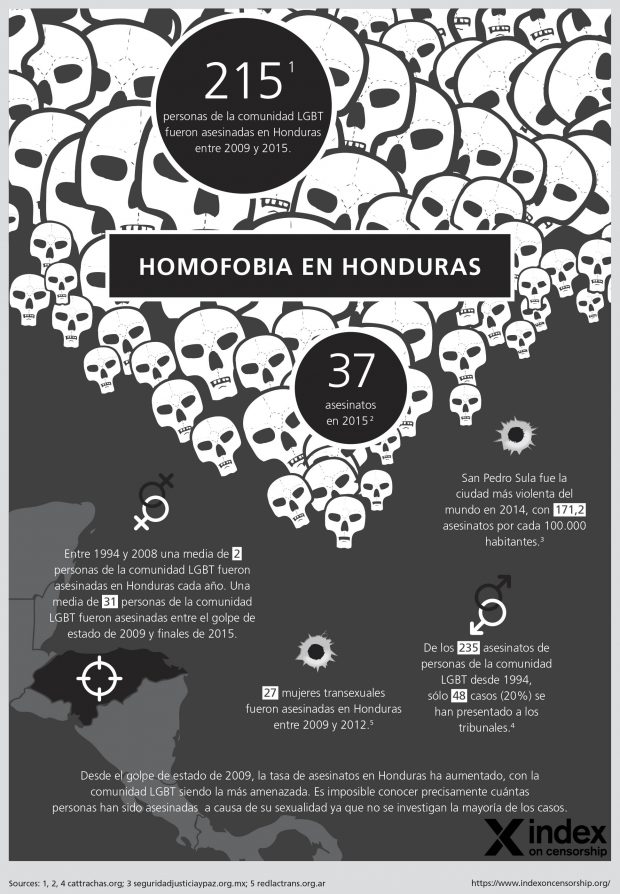
Un año tras volver del exilio, Danny Reyes, un activista homosexual hondureño aún teme ser asesinado en cualquier momento. “Yo estaba encarcelado en muchas ocasiones, he sido víctima de tortura y violencia sexual y todo a causa del activismo. En muchas ocasiones he sobrevivido persecuciones e intentos de sicarios,” dijo, en una entrevista con Index on Censorship.
Activistas en Honduras tienen que lidiar con constantes amenazas y atracos, a menudo fatales. Reyes, el coordinador del grupo activista para lesbianas, hombres homosexuales, bisexuales y transexuales Arcoíris, estuvo 10 meses en el extranjero por su propia seguridad pero se vio obligado a volver a estar a la vanguardia en la lucha contra la discriminación.
“Para poder continuar con mi vida personal y con mi trabajo, tengo que estar consciente de que eso [la muerte] puede ocurrir en cualquier momento.” Cada año se asesinan docenas de hondureños LGBT y muy pocos de los asesinatos son llevados ante la justicia, según las cifras del respetado ONG hondureño Cattrachas. Los periodistas y activistas que se pronuncian son atracados. Uno de ellos fue Juan Carlos Cruz Andara que murió tras ser apuñalado 25 veces por agresores desconocidos en junio del año pasado.
Arcoíris denunció 15 incidentes de seguridad contra sus miembros durante la segunda mitad de 2015, incluyendo vigilancia, acoso, detenciones arbitrarias, atracos, robos, amenazas, agresión sexual e incluso asesinato. Otros activistas LBGT han experimentado deshaucios, cargos falsos, difamación, desapariciones forzadas y restricciones del derecho de reunión.
Todos los activistas consultados por Index dijeron que el nivel de violencia homófoba aumentó desde la expulsión del presidente liberal Manuel Zelaya en el golpe militar de 2009.
La elección del candidato de la derecha Porfirio Lobo Sosa al año siguiente coincidió con la militarización de Honduras, un aumentó en el número de casos de violencia relacionada con las pandillas, y una restricción de los derechos humanos.
Los documentos de Cattrachas muestran que de media dos personas LGBT fueron asesinadas cada año en el país entre 1994 y 2008. Tras el golpe de 2009 el número ha subido vertiginosamente a una media de 31 asesinatos al año, según las cifras de Arcoíris. A principios de 2016 había indicaciones de que se intensificaba más la situación con el asesinato de Paola Barraza, un miembro de Arcoíris, el 24 enero. En realidad es muy difícil conocer exactamente cuántas personas han perdido la vida a causa de su sexualidad porque la gran mayoría de los casos siguen sin resolverse.
Eric Martínez Salgado, que trabaja como voluntario con el grupo activista LGBT Kukulcanhn, contó a Index que los activistas homosexuales protestaron firmemente contra la discriminación y el golpe de estado. Cree que el gobierno consideraba su grupo como una amenaza al orden social tradicional y que empezó a amenazarles para “enviar un mensaje” a otros manifestantes.
Uno de las figuras más prominentes del activismo homosexual de todos los tiempos, Walter Tróchez, fue asesinado en un tiroteo desde un coche en 2009. Los grupos de derechos humanos notaron que había sido secuestrado anteriormente, batido y amenazado por manifestarse contra el golpe de estado y abogar por derechos para homosexuales. Cuatro años más tarde, un amigo de Tróchez y también activista homosexual Germán Mendoza fue detenido y acusado de su asesinato.
Mendoza contó a Index que le guardaban en condiciones deplorables y fue torturado repetidas veces. Finalmente lo soltaron tras probar su inocencia el año pasado. Mendoza cree que fue detenido porque el gobierno quería utilizarlo “como cabeza de turco para lavarse las manos de la responsabilidad” de la muerte de Tróchez, que sigue sin resolverse. El gobierno hondureño no respondió cuando se le pidió un comentario respecto al tema.
Las guerras de las pandillas fueron un enorme factor que influyeron en el estatus de Honduras como el país con el mayor número de asesinatos en 2012, sin embargo la principal preocupación de la comunidad homosexual no son las pandillas sino el estado de las fuerzas de seguridad.
“La policía y otros agentes se constituyen en el principal perpetrador de violaciones a los derechos de la comunidad LGBT,” advirtió el año pasado la Coalición contra la Impunidad, un pacto entre 29 ONG hondureños, citando presunta “política de policía de frecuentes amenazas, detenciones arbitrarias, acoso, agresión sexual, discriminación, tortura y tratamiento cruel o degradante.”
Como resultado muchos activistas vulnerables son reacios a pedir protección, por miedo a que el contacto con la policía pueda generar mayores riesgos en la seguridad o represalias. Los periodistas que escriben sobre la violencia homofóbica en Honduras también arriesgan la vida. Dina Menza, una investigadora independiente que ha escrito mucho sobre el tema fue nominada a los premios Libertad de Expresión en 2014 otorgado por Index on Censorship por su trabajo. Meza dijo que los medios principales del país retratan la comunidad LGBT bajo una luz negativa.
Meza, que lanzó el sitio de noticias Pasos de Animal Grande el año pasado para llamar la atención sobre las dificultades que sufren los sectores más vulnerables de la sociedad, dijo que periodistas que escriben sobre la violencia contra la comunidad LGBT también han sido objeto de persecuciones. Dijo que los periodistas no sólo son agredidos físicamente por las fuerzas de seguridad y echados de eventos públicos sino son también objeto de campañas de desprestigio gubernamentales.
“Aquí el vincularnos como defensores de derechos humanos con el crimen organizado y el narcotráfico, eso es lo más normal para desprestigiar nuestra labor y para sembrar la duda en la gente sobre el trabajo que estamos haciendo,” Meza explicó. “Si vamos a nivel internacional y hablamos, dicen que tenemos una campaña en contra del estado de Honduras y que promovemos que no venga inversión, que queremos incendiar el país.”
Peter Tatchell, director del grupo activista LGBT the Peter Tatchell Foundation en Londres, pide que el mundo preste atención a los asesinatos. Dijo: “Esta violencia, extendida y escandalosa contra la comunidad LGBT hondureña apenas se reporta en el resto del mundo. Las grandes organizaciones LGBT tienden a centrase en casos de homofobia más conocidos como los de Egipto, Irán y Uganda. Lo que está pasando en Honduras es mucho peor. ¿Esta negligencia es porque es un país pequeño con pocos recursos y poco peso geopolítico? La ONG, Organización de Estados Americanos y proveedores de ayuda internacional deben hacer más para presionar al gobierno hondureño a erradicar crímenes contra la comunidad LGBT y sensibilizar al público sobre el tema a fin de combatir los prejuicios”.
Meza y los activistas entrevistados por Index también sostienen que los grupos católicos y evangélicos tienen cada vez más influencia en la sociedad hondureña. Reyes de Arcoíris ha descrito el estado, la iglesia y los medios principales como un triunvirato que ha alimentado “la impunidad, el fundamentalismo, el machismo y la misoginia” en todo el país con consecuencias desastrosas para la comunidad LGBT.
“La familia y la escuela son los primeros lugares donde nos violentan y nos discriminan. Salimos de casa a muy tempranas edades, huyendo porque la familia está construida con valores religiosos. Nos castigan de una forma cruel y la afectación psicológica es terrible,” dijo Reyes. “Las oportunidades que tenemos de trabajo o educación cada día son menos. Podemos ser trabajadores sexuales o comerciantes vendiendo en la calle o meternos en el closet para poder conseguir un trabajo, pero si se enteran de nuestra orientación sexual es casi seguro que nos despiden.”
A pesar de los riesgos a los que se enfrentan tanto él como sus amigos, Reyes dijo que la necesidad de un cambio drástico es lo que le da la fuerza para seguir luchando contra la discriminación: “Necesitamos encontrar un Honduras que esté libre de violencia y homofobia. Creemos que es nuestra responsabilidad luchar por eso, para que las próximas generaciones tengan un espacio donde vivir en un mundo mejor.”
Traducido por Caoimhin Logue. Este reportaje es de la nueva edición de la revista Index on Censorship. Se puede probar la edición digital aquí.
19 Apr 2016 | About Index, Azerbaijan Statements, Campaigns, mobile, Statements
PEN International and Privacy International led 14 free expression and media freedom organisations, including Index on Censorship, in submitting an intervention today in the case of Azerbaijani journalist, Khadija Ismayilova before the European Court of Human Rights (ECtHR).
The intervention elaborates the freedom of expression and privacy implications of her case.
“The appalling treatment of Khadija Ismayilova by the Azerbaijani authorities is symptomatic of a relentless crackdown on journalists and freedom of expression in the country in recent years”, said Jennifer Clement, President of PEN International. “This important case before the ECtHR is an opportunity to not only redress the injustice in one egregious case but to give wider protection to the media as a whole.”
Ismayilova was sentenced to 7.5 years in prison in September 2015, after being convicted of charges that the members of the coalition believe are retribution for her reports on corruption involving senior government officials.
Before her arrest in December 2014, she had been subjected to a relentless campaign of intimidation and persecution very likely orchestrated by the Azerbaijani authorities to discredit her investigative reporting on corruption amongst the highest levels of society.
“Khadija Ismayilova has suffered a serious invasion of her personal privacy through the installation of hidden cameras and wires in her flat and publication of secretly filmed videos among other incidents. Azerbaijan has a positive obligation to carry out an effective investigation into these violations,’ said Camila Graham-Wood, Legal Officer at Privacy International.
The coalition is represented in this case by barristers Can Yeginsu from 4 New Square Chambers and Miranda Butler from 3 Hare Court.
The full intervention is available here.
Related:
27 May: 40 protests for Khadija Ismayilova’s 40th birthday
Azerbaijan: Sport for Rights coalition condemns sentencing of journalist Khadija Ismayilova
15 Apr 2016 | Events
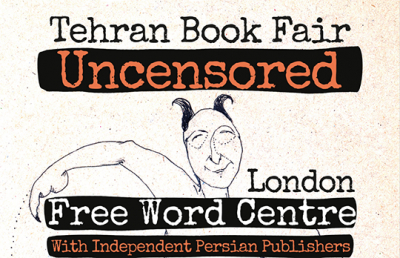
Join us for the first ever Tehran Book Fair Uncensored in Britain, an event featuring an independent book fair and a discussion on censorship in Iran since the 1979 Iranian Revolution.
Taking place on 6-7 May 2016 at London’s Free Word Centre, the book fair coincides with the Tehran Book Fair, but unlike the Iranian counterpart, it’s free from censorship, and will feature censored books from independent Iranian publishers.
Most of the event will be in Farsi, but there will be an English-language session too on Friday 6 May from 4.30pm to 5.30pm – in association with Index on Censorship and Small Media.
Displayed books will range from novels to social science and from plays to history. Participants will also have the chance to see broadcasted footage from the Tehran International Book Fair, and to get to know the publishers and authors and buy signed books.
Participating publishers at the book fair will include:
The English-language event on Friday 6 May will focus on censorship in Iran and will include a talk from Index on Censorship about its work across the Middle East. During this session, Small Media will also present Writer’s Block, an online interactive data visualisation of censorship in Iran since the 1979 revolution.
The event is free, but booking is required through Free Word Centre’s website.
When: English-Language event with Index on Censorship and Small Media, Friday 6 May 2016, 4.30pm. Farsi events: Friday 6 May 2016, 11am – Saturday 7 May 2016, 6pm
Where: Free Word Lecture Theatre at the Free Word Centre (map)
Tickets: Free, but booking required through Free Word Centre’s website. Tickets grant entry to the fair but the talks cannot be pre-booked – entry to these is allocated on the day on a first come, first served basis (lecture theatre capacity: 90 people).
14 Apr 2016 | Asia and Pacific, Burma, China, Eritrea, Europe and Central Asia, Iran, Middle East and North Africa, mobile, News, North Korea, Saudi Arabia, Sudan, Turkmenistan, Uzbekistan
[vc_row][vc_column][vc_column_text]
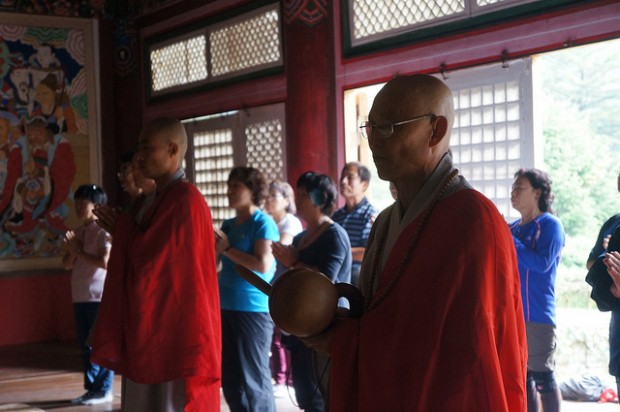
Pohyon Temple in the Myohyang mountains, once a national center for Korean Buddhism. Credit: Uri Tours / Flickr
After the United States Commission on International Religious Freedom, an independent organisation created by the US Congress to evaluate religious freedom conditions around the world, released its 2015 report, it became clear that an insufficient amount of progress had been made since Index on Censorship last reported on the issue.
Here’s a roundup of some the most appalling religious freedom violations from across the globe.
Burma
Bigotry and intolerance continue to scorch the lives of religious and ethnic minorities in Burma, particularly Rohingya Muslims. The Burmese government demonstrated little effort toward intervening or properly investigating claims of abuse, including those carried out by religious figures in the Buddhist community. As internet availability spread throughout the country, social media played a role in promoting a platform of hate and proposed violence against minority populations. Rohingya Muslims in the country face a unique level of discrimination and persecution. The government denies them citizenship and the right to identify as Rohingya. Additionally, four discriminatory race and religion bills could further the prejudices affecting religious minorities.
North Korea
North Korea is a nation where genuine freedom of religion or belief is non-existent; it remains one of the most oppressive regimes and worst violators of human rights. Punishment comes to those who pose difficult questions while the government maintains its control through a constant threat of imprisonment, torture and even death for those who break the law regarding religion. Estimates suggest up to 200,000 North Koreans are currently suffering in labor camps, tens of thousands of whom are there for practicing heir faith. In February 2014, the Commission of Inquiry on Human Rights in the Democratic People’s Republic of Korea released its report documenting the systematic, severe violations of human rights in the country. It found “an almost complete denial of the right to freedom of thought, conscience”.
Saudi Arabia
Officially an Islamic state with eight to ten million expatriate workers of different faiths, Saudi Arabia continues to restrict most forms of public religious expression inconsistent with its interpretation of Sunni Islam. The government continues to use criminal charges of blasphemy to suppress any dialogue between dissenting viewpoints, with a new law helping drive home the goal of silence. The Penal Law for Crimes of Terrorism and its Financing criminalises virtually all forms of peaceful dissent and free expression, including criticising the government’s view of Islam. Lastly, authorities continue to discriminate grossly against dissident clerics and members of the Shia community.
Sudan
The Sudanese government continues to engage in massive violations of freedom of religion, due to president Omar al-Bashir’s policies of Islamisation and restrictive interpretation of sharia law. Despite 97% of the population being Muslim, there is a wide range of other religions practiced. The country’s turmoil from religious persecution rests on the 1991 Criminal Code, the 1991 Personal Status Law of Muslims, and state-level “public order” laws, which have restricted freedom for all Sudanese. The laws – which contradict the country’s constitutional and international commitments to human rights and freedom of religion – allow death sentences for apostasy, stoning for adultery, cross-amputations for theft, prison sentences for blasphemy and floggings for undefined “offences of honor, reputation and public morality”. Since 2011, more than 170 people have been arrested and charged with apostasy.
Article continues below
[/vc_column_text][/vc_column][/vc_row][vc_row][vc_column][vc_custom_heading text=”Join the Index mailing list and get an exclusive gift” font_container=”tag:p|font_size:28|text_align:left” use_theme_fonts=”yes”][vc_separator color=”black”][/vc_column][/vc_row][vc_row][vc_column width=”1/2″][vc_column_text]
Index on Censorship’s summer magazine 2016
We’ll send you our weekly emails and periodic updates on our events. We won’t share your personal information with anyone outside Index.
You’ll also get access to an exclusive collection of articles from our landmark 250th issue of Index on Censorship magazine exploring journalists under fire and under pressure. Your downloadable PDF will include reports from Lindsey Hilsum, Laura Silvia Battaglia and Hazza Al-Adnan.[/vc_column_text][/vc_column][vc_column width=”1/2″][gravityform id=”20″ title=”false” description=”false” ajax=”false”][/vc_column][/vc_row][vc_row][vc_column][vc_separator color=”black”][/vc_column][/vc_row][vc_row][vc_column][vc_column_text]Uzbekistan
In Uzbekistan, the government imprisons individuals for not conforming to officially prescribed practices or whom it claims are extremist, including as many as 12,000 Muslims. A highly restrictive religion law is imposed, the 1998 Law on Freedom of Consciences and Religious Organisations, which severely limits the rights of all religious groups and facilitates Uzbek government control over religious activity. Many who don’t fit into the framework of officially approved practices are regularly repressed. Additionally, the government has continued a campaign against independent Muslims, targeting those linked to the May 2005 protests in Andijan; 231 are still imprisoned in connection to the events, and ten have died. All the while, Uzbekistan has pressured countries to return Uzbek refugees who fled during the Andijan tragedy.
Turkmenistan
In an environment of nearly inescapable government information control, severe religion freedom breaches persist in Turkmenistan. Continuing police raids and harassment of registered and unregistered religious groups matched with laws and policies that violate international human rights norms has the nation as one of the year’s biggest offenders. With an estimated total population of 5.1 million, the US government projects that the country is 85% Sunni Muslim, 9% Russian Orthodox, and a 2% total that includes Jehovah’s Witnesses, Jews, and evangelical Christians. Despite Turkmenistan’s constitutionally guaranteed religious freedom and separation of religion from the state, the 2003 religion law negates these provisions while setting intrusive registration criteria for individuals. It also requires that the government is informed of all foreign financial support, forbids worship in private homes and places discriminatory restrictions on religious education.
China
While the Chinese constitution guarantees freedom of religion, this idea really only applies to “normal religions”, better known as the five state-sanctioned “patriotic religious associations” associated with Buddhism, Taoism, Islam, Catholicism and Protestantism. Even still, the government monitors religious activities unfairly, and there has been an increased religious persecution of Uighur Muslims in the name of fighting terrorism. All around repression in China worsened in 2014, including the governmental push for controlling Tibet, Xinjiang, and even Hong Kong, as well as controls on the internet, social media, human rights defenders, activists and journalists.
Eritrea
Ongoing religious freedom abuses have continued in Eritrea, including torture or ill-treatment of religious prisoners, random arrests without charges and banning’s on public religious activities. The situation is especially serious for Evangelical and Pentecostal Christians and Jehovah’s Witnesses, and the government suppresses Muslim religious activities and those opposed to the government-appointed head of the community. In 2002, the government increased its control over religion by imposing a registration requirement on all religious groups other than the Coptic Orthodox Church of Eritrea, Sunni Islam, the Roman Catholic Church and the Evangelical Church of Eritrea. The requirements mandated that the non-preferred religious communities provide detailed information about their finances, membership, activities, and benefit to the country. Additionally, released religious prisoners have reported to USCIRF that they were confined in crowded conditions, and subjected to extreme temperature fluctuations. The government continued to arrest and detain followers of unregistered religious communities. Recent estimates suggest 1,200 to 3,000 people are imprisoned on religious grounds in Eritrea, the majority of whom are Evangelical or Pentecostal Christians.
Iran
Poor religious freedom in Iran continued to worsen in 2014, particularly for minority groups like Bahá’ís, Christian converts, and Sunni Muslims. The government is still engaging in systematic violations, including prolonged detention, torture, and executions based on the religion of the accused. Despite Christians, Jews, and Zoroastrians being recognised as protected minorities, the government has consistently discriminated against its citizens on the basis of religion. Killings, arrests, and physical abuse of detainees have increased in recent years, including for religious minorities and Muslims who are perceived as threatening the government’s legitimacy.[/vc_column_text][/vc_column][/vc_row][vc_row][vc_column][vc_basic_grid post_type=”post” max_items=”12″ style=”load-more” items_per_page=”4″ element_width=”6″ grid_id=”vc_gid:1493906845781-a7b9ac80-f77d-2″ taxonomies=”1742″][/vc_column][/vc_row]
