11 Sep 2015 | Campaigns, Mapping Media Freedom, mobile, Press Releases
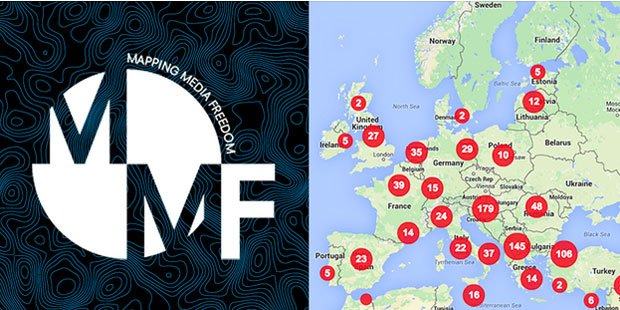
Index on Censorship, the European Federation of Journalists and Reporters Without Borders are delighted to announce the expansion and redesign of Mapping Media Freedom, which records threats to journalists across Europe, and which will now also cover Russia, Ukraine and Belarus.
First launched in May 2014, the map documents media freedom violations throughout the European Union and neighbouring countries including the Balkans and Turkey.
More than 700 reports were logged on the map in its first year, lifting the lid on the everyday threats to media freedom that have previously gone largely unreported or undocumented.
“Mapping Media Freedom has highlighted the kinds of threats faced by media organisations and their staff everyday throughout Europe — from low-level intimidation to threats of violence, imprisonment, and even murder. Having a detailed database of these incidents – most of which previously went unreported — helps us and others to take action against the culprits,” said Index on Censorship CEO Jodie Ginsberg.
The relaunched online platform will make it easier for policy makers and activists to identify trends in media freedom and to respond efficiently with immediate assistance or to campaign on specific issues. It also provides support such as legal advice and digital security training to journalists at risk. Anyone can submit their own reports to the site for verification by project officers.
“At a time when freedom of information is facing threats not seen since the times of the Soviet Union, supporting journalists and bloggers is crucial. While part of the continent is sinking in an authoritarian drift, online surveillance has become a common challenge”, said RSF Programme Director Lucie Morillon.
Following renewed funding from the European Commission earlier this year, the crowd-sourced map incorporates new features including country filters and an improved search facility. The project also aims to forge new alliances among journalists across the continent, especially young media practitioners who will find useful resources and in depth coverage on a dedicated “Free Our Media!” page.
In reaction to new draconian measures and violence in the region, the new design coincides with an expansion into Russia, Ukraine and Belarus. All new reports from this area will be available in English and the regional language.
“The enlargement of the monitoring process to Ukraine, Russia and Belarus is good news for journalists and media workers in the region. Journalists are usually at the heart of violent demonstrations, clashes and armed conflicts where they may be shot, assaulted, kidnapped, arrested, abused and killed. They are facing difficult professional challenges between extremists or propaganda agents. Thanks to its affiliates, the EFJ will continue to document all media violations and raise awareness to end impunity when violations occur”, said Mogens Blicher Bjerregård, EFJ President.
Partners, country correspondents and affiliates to the project — including Human Rights House Ukraine, Media Legal Defence Initiative and European Youth Press — will work together to ensure the growing threats to media freedom in the region are highlighted, and tackled.
For further information please contact Hannah Machlin, project officer,[email protected], +44 (0)207 260 2671
Mapping Media Freedom
Click on the bubbles to view reports or double-click to zoom in on specific regions. The full site can be accessed at https://mappingmediafreedom.org/
|
18 Dec 2014 | Magazine, News, Volume 43.04 Winter 2014
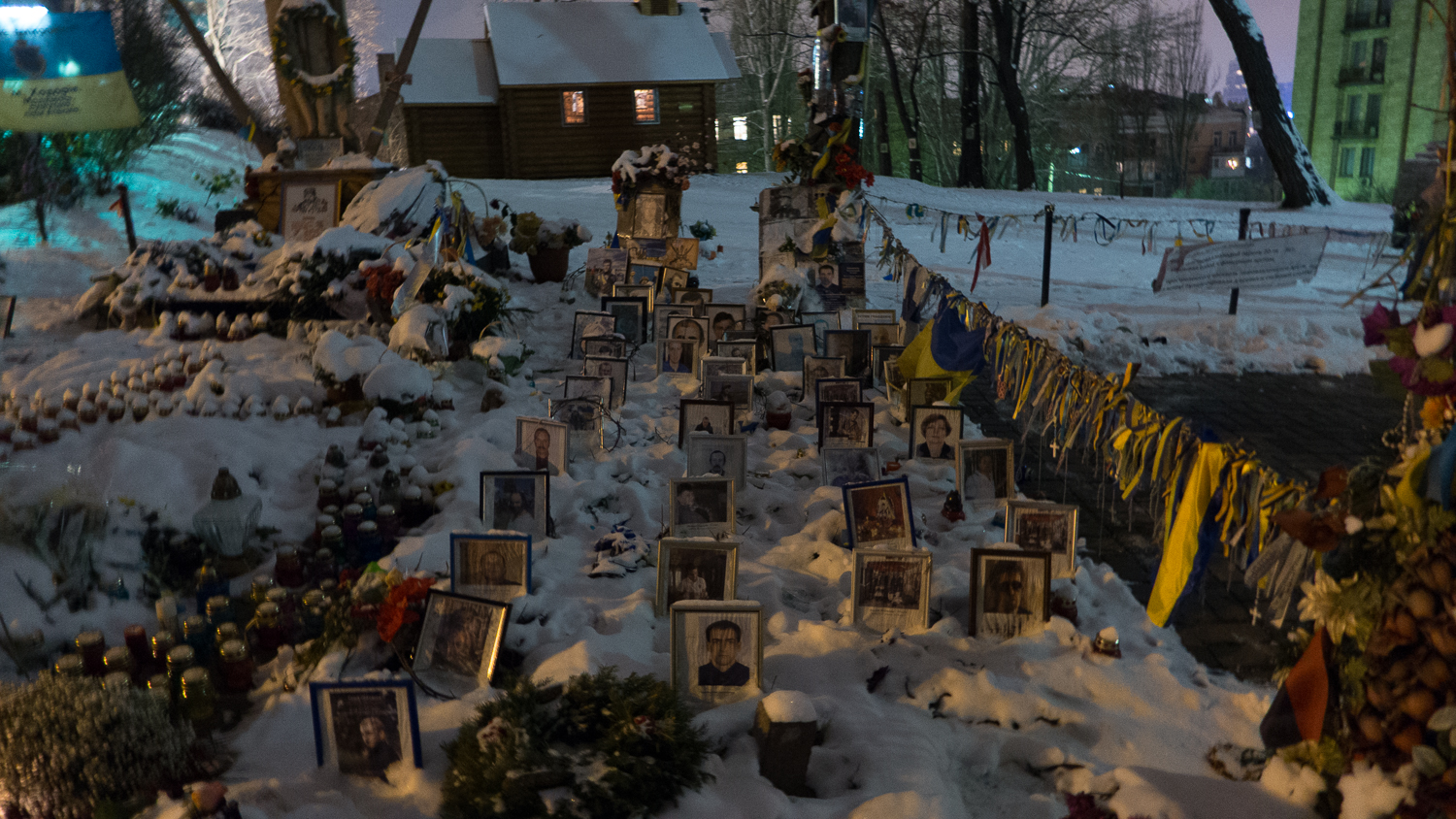
A makeshift shrine remembers the Ukrainians killed during protests on Maidan Nezalezhnosti. (Photo: Sean Gallagher / Index on Censorship)
“There is no civil war in Ukraine. It is a war between Russia and Ukraine, and it is inspired by heavy Russian propaganda,” says Volodymyr Parasyuk as we sit in a café on the main square of the regional capital Lviv in western Ukraine.
This year Parasyuk became a national hero in his country. Some say he changed history when he made a passionate speech on Maidan Nezalezhnosti in Kiev on 21 February 2014, after the police killed about 100 protesters. Parasyuk, head of a sotnia, a unit of 100 men, and part of the protesters’ defence force, demanded President Yanukovich resign and said otherwise protesters would launch an armed attack. The next day the head of state fled the country, and there was a new government formed in Ukraine.
Parasyuk knows what he is saying about war. He joined a voluntary battalion of Ukrainian forces and fought separatists in the east of his country during the summer and autumn. He was wounded and spent a couple of days in detention, but managed to escape.
“This is direct aggression by the Kremlin against my country. This war is completely directed from Russia. We do not have internal reasons to fight each other, the conflict is provoked by lies and propaganda that come from the east,” says Parasyuk.
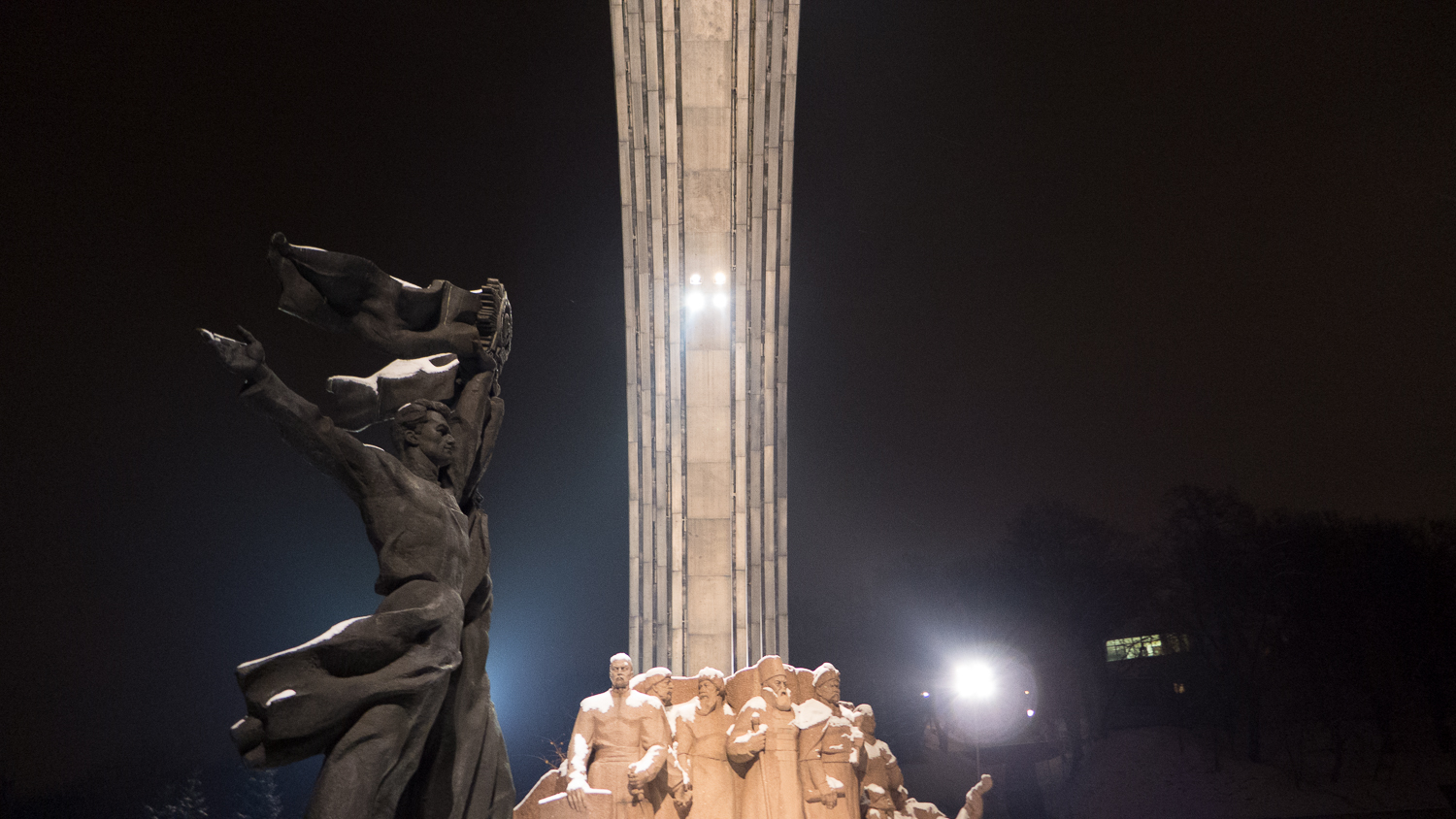
Statues near Maidan Nezalezhnosti celebrate the friendship between Russia and the Ukraine. (Photo: Sean Gallagher / Index on Censorship)
To read the full article, subscribe to Index on Censorship magazine or download the app, get 25% off print orders until 31 Dec 2014.
This excerpt was posted on 18 December 2014 at indexoncensorship.org
26 Jun 2014 | About Index, Campaigns, Statements, Ukraine
President Petro Poroshenko
11 Bankova street
01220 Kyiv
Ukraine
26 June 2014
Mr President,
We, the undersigned members and partners of the Human Rights House Network (HRHN), condemned in the strongest terms human rights violations which took place throughout Ukraine since 29 November 2013, and now call upon you to extend the mandate of the International Criminal Court investigations (taking into account events in Crimea and Eastern Ukraine) and to ratify the Rome Statute, in order to encourage such investigations, as an essential part of bringing peace to the country.
We welcome the repeated pledges of Ukrainian authorities to investigate all human rights violations committed since 29 November 2013 and hold those accountable, throughout the country and irrespective of which side the violator belongs to in the ongoing armed conflict in East Ukraine. The current situation of impunity must end.
The International Criminal Court is the only international body able to not only document grave human rights violations, amounting to core international crimes (war crimes, crimes against humanity, or genocide), but also investigate individuals responsible for such crimes. In order to restore peace and strengthen trust into State institutions, those responsible for such human rights violations have to be held accountable. We have for a long time called for a comprehensive reform of the judicial system in the country, which still remains to be initiated. Unfortunately, the national judicial system now shows its limits and in our view it is clear that it does not have the adequate knowledge, independence and resources to investigate all human rights violations since 29 November 2013 throughout the country.
Therefore, it is necessary to activate the international justice system, based on the complementarity principle, to guarantee that investigation into core international crimes committed by all parties in Ukraine, including by members of law enforcement and State agents, is credible and transparent, bringing those responsible to justice.
The Court’s jurisdiction should however not be limited in time, as it is now. On 17 April 2014, the Government of Ukraine indeed lodged a declaration under Article 12(3) of the Rome Statute accepting the jurisdiction of the ICC over crimes committed on its territory from 21 November 2013 to 22 February 2014.[3] We now call upon the Government to issue a declaration extending ICC jurisdiction from 21 November 2013 until the date of the entry into force of the Rome Statute for Ukraine.
We also call upon the authorities in Ukraine to accede to the Rome Statute as soon as possible. By doing this, Ukraine will make an important step to permanently depart from the culture of impunity that is prevailing.
In addition to the investigation into human rights violations, and action taken to end the use of violence in the country, Ukraine needs to undertake a massive reform of its legislation and practice in many fields. Ukraine’s law enforcement agencies have needed radical reform for a long time now: It is not about changing the names of institutions and units or about window-dressing, but about systemic changes, starting from the principles for establishing and structuring enforcement agencies, and ending with approaches to evaluating their performance.
We therefore support Ukraine’s efforts to propose a resolution at the United Nations Human Rights Council’s on-going session, although we deeply regret the draft resolution’s silence about the role of civil society in the country and the need for an investigation by the Court.
In Ukraine, human rights NGOs have proven their strong commitment to the rule of law and the respect of all human rights for all people, as well as their high level of professionalism and excellence. No country can build a sustainable future without full inclusion of civil society in decision-making, especially Ukraine in its present situation. Furthermore, States and leaders in all sectors of society must acknowledge publicly the important and legitimate role of human rights defenders in the promotion of human rights, democracy and rule of law, and avoid stigmatisation, as stated by the Human Rights Council resolution 22/6 of 21 March 2013.
Finally, we also welcome the reference in the draft resolution on Ukraine at the Human Rights Council to the extremely worrying human rights situation in Crimea and join Ukrainian authorities, the United Nations, the Organisation for Security and Cooperation in Europe, and other international voices, in condemning the enforcement of legislation of the Russian Federation on the territory of Crimea, at variance with the United Nations General Assembly resolution 68/262.
The role of civil society is essential in documenting human rights violations in Crimea and providing support to victims of such violations. A field mission has been launched by Ukrainian and Russian human rights defenders in co-operation, with which we expect full cooperation by all governmental agents in Ukraine.
On this background, we call upon you Mr President and the Government, with no further delay, to issue a declaration to extend the jurisdiction of the International Criminal Court from 21 November 2013 until the date of Ukraine’s accession to the Rome Statute either through appeal of the competent body of the Government or by adopting the Draft Law #4081a.
We further call upon you to:
- Take all necessary measures to support the work of human rights NGOs, journalists and bloggers and other media, including by investigating any threats, intimidation, harassment and violence against them, including arbitrary detentions, abductions, attacks and killings;
- Strongly and publicly acknowledge the important and legitimate role of human rights defenders in the promotion of human rights, democracy and the rule of law as an essential component of ensuring their protection; In line with United Nations Human Rights Council resolution 22/6 of 21 March 2013, paragraph 5
- Ensure that the reform process in the country, as well as all dialogue about the future of the country, is inclusive and transparent, giving space to civil society.
Sincerely,
Human Rights House Kyiv (on behalf of the following NGOs):
- Association of Ukrainian Human Rights Monitors on Law Enforcement (Association UMDPL)
- Centre for Civil Liberties
- Human Rights Information Center
- Institute of Mass Information
- Kharkiv Human Rights Protection Group
- La Strada Ukraine
- NGO “For Professional Journalism” – Svidomo
- Ukrainian Helsinki Human Rights Union
Education Human Rights House Chernihiv (on behalf of the following NGOs):
- Chernihiv Public Committee of Human Rights Protection
- Center of Humnistic Tehnologies “AHALAR”
- Center of Public Education “ALMENDA”
- Human Rights Center “Postup”
- Local Non-governmental Youth organizations М’АRТ
- Transcarpathian Public Center
- Ukrainian Helsinki Human Rights Union
Azerbaijan Human Rights House (on behalf of the following NGOs):
- Association for Protection of Women’s Rights – APWR
- Azerbaijan Human Rights Centre (AHRC)
- Institute for Peace and Democracy
- Human Rights Centre
- Legal Education Society
- Legal Protection and Awareness Society
- Media Rights Institute
- Public Union of Democracy Human Rights Resource Centre
- Women’s Association for Rational Development (WARD)
Barys Zvozskau Belarusian Human Rights House in exile, Vilnius
- Belarusian Association of Journalists
- Belarusian PEN Centre
- Belarusian Helsinki Committee
Human Rights House Belgrade (on behalf of the following NGOs):
- Belgrade Centre for Human Rights
- Helsinki Committee for Human Rights, Serbia
- Human Rights House Belgrade and Lawyers’ Committee for Human Rights –YUCOM
Human Rights House London (on behalf of the following NGOs):
- Index on Censorship
- Vivarta
Human Rights House Tbilisi (on behalf of the following NGOs):
- Article 42 of the Constitution
- Caucasian Centre for Human Rights and Conflict Studies (CAUCASIA)
- Georgian Centre for Psychosocial and Medical Rehabilitation of Torture Victims
- Media Institute
- Human Rights Center
- Union Sapari – Family Without Violence
Human Rights House Oslo (on behalf of the following NGOs):
- Human Rights House Foundation
- Norwegian Helsinki Committee
- Health and Human Rights Info
Human Rights House Voronezh (on behalf of the following NGOs):
- Civic Initiatives Development Centre
- Confederation of Free Labor
- For Ecological and Social Justice
- Free University
- Golos
- Interregional Trade Union of Literary Men
- Lawyers for labor rights
- Memorial
- Ms. Olga Gnezdilova
- Soldiers Mothers of Russia
- Voronezh Journalist Club
- Roronezh – Chernozemie
- Youth Human Rights Movement
Human Rights House Yerevan (on behalf of the following NGOs):
- Helsinki Citizens’ Assembly – Vanadzor
- Journalists’s Club Asparez
- Public Information and Need of Knowledge – PINK
Human Rights House Zagreb (on behalf of the following NGOs):
- APEO / UPIM Association for Promotion of Equal Opportunities for People with Disabilities
- B.a.B.e.
- CMS – Centre for Peace Studies
- Documenta – Centre for Dealing with the Past
- GOLJP – Civic Committee for Human Rights
- Svitanje – Association for Protection and Promotion of Mental Health
The Rafto House in Bergen – Norway (on behalf of the following NGOs):
The House of the Helsinki Foundation For Human Rights – Poland (on behalf of the following NGOs):
- Helsinki Foundation for Human Rights, Poland
Copies have been sent to:
- Mr Oleksandr Turchynov, Chairman of Verkhovna Rada
- Office of the Commissioner for Human Rights of the Council of Europe
- Private Office of the Secretary General of the Council of Europe
- Chairman of the Organisation for Security and Cooperation in Europe (OSCE)
- OSCE Special Monitoring Mission to Ukraine
- OSCE’s Office for Democratic Institutions and Human Rights
- United Nations Human Rights Monitoring Mission in Ukraine
- Delegation of the European Union in Ukraine
- Subcommittee on Human Rights of the European Parliament
- Diplomatic community in Kyiv, Brussels, Geneva and Strasbourg
- Various ministries of foreign affairs and parliamentary committees on foreign affairs
About the Human Rights House Network (www.humanrightshouse.org)
The Human Rights House Network (HRHN) unites 87 human rights NGOs joining forces in 18 independent Human Rights Houses in 13 countries in Western Balkans, Eastern Europe and South Caucasus, East and Horn of Africa, and Western Europe. HRHN’s mandate is to protect, empower and support human rights organisations locally and unite them in an international network of Human Rights Houses.
The Human Rights House Kyiv and the Education Human Rights House Chernihiv are members of HRHN. 10 independent Ukrainian human rights NGOs are members of both Human Rights Houses.
The Human Rights House Foundation (HRHF), based in Oslo (Norway) with an office in Geneva (Switzerland), is HRHN’s secretariat. HRHF is international partner of the South Caucasus Network of Human Rights Defenders and the emerging Balkan Network of Human Rights Defenders.
HRHF has consultative status with the United Nations and HRHN has participatory status with the Council of Europe.
25 Jun 2014 | News, Russia, Ukraine
Wrestling for the rights to define the Ukrainian conflict, both Russia and Ukraine have utilised a range of tactics to control and limit media coverage in the region. This, alongside, the constant to and fro between media freedom and the skewed official lines has politicised the role of the media and manipulated perceptions of the conflict, further distancing coverage from reality.
Every fact is a battle to be fought and won. Who made up the Ukrainian protest movement? Activists and other members of civil society, or thugs, neo-Nazis or far-right extremists? What are Russia’s motivations? Geo-political revisionism, a nationalistic desire to rebuild empire or for the protection of a persecuted minority? There is not one answer to questions like these; indeed the answers appear to changes depending on where they come from.
A sure-fire tactic to control the number of answers on offer is to limit the number of journalists able to cover the story. There have been a number of cases across the region where journalists have either been detained or refused entry to key areas of the conflict. In May, it was reported that three journalists, including a writer for Russia Today, had been detained by Ukraine’s Security Services (SBU), with a further three refused entry at the border. With no clarification of the grounds for their detention, as well as refusing them access to legal representation, the legality of such acts is dubious at best; as Human Rights Watch (HRW) states: “Failure to provide information on the whereabouts and fate of anyone deprived of their liberty by agents of the state, or those acting with its acquiescence, may constitute an enforced disappearance.”
This however, is not a tactic employed exclusively by Ukraine. According to the Committee to Protect Journalists (CPJ), Russian authorities and pro-Russian separatists detained five journalists in Crimea and mainland Ukraine. On 2 June in Donetsk, unidentified armed men in camouflage raided the offices of regional newspapers Donbass and Vecherny Donetsk, detaining senior editorial staff, and accusing the publications of “incorrect reporting”. It is reported that the captor’s demands included the stipulations that the editors, “change the papers’ editorial policy”.
This proved to be effective. The deputy editor of Donbass stated that both his paper and Vecherny Donetsk were “discussing the separatists’ demands and were considering shutting down the outlets for fear of future retaliation”.
Beyond limiting the freedom of journalists covering the conflict, state-led censorship and propaganda is creating media vacuums in key areas, promoting narrow and strictly controlled interpretations of the conflict.
Attacks on the media in Russia have ramped up significantly following Putin’s return to the presidency and have taken on a distinct urgency with the continuation of the Ukraine conflict. One example is the legislation pushed through the Duma banning the publication of negative information about the Russian government and military. This positions Russian activities in Ukraine at the heart of controlling perceptions of Russia in the media. Quoting the official explanatory note to the legislation, HRW reports: “’The event in Ukraine in late 2013-early 2014 evidenced…an information war’, and demonstrated the necessity to protect the younger generation from ‘forming a negative opinion of [their] Fatherland.’”
Another key piece of legislation at play in this context is the “Lugovoi Law”, which allows Roskomnadzor, the Russia state body for media oversight, to block online sources without any court approval. One publication that was blocked was Grani.Ru due in part to its criticism of the state’s handling of the Bolotnaya Square protests. Grani.Ru have unsuccessfully appealed the ruling, but Yulia Berezovskaya, director-general of Grani-Ru is not surprised.
Roskomnadzor has not lost a single case against the media. The Office of the Prosecutor General and Roskomnadzor refused to indicate the “offensive” materials that should have been removed from the website so that access could be restored.
Berezovskaya continues to see this as part of a larger shift in the state’s relationship to the media in the light of the Ukrainian crisis: “The Ukrainian crisis is a major part of Russian TV news while domestic issues are not covered.”
Rolling out robust limitations against opposition or independent media outlets in Russia, at times irrespective of the events in Ukraine, guarantees in a large part the allegiances of media bodies covering the crisis. Indeed with many voices absent from the debate, the state can be confident the official line is being towed, at times, irrespective of fact.
The manipulation of fact has come to define a large part of pro-Russia content. Moscow Times reports “when Vesti.Ru described clashes between pro-Russian and pro-Kiev protesters in Simferopol…it showed footage of earlier protests in Kiev, which were more violent.” Channel One, when alleging that violence in Ukraine has sent a flood of refugees heading for Russia’s Belgorod region, used footage, not of the Ukrainian-Russian border, but of the Ukrainian-Polish border.
By restricting who can report on the Ukrainian crisis through access or censorship, the state can identify which untruths should be accepted as “truth” and which truths should not be seen. But as the conflict endures, the battle to shape perceptions, both home and abroad will continue. As it does, how can we identify the true actions, motivations and responsibilities, before untruths take hold and become something more, something resembling and assumed to be fact?
This article was published on 25 June 2014 at indexoncensorship.org
