16 Jan 2021 | Belarus, Media Freedom, News
Rt. Hon. Dominic Raab MP
First Secretary of State and Secretary of State for Foreign, Commonwealth and Development Affairs
Dear Foreign Secretary,
Earlier this week, one of Index on Censorship’s friends and former colleague, journalist Andrei Aliaksandrau, was detained in Minsk along with his partner, Irina Zlobina. We are extremely alarmed at the news of their detention. Both have been held incommunicado in a Minsk jail since their detention on Tuesday 12 January.
Aliaksandrau is a long-standing champion of media freedom, having sought to uphold this fundamental right as a journalist, and through his work at the London-based freedom of expression organisations, Index on Censorship and Article 19. We are concerned to learn that he is being detained as a suspect in a criminal public order case instituted by the Minsk Department of the Investigative Committee.
On 14 January, police raided the offices of the independent BelaPAN news agency claiming they were looking for evidence related to the criminal case against Aliaksandrau. Aliaksandrau is no longer a BelaPAN staff member, having left his post as deputy director in 2018. Nonetheless, several pieces of equipment were confiscated from BelaPAN’s offices, including personal computers. BelaPAN is the oldest non-governmental independent Belarusian news agency. These combined actions are a direct breach of Article 19 of the Universal Declaration of Human Rights.
As the UK continues to proudly champion media freedom through its media freedom campaign, Index on Censorship calls on the British government to immediately intervene with the Government of Belarus to secure the release of Andrei Aliaksandrau and Irina Zlobina. We are concerned that the decision to detain them may be part of a fresh effort to repress the key defenders of the right to media freedom and freedom of expression aimed at quashing the months of protests that have besieged President Lukashenka’s regime.
According to the Belarus Association of Journalists, journalists were detained 479 times in Belarus in 2020. We cannot allow this pattern of repression to continue in 2021.
We urge you to do everything in your power to see to the release of Andrei Aliaksandrau and Irina Zlobina, and to ensure that no one else is imprisoned for exercising and defending their fundamental rights.
We thank you in advance for taking our concerns into consideration and look forward to your response.
Yours faithfully,
Ruth Smeeth
Index on Censorship
[This letter has been updated with new facts on dates of detention]
16 Jan 2021 | Belarus, Media Freedom, News
Dear HE Ambassador Yermalovich,
Index on Censorship expresses our alarm at the detention in Belarus of our friend and former colleague, journalist Andrei Aliaksandrau. As you will be aware Aliaksandrau was detained along with his partner, Irina Zlobina, in Minsk on Tuesday 12 January 2021. We understand that they are both being held incommunicado in a Minsk jail.
Aliaksandrau is a long-standing champion of media freedom, having sought to uphold this fundamental right as a journalist, and through his work at freedom of expression NGOs including both Index on Censorship and Article 19. We are extremely concerned to learn that he is being detained as a suspect in a criminal public order case instituted by the Minsk Department of the Investigative Committee.
On 14 January, police raided the offices of the independent BelaPAN news agency claiming they were looking for evidence related to the criminal case against Aliaksandrau. Aliaksandrau is no longer a BelaPAN staff member, having left his post as deputy director in 2018. Nonetheless, several pieces of equipment were confiscated from BelaPAN’s offices, including personal computers.
Index on Censorship condemns in the strongest terms the detention of our former colleague and his partner. We call on the Belarusian authorities to immediately release them and unconditionally drop all charges against them. Moreover, we condemn the subsequent raid on BelaPAN’s office and remind the Belarusian authorities that repressive measures taken as a reaction to the voicing of critical opinions about the government are incompatible with the right to freedom of expression and a clear violation of Belarus’ obligations under international law.
We urge your government to exercise restraint and to cease all further interference with the core human rights of those who are peacefully and legitimately exercising their right to freedom of expression. We call on you to release everyone, including Andrei Aliaksandrau and Irina Zlobina, who are imprisoned for their defence of that right.
Yours faithfully,
Ruth Smeeth
Index on Censorship
[This letter has been updated with new facts on dates of detention]
27 Dec 2017 | Belarus, Mapping Media Freedom, Media Freedom, media freedom featured, News, Volume 46.04 Winter 2017 Extras
[vc_row][vc_column][vc_custom_heading text=”The winter 2017 issue of Index on Censorship magazine examines the state of the right of assembly 50 years on from 1968. Kyra McNaughton details how authorities in Belarus police the reporting of protests using data from Index on Censorship’s Mapping Media Freedom project.”][vc_column_text]
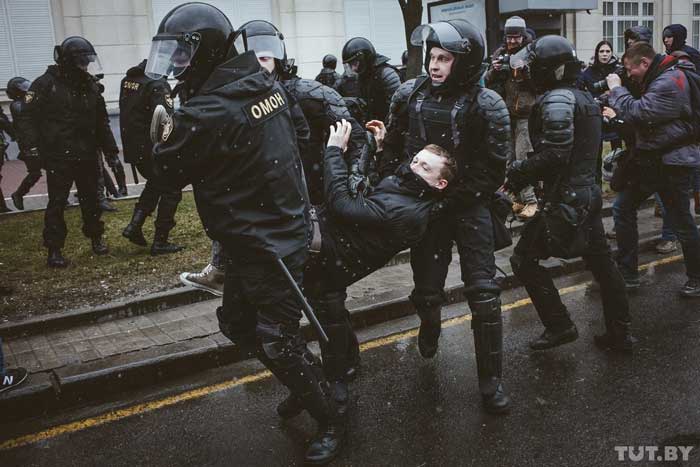
Belarusian police detain Belarus Free Theatre’s Siarhai Kvachonok on Saturday March 25 2017 during protests against Presidential Decree No 3, which imposes a tax on unemployed people. (Photo: Tut.by)
“Europe’s last dictatorship” doesn’t tolerate dissent. The country’s constitution claims to protect freedom of the press, but many laws seem to contradict this.
Independent outlets are constrained by laws in favor of state-run media. Most frequently targeted are Belarus’s independent journalists and Belsat TV, alternatives to the heavily censored state-run Belarusian news. These targeted journalists often fall victim to Belarus’ restrictive regime for press accreditation, a system used by the government to “maintain its monopoly on information in one of the world’s most restrictive environments for media freedom”, according to a report by Index.
“An openly critical stance of the [Belsat TV] towards the authorities of Belarus results in the situation when it is not officially registered in the country and its journalists are pushed beyond the legal system through rules that neither grant them official accreditation, nor recognise freelancers as journalists”, said Andrei Aliaksandrau, deputy director of BelaPAN and editor of the Belarus Journal. “Reporters are subject to administrative prosecution, arrests and fines on ridiculous charges of ‘illegal production of mass media materials’”.
In order to stifle awareness of the public’s unhappiness with the current political climate, the government targets journalists covering protests before, during and after the demonstrations. Index’s Mapping Media Freedom has documented as many as 22 cases since 2015.
“For the past 20 years the authorities in Belarus have been known for their harsh police violence against street protests, including against journalists … After 2011 street protests and mass opposition rallies became rare in Belarus, right until early 2017 when people returned to the streets of Belarusian cities to protest against deterioration of economic situation. The police used brutal force again; and journalists were among those detained”, said Aliaksandrau.
With tactics ranging from detention to assault, Belarusian law enforcement specifically go after independent reporters in an effort to prevent the public from knowing the full extent of protests.
Before
Between March and May of 2017, MMF documented five cases of journalists detained before they were scheduled to cover protests.
Two Belsat TV journalists and one independent journalist were detained twice in one day on their way to cover protests on 18 March 2017. The journalists were first accused of a traffic violation, then later of stealing a car and robbing a bank, according to MMF. The journalists were going to cover one protest in a series nationwide called against a proposed tax.
That same day, four different groups of Belsat journalists were detained in different cities to prevent coverage of demonstrations.
Also on the same day, two Belsat TV journalists were detained during a live broadcast. They were reporting on a possible protest when two police officers arrived. The two were detained without explanation and released hours later.
During
Since 2015 there are 11 documented cases on MMF of journalists being targeted while on site of a protest.
On 25 March 2017, Freedom Day in Belarus, 39 journalists across the country were detained, totalling around 90 detentions alone in the month of March, according to the European Federation of Journalists (EFJ). MMF reports seven of the 30 detained were beaten by police.
After the mass detentions on Freedom Day, 16 journalists were detained the next day during solidarity rallies across the country. Of those detained between both days, some were charged with “hooliganism” and sentenced from five to fifteen days in prison.
In 2015, as independent blogger Viktar Nikitsenka was leaving a demonstration, plain-clothed police officers seized him and dragged him into a bus where he was reportedly beaten. Information and materials were deleted from his phone and camera and his equipment was stolen. He was fined 450 euros.
When Nikitsenka filed a complaint against the officers for unlawful use of force, it was rejected.
After
On 18 March 2017, four Belsat TV crews intending to report on protests were detained in different cities. In one incident, Belsat TV journalist Ales Lyauchuk reported that he and a colleague were stopped by traffic police after covering a protest, then “dragged out of the car [and] brutally assaulted”. The two were reportedly stopped without explanation and held at the station for three hours, their equipment damaged and seized.
“They said that if this goes on, they will shoot us”, Lyauchuk said.
Five days before, video blogger Maksim Filipovich received three separate prison sentences for participating in “illegal” protests. Riot police arrested him at his parents flat, which he livestreamed.
“Targeting journalists who are trying to report on protests is misuse of official powers and it shows how little media freedom there is in Belarus”, said Joy Hyvarinen, Head of Advocacy.
As coverage of protests is censored by targeted the journalists who cover them, freedom of expression both in the form of journalism but also protest is being stifled. Instead of immediately targeting protests, the Belarusian government diminishes the purpose of a protest, since the cause can’t gain attention.
In countries like Belarus where press freedom is protected by the constitution, rulers ignore the law to advance a political agenda.
[/vc_column_text][/vc_column][/vc_row][vc_row content_placement=”top”][vc_column width=”1/3″][vc_custom_heading text=”What price protest?” font_container=”tag:p|font_size:24|text_align:left” link=”url:https%3A%2F%2Fwww.indexoncensorship.org%2F2017%2F12%2Fwhat-price-protest%2F%20|||”][vc_column_text]Through a range of in-depth reporting, interviews and illustrations, the summer 2017 issue of Index on Censorship magazine explores the 50th anniversary of 1968, the year the world took to the streets, to look at all aspects related to protest.
With: Micah White, Robert McCrum, Ariel Dorfman, Anuradha Roy and more.[/vc_column_text][/vc_column][vc_column width=”1/3″][vc_single_image image=”96747″ img_size=”medium” alignment=”center” onclick=”custom_link” link=”https://www.indexoncensorship.org/2017/12/what-price-protest/”][/vc_column][vc_column width=”1/3″ css=”.vc_custom_1481888488328{padding-bottom: 50px !important;}”][vc_custom_heading text=”Subscribe” font_container=”tag:p|font_size:24|text_align:left” link=”url:https%3A%2F%2Fwww.indexoncensorship.org%2Fsubscribe%2F|||”][vc_column_text]In print, online. In your mailbox, on your iPad.
Subscription options from £18 or just £1.49 in the App Store for a digital issue.
Every subscriber helps support Index on Censorship’s projects around the world.
 SUBSCRIBE NOW[/vc_column_text][/vc_column][/vc_row][vc_row][vc_column][vc_custom_heading text=”Mapping Media Freedom” use_theme_fonts=”yes”][vc_separator color=”black”][vc_row_inner][vc_column_inner width=”1/4″][vc_icon icon_fontawesome=”fa fa-times-circle” color=”black” background_style=”rounded” size=”xl” align=”right”][/vc_column_inner][vc_column_inner width=”3/4″][vc_column_text]
Since 24 May 2014, Mapping Media Freedom’s team of correspondents and partners have recorded and verified more than 3,700 violations against journalists and media outlets.
Index campaigns to protect journalists and media freedom. You can help us by submitting reports to Mapping Media Freedom.
[/vc_column_text][/vc_column_inner][/vc_row_inner][vc_separator color=”black”][/vc_column][/vc_row][vc_row][vc_column][vc_custom_heading text=”Don’t lose your voice. Stay informed.” use_theme_fonts=”yes”][vc_separator color=”black”][vc_row_inner][vc_column_inner width=”1/2″][vc_column_text]Index on Censorship is a nonprofit that campaigns for and defends free expression worldwide. We publish work by censored writers and artists, promote debate, and monitor threats to free speech. We believe that everyone should be free to express themselves without fear of harm or persecution – no matter what their views.
Join our mailing list (or follow us on Twitter or Facebook) and we’ll send you our weekly newsletter about our activities defending free speech. We won’t share your personal information with anyone outside Index.[/vc_column_text][/vc_column_inner][vc_column_inner width=”1/2″][gravityform id=”20″ title=”false” description=”false” ajax=”false”][/vc_column_inner][/vc_row_inner][vc_separator color=”black”][/vc_column][/vc_row][vc_row][vc_column][vc_basic_grid post_type=”post” max_items=”3″ element_width=”12″ grid_id=”vc_gid:1513938526925-22ecd957-f7ad-4″ taxonomies=”19962″][/vc_column][/vc_row]
4 Aug 2014 | Awards, Azerbaijan, Azerbaijan News, News
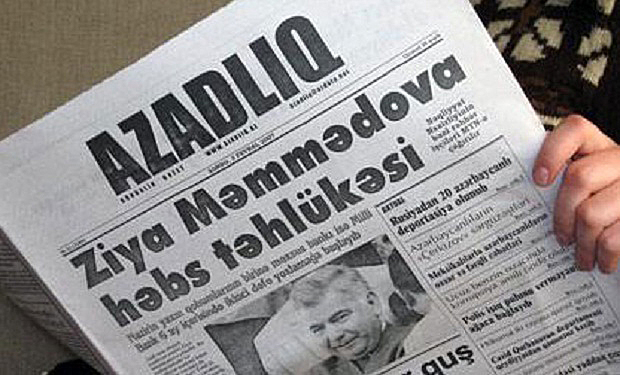
Index Award winning Azadliq newspaper was forced into cancelling its print run last week with little hope of restoring its publication.
It is not that easy to get to the editorial office of Azadliq in Baku. Once you enter the building of Azerbaijan Publishing House, a police officer, who sits close to a statue of Heydar Aliyev, the late “father of the nation” and the actual father of the incumbent president Ilham Aliyev, asks you to call the office of the newspaper to get someone to pick you up downstairs. “Everyone in Baku knows their number,” an old lady in the phone room says as she tells me how to reach Azadliq.
Rahim Haciyev, an acting editor of the daily, smiles as he greets me, and leads to the top floor of the building that looks like a shattered remnant of the Soviet past. We pass a dark and neglected corridor that seems to be last painted around 1989 – the year Azadliq was launched.
The last day of July 2014 can become the end of what was the last independent daily in Azerbaijan as it was forced into suspension of publication.
“We owe 20,000 manat (about £15,000) to the publishing house, and they refuse to print our newspaper unless we pay the debt. But we are not able to, because we don’t get money for the newspaper sales. Gasid, the state-owned press distribution company, owes us 70,000 manat (about £53,000), which should be enough to cover our debts and operation costs. Its general manager is an MP and a member of the ruling party – and they just won’t pay us,” says Rahim Haciyev.
The authorities of Azerbaijan have used economic pressure to silence one of the last critical voices in the country. Last year the newspaper was a target of defamation suits that have resulted in £52,000 in fines, which were followed by bans against selling the paper at tube stations and on the streets of Baku. Thus, Azadliq lost sales of 3,500 copies daily – and with the official distribution network refusing to pay for the copies they sell, it has resulted in a complete blockade of any revenue streams. The State Press Support Fund refused to support the paper as well.
“The authorities have tried to stifle us for a long time, and it looks like they have finally succeeded. I don’t see them letting us go back to print. The only chance is strong pressure from the West, but I don’t expect this to happen. The Western democracies are now preoccupied with weakening the influence of Russia in the region, so it is unlikely they are going to put too much pressure on its neighbouring countries,” says Haciyev.
Azadliq’s editor also sees pressuring of the paper as a part of a wider campaign of the Azerbaijani authorities aimed at silencing of the country’s civil society. Two well-known human rights defenders, Leyla Yunus and Rasul Jafarov, were arrested last week; they will be detained pending trial for three months each.
“At the moment, when repressions against the civil society and human rights activists are getting tougher, the last thing they need is a critical newspaper that spreads the word about their clampdown. And we were the last daily that reported on those cases,” Haciyev points out.
Azadliq’s editorial team keeps working, although they have not been paid for two and a half months. The paper’s website, which is one of the most popular news source online in Azerbaijan, is still updated, but nobody knows for how long.
“Azadliq” means “freedom” is Azerbaijani. There is less and less freedom in the country that looks set to take a sad lead on the number of closed down media outlets and human rights activists in jail.
This article was posted on August 4, 2014 at indexoncensorship.org
