16 Mar 2017 | News, Turkey, Turkey Uncensored
[vc_row][vc_column][vc_column_text]
It took me three tries to watch the video, which has since been removed from YouTube by the user. The first pass was simply because it was one of the most popular videos during the latest war of words Europe-Turkey crisis. On the second pass, I got over my initial disgust and watched it fully. The third pass allowed me to step back and think about the question of how its creator is part of a social phenomenon.
In the video, a Turkish man of about 25 or so with an Islamic beard is phoning the Dutch police while proudly telling the viewer what he is up to with a wicked smile. As soon as the call is answered, he begins speaking in Turkish while in the background a friend blares an Ottoman war march from another smartphone. He tells the police: “Get your grannies ready! Because our grandfathers are coming for them!” He does not use the F word. He doesn’t need to. His obscene smile makes that clear.
This man is a fellow citizen of Turkey. As an educated Turk, I am supposed to understand him, even respect him and his point of view. Otherwise I would be categorised as part of the “oppressive, arrogant elite”. He, on the other hand, has no such responsibility. He just is. He’s free to carry on in his chauvinist bubble secure in the righteousness of his cause.
Soon the world might be full of such men and women, who are proud to be vulgar and carrying unleashed banality as a political identity. All over the globe, these individuals claim to be “real people”. If they are the “real”, then anyone who is astonished by their inane antics of this reality show is “unreal”.
Unfortunately, these “real people” like the men in the video have been the social and psychological stronghold of Turkey’s government and President Recep Tayyip Erdogan. They are also the leading actors in the Europe-Turkey crisis playing out on the streets of the continent’s cities. They have become internationally visible due to the demonstrations in The Netherlands and elsewhere. A European citizen who sees such videos and such people may think that these “real people” represent all Turks. They do not.
As a matter of fact, these people simply were not. They did not exist. They were manufactured during the AKP’s time in power. It is as if the concept of shame has been removed from the social lexicon. This loosening of morals has allowed these individuals to become the dominant figures and even role models in society. As the AKP and Erdogan evolved to become borderless, so did their followers.
When the AKP was vying to come to power in 2002, I went on an election tour to meet this new brand of conservative. It was a new social movement — a movement of the righteous, if you will — being born before our eyes. I met local representatives of the party who were usually the most respected figures in their town or neighbourhood. Each of them was exceedingly polite, presentable and moderate in their conservative lifestyle. Although the conventional wisdom had it that these new kids on the block couldn’t possibly pull off an election win, some of us were aware that there was something new in the air and that the political scene would never be the same. Abdullah Gül, an AKP founder and former president was the balanced and well-educated figure who described this young force by saying: “We are the WASPs of Turkey.”
And then it happened. The AKP wasp won the election in a landslide. In my column written after Erdogan’s first, unexpected victory, I wrote:
“Erdogan somehow magically made himself be seen as the underdog and managed to identify himself with the masses. Throughout the election period, he made himself look like he was never allowed to speak by the old guards of the secular regime, which made the voters suffer for and with him. Now he is the winner and we will see for how long he will be able to sustain the role of ‘the sole oppressed’. And we also will have to think what the political answer could be to this spectacle of the fabricated oppressed.”
The column was printed in November 2002. Since then Turkey’s political opposition has struggled to formulate a response to Erdogan’s “underdog politics”. Now he’s playing it on an international stage with much higher stakes.
So if Europeans or Americans are wondering whether or not the argument of the “oppressed and neglected real people are coming to power” farce is sustainable, the answer is it sustained in Turkey for 15 years and still there is no light at the end of the tunnel. For the last fifteen years rebranding the lumpenproletariat as “the real people” in Turkey first legitimised, then exhilarated and finally sanctified all the eccentricities, banality and the ultimate vulgar and now all Europe is watching the spectacle of this fabricated mass. Meanwhile Erdogan, who still is “the man who is not allowed to speak”, is giving endless speeches about how he and his people are silenced.
During the first half of these 15 years, one of the most popular stories circulating on Facebook was about that old cliché: boiling the frog slowly. Before the Turkish and Kurdish opposition were deep fried in prison cells, Erdogan was excelling in making different and sometimes opposite sectors of the social and political spectrum believe that he was actually their man in Ankara. The Kurds fell for it. The liberal democrats fell for it. Some feminists and some LGBT people did as well, not to mention the conservative nouveau riche and radical Islamists.
However, on the day that his second term began in 2007, he was already very clearly hinting at what he would do. In his victory speech on the election night, he said: “All those who did not vote for us are also the colours of this country.” Somehow many intellectuals saw this as an “all-embracing” speech. But I wasn’t. My article on that day infuriated many. From my point of view, Erdogan was making people like me “the embellishment on the plate that could be removed if not wanted”. Somehow, as with the USA today, the masses have a tendency to woolgathering, to think that things cannot be that bad even when the leaders make it crystal clear they actually will be. Yes, that wall could really happen. What’s worse, children could have teachers loyal to Trump’s doctrine, Americans could be glued to Trump TV and neighbours could turn on neighbours for disloyalty.
A country’s leadership sets the tone, but can also penetrate the very fabric of the public’s existence, igniting a metamorphosis that creates political clones. Power doesn’t just stun people but also hypnotises them into becoming little creatures at the command of the leader.
So now I am watching a video produced by my fellow citizen, a Frankenstein monster, who thinks that the idea of our Ottoman grandfathers raping European grandmothers is not only amusing but also a way to educate infidel Westerners. He was just about 10 when the AKP came to power. He grew up imbibing the belief that he could do anything if portrayed himself as the underdog. He thinks that educated people are evil because it has been drilled into his little mind by the political machine. He has been ruthlessly force-fed Turkey’s rewritten history, which is a bizarre combination of the greatness of our illustrious ancestors and how the secular elite paired with Westerners to steal Turkey’s greatness through devilish tricks. He believes that if one man rules the country all the confusion will be gone, Turkey will be great again and everything will be awesome.
Today I wonder what happened to those polite and proper AKP representatives I met in 2002. But more importantly what will happen to these newly fabricated people if — and when — Erdogan is gone? What will happen to these creatures after their creator has left the scene? Will some future leader be trolling through video channels to hunt them down?
Turkey Uncensored is an Index on Censorship project to publish a series of articles from censored Turkish writers, artists and translators.
[/vc_column_text][/vc_column][/vc_row][vc_row][vc_column][vc_basic_grid post_type=”post” max_items=”4″ element_width=”6″ grid_id=”vc_gid:1489681834044-91157d11-36c9-7″ taxonomies=”55″][/vc_column][/vc_row]
10 Oct 2016 | mobile, News, Turkey, Turkey Reports
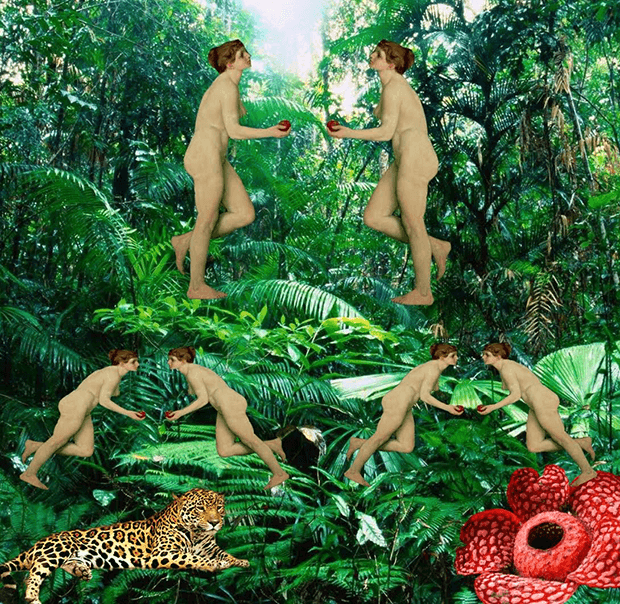
Yeni Bir Şarkı Söylemek Lazım, Video, 2016, Işıl Eğrikavuk
Asena Günal is the program coordinator of Depo which is a center for arts and culture at Tophane, Istanbul. She is one of the co-founders of Siyah Bant, a research platform that documents censorship in the arts in Turkey.
“Is it just me? I don’t think so, but these days I’m in a state where I don’t know what to hold on to, what to do. I push myself to continue my work. Should I continue with art, or should I channel myself to more urgent things; that’s how suffocated I feel,” Hale Tenger, a prominent contemporary artist from Turkey, said in a roundtable discussion published in the Istanbul Art News.1 This pessimism reflects the general mood of artists and many other intellectuals in Turkey, a country that has experienced incidents so numerous in the past year that they could fill decades.
Since July 2015, almost 300 people have been killed and thousands wounded in various attacks by IS and the Kurdistan Freedom Eagles (TAK). After the elections in June 2015, in which the Kurdish party passed the 10% threshold and AKP lost its single party position, president Erdoğan pushed for another election. In November 2015, the AKP won the election and ended the peace process with the Kurdistan Workers Party (PKK). The government put severe limitations on the Kurdish and pro-peace opposition. A total of 2,212 academics, who signed a petition to condemn the state violence in the southeast of Turkey, have been targeted by Erdoğan, received threats, have been faced with criminal and disciplinary investigations, and four of them were detained and jailed for about a month. A growing number of academics have been dismissed or suspended, some were forced to resign and had to leave the country. Almost two thousand lawsuits have been filed against people alleged to have insulted the president online or offline.2
In January 2016, two members of the art community were arrested and then sued for participating in the peaceful demonstration “I am Walking for Peace” in Diyarbakır. The march was organised to protest state violence in the Kurdish region and ask for the restarting of the peace process. Artists Pınar Öğrenci and Atalay Yeni were arrested and then released conditionally. Their court cases still continue.
The impact of the recommencement of the war has made itself felt in various fields and ways. The cancellation of the exhibition “Post-Peace” in February 2016 shows the difficulty of expressing critical views on state policies. The exhibition curated by an Amsterdam-based curator Katia Krupennikova was cancelled by the institution Aksanat just five days before the opening, with the director citing the rising tension and the mourning after another bombing in Turkey as the reason. Given that other events went on as scheduled, many thought one of the video works in the exhibition, critical of the dirty war policies of the Turkish state against the Kurdish guerilla was considered risky by Aksanat.3 This was one of the incidents in which the state itself did not act, and actors in the artistic community took on this role. It created a discussion in the art scene about how to struggle in times of repression.4
Ayhan ve ben (Ayhan and me) from belit on Vimeo.
In April 2016, the screen of the public art project YAMA on a hotel roof was shut down by the Istanbul municipality on the basis of an anonymous complaint, claiming that the work of artist Işıl Eğrikavuk, a video animation, projecting the slogan “Finish up your apple, Eve!”, insulted religious sensibilities. When pressed, the municipality cited “visual pollution” as the reason for discontinuing the screening. This turn illustrates a strategy by the national and local government to legitimise their acts of censorship as purely procedural and administrative actions. After Eğrikavuk made a statement, YAMA’s curator Övül Durmuşoğlu declared the project’s support for the artist. Durmuşoğlu organised a meeting to discuss the case and invited Egrikavuk, legal consultants and people from the art scene. In the following days, Eğrikavuk did a performance based on this restraint. Both the meeting and the performance attracted a wide audience.
Even before the coup attempt of 15 July, there was such an atmosphere where people were worried about terrorist attacks, human rights violations, and limitations on freedom of expression. The coup attempt left 246 citizens and 24 coup planners dead and a nation deeply traumatised. The Gülen movement is accused of being behind the last coup attempt. The coup attempt was followed by a State of Emergency which allowed the cabinet under the chairmanship of the president to issue decrees that have the force of law.5 Unsurprisingly, Erdoğan has been using the attempt as an opportunity to eliminate critical voices.
In the five days between the coup attempt and the declaration of State of Emergency on 20 July, many festivals, biennials and concerts were postponed or cancelled by their organisers. The Sinop Biennial (Sinopale) was postponed “due to recent events in Turkey”, the One Love Festival was cancelled “due to availability problems on the schedules of artists and groups”, many concerts of the Istanbul Jazz festival including a performance by Joan Baez was cancelled6, Muse cancelled its concert“due to recent capricious events” and Skunk Anansie did the same “in light of the recent extraordinary events”. One issue of the satirical magazine Leman was banned as it suggested that both soldiers and civilians involved in the country’s recent unsuccessful coup were pawns in a larger game.
After the coup attempt, Erdoğan called the people to “Democracy Watch”-meetings. The biggest and final meeting, was the one at Yenikapı on 7 August 2016.7 Erdoğan invited popular figures, like singers, actors, and actresses to join the meeting. Pop singer Sıla announced on social media that although she was against the coup she would not be part of such a “show” and would not participate in the big meeting in Yenikapı. Sıla was the only figure brave enough to make such a declaration and not step back. But this resulted in the cancellation of her concerts in five different cities. Many people supported her by sharing her music videos and their own photos with an album of Sıla online.
Theatre actor Genco Erkal’s company “Dostlar Tiyatrosu” was banned from performing a play based on the writings of Turkish communist poet Nazim Hikmet and Bertolt Brecht. It was going to be performed in the garden of Kadıköy High School but the school cancelled the contract due to security reasons. It was obvious that security was not the issue and the school was under pressure from the Ministry of Education because of Genco Erkal’s critical stance. After protests of the theater company and members of the main opposition party (CHP), who brought the case to the Parliament, the Governorate lifted the ban.
Municipal and state theaters have been under a tight grip for some time and there have been ongoing discussions about privatisation of these institutions. The State of Emergency not only aimed at Gülenists who were accused of being part of the planning of the coup but also many artists with apparent oppositional stance were affected. On 1 August, the Istanbul Municipality fired 20 people, including director Ragıp Yavuz, actor Kemal Kocatürk, and actress Sevinç Erbulak from the Municipal Theatre based on the decree law number 667 which was announced after the declaration of the State of Emergency. They were not even granted an explanation for why they lost their jobs, but only received a vague reference to supposedly having failed “the evaluation criteria”8. Obviously, they did not have any connection with coup plotters. Eleven of them have been reinstated in their former positions.
Besides bans and purges, the State of Emergency has enabled the government to re-regulate the organisational structure of the state. A new law that would bring the privatisation of State Theatre, State Opera and Ballet, Atatürk Cultural Center, and Turkish Historical Society was discussed in Parliament. Many people from the field of theatre, opera and ballet expressed their concern that the State of Emergency might be utilised to bring privatisation after years of discussion on instating an independent arts council.
It is now common for the members of the ruling party to randomly target artists, writers, or academics in order to intimidate wider cultural milieu. A recent example is from the field of contemporary arts: In September 2016, an AKP MP Bülent Turan targeted the curator of the Çanakkale Biennial Beral Madra and called on the Çanakkale Municipality (run by CHP) not to work with her. The accusation was being critical of Erdoğan, and hence -so the argument went further- being “pro-coup”. Madra became a target because of her critical tweets and Facebook posts. Being critical of Erdoğan has long been risky but now it is associated with being “pro-coup”. Beral Madra withdrew from her position as to not put the Biennial at risk. Then the organising institution announced that the biennial would be cancelled altogether. They were saddened by the current political atmosphere, which did not place art as a primary point of concern. The CHP-run municipality and many people from the art scene expressed concern over the cancellation, highlighting instead the potential of art to counter the authoritarian discourse of AKP and expressing their wishes for the Biennial to go ahead as planned.
Despite this rising authoritarianism and the pessimistic atmosphere, Turkey’s culture and art scene will continue its struggle. Last week there were many openings in different galleries around Istanbul and almost all of them were crowded. People from the art scene are in need of each other more than ever, aware of the vital importance of solidarity in times of hardship. Film, music, dance and performance festivals started to take place, their posters filling the streets. So I would like to finish with another quote from the same issue of Istanbul Art News, by Deniz Artun,9 the director of Ankara Galeri Nev, as I tend to share its optimistic sentiment: “I guess that art history has shown us time and again just how deep the traces left by exhibitions, artworks, artists emerging with ‘pertinacity’ will be; not those amidst freedoms and prosperity, but those coming forth among fears and uncertainties that are burdensome for all of us.”
- September 2016, no. 34.
- Although many have been dropped after the attempted coup d’état in a show of good will they nonetheless can be said to have had a chilling effect on oppositional voices.
- See https://www.indexoncensorship.org/2016/05/75504/ for the open letter of belit sağ, the artist of that particular video work, and the artists’s response to the cancellation. Sara Whyatt elaborates the case in detail, http://artsfreedom.org/?p=11374.
- Özge Ersoy discusses this incident in terms of the different approaches to responsibility, transparency, sensitivity, institutional self-censorship, and institutional sustainability. See her report on the relationship between artists, curators, and institutions in the context of artistic freedom in Turkey: http://www.siyahbant.org/wp-content/uploads/2016/07/SiyahBant_Arastirma_KuratoryelPratikler-1.pdf.
- According to the Turkish Constitution, the Council of Ministers, which is led by the President, can declare a State of Emergency based on “widespread acts of violence aimed at the destruction of the free democratic order.” It must be approved by Parliament and allows the ministers to pass decrees that have the force of law, although they can be overruled by Parliament. It gives the state the right to derogate certain rights, including freedom of movement, expression and association, during times of war or a major public emergency.
- Joan Baez gathered reactions from Turkey with her statement that “I’m not sure I’ve seen anything like the immense and unpredictable danger which presents itself in today’s Turkey”. Istanbul Jazz Festival Director Pelin Opçin expressed her disappointment as Baez made them feel alone and punished by way of isolation: http://www.hurriyetdailynews.com/turkish-fans-let-down-by-joan-baez-remarks.aspx?pageID=238&nID=101923&NewsCatID=383
- Two opposition parties (CHP and MHP) were invited but the Kurdish opposition party (HDP) was not, showing the problematic character of the rhetoric of “democracy” and “national unity”.
- “As well as not being able to get an answer as to who, on what criteria judged our performance we could not reach any official explanation for our dismissal”, stated the theatre actors; https://twitter.com/oyuncusendika/status/763749835094822912?lang=tr
- September 2016, no. 34.
More about the arts in Turkey:
Belit Sağ: Refusing to accept Turkey’s silencing of artistic expression
Life is getting harder for objective journalists in Turkey, says cartoonist sued by Erdogan
Turkey: Artistic freedom and censorship
Turkey: Artists engaged in Kurdish rights struggle face limits on free expression
4 Aug 2016 | Europe and Central Asia, News, Turkey, Turkey Uncensored
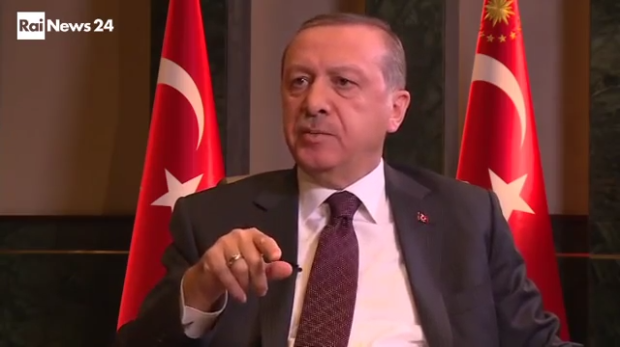
Turkish president Recep Tayyip Erdogan interviewed on Italy’s RAI News 24
Turkey’s third post-coup week has been full of uncertainties, suspicion and concern. As of Wednesday morning there were 1,297 individuals subject to an international travel ban, among them 35 journalists and 51 lawyers.
A developing rift between Ankara and Rome illustrates what Turks can expect from the government-controlled and -aligned media: a moulding of the truth to fit the words and agenda of the country’s president.
In a combative interview with Italy’s RAI News 24, president Recep Tayyip Erdogan challenged the Italian government’s investigation of his son Bilal. He warned that the incident would put Turkey’s relations with Italy “in difficulty”.
“If my son had entered Italy, he would perhaps be arrested. What is this? My son, who is a bright man, is accused of money laundering. Instead of hassling my son, Italy should deal with its own mafia,” he said angrily.
His anger spilled over to the city of Bologna as well. “In that city they call me a dictator,” Erdogan said. “They organise pro-PKK demonstrations. Why don’t they [Italian authorities] step in? This issue will jeopardise our relations with Italy.”
Later, Italy’s prime minister, Matteo Renzi, responded on Twitter: ”In this country the judges respond to the laws and the Italian constitution, not the Turkish president. It’s called ‘rule of law.'”
It’s unnerving how this not-so-diplomatic sparring played out in the Turkish press. While Erdogan’s words were widely quoted on TV channels, the Italian prime minister’s reaction was missing. As media-monitoring organisations pointed out, half of reality was missing, self-censored by subservient outlets under the president’s thumb.
Erol Önderoğlu, Reporters Without Borders’ Turkey representative, asked via Twitter whether or not Turkish TV channels would consider reporting Renzi’s “rule of law” comments. Sadly, he knew they wouldn’t.
It goes further, though. As if self-censorship wasn’t enough, the government moved to block access to articles about the money laundering allegations against Bilal Erdogan following the RAI interview. Cumhuriyet — one of the handful of independent media outlets remaining — reported that Diken and Gazeteport — already under the eye of the government — were sites that had their coverage censored.
At the same time, behind the smokescreen of a subservient press, the Erdogan administration has turned its oppressive measures on Kurdish journalists. Police in the Karayazı District of Erzurum Province detained Mehmet Arslan, a reporter for Dicle News Agency (DİHA). Turkish telecommunications regulator, TIB, blocked access to the website of JİNHA news agency, which mainly covers Kurdish issues.
Journalists on social media were warning authorities that there was a high risk that a journalist in detention, Haşim Söylemez, who recently had two successive brain surgeries, could face health issues in jail.
A colleague of his, briefly arrested with Söylemez, tweeted that “he had a hard time even standing up in the cell”.
Önderoğlu is as deeply concerned as I am about the coming weeks. He said in next four months at least 149 journalists will be facing courts and, due to emergency rule practices, there will be many legal inquiries underway about the others, mainly based on the Anti-Terror Law and the Criminal Code.
Turkey Uncensored is an Index on Censorship project to publish a series of articles from censored Turkish writers, artists and translators.
29 Jul 2016 | Academic Freedom, Campaigns -- Featured, Europe and Central Asia, Mapping Media Freedom, News, Turkey
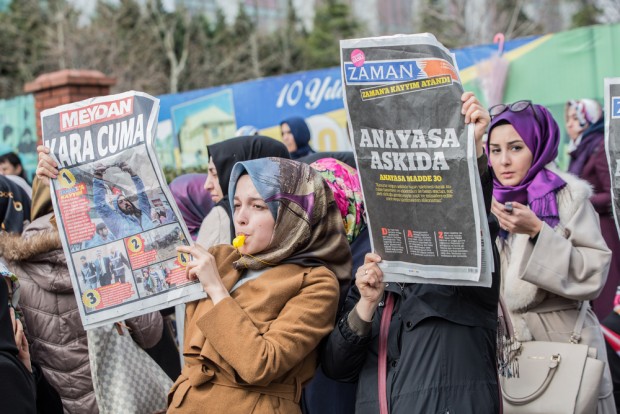
People gather in solidarity with the press outside Zaman newspaper in Istanbul in March 2016
By Ianka Bhatia and Sean Vannata
The spotlight has been on Turkey following the attempted coup against President Recep Tayyip Erdogan and the government’s ensuing crackdown on journalists, teachers, judges and soldiers. How did it come to this? Here are five key articles on Turkey from Index on Censorship showing the escalation of threats to freedom of expression prior to July’s failed coup.
1. Silence on campus
Early in 2015, an academic at Ankara University’s political sciences department spent an evening writing questions for an exam. He never for one minute suspected that one of those questions might lead to death threats. Index’s Turkey editor Kaya Genç reported on the struggle for academic freedom in Turkey’s election year for the summer 2015 issue of Index on Censorship magazine.
2. “Judicial coup” sends clear warning to Turkey’s remaining independent journalists
“Nothing could illustrate the course of developments in Turkey better than the case of prosecutor Murat Aydın,” Yavuz Baydar wrote for Index on 8 June 2016. “In what was described as a ‘judicial coup’ in critical media, Aydin was one of 3,746 judges and prosecutors, who were reassigned in recent days, an unprecedented move that has shaken the basis of the justice system. Some were demoted by being sent into internal “exile”, some were promoted.”
3. Turkey war on journalists rages on
The ongoing deterioration in Turkey’s press freedom has been well documented by Index on Censorship’s Mapping Media Freedom project since its launch in 2014. Back in March 2015, Index’s assistant online editor Ryan McChrystal looked at how, with journalists being killed, detained and prevented from working, the crackdown on Turkey’s media only appears to be getting worse.
4. Interviews with Turkey’s struggling investigative reporters
Kaya Genç interviews writers from the acclaimed independent newspaper Radikal about its closure and the shape of Turkish investigative journalism today for the summer 2016 issue of Index on Censorship magazine.
5. Turkey’s film festivals face a narrowing space for expression
The Siyah Bant initiative, which carries out research on censorship of the arts in Turkey, has given much coverage to obstacles to freedom of expression in the cinematic field in research published in recent years. In June 2016, Index published a report on cases of censorship at Turkish film festivals.
