1 Dec 2022 | China, Hong Kong, Tyrant of the Year 2022
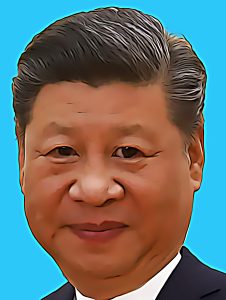 Xi Jinping has excelled with his tyrant credentials this year. Earlier this year, a controversial United Nations‘ report said that “serious human rights violations” have been committed in Xinjiang while Xi’s government is behind moves to repress Uyghurs living in Europe.
Xi has also now started a third term in power, after a 2018 change to the country’s laws to end the previous two-term limit. Tyrants just love to rip up the rule book when it comes to clinging to power.
“My nomination for Tyrant of the Year 2022 goes to the man who somehow made us all feel sorry for Hu Jintao when he snubbed the former Chinese Communist Party leader back in October, a remarkable feat given that Hu isn’t exactly an ally when it comes to human rights and free speech,” says Index on Censorship’s editor-in-chief Jemimah Steinfeld.
Xi’s policies are increasingly being called into question.
“His Zero Covid policy is as barmy as it is draconian. It’s led to the deaths of many who have not been able to get urgent medical treatment, been locked in their apartments when they’ve caught fire, have taken their own lives out of desperation,” says Steinfeld.
The protests against his policy (and indeed his legitimacy) showed a kink in Xi’s armour but he responded in true autocratic style – arrests, arrests and more arrests (plus a raft of other silencing measures).
“The CCP’s unofficial promise to make people’s lives materially better in exchange for fewer political freedoms has been broken,” says Steinfeld. “Unemployment is high and people are miserable and yet his merciless reign shows no signs of getting easier.”
1 Dec 2022 | Artistic Freedom, China
“If a painting can overthrow a government, then the government must be very fragile”
Since its inception, the Chinese Communist Party (CCP) has sought to exert influence over every component of Chinese society, including the world of art. Art is perceived by the CCP as a tool to legitimise its systems of government, not as an expression of human creativity. This project has taken on global relevance as the CCP has sought to utilise art and culture to counter international criticism on a range of topics including the state’s treatment of Uyghurs and Hong Kong’s independence, and assuage concerns about its growing influence in the world economy and international institutions.
The CCP sees itself as the single arbiter of Chinese culture. By the CCP’s definition, being “Chinese” encapsulates not only Chinese nationals but the entire global diaspora. As a result, even artists living in Europe but originally from mainland China, Tibet, Xinjiang, Hong Kong, Taiwan, and elsewhere can be subject to attempts at censorship if their art does not toe the party line. The tactics used to achieve this goal are diverse: from physical violence and the leveraging of financial ties over European galleries to the threatening of family members. Fear of repercussions for themselves or their families is enough to silence many artists even if they now live in Europe.
The extra-territorial nature of CCP censorship should concern anyone wishing to ensure artistic expression is protected. The perpetual threat of violence against artists and their family members in Europe is a stark reflection of the challenge to freedom of expression that the CCP poses across the world. The ability of the CCP to silence critics and curate conversations about themselves globally is unprecedented.
However, the CCP’s struggle against dissident artists also reflects its weakness. Lumli Lumlong, a Hong Kong painting duo based in the UK, told Index “We really want to expose the cruelty of the CCP. They are fragile, their hearts are made of glass.” While the CCP’s soft power operations in Europe have struggled to influence the artistic landscape in Europe, artists have played a crucial role in raising awareness in Europe of the CCP’s human rights abuses.
To investigate the current state of artistic freedom in Europe, and whether and how the CCP attempts to undermine it, Index on Censorship has submitted over 35 Freedom of Information requests and has conducted interviews with more than 40 artists, curators, academics and experts from 10 European countries. The report demonstrates how art can be used by states to extend the reach of censorship into cities across Europe, while also offering a powerful way for artists to challenge state power.
You can download the report here
26 Oct 2022 | Hong Kong, Jimmy Lai, News, Political prisoners
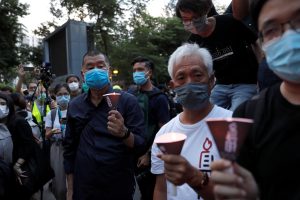
Jimmy Lai attends a candlelight vigil to mark the 31st anniversary of the crackdown of pro-democracy protests at Beijing’s Tiananmen Square in 1989. Photo: Tyrone Siu/Reuters/Alamy
The conviction of Jimmy Lai yesterday on the trumped-up charges of fraud serve a very specific purpose – discredit the 74-year-old Hong Kong media mogul and activist ahead of his National Security trial in December. So said Caoilfhionn Gallagher KC, who is part of Lai’s international legal team at Doughty Street Chambers.
Gallagher was speaking on a panel held on Monday ahead of the trial to discuss Lai, who has been imprisoned in Hong Kong since 2020. The panel took place at the House of Lords and was chaired by veteran journalist John Simpson. The event was hosted by Baroness Helena Kennedy KC. Rebecca Vincent from Reporters Without Borders (RSF) and the last Governor General of Hong Kong, Lord Patten of Barnes, were also on the panel.
Simpson, describing Lai as a personal friend, introduced the event and acknowledged Lai’s personal wealth, pointing out it would have been easier for Lai to have used his money to escape rather than to “face the music”.
Reading a speech from Lai’s son, Simpson quoted Sebastian Lai when saying the CCP “had to corrupt the Hong Kong justice system, twisting it and bending it to fit their whims. So today, I call on the UK government to protect him and secure his freedom.”
This was a strong theme of the debate. While Iain Duncan Smith and Chris Bryant – two prominent MPs from different ends of the parliamentary political spectrum – were present, there was a general feeling that the British government had to do more to help a British citizen unfairly imprisoned abroad, and there had to be more awareness.
Despite acknowledging the help of the Foreign Office and Civil Service, Gallagher feels the previous and current Foreign Secretary ignored the plight of Lai. She said: “We haven’t met Liz Truss or James Cleverly, despite asking to. Whoever is the Foreign Secretary needs to engage with us and make this a political priority. People need to be shouting from the rooftops about this case.”
Patten stated his admiration for Lai, saying: “I hope we make a fuss about him and continue to do so”. He added: “Not only is he a formidable man, but of all the things that angers the CCP is not only that he chose to stay in Hong Kong when he could have left, but that he is also emblematic of what they find so difficult to accept.”
The continued imprisonment of Jimmy Lai and his Apple Daily colleagues will have strong implications for the residents of Hong Kong, Baroness Kennedy believes. She said: “I think, at the moment, a lot of people in Hong Kong believe that these issues won’t affect them, thinking “oh, they’re only going after Jimmy Lai”.” But as Kennedy pointed out, even speaking to people who have been charged under the draconian national security law (which was passed in the summer of 2020) can see people fall foul of the law. And indeed, her wider point was echoed throughout the talk, namely that no one wants to be the frog in the pot of boiling water, not acknowledging how serious the threat is.
Rebecca Vincent said that RSF were releasing a petition to shed light on Jimmy Lai’s situation, urging the Chinese government to drop all charges against him and release Lai, and his colleagues from Apple Daily, without delay.
21 Oct 2022 | Hong Kong, Jimmy Lai, News, Political prisoners
On the east coast of the USA around 100 children have sent postcards to a man they do not know who is incarcerated over 8,000 miles away. The man is Jimmy Lai, the Hong Kong media mogul and activist.
The postcards have provided a brief ray of light in an otherwise dark chapter for a man locked up for his political beliefs, and the city state of Hong Kong which is currently in the ever-tightening grip of the Chinese Communist Party (CCP).
Lai is imprisoned on charges most us will, hopefully, never have to face. The billionaire publisher and founder of Apple Daily has been jailed since December 2020 after he lit a candle during a public commemoration of the 1989 Tiananmen Square massacre.
The charges were related to this and his other pro-democracy protests. He is perhaps the most high-profile victim of the National Security Law, which was passed in the summer of 2020 with the precise aim of punishing and stifling dissent. This month he faces a trial without jury, where he will plead not guilty to the national security charges.
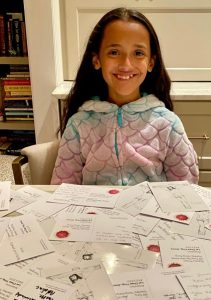
April Ponnuru’s daughter with the postcards.
April Ponnuru has organised the campaign on behalf of The Committee For Freedom in Hong Kong Foundation (CFHK). It was her idea for children at her daughter’s school, in Virginia, to send supportive postcards to Lai after learning he is a devout Catholic.
“My children are in a Catholic school and are Catholic, and I was thinking about how Catholics believe in the idea called corporal works of mercy, and they are these physical acts we do for people that import a lot of grace and mercy, and one of those is visiting the imprisoned,” she said.
She explained how Lai being persecuted for his ideas and belief – not only political but also regarding his faith – inspired her to contact her children’s school.
“This is a great example for these kids of somebody who stood up for their faith and is suffering unjust consequences for that. I thought they could write postcards to Jimmy and tell him they know a little bit of his story, and they’re praying for him and admire him.”
Lai is currently held at Stanley Prison, a maximum-security facility in Hong Kong where he has spent time in solitary confinement. Already a believer, he has found strength through his faith. A drawing of Jesus Christ on the cross done by Lai from prison was printed on the postcards the children sent.
This drawing was originally published in Index on Censorship’s spring 2022 magazine, alongside letters of his, many of which reference his faith.
Ponnuru said: “We thought it would be nice to include some religious art by Jimmy, and it would be a really meaningful thing that this art he sent out in the world would come back to him from a lot of children. For the children it was a great way to participate in corporal works of mercy that they ordinarily wouldn’t be able to do so. By sending him a card and message, they are visiting him.”
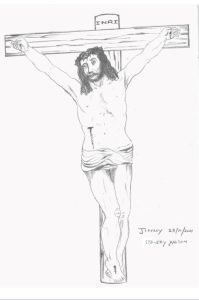
Jimmy Lai’s drawing of Jesus Christ.
She is eager to point out that she wants any child to have the opportunity to send a postcard, as the message of the project should not be defined just by Catholicism.
“This isn’t limited to Catholic schools. We would love any child to participate, children of all faiths and no faith. It’s about understanding the injustice of what is happening to Jimmy and others in Hong Kong. This pilot programme is just the beginning, and we would be very happy to create a postcard that would be appropriate for students at public and other schools to send as well,” Ponnuru said.
“Overall, a number of people have said to me they would love to bring it to their school, and priests have told me they are interested in copying the programme. We are going to write to other schools to encourage them to join the project.”
It’s understood the postcards were received in prison within three months of being sent, and that Lai is being allowed to read one daily, enabling him to have regular contact with the outside world.
If you would like more information about the project, and to request postcards for Jimmy Lai, please contact [email protected].
